Forest Path
The mid-tone leafy green with gray already mixed in, reviewed honestly: the cabinets and walls where it stays garden, the light that turns it khaki-gray, and what to pick instead.

Jessica has spec'd whites and neutrals for more than 300 rooms and keeps a sample wall of painted drawdowns in her studio. Every color review is checked against real reader rooms in the comments and re-tested when a formula changes. About the testing process →
- 1Vintage Vogue12
- 2Sage Green22
- 3Forest Path34
- 4Clary Sage41
- 5October Mist47
The Fast Verdict
Forest Path is a true mid-tone leafy green: grayed so it never goes mint, green enough that nobody will call it greige. At LRV 34 it has cabinet weight and still leaves a living room some air — the useful middle of Behr's N400 strip, a step lighter than Thai Basil and a step more leaf than Natures Gift. South light and 2700K lamps keep it garden-green; cool north rooms and 4000K LEDs strip the leaf and leave khaki-gray, sometimes with a cooler cast people read as blue. Buy it for cabinets, a daylit room, or one committed wall. Do not buy it hoping for a pale sage.
Kitchen cabinets and islands · daylit living rooms and bedrooms · an accent wall that actually reads green · anyone who wants leafy mid-tone sage without going dark
The room faces north and stays dim · you wanted a pale sage or a gray · your bulbs are 4000K LEDs you will not change · you need the famous Evergreen Fog name for resale talk
- Leafy green that stays garden, not mint — grayed just enough to live with
- LRV 34 is the useful middle: cabinets and four walls both work in daylight
- Lighter than Thai Basil, greener than Natures Gift — the N400 step people actually want
- Flatters oak, walnut, brass, and warm whites
- Home Depot Saturday color — no special-order deck required
- Goes khaki-gray, and sometimes cooler, in dim north rooms
- Too deep and too muted if you actually wanted a pale sage
- Cool LEDs and gray stone kill the leaf on cabinets
- No famous name if a buyer expects Evergreen Fog on the listing
What Color Is Forest Path, Really?
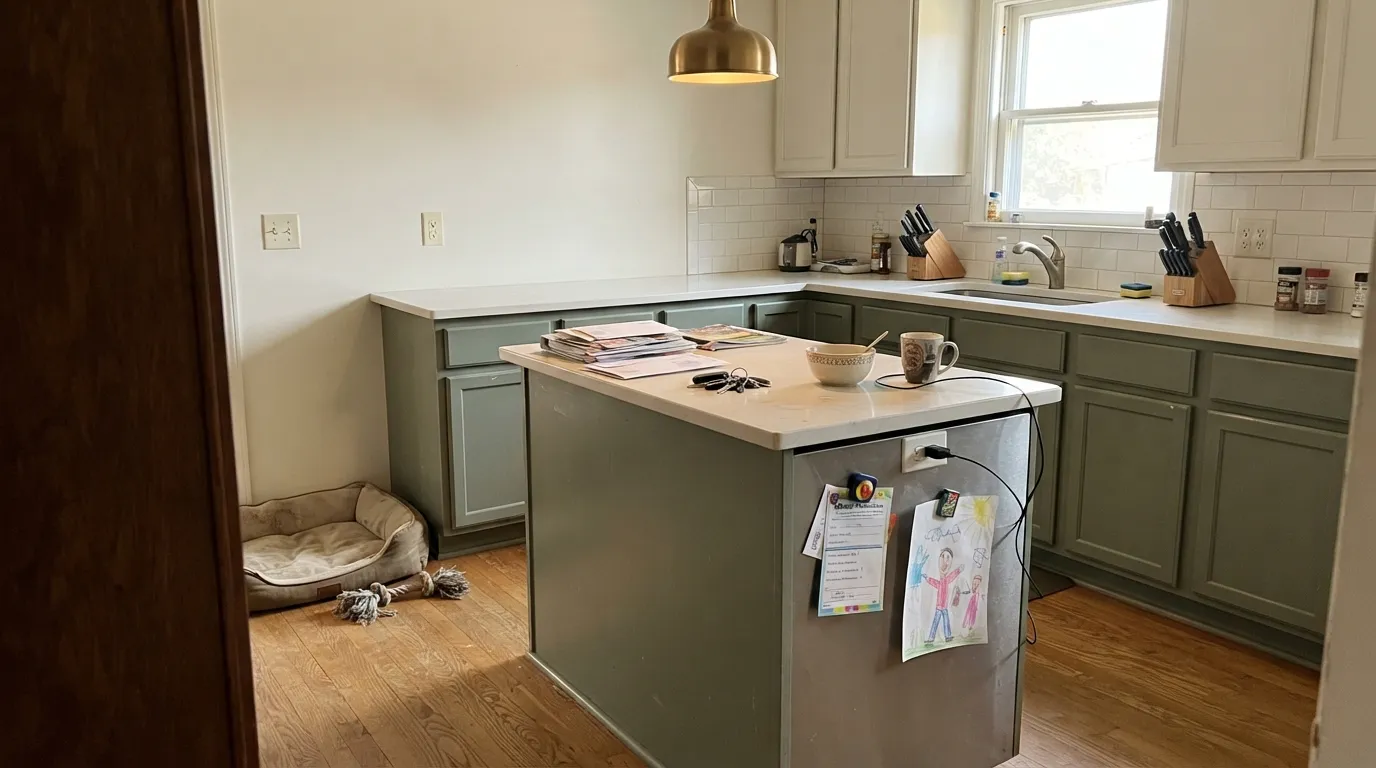
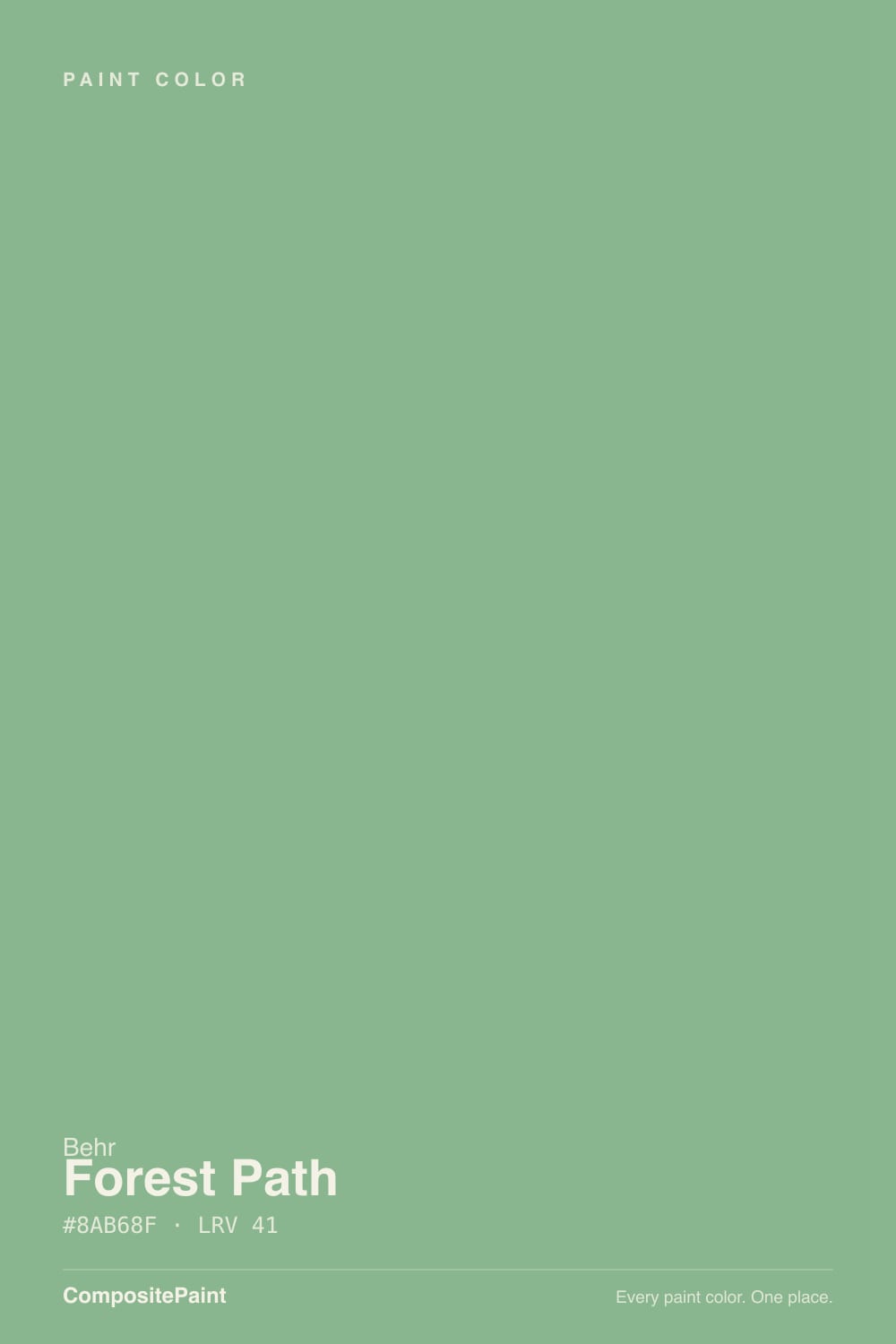
A grayed leafy green — shade-garden leaf, not grass, not mint, not the yellow-gold olive Behr sells as Secret Meadow. The gray is the softener: it knocks the chroma down so the wall can sit next to cream trim and oak without screaming garden-center. The leaf is still the first thing you see. Hex #93A190 sits at 147-161-144 — green clearly on top, red a hair above blue — which is why it reads yellow-green and earthy rather than spa-cool. Behr files it as N400-4, the mid step on a muted green strip: Frosted Sage (N400-2) is the pale mint above it, Thai Basil (N400-5) is the deeper herb below. It is not a Color of the Year and it has no famous room attached to it. It is the Home Depot green people put on cabinets and one wall when they want medium sage with gray in it, then discover the chip was the lightest the color will ever look.
At LRV 34 it sits in the useful middle of the sage shelf. Clary Sage (SW 6178, LRV 41) is a full step lighter and the easy four-wall version. Evergreen Fog (SW 9130, LRV 30) is a half-step deeper, more olive-gray, and the cabinet sage most people should sample first if they want a famous name. Thai Basil (N400-5, LRV 24) is the same strip, darker, and a bigger four-wall bet. Natures Gift (N410-4, LRV 35) is almost the same depth with the green turned down until it behaves like stone. Forest Path is the one that still looks like a leaf at a depth a bedroom can take. Plan for four walls to read a half-step deeper and slightly more gray-green than the 3-inch card — every muted sage does this, and it is the number-one surprise in rooms that looked perfect in the aisle.
Undertone in one line: yellow-green first, gray second — never mint, never olive-gold, never a true blue-sage. Warm south light and 2700K lamps pull the yellow and the leaf comes forward. Cool north light and white LEDs cancel that yellow and leave a khaki-gray; in the coldest rooms a cooler, almost blue-gray cast shows, which is the version a few owners flag as too blue. Both the garden wall and the tired gray are the same paint being honest about the room.
Where It Shines
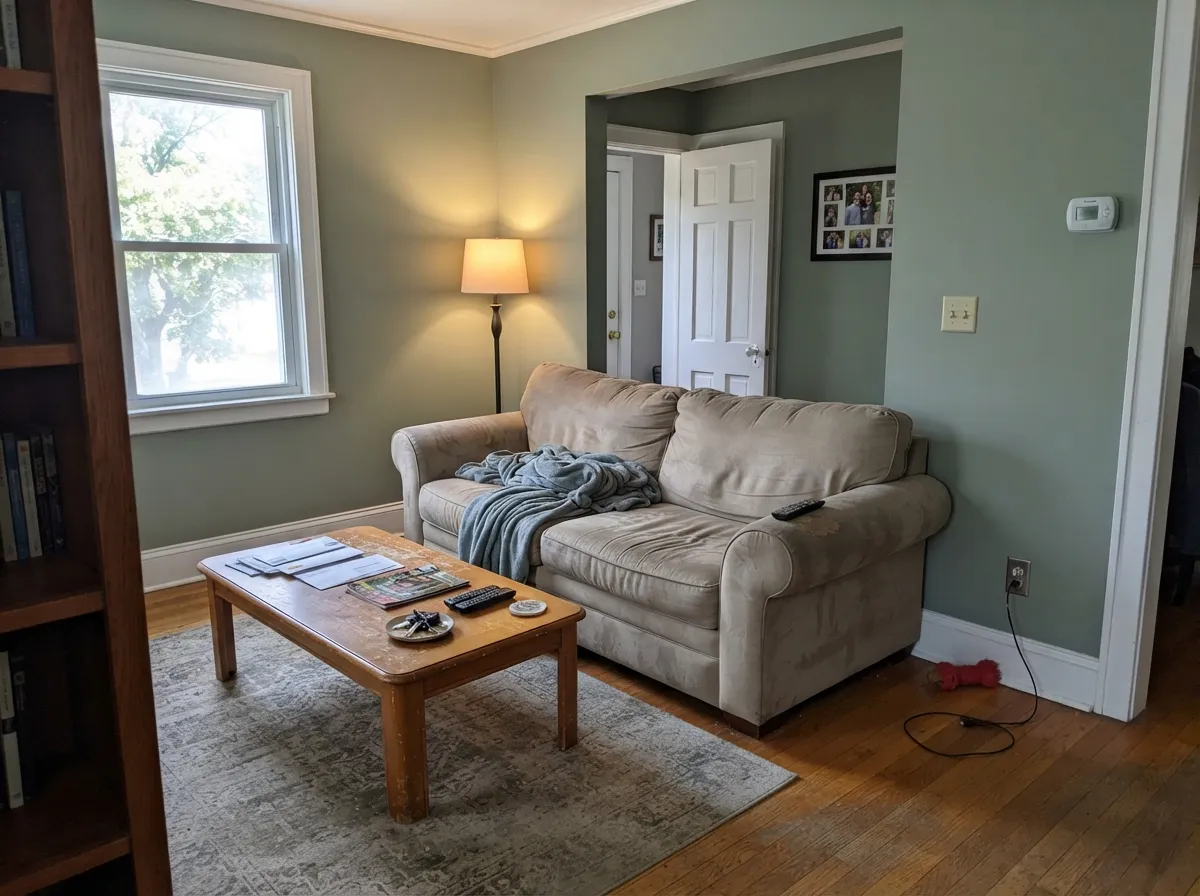
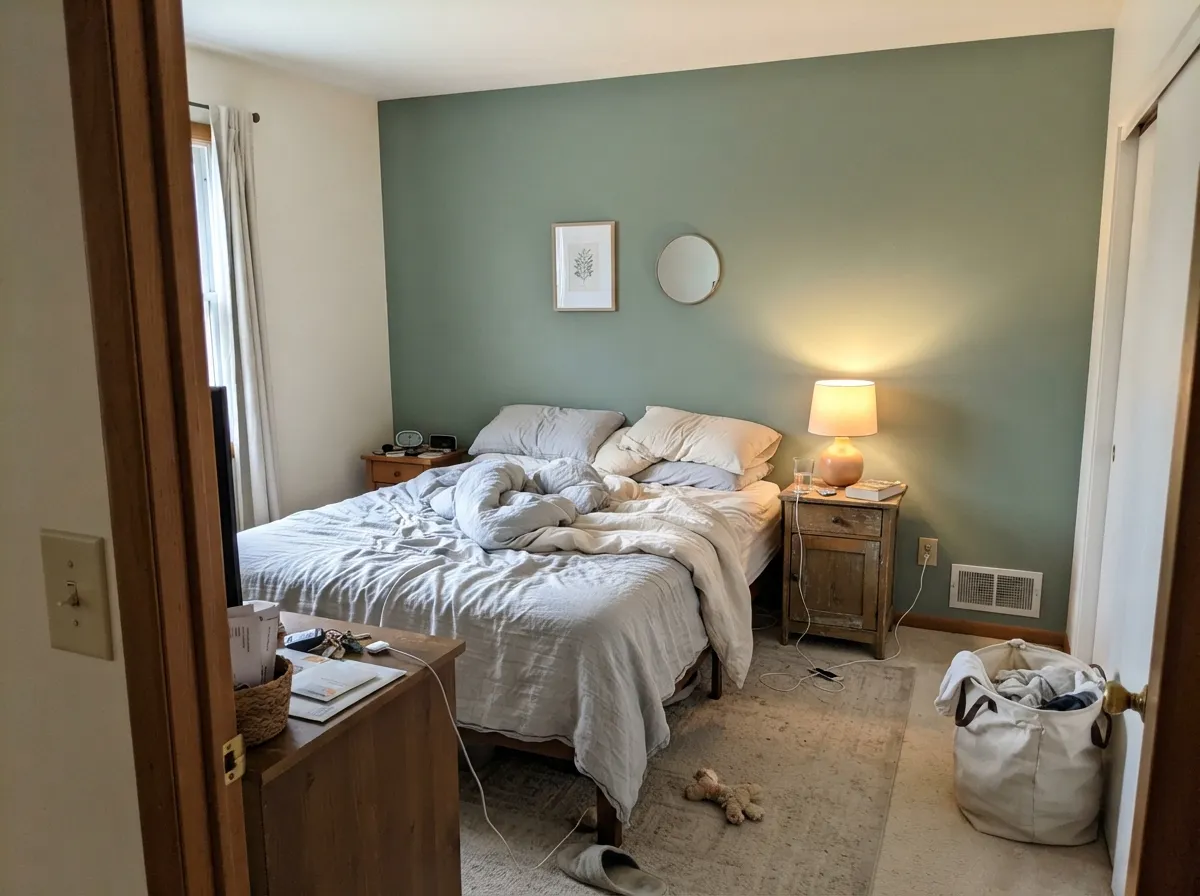
This color is built for surfaces that should feel like furniture and for rooms that already have daylight. On kitchen cabinets, an island, a powder-room vanity, or a single living-room wall, LRV 34 reads as a decision instead of a tint — especially with a warm white, oak or walnut, and unlacquered brass. Give it south or west light and the gray steps back so the leaf shows; give it 2700K lamps at night and it stays garden instead of going army-green. Four walls work too, which is the whole point of this depth versus Thai Basil: a daylit bedroom or living room still breathes. The small commitment is the lowest-risk version of the same idea.
Where It Fails
Almost every regret story about a muted mid-tone green follows one of three scripts, and Forest Path is no exception. None of them are a coverage problem. If your room matches one, this is not your green, and a third coat will not fix it.
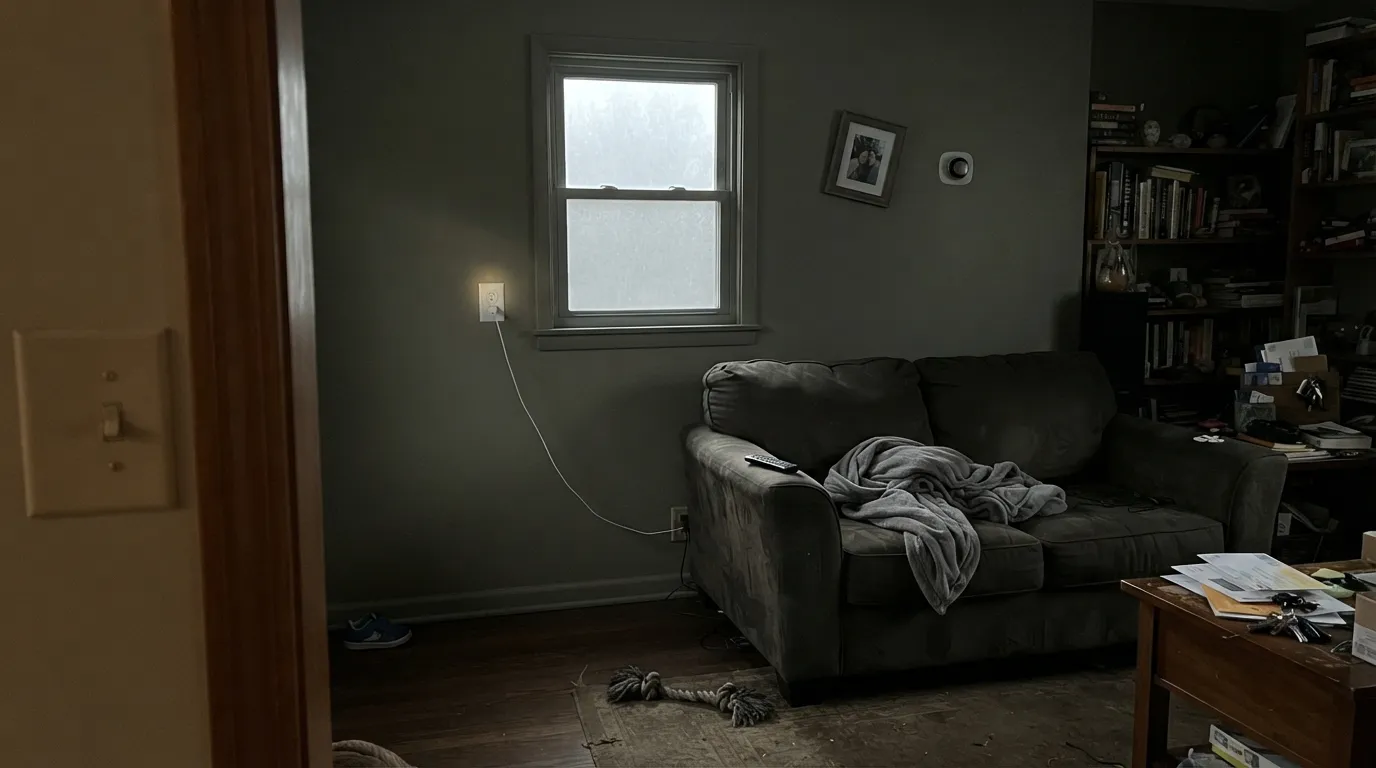
Cool, flat daylight kills the yellow that keeps this color alive. On the chip it looks like a medium leafy sage; on four walls in a dim or north room it drops a half-step and the gray comes forward — khaki-green, slightly dirty, and in the coldest light a cooler cast people describe as too blue. Furniture can save a bedroom; an empty dining room will not. If the room cannot give the color daylight, sample Clary Sage (LRV 41) or keep the walls cream and put Forest Path on one surface.
Pale sages photograph like a hint of color. Forest Path photographs like a green room. If you saved October Mist (CC-550, LRV 47), Clary Sage, or a minty spa green, this saturation is too high in depth — it will look dusty and heavy next to the picture you wanted. Stay on the N400 strip and step up to Frosted Sage (N400-2, LRV 62) if you still want this family but need the room to stay airy; know that Frosted Sage is a cooler mint, not a paler version of this yellow-green.
4000K LEDs and leftover kitchen fluorescents kill the yellow that keeps the leaf honest, and the doors go institutional gray-green. Carrara-type marble and blue-gray porcelain do the same from the other direction: they push a grayed herb toward khaki while the stone looks colder. Swap every bulb to 2700K–3000K before you blame the paint. If the cool stone is staying, this is the wrong green.
Room by Room
This is the job the depth was mixed for. Satin on lowers or an island, a light perimeter in Alabaster or White Dove, oak or walnut floors, brass or bronze pulls. At LRV 34 the doors read as painted furniture without the cave of Pewter Green (SW 6208, LRV 12) or the heavier bet of Thai Basil. Full uppers and lowers in a small, dark kitchen is the version that closes in — keep the perimeter light unless the room is large and south-facing. 2700K under-cabinet strips are part of the spec. Cool gray quartz is the pairing to refuse.
South or west windows keep the leaf honest and the gray in check, so wood furniture and art look deliberate. Eggshell, with White Dove trim in semi-gloss so the edge stays soft. One dark note — Hale Navy on a door or Iron Ore on a fireplace — keeps the muted green from floating. Skip it if this is a closed north room with one lamp; that is the khaki-gray version of this paint.
Restful without going spa, and deep enough to feel like a color after dark. Matte or eggshell; cream or white bedding; 2700K lamps. A south-facing bedroom is easy. A north-facing one with the blinds down is the stony, cooler-cast version — test a big board before you commit four walls. If you love the color but the light is ordinary, one headboard wall is the safer dose.
Small rooms take mid-tone green well, and you can control the bulbs. Satin on a vanity under a warm stone top, or all four powder-room walls in eggshell with brass and a cream towel. It looks custom without betting the house. Cool gray tile is still a no.
Four walls at this depth are a dining-room color if there is a real window and lamps on at dinner. An accent wall in a daylit living room is the weekend version of the same idea — enough green to feel decided, not enough to enclose the rest of the house. Eggshell or matte; White Dove trim. A closed interior dining room with one overhead will go khaki-gray by the salad course.
Full outdoor sun grays a muted herb toward tired olive, and from the street it can read as faded sage rather than a color you chose. The exception is a shaded shutter or a north-facing door on a warm-white house, where the gray-green looks intentional. Walk the sample around the house at 4pm before you commit a facade.
Your Light Is the Risk
Warm sun pulls the yellow-green forward and the walls read leafy all day — garden, grounded, not mint. This is the light the cabinet photos were taken in.
Cool, flat daylight kills the yellow and leaves khaki-gray, sometimes with a cooler, almost blue-gray cast. Fine if you half-wanted a dusty green-gray; disappointing if you painted to get a garden wall.
Morning east light is the most honest leafy-green read; west afternoon and golden hour warm it toward olive for an hour. Sample on two walls and look at both before noon and after four.
2700K bulbs keep the leaf note and make cabinets look expensive after dark. Cool 4000K LEDs — including a lot of under-cabinet strips — flatten it toward institutional gray-green. Swap bulbs before you swap paint.
Most complaints about Forest Path are a light mismatch. Upload a photo of your actual room and see it on your walls — then ask for the same wall in north light or evening lamps before you buy a single sample.
Need It From Another Brand?
Any paint counter can custom-tint Behr N400-4 directly. If you would rather stay in one brand's own deck, these are the closest stock matches, measured as ΔE2000. Under 2 is a difference you will not see on the wall.
| Brand | Closest color | ΔE | LRV | |
|---|---|---|---|---|
| Sherwin-Williams | Acacia HazeSW 9132 · Sherwin-Williams | 4.7 | 32 | Color page → |
| Benjamin Moore | Grenadier Pond698 · Benjamin Moore | 1.9 | 34 | Color page → |
| Valspar | New PatinaP061 · Valspar | 0.9 | 33.2 | Color page → |
| PPG / Glidden | EdamamePPG1030-4 · PPG / Glidden | 4.0 | 35 | Color page → |
| Glidden | Tender Forest Sage30GY 33/144 · Glidden | 2.4 | 33 | Color page → |
| Dutch Boy | Mossed Thicket424-3DB · Dutch Boy | 3.0 | 35 | Color page → |
Similar Behr Colors
The nearest shades to Forest Path within Behr's own range, ranked by perceptual color distance — useful when you want the same look a touch lighter, darker, or warmer.
WCAG 2.1: AA is 4.5 : 1 for normal text, 3 : 1 for large text, AAA is 7 : 1.
Forest Path vs the Colors You're Also Considering
Every Forest Path sample board has the same rivals on it. The numbers show the real lightness gap — then it comes down to which risk you would rather live with.
Pick this when you want more leaf and a little more air at LRV 34, and you are already in the Behr aisle.
Sherwin-Williams SW 9130 · LRV 30Evergreen FogPick this if you want the famous cabinet sage most people should sample first — a half-step deeper, more olive-gray, and the one with a decade of owner photos.
Pick this when you want the room to actually look green, with enough depth for cabinets, not just a tinted wall.
Sherwin-Williams SW 6178 · LRV 41Clary SagePick this if you want the genuinely easy four-wall sage — a full step lighter, and the one that still breathes in ordinary daylight.
Within Behr, Bitter Sage N390-4 at LRV 40 is slightly yellower and reads more like a sage. Mermaid Net 480F-4 at LRV 40 and hex #7EB699 pushes toward blue-green, so it feels cooler and more coastal. Athenian Green 440F-4 at LRV 41 leans yellow-green and reads leafier. Country Weekend MQ6-40 at LRV 43 and Australian Jade S420-4 at LRV 42 are both a touch lighter and cooler. Potting Moss BXC-82 at LRV 39 is the grayest and most muted of the group.
Across brands, Hirshfield's Green Bonnet H0080 at LRV 40 and deltaE 1.0, Benjamin Moore Gumdrop 564 at LRV 42 and deltaE 1.63, Dunn-Edwards Forest Frolic DE5669 at LRV 40 and deltaE 1.84, and Valspar Green-Eyed Lady 8002-33D at LRV 43 and deltaE 1.87 are all visually identical in normal room light. Clare Matcha Latte PNT100-DP-50 at LRV 42 and deltaE 2.85 is very close, so sample it first. Dutch Boy Crisped Green 229-4DB at LRV 44 and deltaE 3.24 is also in the very close band, sitting a little lighter and yellower.
Forest Path Coordinating Colors
The rule for coordinating with Forest Path: warm whites, earthy greiges, and one dark note — and keep cool gray, icy white, and blue-gray stone at arm's length. It pairs with cream better than with beige-gone-yellow, loves walnut and brass, and layers cleanly with the deeper step on its own Behr strip. These are the partners that keep showing up in rooms that work:
Not Famous, Still the Useful N400 Step
Forest Path has no Color of the Year badge and no catalog moment behind it. Behr files it as a shady mid-tone green meant to bring a bit of outdoors inside, then leaves it on the N400 strip at Home Depot — and sells the same code as a satin cabinet, door, and trim enamel. That filing is the useful information. You are not buying a trend stamp. You are buying the Saturday version of a medium sage: leafier than Natures Gift, lighter than Thai Basil, easier to get than a Benjamin Moore Historic, and just as dependent on daylight.
The strip itself is a ladder, not a single personality. Frosted Sage at N400-2 is a cool mint-pale; Forest Path at N400-4 is a warm yellow-green; Thai Basil at N400-5 is the same herb, darker. Do not assume the pale step is a tint of this one — sample the handoff. If the sage-cabinet era cools off, a grayed leaf on an island or a vanity ages closer to a classic green than to a dated accent. If you paint a north living room, you are making a louder bet than this color ever asked you to make.
Forest Path With Wood Tones and Floors
This decision gets made at the floor, not the paint desk. Walnut and espresso are the color's best friends — the red-brown depth makes the leaf read garden and expensive. Medium oak and white oak are safe and keep the room from going lodge. Cream carpet is fine.
The honest maybe is orange honey oak: the yellow in the stain and the yellow in the paint can stack, and the room tips olive. A large rug helps; a sample board on the actual floor at 3pm is cheaper than a repaint. The honest no is cool gray LVP and blue-gray tile. A grayed herb and a blue-gray floor exaggerate each other — the floor goes colder, the walls go khaki, and no sheen change fixes the geometry.
Metals are the easy part: unlacquered brass, antique bronze, and matte black all work; polished chrome is the one that leans cold against it.
Three Ready Palettes Built on Forest Path
A color is never alone on the wall. These are complete combinations in the 60-30-10 pattern, with the reason each one holds together. Every one opens in the visualizer.
Alabaster keeps the kitchen from closing in and gives the leafy cabinets a warm, quiet edge without stacking yellow on yellow. Accessible Beige is the earthy handoff into the living room so the green reads like the same house getting softer, not a color change.
Try this palette in your roomWhite Dove matters here — a stark bright trim white would make the walls look dusty and tired by comparison. Iron Ore is the single near-black note so the leafy drench reads deliberate. This only works if the room has a real window and 2700K lamps at night.
Try this palette in your roomThai Basil is the deeper step on the same Behr N400 strip, so the wall-to-cabinet handoff is a depth change, not a color change. Behr Swiss Coffee is the warmest of the safe off-whites — creamy enough to keep the herb from going cold, and it will show, so sample it next to the green in afternoon sun.
Try this palette in your roomForest Path FAQ
Is Forest Path sage or gray-green?
Sage — grayed leaf, not a colored gray. In cool or dim light it can pass for khaki-gray, and under warm lamps it turns garden-green, but on cabinets or four walls nobody will call it greige. If gray-green is what you actually want, Natures Gift is the dustier lane at almost the same LRV; if you wanted pale sage, this is too deep.
Is it good for kitchen cabinets?
That is its best job. Satin cabinet enamel, a light perimeter, wood floors, brass or bronze hardware. Keep the counters warm or quiet — cool gray quartz is the pairing that sours it. Full perimeter cabinets in a small dark kitchen is a bigger commitment than the island alone. 2700K under-cabinet lighting is not optional.
What trim white goes with Forest Path?
A grayed warm white, not a gallery white. White Dove is the default; Alabaster if your painter is already in Sherwin-Williams; Behr Swiss Coffee if you want cream and you have sampled the two warms together in afternoon sun. Polar Bear and other gallery-bright whites make the herb look dusty and olive by comparison. Semi-gloss on the trim, eggshell or satin on the color.
Is Forest Path too dark for walls?
On four walls it is a living-room, bedroom, or dining-room color in real daylight, not a whole-house default in a dim ranch. At LRV 34 it is the version of this family that still breathes — unlike Thai Basil at LRV 24. A north bedroom will confirm the khaki-gray reviews. If you love the color but the light is ordinary, put it on millwork or one wall and keep the rest light.
Forest Path or Evergreen Fog for cabinets?
Evergreen Fog if you want the famous cabinet sage with a decade of owner photos — a half-step deeper (LRV 30), more olive-gray, and the safer talking point. Forest Path if you want more leaf and a little more air (LRV 34) and you are already at Home Depot. Same job, different chroma. Sample both on an actual door; the chip will lie about how green each one really is.
Does Forest Path work with oak floors?
Walnut and medium oak are excellent — the brown depth makes the leaf read garden and deliberate. Pale white oak is safe and a little more modern. Orange honey oak is the one to sample in place: the yellow in the stain and the yellow in the paint can stack toward olive. Cool gray LVP is the hard no — it pushes the green khaki while the floor goes colder.
Have you painted with Forest Path?
Rate it — one tap helps the next reader decide.
Ask a Question