Dark Everglade
The near-black teal-green almost nobody names first, reviewed honestly: the light it needs to read as green at all, and what to pick instead.

Jessica has spec'd whites and neutrals for more than 300 rooms and keeps a sample wall of painted drawdowns in her studio. Every color review is checked against real reader rooms in the comments and re-tested when a formula changes. About the testing process →
- 1Deep Space3
- 2Dark Everglade8
- 3Hidden Gem14
- 4Van Courtland Blue31
The Fast Verdict
Dark Everglade is a blackened blue-green sitting at LRV 8 — deep enough that in anything but direct light it just reads black. Give it a sunny window, a lamp, or full exterior sun and the teal comes forward and it looks genuinely expensive on a vanity, a front door, or a run of cabinets. It carries none of the marketing a Color of the Year gets — Behr sells it mostly as cabinet, trim, and porch enamel rather than a headline wall color — which is exactly why it has stayed a quiet, undiscovered workhorse instead of an overexposed Pinterest color.
Bedrooms and dens with a lamp or real daylight · vanities, powder rooms, small cabinet runs · front doors, shutters, and porch floors in full sun · anyone who wants a dark teal-green nobody else on the street has
The room has no direct light at all · you're pairing it with black hardware or a black countertop · you want it to visibly read green in every light, not just some · you want a color with a known name to point to
- Genuinely deep, unusual teal-green — reads expensive on cabinets and doors
- Sold as cabinet, trim, and porch-and-patio enamel, so it's built and tested for hardworking surfaces
- Warms into a real emerald-teal glow in direct sun or under a lamp
- Small-room and small-surface safe — vanities, doors, and islands take the depth well
- A genuinely undiscovered color — no Color-of-the-Year hype, no overexposed Pinterest room
- LRV 8 — with no direct light on it, it just reads flat black
- Cool LEDs erase the teal cast at night and leave a muddy charcoal
- Disappears next to black hardware or a black countertop — needs a lighter partner for definition
- No public track record to lean on — very few documented reader rooms or forum threads exist yet
What Color Is Dark Everglade, Really?
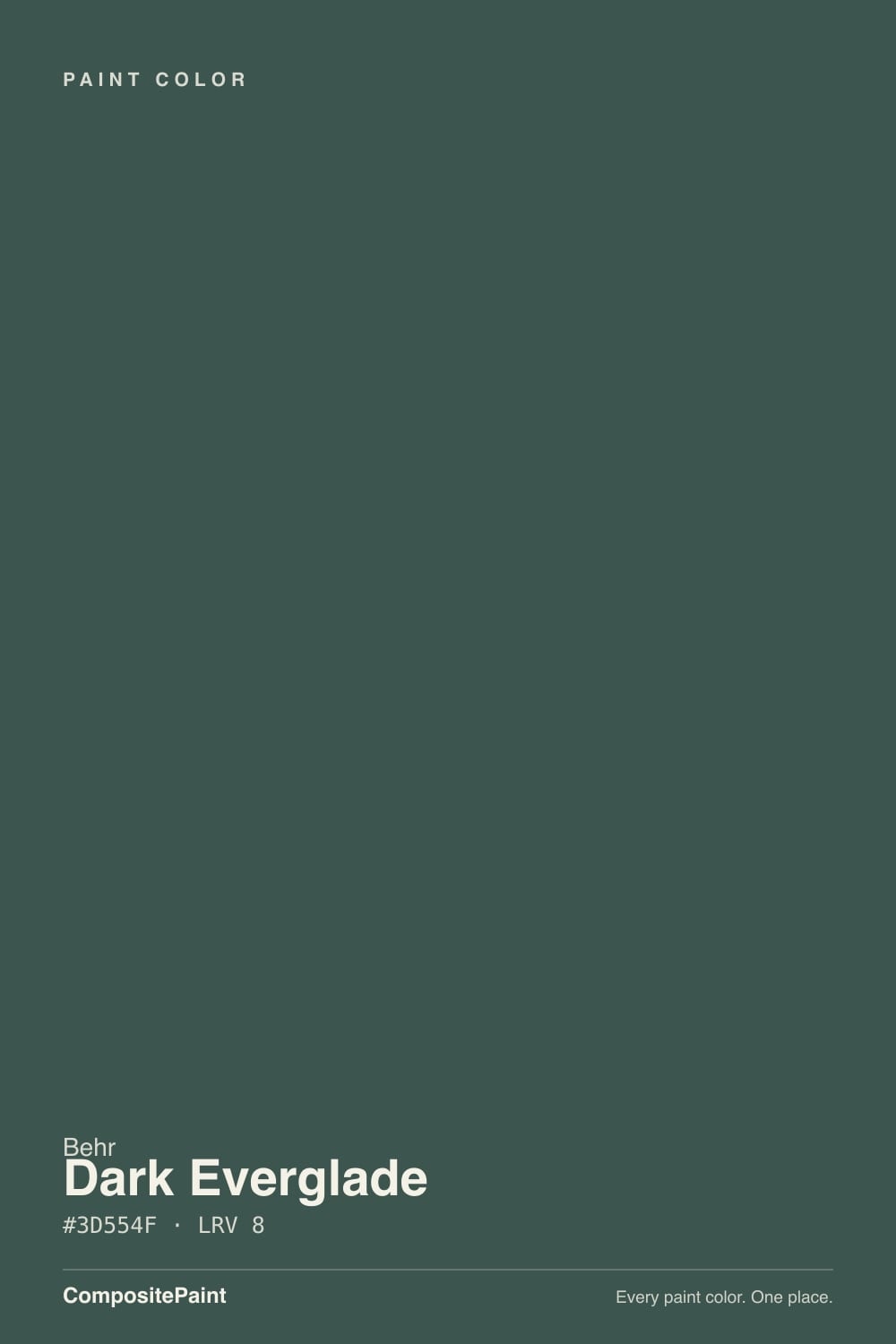
A deeply saturated, blackened blue-green — more teal than pure green, with the blue channel running almost as high as the green. Behr's code, HDC-CL-21A, is a holdover from its older Home Decorators Collection naming scheme, the kind of code the brand mostly abandoned when it moved to the current PPU and MQ systems. That legacy code is a real tell: this is not a color Behr built a campaign around. Home Depot sells it chiefly as cabinet-and-trim enamel and porch-and-patio enamel, not as a marquee interior wall paint — a color built for hardworking surfaces, not a magazine spread.
At LRV 8 it sits in the same near-black band as the site's other chameleon darks — Wrought Iron, Salamander, Ashwood Moss, Narragansett Green. That band behaves one specific way: without direct light hitting the surface, the color reads as flat black, full stop. Give it a lamp, a south window, or open sun on an exterior door and the blue-green wakes up and reads as a genuine deep teal. This is not a flaw unique to Dark Everglade — every color this dark works this way — but it is the single fact that decides whether a buyer loves or regrets it.
Undertone in one line: blue-green first, green second, never a true black and never a true navy. If your sample reads pure black, that's the light, not the paint; if it reads warmer and greener, that's direct sun or a warm bulb doing exactly what this color is built to do.
Where It Shines
This is a color for surfaces that get real light on them, not whole dim rooms. On a front door in full sun, a bathroom vanity under a window, or cabinets that catch afternoon light, it reads as a genuinely sophisticated dark teal-green — the kind of depth that makes a small commitment look custom. Because Behr already sells it as cabinet and trim enamel, it is built and tested for exactly this job: hardworking painted surfaces, not a full accent wall in a windowless room.
Where It Fails
The regret stories for this whole class of near-black color follow the same three scripts, and Dark Everglade is no exception. None of them are the paint failing — they are a mismatch between how dark, chameleon colors behave and what the buyer expected on the chip.
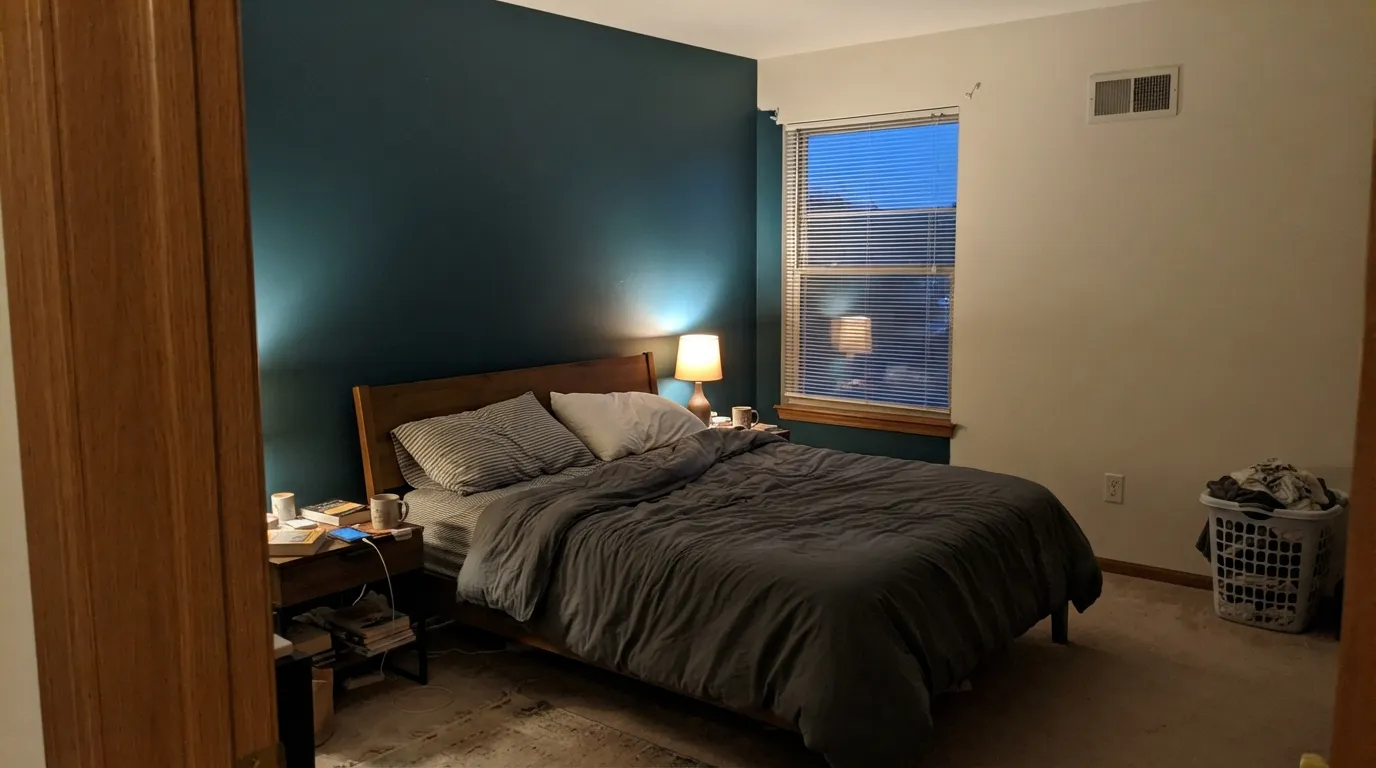
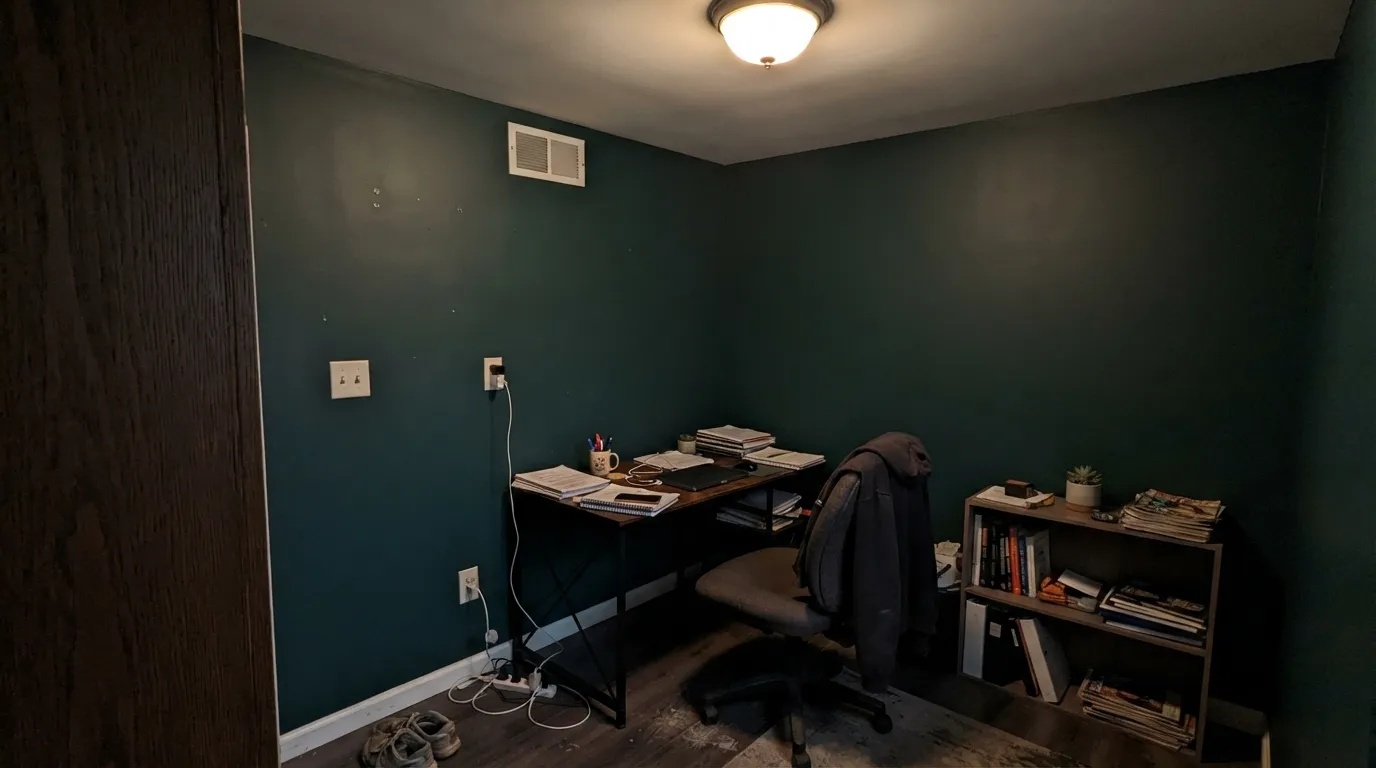
LRV 8 is dark enough that without a lamp or real daylight hitting the wall, it simply reads black — not moody teal, not dramatic green, just black. If the room is genuinely dim all day, this color will look like a plain near-black in it, every time.
Cold light strips the blue-green out completely and leaves a flat, slightly muddy charcoal. Warm 2700K bulbs are part of the job here, the same way they are for every dark color on this deck — swap the bulb before you blame the paint.
Two near-blacks side by side erase each other — the door or cabinet edge disappears and the room loses definition. Give it a lighter partner (unlacquered brass, a pale stone counter, a warm white frame) so the eye can find the edges.
Room by Room
Real owners paint guest bedrooms this color and mean it as a compliment; under warm lamplight it goes velvety-teal rather than heavy. Matte finish hides texture and deepens the color. Skip it if the room is genuinely windowless or north-dark all day.
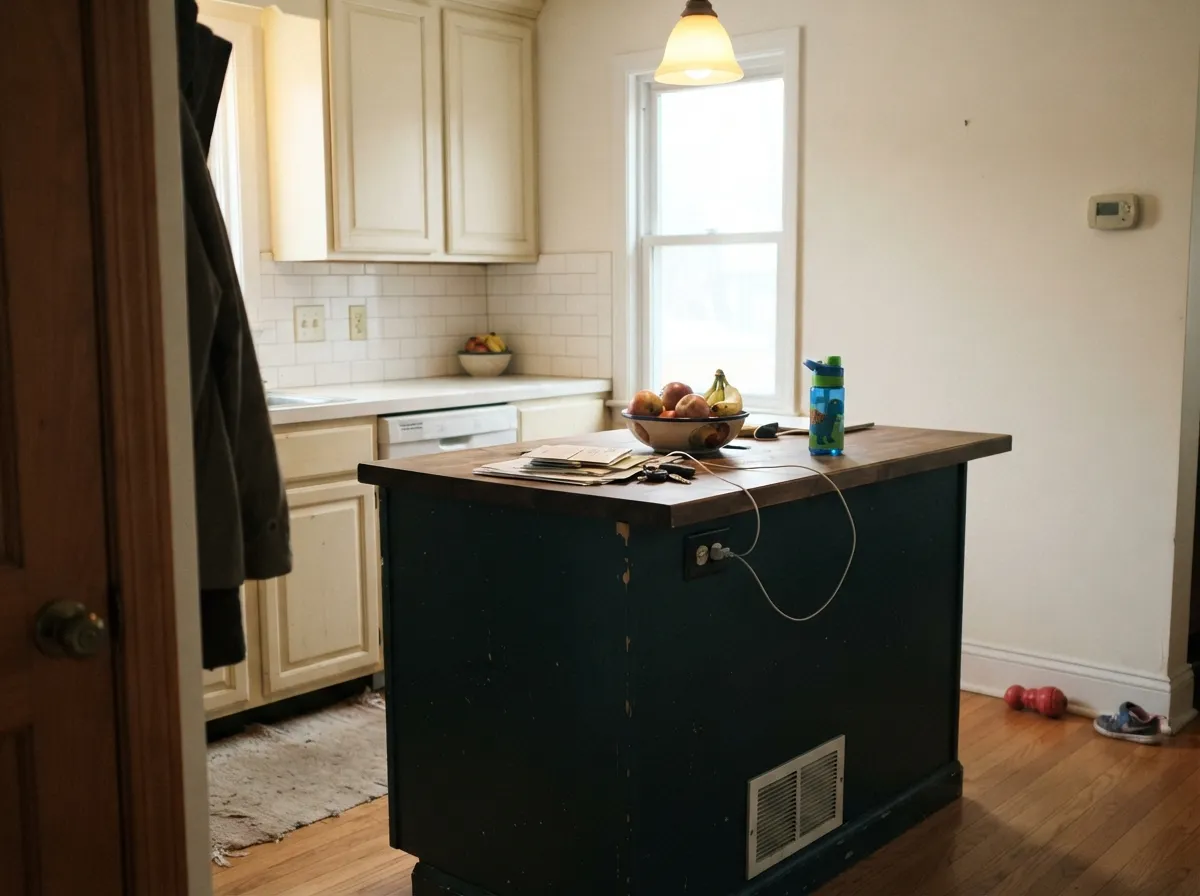
Behr sells this specifically as satin and semi-gloss cabinet-and-door-trim enamel, so it is formulated for exactly this use. An island, a vanity, or a run of lower cabinets under task lighting is where it looks most deliberate.
A little room with no shortage of light (a sconce, a window) takes this depth well and reads finished in one weekend. A powder room with only a fan-light and no window is the wrong candidate.
Low, lamp-lit rooms flatter it the same way they flatter every color in this near-black family. Leather, walnut, and brass reading-lamp light are its natural company; eggshell holds up to chair scuffs.
Beautiful as a closed, well-lit room; riskier open-plan, where it has to hold its own against whatever light and wood tones the adjacent kitchen or dining area bring in.
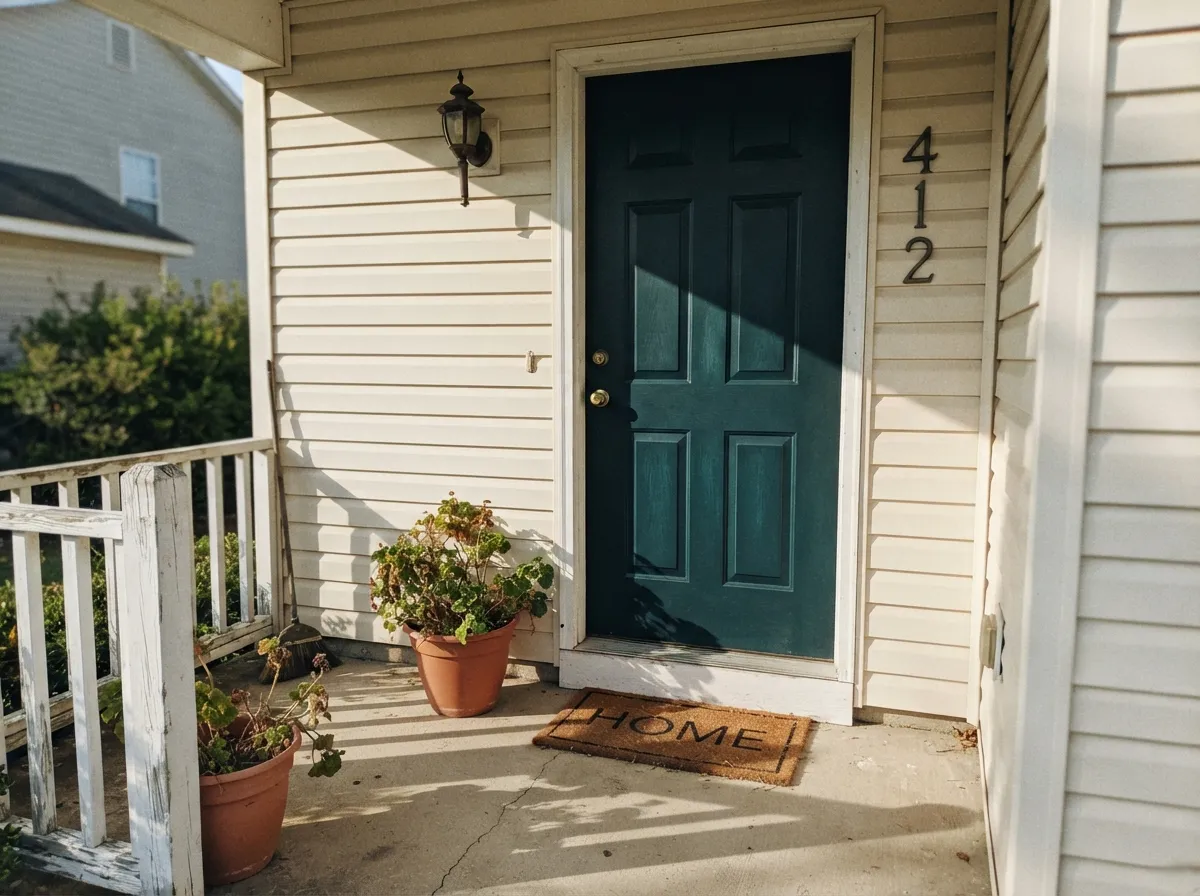
Behr also sells Dark Everglade as a textured porch-and-patio enamel, and full outdoor sun is exactly the light this color needs — a front door or shutters in this shade read a true, rich teal-green rather than black, no lamp required.
Your Light Is the Risk
This is where the color earns its name — full light pulls a true, saturated blue-green out of what otherwise reads black. Exterior doors and sun-hit vanities show it best.
Without a lamp or real daylight on the surface, LRV 8 just reads black. If the room stays shaded all day, expect a near-black wall, not a green one.
Cooler morning light pushes it toward blue-black; warm afternoon and evening sun pulls the green forward. The swing is real — sample it at both ends of the day before committing a whole cabinet run.
2700K warm bulbs keep the teal alive after dark. Cool white LEDs flatten it into a dull charcoal — the same trade-off every dark color on this site makes.
Most complaints about Dark Everglade are a light mismatch. Upload a photo of your actual room and see it on your walls — then ask for the same wall in north light or evening lamps before you buy a single sample.
Need It From Another Brand?
Any paint counter can custom-tint Behr HDC-CL-21A directly. If you would rather stay in one brand's own deck, these are the closest stock matches, measured as ΔE2000. Under 2 is a difference you will not see on the wall.
| Brand | Closest color | ΔE | LRV | |
|---|---|---|---|---|
| Sherwin-Williams | Rock GardenSW 6195 · Sherwin-Williams | 4.5 | 8 | Color page → |
| Benjamin Moore | Hidden Falls714 · Benjamin Moore | 2.5 | 9 | Color page → |
| Valspar | Long Water8003-39G · Valspar | 4.5 | 8 | Color page → |
| PPG / Glidden | Midnight CloverPPG1138-7 · PPG / Glidden | 1.3 | 8 | Color page → |
| Glidden | Midnight CloverPPG1138-7 · Glidden | 1.9 | 8 | Color page → |
| Dutch Boy | Minnesota Pines328-7DB · Dutch Boy | 3.3 | 8 | Color page → |
Similar Behr Colors
The nearest shades to Dark Everglade within Behr's own range, ranked by perceptual color distance — useful when you want the same look a touch lighter, darker, or warmer.
WCAG 2.1: AA is 4.5 : 1 for normal text, 3 : 1 for large text, AAA is 7 : 1.
Dark Everglade vs the Colors You're Also Considering
Every Dark Everglade sample board has the same rivals on it. The numbers show the real lightness gap — then it comes down to which risk you would rather live with.
Pick this for the clearly blue-green, teal-leaning version — Black Evergreen is flatter and grayer by comparison.
Behr MQ6-44 · LRV 8Black EvergreenPick this if you want the same near-black depth with less blue — Black Evergreen reads more neutral charcoal-green, less overtly teal.
Pick this if you're staying in the Behr deck so cabinet, trim, and porch enamel all match without cross-brand color-matching.
Benjamin Moore HC-157 · LRV 8Narragansett GreenPick this if you want a documented colonial pedigree to point to — it's one of Benjamin Moore's Historical Colors.
Pick this for a color that still clearly reads green-teal in normal daylight, not only in direct sun.
Sherwin-Williams SW 7623 · LRV 4CascadesPick this for a darker, cooler near-black teal that barely shows green even in good light.
Pick this for the deepest, most saturated version — near-black instead of a readable dark green-blue in average light.
Behr N430-6A · LRV 14Hidden GemPick this if LRV 8 feels too dark to commit to — Hidden Gem is the same family, six points lighter and visible in more rooms without a lamp.
Within Behr, Midnight In Ny N440-7 (#385654, LRV 8) is the closest neighbor and leans a little more blue, while Black Evergreen MQ6-44 (#465452, LRV 8) and Evergreen Field HDC-WR16-05 (#47534F, LRV 8) are both slightly grayer and read a touch softer. Abysse PPU12-01 at LRV 9 is marginally lighter and cooler. At this darkness all of them behave much the same on a wall, and the differences only appear in bright daylight.
Across brands, Midnight Clover PPG1138-7 (#3C564E, LRV 8) is visually identical in normal room light at a deltaE of 1.25, and Gedney Green H0096 by Hirshfield's is the same story at 1.88. Moss Cottage DET608 by Dunn-Edwards (deltaE 2.21) and Hidden Falls 714 by Benjamin Moore (LRV 9, deltaE 2.53) are very close, so sample first. Rock Garden SW 6195 by Sherwin-Williams, at deltaE 4.49, is close but visibly different side by side, reading greener and less blue.
Dark Everglade Coordinating Colors
The rule for coordinating with Dark Everglade: give it a warm, light partner so it has something to contrast against, and keep true black away from it — two near-blacks side by side just erase each other's edges. These are the partners that keep it legible instead of flat:
A Legacy Shade, Not a Trend Color
Nothing in the record turns up a Color of the Year credit, a celebrity-designer moment, or a viral room for Dark Everglade — and the code itself explains why. HDC-CL-21A belongs to Behr's older Home Decorators Collection naming system, a scheme the brand has largely retired in favor of its current PPU and MQ codes. Colors that still carry the old prefix tend to be quiet holdovers rather than the shades getting fresh marketing pushes.
That shows up in how Behr actually sells it: not as a flagship wall-paint color, but as cabinet-and-door-trim enamel, textured porch-and-patio enamel, and interior chalk finish paint. In other words, Behr itself is pointing buyers toward hardworking surfaces — doors, cabinets, floors — rather than a headline accent wall. Treat that as useful information, not a red flag: a color built and tested for enamel and porch use is exactly the kind of color that quietly outperforms trend colors on the surfaces people actually touch.
Dark Everglade With Wood Tones and Metals
Mid-tone and pale woods are the safest company: white oak, ash, and driftwood-gray finishes let the blue-green read clearly instead of fighting an orange floor for attention. Walnut and espresso work too, sinking the whole pairing into one deep, quiet register that reads intentional rather than busy.
Honey oak and yellow-orange stained trim are the one real caution — the warm-orange cast pulls against this color's blue lean harder than it does against a true green, and both sides can end up looking slightly off. A pale rug or a lighter trim line between the two solves it in most rooms.
Metals: unlacquered brass and warm bronze are the classic partners and the ones Behr's own cabinet-and-trim marketing leans on. Brushed nickel is fine and neutral. Polished chrome and matte black hardware are the two to sample first — chrome can read cold against the teal, and black hardware on a Dark Everglade cabinet risks the same edge-disappearing problem as a black countertop.
Three Ready Palettes Built on Dark Everglade
A color is never alone on the wall. These are complete combinations in the 60-30-10 pattern, with the reason each one holds together. Every one opens in the visualizer.
A warm trim white keeps the room from turning into a cave, and one more near-black note on a fireplace or single built-in adds depth without competing with the green. Brass reading-lamp light finishes it.
Try this palette in your roomCream walls keep the small room bright while the vanity carries the color, and a near-black mirror frame ties the two darks together without doubling the green. Brass or unlacquered fixtures keep it from reading cold.
Try this palette in your roomA bright white body gives the door full sun exposure to work with, which is exactly the light this color needs to read as teal-green instead of black. Iron Ore shutters add a second dark note that reads intentional, not repeated.
Try this palette in your roomDark Everglade FAQ
Is Dark Everglade black or green?
Green — a blackened blue-green, technically — but only where it gets real light. At LRV 8 it reads as plain black in shade or dim rooms and only shows its teal-green undertone in direct sun, near a window, or under a warm lamp. If you want a color that reads green everywhere, this is too dark; look at Behr Hidden Gem instead.
Is it warm or cool?
Cool-leaning — it's blue-green first, green second, and never tips warm. Warm 2700K lamplight and direct afternoon sun both pull more green out of it; cool morning light and cool LEDs push it toward blue-black.
What is the HDC-CL code — is this an old or discontinued color?
HDC-CL is Behr's older Home Decorators Collection naming scheme, which the brand has mostly replaced with its current PPU and MQ codes. That makes this a legacy shade rather than a new one, but it is still actively sold — Home Depot currently lists it in cabinet-and-trim enamel, porch-and-patio enamel, and interior chalk finish paint.
Can I use it on kitchen cabinets?
Yes — this is arguably its best-documented job. Behr sells Dark Everglade specifically as satin and semi-gloss cabinet-and-door-trim enamel, so it is formulated for high-touch painted surfaces, not just walls.
Does it work on a front door?
Yes, and it may be an even stronger use than interior walls. Behr also sells it as a porch-and-patio enamel, and full outdoor sun is exactly the light that pulls the teal-green out of this near-black shade — pair it with a light-colored house body so the door gets real light to work with.
What goes with Dark Everglade?
Warm whites and creams on trim (White Dove, Alabaster), unlacquered brass or warm bronze hardware, and pale-to-mid wood tones. Avoid pairing it directly with black hardware or a black countertop — two near-blacks together erase each other's edges.
Have you painted with Dark Everglade?
Rate it — one tap helps the next reader decide.
Ask a Question