Castle Path
The mid-greige Behr sells for whole-house walls, reviewed honestly: the stone-sage rooms where it flows, the light that turns it green, and what to pick instead.

Jessica has spec'd whites and neutrals for more than 300 rooms and keeps a sample wall of painted drawdowns in her studio. Every color review is checked against real reader rooms in the comments and re-tested when a formula changes. About the testing process →
- 1Evergreen Fog30
- 2Clary Sage41
- 3Castle Path54
- 4Morning Zen60
- 5Alabaster82
The Fast Verdict
Castle Path is the Home Depot greige that is not quite greige. At LRV 54 it sits in the same whole-house band as Revere Pewter, light enough to run hall to living room to bedroom, but the hex is stone-sage — gray-green first, beige second. South light keeps it looking like a weathered path. Cool north rooms and 4000K LEDs pull the herb, and the greige you bought is gone. Buy it if you want a quiet whole-house neutral with a hint of garden wall. Do not buy it hoping for beige.
Whole-house walls in decent daylight · hallways, stairs, and entries that need one color to flow · living rooms with oak and a warm white trim · anyone who wants greige with a stone-sage lean
You actually want beige · the room faces north and stays dim · your floors are cool gray LVP · you wanted Clary Sage's obvious green · a closed kitchen with little sun
- Whole-house depth (LRV 54) — body without the cave of a true mid-tone
- Gray-green stone that covers pink builder beige instead of amplifying it
- Hallways and stairs carry room to room without a color change at every doorway
- South light and 2700K lamps keep it looking like weathered path, not herb
- Home Depot interior and exterior in the same code — one chip for walls and siding
- Not beige — buyers expecting tan greige see sage by the second wall
- Goes drab sage-gray in dim north rooms and dark kitchens
- Cool LEDs and gray LVP pull an olive-dirty overtone
- Quiet to the point of bland on an exterior if you wanted a statement
What Color Is Castle Path, Really?
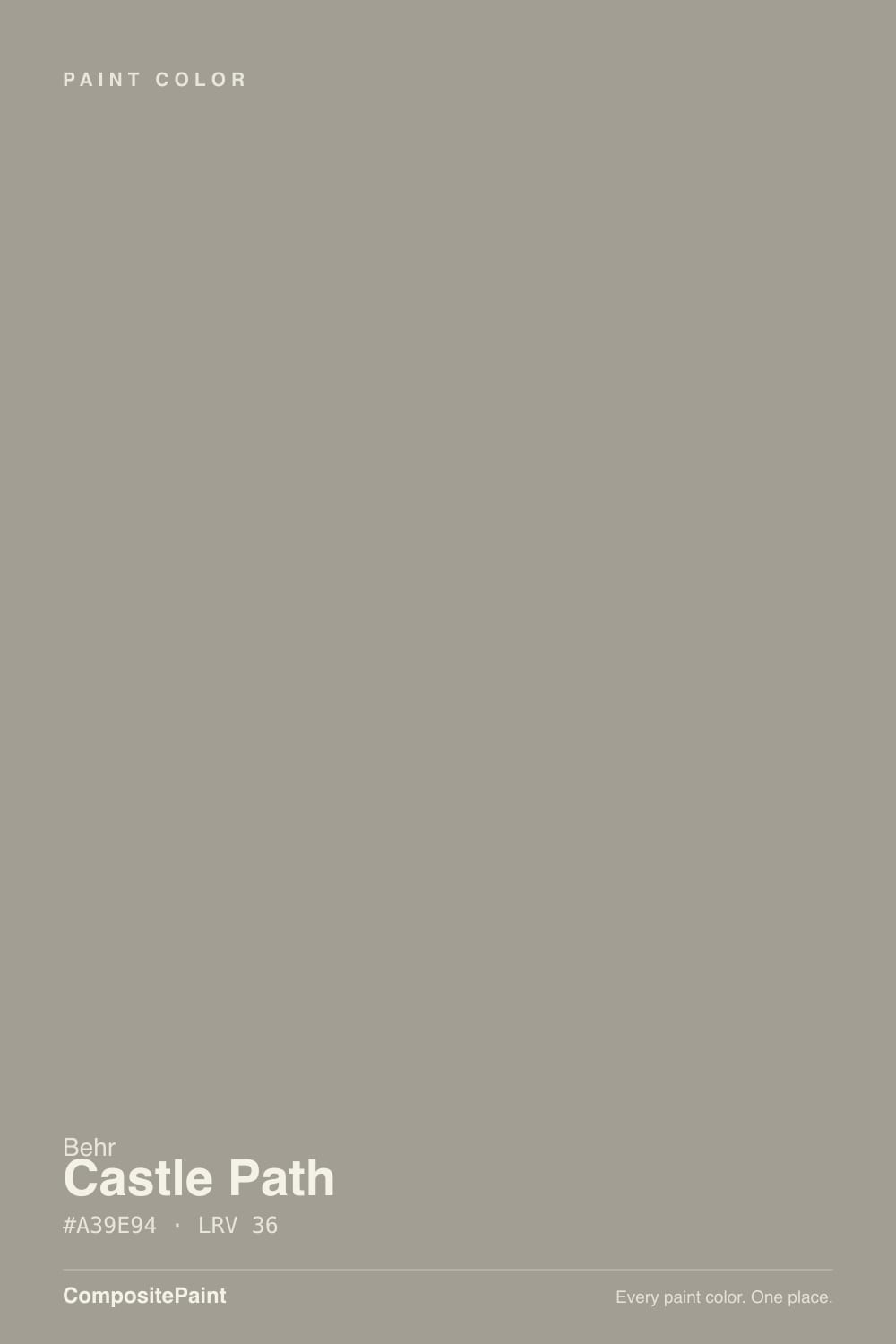
A muted sage-stone — the color of a limestone path after rain, not sand, not putty, not the tan greige the name lets you imagine. Hex #C1C4AF sits at 193-196-175: green a notch above red, blue clearly lower, chroma low enough that it still passes for a whole-house neutral in a daylit room. Behr files 730C-3 in the Neutral family on its own color page, and that is how most people buy it — as the mid-greige for hallways and open main floors. This deck files it as green, and that filing is the more honest one. It is not a Color of the Year and it has no famous room attached to it. What it does have is a paper trail of ordinary houses: a 2013 blog that ran it through an entry, halls, and stairs specifically because it read gray-green instead of pink, and Houzz threads that keep recommending it as a rental-safe, cherry-wood-friendly putty you can put next to blues or greens.
At LRV 54 it is in the useful middle of the greige shelf. Revere Pewter (LRV 56) is a hair lighter and the famous Historic version of this depth. Agreeable Gray (LRV 60) is the airy whole-house greige people actually mean. Behr Greige (LRV 46) is a full step darker and sandier. Castle Path is the one that still bounces enough light to cover an open main floor without washing out the way a pale greige does, and without the cave of a true mid-tone. Home Depot already sells the code as interior and exterior, which is the store's tell: this is a body color, not an accent. Plan for four walls to read a half-step deeper and slightly more sage than the 3-inch card. Every low-chroma green-gray does this, and it is the number-one surprise in rooms that looked perfectly beige in the aisle.
Undertone in one line: yellow-green gray first, sandy beige second — never pink, never a true tan, never spa-blue. If the sample looks like quiet stone, that is south or west light doing its job. If it looks clearly sage or faintly olive, the room is north, dim, or running on cool LEDs. If it looks like plain greige, you are standing it next to a pink builder beige, which is the exact trick the 2013 hallway painter used it for. All three versions are the same gallon being honest about the room.
Where It Shines
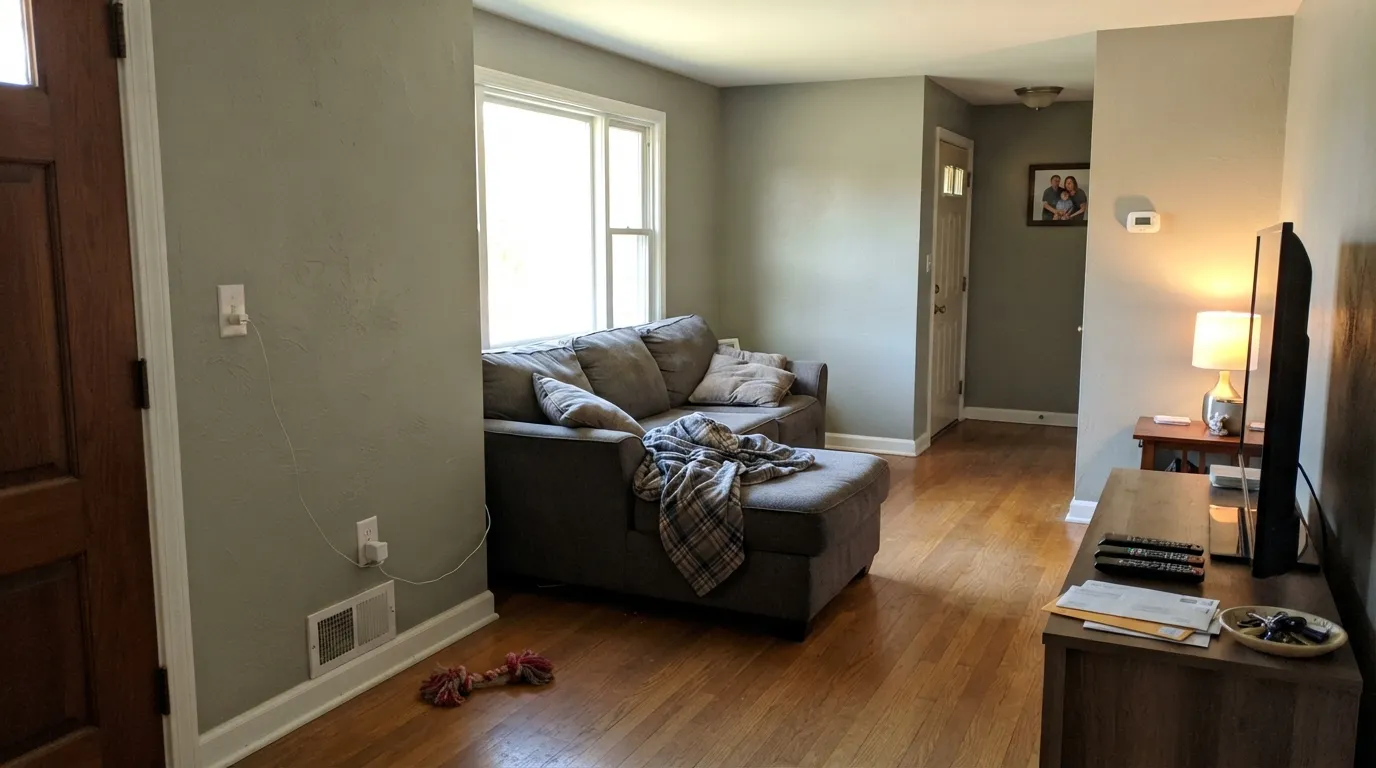
Give it real daylight and a warm white trim and Castle Path does the whole-house job Behr implies: one color from the entry through the hall and into the living room, with enough pigment to hide scuffs and enough gray-green to keep beige from going yellow. Living rooms with oak floors and a worn sofa are its home turf. Hallways and stair runs are the second home — the 2013 blog that chose it for those connectors was not guessing. Eggshell, Polar Bear or White Dove on the trim, 2700K lamps at night. The green stays a hint. That is the version worth buying.
Where It Fails
Almost every unhappy story about Castle Path follows one of three scripts, and all three are visible on a sample board before you open a gallon. None of them are a coverage problem. If your room matches one, this is not your greige, and a third coat will not fix it.
On the chip it passes for a quiet greige. On four walls the sage is the first thing a guest will name — depth multiplies the yellow-green, and this deck files 730C-3 as green for a reason. If your saved photo was Accessible Beige or a sandy putty, Castle Path will look like someone mixed greige with a garden wall. Pick Accessible Beige (LRV 58) or Agreeable Gray (LRV 60) and stop asking a sage-stone to behave like tan.
Cool, flat daylight kills the sand and leaves a drab sage-gray, sometimes with an olive cast. Houzz already has the dark-kitchen version: sample after sample, Castle Path marked too dark. At LRV 54 there is not enough bounce to rescue a north bedroom, a windowless hall, or a closed kitchen on one overhead. Warm lamps help after dark; they will not rewrite the daylight. Step to Agreeable Gray, or keep this color in the rooms that actually see sun.
4000K LEDs and leftover kitchen fluorescents strip the yellow and leave institutional gray-green. Cool gray LVP, gray-washed wood, and a stark blue-white trim do the same from the other direction: they push the herb into relief so the wall looks dirty next to the cool neighbor. Swap every bulb to 2700K–3000K before you blame the paint. If the cool floor is staying, this is the wrong greige.
Room by Room
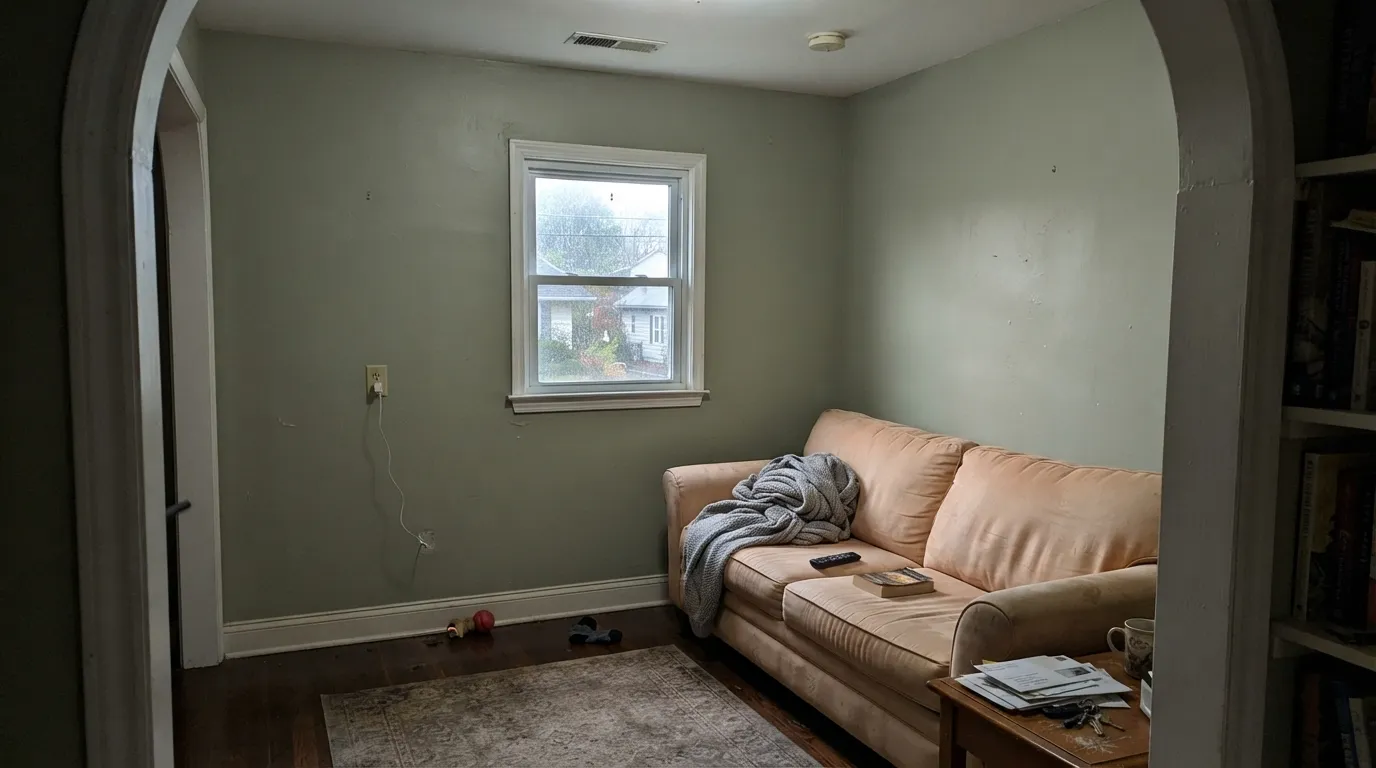
With south or west light it is the calm stone backdrop that makes a worn sectional and oak floors look decided. Eggshell on the walls, Polar Bear or White Dove on the trim in semi-gloss. One small north window and no lamps? This is not the living-room color — the sage-gray version shows up, and you will think you bought the wrong greige.
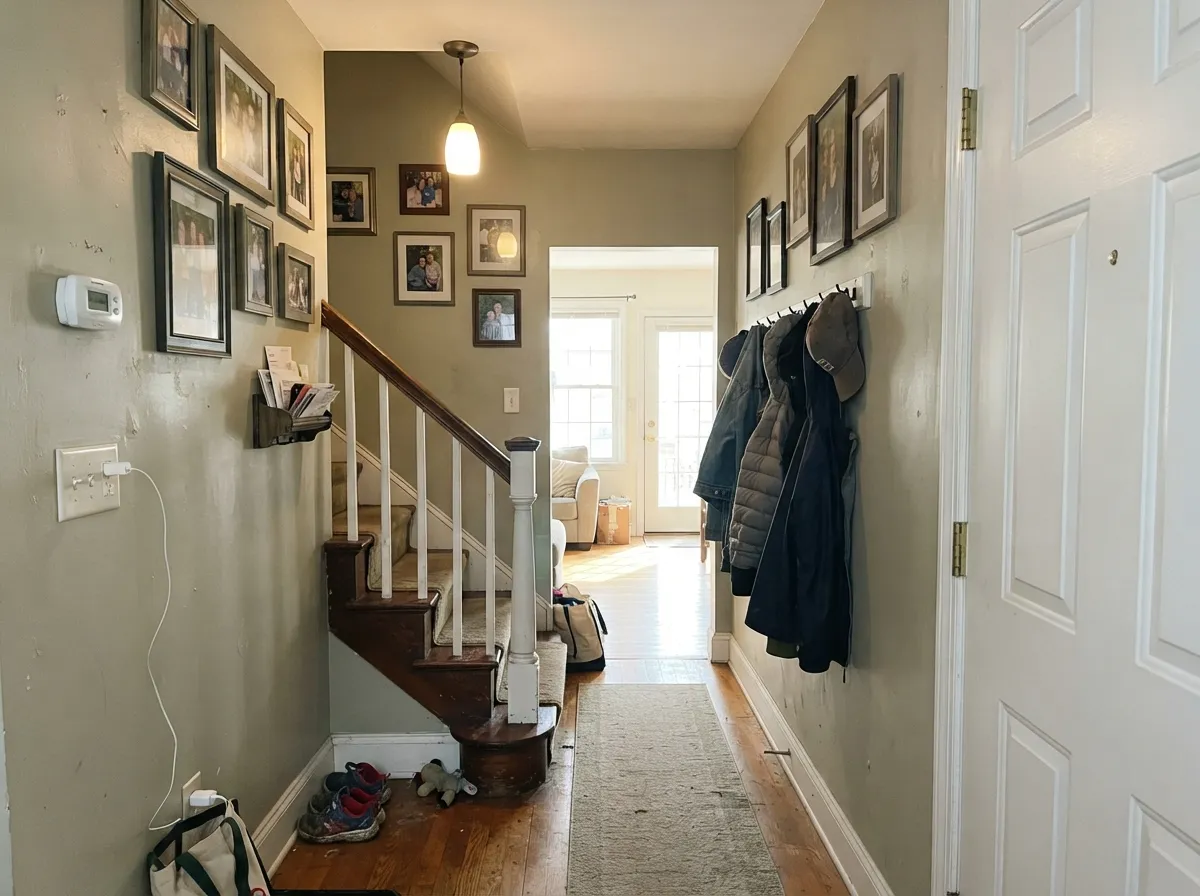
This is the job the depth was mixed for. An open hall that borrows daylight from both ends carries room to room without clashing, hides fingerprints, and is why a 2013 homeowner ran it through the entry, halls, and stair run after a pink-beige. Eggshell; same white on every door. A windowless interior hall at this LRV still needs a lamp or it goes olive-gray by the coat hooks.
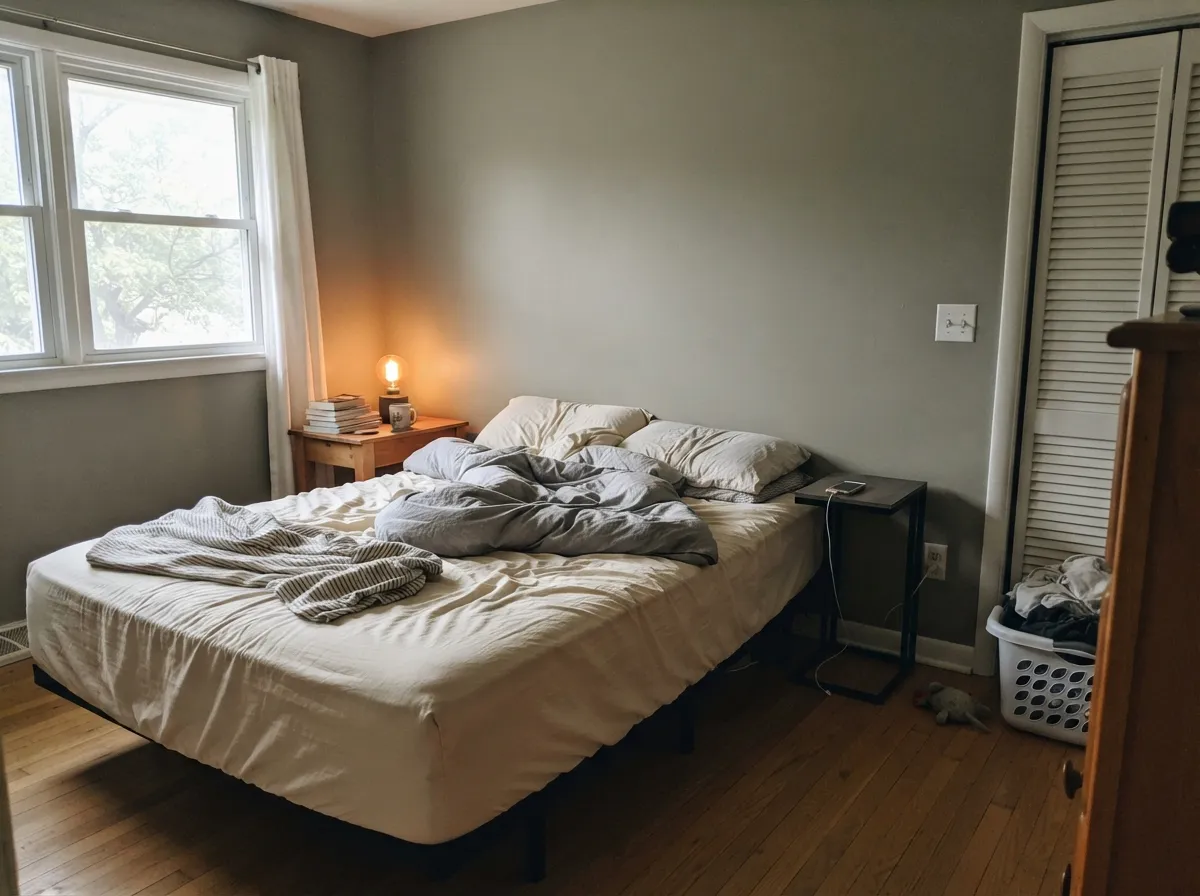
Restful without going spa, and deep enough to feel like a color after dark. Matte or eggshell; cream or white bedding; 2700K lamps on both sides of the bed so corners do not sink. A south-facing bedroom is easy. A north-facing one with the blinds down is the sage-gray version — test a big board before you commit four walls.
On the walls of an open kitchen-living room with warm wood it is a Houzz-classic putty, especially next to cherry or oak. A closed, dark kitchen is the documented miss: too dark, too green, no bounce. Satin on an island under lighter perimeter walls is the safer cabinet dose. Cool gray quartz is the pairing to refuse. 2700K under-cabinet strips are part of the spec.
An open dining room that borrows living-room sun is a natural fit, and the mid-tone hides chair-rail scuffs better than a pale greige. A lamp-only dining room needs 2700K bulbs or dinner goes drab. A home office with a real window is fine on a video call; an interior office on cool overheads is the olive-gray version.
Home Depot sells 730C-3 as an exterior body color, and full sun lifts the sage into a limestone-gray that does not glare. Polar Bear trim, a Hale Navy or Iron Ore door. Reddit already grouped it with Accessible Beige and Revere Pewter as the bland option, which is honest: this is a background house, not a curb-appeal color. Hold a large sample against any pink or orange brick before you commit.
Your Light Is the Risk
Warm, steady sun holds the sand and the sage in the same frame. This is the weathered-path read — greige from across the room, a hint of garden wall up close.
Cool gray daylight strips the sand and leaves sage-gray, sometimes olive. Fine if you half-wanted green; disappointing if you wanted greige.
Greener in the cool morning, sandier through west afternoon and golden hour. Sample it at 8am and at 5pm before you buy — both versions are the color.
2700K lamps pull a quiet stone-warmth and it goes cozy. 4000K LEDs sharpen the sage and can flash olive-gray — swap bulbs before you repaint.
Most complaints about Castle Path are a light mismatch. Upload a photo of your actual room and see it on your walls — then ask for the same wall in north light or evening lamps before you buy a single sample.
Need It From Another Brand?
Any paint counter can custom-tint Behr 730C-3 directly. If you would rather stay in one brand's own deck, these are the closest stock matches, measured as ΔE2000. Under 2 is a difference you will not see on the wall.
| Brand | Closest color | ΔE | LRV | |
|---|---|---|---|---|
| Sherwin-Williams | ContentedSW 6191 · Sherwin-Williams | 3.2 | 52 | Color page → |
| Benjamin Moore | Spanish Olive1509 · Benjamin Moore | 2.3 | 53 | Color page → |
| Valspar | Wedding Mint5006-3B · Valspar | 2.5 | 53.6 | Color page → |
| PPG / Glidden | Pale PinePPG1030-2 · PPG / Glidden | 0.7 | 55 | Color page → |
| Glidden | Side KickPPG1126-4 · Glidden | 0.5 | 53 | Color page → |
| Dutch Boy | Colonial Gray422-2DB · Dutch Boy | 3.2 | 54 | Color page → |
Similar Behr Colors
The nearest shades to Castle Path within Behr's own range, ranked by perceptual color distance — useful when you want the same look a touch lighter, darker, or warmer.
WCAG 2.1: AA is 4.5 : 1 for normal text, 3 : 1 for large text, AAA is 7 : 1.
Castle Path vs the Colors You're Also Considering
Every Castle Path sample board has the same rivals on it. The numbers show the real lightness gap — then it comes down to which risk you would rather live with.
Pick this when Agreeable Gray looked washed out and you want the same whole-house job with more body and a stone-green lean.
Sherwin-Williams SW 7029 · LRV 60Agreeable GrayPick this if you want the light, airy whole-house greige — the safest greige until the light goes cool, and it will not surprise you with sage.
Pick this for the Home Depot version of this LRV: a little greener, a little more path-stone, without the designer-deck price.
Benjamin Moore HC-172 · LRV 56Revere PewterPick this if you want the famous Historic greige at nearly the same depth — a great greige with one real risk, and a name buyers already know.
Side-by-side comparison →Pick this when Sea Salt felt too minty or too pale and you want the warmer, sandier, more whole-house version of a gray-green.
Sherwin-Williams SW 6204 · LRV 63Sea SaltPick this if you want the famous green-gray — lighter, cooler, spa-soft, and beautiful when the light agrees with it.
Pick this when the green should stay a hint. Castle Path is the whole-house stone; Clary Sage is the garden wall.
Sherwin-Williams SW 6178 · LRV 41Clary SagePick this if you actually want sage — it is a genuinely easy herbal green, a full step deeper, and nobody will call it greige.
Behr Fashion Gray (PPU18-15) sits at LRV 34, a step darker and cooler than Castle Path. On a big sunlit wall the two are hard to tell apart, but in dimmer rooms Fashion Gray reads more like a true gray while Castle Path holds its warmth. Pick Fashion Gray if beige undertones worry you; pick Castle Path if gray tends to feel cold in your light.
Behr Shiitake (N220-4), also LRV 34, drifts slightly green rather than red-orange. It pairs more naturally with olive and sage schemes, while Castle Path is safer next to wood tones and warm whites.
The most common cross-shopping is with Benjamin Moore Revere Pewter (HC-172), which is a different animal: at LRV 56 it is a full band lighter. Revere Pewter is the choice for small or dark rooms that need a light greige; Castle Path is the choice when Revere Pewter would wash out and you want walls with visible weight.
Castle Path Coordinating Colors
The rule for coordinating with Castle Path: a clean or softly warm white, one dark, and stay on the yellow-green side of the fence. It wants contrast more than matching taupe-on-taupe, and it argues with icy blues, cool gray stone, and creamy yellows that stack on its herb. These are the partners that keep showing up in rooms that work:
A Whole-House Greige With No Famous Room
Castle Path has never been a Color of the Year and it does not have a celebrity kitchen attached to it. That is not a slight. It is the Home Depot mid-greige people actually roll when they want one color to run the main floor: a 2013 blog used it to cover pink-beige in an entry, halls, and stairs because it read gray-green and made the existing trim look whiter; Houzz has recommended it for rental townhomes, cherry-wood open plans, and antique-colonial entries that need a putty you can put with blues or greens. Home Depot sells the same 730C-3 as interior and exterior, which is as close as Behr comes to calling it a body color.
The catch the aisle card does not advertise is the family. Shoppers trained on Agreeable Gray and Accessible Beige hear greige and picture tan-gray. Castle Path is limestone: yellow-green gray with just enough sand to pass in good light. If that stone-path read is what you want, LRV 54 is a genuinely useful whole-house number. If you wanted the beige, you are in the wrong strip.
Castle Path With Wood Tones and Floors
Warm wood is the easy yes. Walnut, pale white oak, butcher block, and most honey oak sit comfortably against it because the yellow-green meets their warmth halfway instead of stacking more orange on top. Cherry is a documented Houzz pairing for exactly that reason. Cream carpet is fine.
Two honest nos. Orange builder oak in a cool room can push the walls khaki — not always a dealbreaker, but sample a big board over the actual floor at 4pm before you roll. Cool gray LVP, gray-washed wood, and blue-gray tile pull the sage into relief, and the wall looks dirty. A large sample over the flooring in late-afternoon light is cheaper than a repaint. Metals are simple: unlacquered brass and matte black both work; polished chrome is the one that leans cold against it.
Three Ready Palettes Built on Castle Path
A color is never alone on the wall. These are complete combinations in the 60-30-10 pattern, with the reason each one holds together. Every one opens in the visualizer.
This is the Home Depot main-floor move: Castle Path through the halls and living room, Polar Bear on every door and the ceiling. Polar Bear is Behr's dependable everyday white — not a creamy stand-in — so the contrast is crisp, and the navy door is the one dark note a whole-house greige needs. Keep it off north rooms with no lamps.
Try this palette in your roomAlabaster is a superb cabinet white, so the wall-to-box handoff stays soft instead of cutting. Evergreen Fog on the island is the best cabinet sage in the SW deck — a full step deeper in the same gray-green family, two depths, one mood, brass hardware. Skip this scheme over cool gray quartz or 4000K cans.
Try this palette in your roomWhite Dove is the safest warm white against this yellow-green gray — a stark bright trim would make the walls look dusty. Clary Sage on one wall or a dresser is the herbal version of the same family, so the bedroom layers instead of theming. 2700K lamps are part of the paint job.
Try this palette in your roomCastle Path FAQ
Is Castle Path gray, beige, or green?
Green-gray first, beige second. Behr files 730C-3 as a Neutral; this deck files it as green, and on four walls that is what you get: a limestone greige with a sage lean. In south light it reads stone; in north light or under cool LEDs it reads herb. If you actually want beige, pick Accessible Beige (LRV 58). If you actually want gray, this is the wrong chip.
What trim white goes with Castle Path?
Polar Bear is the same-aisle everyday white and gives a crisp, high-contrast edge. If that brightness makes the walls look dingy, step to White Dove — the safest warm white in the BM deck — or Alabaster for a softer handoff. Behr Swiss Coffee is the miss in the other direction: it is the warmest of the safe off-whites, and stacked on this already-yellow sage it shows. A cooler gallery white next to LRV 54 will make Castle Path look dirty. Semi-gloss on the trim, eggshell on the walls.
Is it good for a whole house?
For daylit open rooms, hallways, and stairs, yes — LRV 54 is why it works as a connector color, and that is how owners actually use it. For a whole house that includes a north bedroom, a windowless hall, and a dark kitchen, no. Run it in the rooms with windows and step up to Agreeable Gray (LRV 60) in the dark connectors, or commit to warm lamps in every dim room before you commit to the gallon.
Does Castle Path work with oak floors?
Warm wood is the easy yes. Walnut, pale white oak, and most honey oak meet the yellow-green halfway, which is why Houzz keeps pairing it with cherry. Orange builder oak can push it khaki — sample a big board over the actual floor in afternoon light. The honest no is cool gray LVP and gray-washed wood: they pull the sage into relief and the wall looks dirty.
How does it compare to Revere Pewter or Agreeable Gray?
Agreeable Gray (LRV 60) is the light, safe whole-house greige. Revere Pewter (LRV 56) is the famous Historic greige at almost the same depth as Castle Path. Castle Path is the Home Depot stone-green version of that band: a little more sage, a little less designer-deck fame. If those two looked washed out, this is the next chip. If they looked perfect and you do not want a green hint, stay there.
Can I use it on cabinets or the exterior?
Yes on both, in doses. Satin Castle Path on an island under lighter walls is a custom look; a whole kitchen of it in a dark room is the Houzz miss. Outside, sun lifts it toward limestone — Polar Bear trim and a Hale Navy or Iron Ore door. It will not be a statement house. Always test against existing brick; pink or orange masonry can make the gray-green look muddy.
Have you painted with Castle Path?
Rate it — one tap helps the next reader decide.
Ask a Question