Black Suede
Behr's velvety near-black, reviewed honestly: where the suede-soft matte glows, the light that turns it teal, and what to pick instead.

Jessica has spec'd whites and neutrals for more than 300 rooms and keeps a sample wall of painted drawdowns in her studio. Every color review is checked against real reader rooms in the comments and re-tested when a formula changes. About the testing process →
- 1Cordovan Brown0
- 2Black Suede6
The Fast Verdict
Black Suede is Behr's answer to a hard, flat black: same near-black depth, but a soft charcoal base that reads velvety instead of stark. It is genuinely dramatic on a door or an island without the glare of a true jet black.
The catch is the undertone — a cool, faintly blue-green cast that stays quiet indoors under lamps and shows up the moment strong daylight or a green hedge hits it. Test it in your own light before you commit a whole door or wall to it.
Front doors and kitchen islands that want depth without stark contrast · powder rooms and dens built for lamplight · accent walls with warm wood and brass · exterior trim, shutters, and garage doors on a light-colored house
You want a true neutral black with zero undertone to test · your trim stays bright white with no transition · the room only gets flat north light and you refuse lamps · you are painting all four walls of a small, already-dim room
- A soft, velvety near-black instead of a flat, glaring one
- Consistent across Behr's whole line — interior enamel, wall paint, and exterior stain all carry the same number
- Flatters brass, walnut, and warm wood without fighting them
- LRV 6 reads convincingly black at a glance, no stark jet-black needed
- Small-room and accent-surface commitment (door, island, powder room) pays off fast
- Cool teal undertone shows in strong direct sun and next to greenery — not a true neutral black
- Needs real coverage: two to three coats and a tinted primer over light walls
- Matte sheen scuffs and shows fingerprints fast in high-touch spots
- Not a safe pick for vinyl siding in full sun — heat absorption is a real risk at this depth
What Color Is Black Suede, Really?
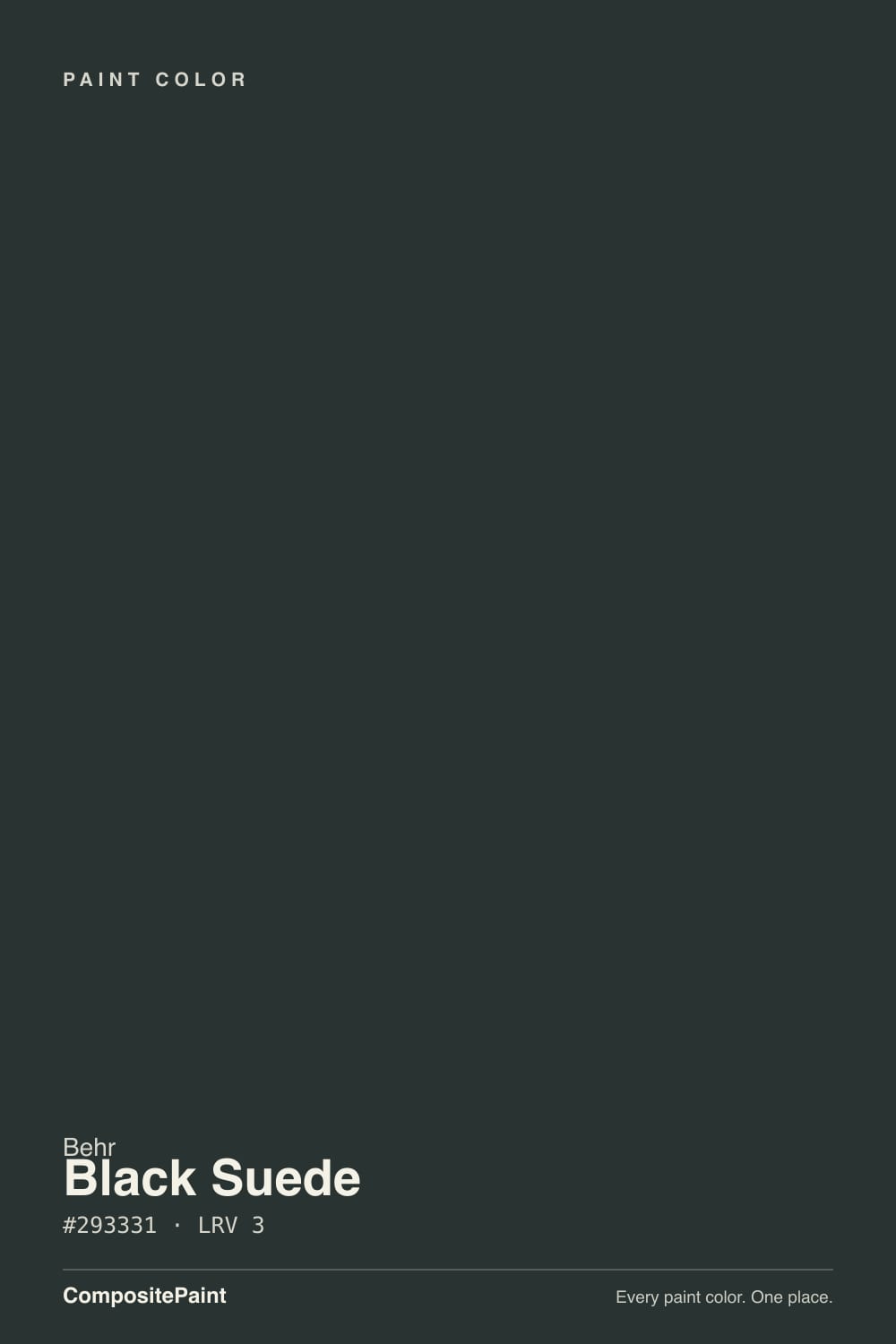
Black Suede is Behr's soft, low-chroma near-black — deep enough to read as black across a room, but built with a charcoal base instead of a straight ink-black tint. That is the whole idea behind the "suede" name: in a matte finish it absorbs light the way brushed fabric does, without the hard sheen-line a true flat black shows in raking light. It shows up across Behr's whole range — Ultra satin enamel for interior doors and cabinets, Premium Plus for walls, Marquee and Dynasty for one-coat coverage, and a solid-color exterior wood stain for fences and siding trim — so the same number follows a project from the front door to the deck rail.
The undertone is the fact to plan around: Black Suede leans cool, with a faint blue-green (teal) cast rather than the warm brown-black some Behr darks carry. In shade, under lamps, or against warm wood it reads as a clean, soft charcoal-black and nobody will call it anything but black. Push it into strong direct sun, or set it beside foliage or a green-leaning stone, and the teal steps forward — not enough to look colored from across the street, but enough that a buyer expecting a true neutral black can be surprised.
At LRV 6 it sits in the same depth band as Sherwin-Williams Iron Ore and Benjamin Moore Wrought Iron — deep enough that sheen changes how it reads more than most colors. Matte softens the black and hides the undertone best; satin and semi-gloss sharpen the black but also sharpen the teal flash in bright light. Decide the sheen by the room's light, not just the surface.
Where It Shines
It earns its keep on the surfaces meant to stand out, not blend in: a front door, a kitchen island, a powder-room vanity, built-ins in a den. Give it brass hardware, walnut, aged leather, or a warm wood floor, and the softness Behr built into the base pays off — it reads rich and intentional instead of flat. It is at its best under warm lamplight or diffuse daylight, where the charcoal base stays quiet and nothing pulls it toward green.
Where It Fails
The regret stories with a near-black this dark tend to follow the same three scripts, and Black Suede's cool undertone makes two of them more likely than with a truly neutral black. None of them are a defect — but if your project matches one, sample a real board first.
In full sun, or against green plantings, the teal in Black Suede comes forward — a soft blue-green cast that a true neutral black never shows. If your goal is zero undertone to think about, this is not that color; Sherwin-Williams Tricorn Black or Iron Ore are the safer defaults.
Near-black colors this deep need real coverage. Going over a light existing wall in one coat leaves visible roller lines and a patchy, lighter-than-the-chip finish — the same complaint that shows up across Behr's darkest colors. Prime with a gray-tinted primer and plan on two full coats minimum, three over anything saturated.
Matte hides the undertone best but scuffs and shows fingerprints fast anywhere hands and shoulders brush it — a stairwell, a mudroom, behind a kitchen chair. Step up to satin or a scrubbable matte line (Marquee, Dynasty) in any spot that gets touched daily.
Room by Room
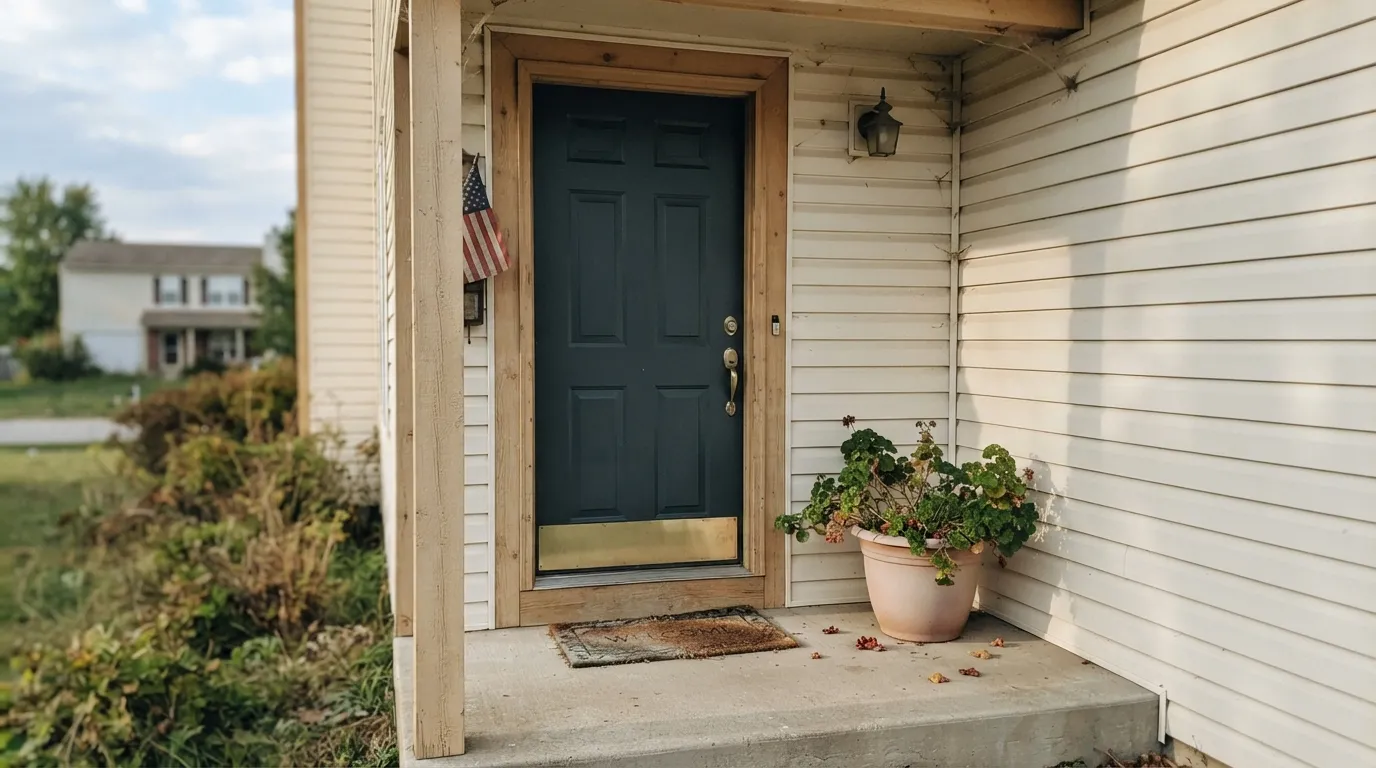
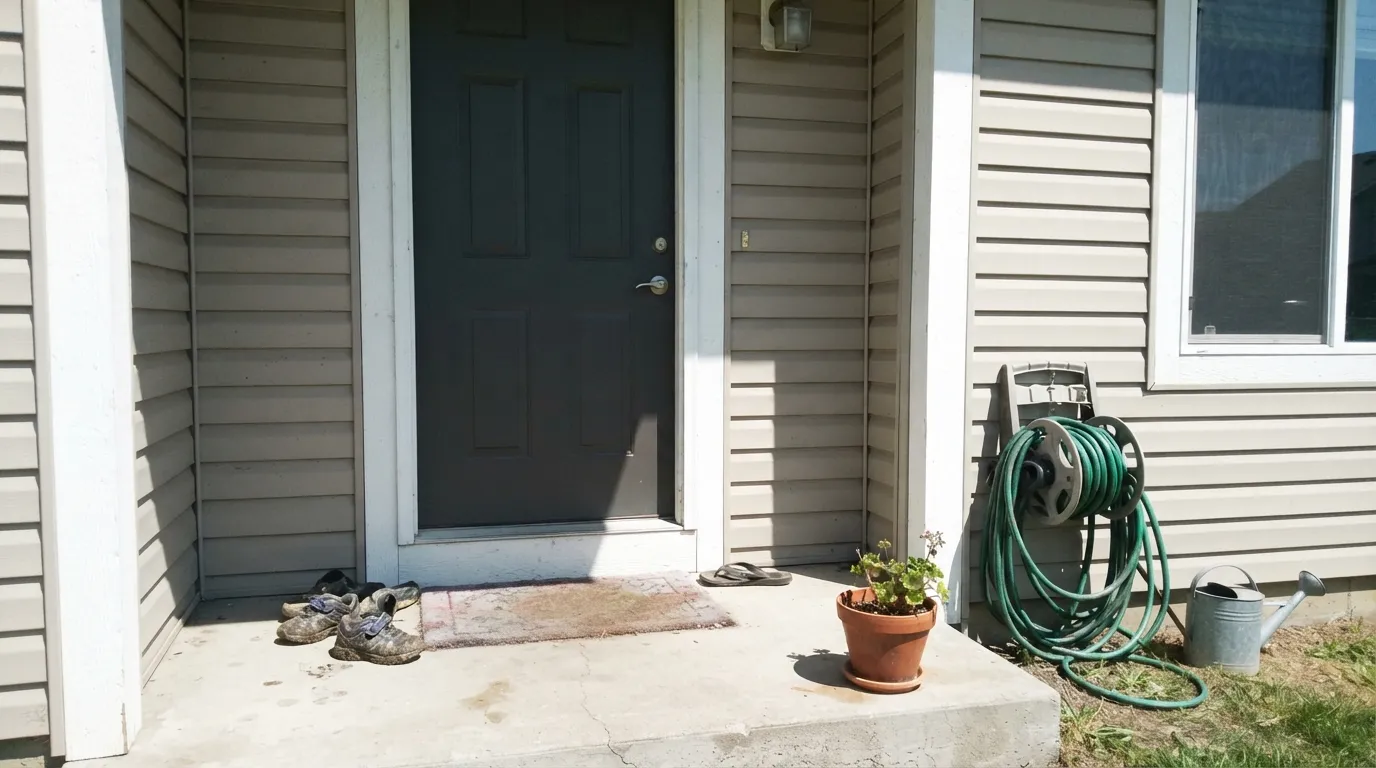
Semi-gloss Black Suede on a door reads modern and expensive against almost any siding color. Watch the exposure: a door in full afternoon sun will show the teal more than a shaded or north-facing one, which most owners find they actually prefer — it keeps the door from looking flat-dead black.
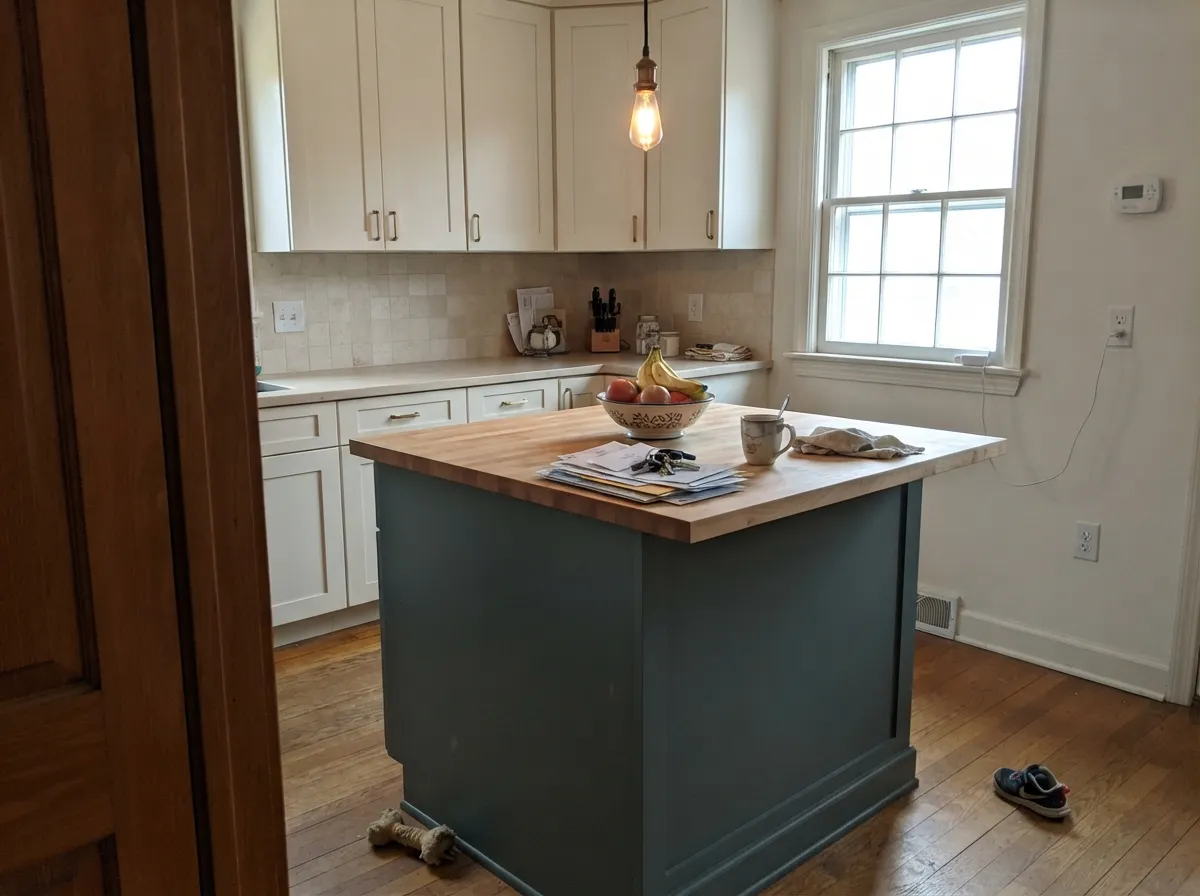
Satin or semi-gloss cabinet enamel on an island surrounded by warm-white perimeter cabinets is a classic, durable statement. Brass and unlacquered hardware are its best partners; polished chrome pulls the cool undertone forward more than brass does.
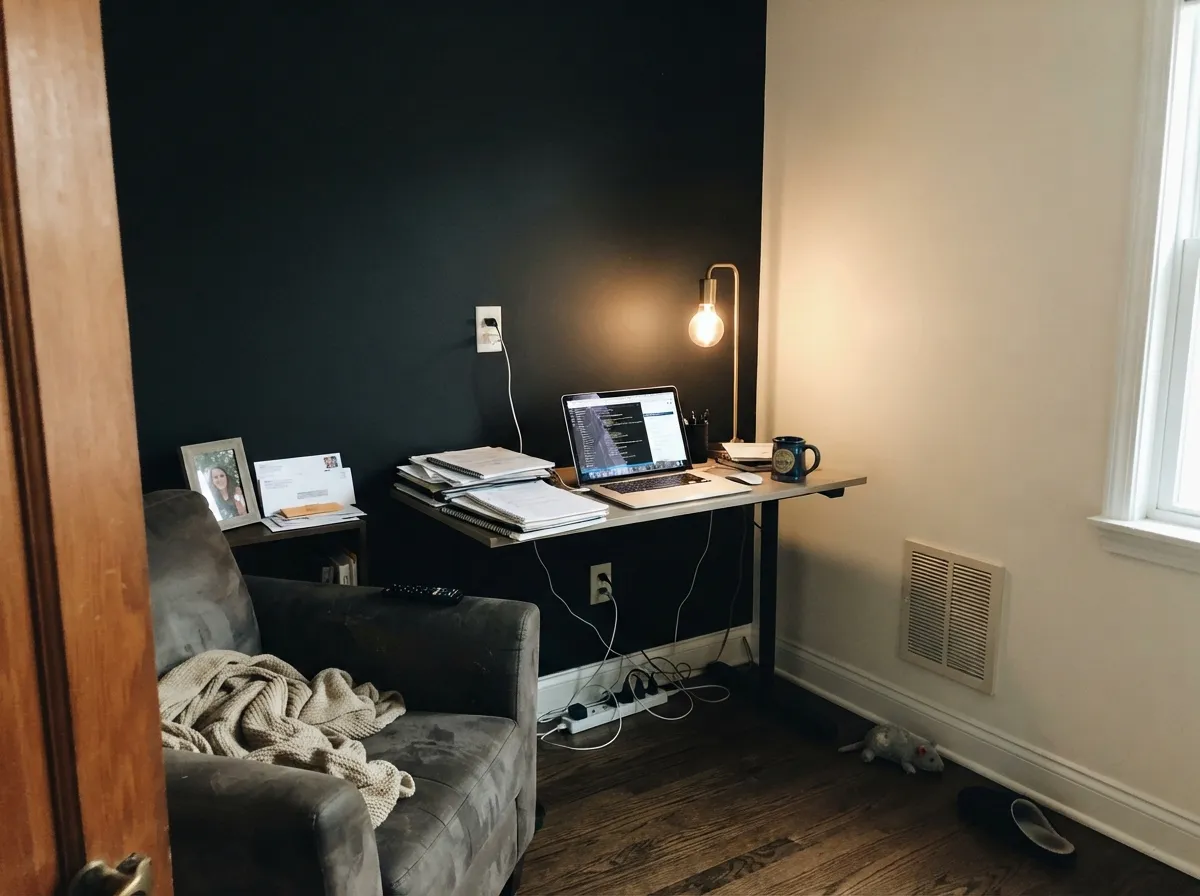
A moody, focused room under 2700K lamplight is exactly the light this color was built for. Built-ins, a desk wall, or all four walls in matte all work — just add warm light, since a north-facing office with only overhead LEDs will read colder than expected.
A small room takes deep color well, and Black Suede on all four walls with a brass sconce and a marble or wood vanity top looks like a design decision, not a dare. Eggshell or matte; add a mirror to keep the room from feeling like a closet.
One wall in a room with warm wood floors and daylight reads dramatic without swallowing the room. Skip it in a small, dim, north-facing room with no other light source — that combination is where the teal turns flat and cold instead of moody.
On a light-colored house, Black Suede trim or shutters give real curb-appeal contrast, and Behr sells it as a solid-color exterior stain for exactly this. The caution is heat, not color: very dark colors absorb enough sun to warp vinyl siding and trim over time, so keep it to wood, fiber cement, or metal surfaces outdoors, not vinyl.
Your Light Is the Risk
Soft, indirect light lets the charcoal base do its job — deep, velvety black with the teal staying quiet. This is where the color looks like the chip.
Full sun on a door or exterior trim pulls the blue-green undertone forward. Not colored from across the street, but visible up close — sample it at midday before committing a whole door.
Cooler and flatter in morning north-leaning light, softer and warmer as afternoon sun angles in from the west. Most owners read this as the color "waking up" through the day.
2700K bulbs neutralize the teal and the black reads soft and warm at night. Cool white LEDs do the opposite — they amplify the blue-green. Swap the bulb before you swap the paint.
Most complaints about Black Suede are a light mismatch. Upload a photo of your actual room and see it on your walls — then ask for the same wall in north light or evening lamps before you buy a single sample.
Need It From Another Brand?
Any paint counter can custom-tint Behr S-H-790 directly. If you would rather stay in one brand's own deck, these are the closest stock matches, measured as ΔE2000. Under 2 is a difference you will not see on the wall.
| Brand | Closest color | ΔE | LRV | |
|---|---|---|---|---|
| Sherwin-Williams | Iron OreSW 7069 · Sherwin-Williams | 0.7 | 6 | Color page → |
| Benjamin Moore | Notre DameCSP-570 · Benjamin Moore | 1.8 | 6 | Color page → |
| Valspar | Arrowhead8006-11F · Valspar | 1.8 | 5 | Color page → |
| PPG / Glidden | OnyxPPG1011-7 · PPG / Glidden | 1.3 | 6 | Color page → |
| Glidden | Deep Onyx00NN 07/000 · Glidden | 1.1 | 7 | Color page → |
| Dutch Boy | Cauldron437-7DB · Dutch Boy | 1.2 | 5 | Color page → |
Similar Behr Colors
The nearest shades to Black Suede within Behr's own range, ranked by perceptual color distance — useful when you want the same look a touch lighter, darker, or warmer.
WCAG 2.1: AA is 4.5 : 1 for normal text, 3 : 1 for large text, AAA is 7 : 1.
Black Suede vs the Colors You're Also Considering
Every Black Suede sample board has the same rivals on it. The numbers show the real lightness gap — then it comes down to which risk you would rather live with.
Pick this for the more velvety, less flat-black texture Iron Ore doesn't have.
Sherwin-Williams SW 7069 · LRV 6Iron OrePick this if you want a whole-house black with a cleaner blue-gray read and none of the suede softness.
Pick this for a hair lighter, softer near-black — Tricorn's flatness never hides, Black Suede's teal at least stays quiet in shade.
Sherwin-Williams SW 6258 · LRV 3Tricorn BlackPick this for a true neutral black with zero undertone to test — the reference black most painters default to.
Black Suede Coordinating Colors
Black Suede pairs easiest with warm off-whites and creams, which give the cool undertone something warm to sit against instead of competing with it. It also works as the deep note in an otherwise cool-neutral scheme, since its own undertone already leans that direction. These are the partners that keep showing up in rooms that work:
Black Suede on Exteriors
Outside, Black Suede works as trim, shutters, a door, or a fence and gains real presence against a light-colored house — full sun reads it a shade cooler and more blue-green than it does indoors, which most exterior applications actually flatter rather than fight. Behr sells it as a solid-color house-and-fence stain as well as a paint, so the same number can carry from a front door to a deck rail.
The one real caution is heat, not color: any paint this dark absorbs enough sun to warp vinyl siding over time, a documented risk with dark colors generally, not something specific to this formula. Keep Black Suede to wood, fiber cement, brick, or metal exteriors, and reserve vinyl trim for a lighter color.
Black Suede With Wood Tones and Metals
Warm wood is this color's best partner. Walnut, oak, and butcher block all sit comfortably next to it, and the wood's warmth balances the cool undertone the way a warm wall color would. Aged leather and rattan do the same job in a den or office.
Metals split the same way the undertone does: brass and unlacquered finishes stay warm and forgiving next to Black Suede, while polished chrome and cool stainless pull the blue-green forward and make the black look colder. Matte black hardware is the safest, most neutral pairing if you want the metal to disappear rather than argue with the paint.
Three Ready Palettes Built on Black Suede
A color is never alone on the wall. These are complete combinations in the 60-30-10 pattern, with the reason each one holds together. Every one opens in the visualizer.
A warm off-white body with a crisp white trim gives the door somewhere quiet to stand out against. The soft charcoal base keeps the door from looking like a flat black cutout in the facade.
Try this palette in your roomAlabaster keeps the room bright enough for daytime work while the single Black Suede wall carries all the drama. Add a warm desk lamp and the accent wall turns velvety instead of heavy.
Try this palette in your roomTwo warm, quiet whites around the edges of the kitchen let one dark island do all the talking. Brass or unlacquered pulls keep the island reading warm instead of cold.
Try this palette in your roomBlack Suede FAQ
Is black suede a true black or does it have an undertone?
It has an undertone — a cool, faintly blue-green (teal) cast rather than a truly neutral black. It reads black at a glance in most light, but strong direct sun or a spot near greenery will bring the teal forward. If you want zero undertone to think about, Sherwin-Williams Tricorn Black is the safer neutral reference.
What sheen should I use for black suede?
Matte on walls hides the undertone best and gives the softest "suede" look. Step up to satin for doors, trim, and cabinets, and semi-gloss for a front door — the extra sheen adds durability but also sharpens whatever light hits it, teal flash included.
Is black suede good for a front door?
Yes — it's one of the color's best jobs. Semi-gloss Black Suede on a door gives real curb-appeal contrast against most siding colors. A door in full afternoon sun will show more of the cool undertone than a shaded one; most owners like the shift rather than mind it.
Does black suede work on kitchen cabinets or an island?
Very well, especially as an island color against warmer-white perimeter cabinets. Use a satin or semi-gloss cabinet enamel for durability, and lean on brass or unlacquered hardware — polished chrome pulls the cool undertone forward more than warm metals do.
How many coats does black suede need over a light wall?
Plan on two full coats minimum, three over anything saturated or previously red, navy, or another dark color. A gray-tinted primer first saves a coat of finish paint and avoids the patchy, roller-line look that one coat over light walls leaves on any near-black.
Can I use black suede on exterior siding?
On wood, fiber cement, or metal, yes — Behr sells it as a solid-color exterior stain for exactly this. Avoid it on vinyl siding: very dark colors absorb enough heat in full sun to warp vinyl over time, which is a known risk at this depth, not a Black-Suede-specific defect.
Have you painted with Black Suede?
Rate it — one tap helps the next reader decide.
Ask a Question