Alpine Trail
The near-black pine green everyone eyes for cabinets and front doors, reviewed honestly: the light it needs to look green, the rooms where it just reads black, and what to pick instead.

Jessica has spec'd whites and neutrals for more than 300 rooms and keeps a sample wall of painted drawdowns in her studio. Every color review is checked against real reader rooms in the comments and re-tested when a formula changes. About the testing process →
- 1Hunter Green5
- 2Alpine Trail10
- 3Sage Green22
- 4Evergreen Fog30
The Fast Verdict
Alpine Trail is a heavy, charcoal-based pine green built to sit at the edge of black — LRV 10, deep enough that most people who buy it are really shopping for a green-tinted alternative to true black. Give it real daylight or a warm lamp and the pine comes through, soft and olive-leaning. Take the light away and it drops straight to a flat near-black with no green left to see. It is a superb small-dose color — a door, a set of lower cabinets, a built-in — and a genuine gamble as a whole-wall color in a dim room.
Lower kitchen cabinets under white uppers · front doors and exterior shutters · libraries, dens and built-ins with real daylight or lamp light · anyone who wants a green dark enough to double as a neutral
You want it to read clearly green in every light, not just good light · the room has no window and no lamp plan · you're rolling it over a bright existing wall and expect one coat · you actually want a true black, not a green pretending to be one
- A genuine pine green, not just a marketing name for black
- Heavy enough to do a true black's visual-weight job on cabinets and doors
- Several LRV points brighter than true near-blacks, so daylight can still bring out the green
- Reads sophisticated rather than trendy — a low-chroma neutral-adjacent green
- Excellent on lower cabinets against white uppers and brass or black hardware
- Reads flat black in any windowless or dim room
- Needs three coats over a light existing wall in standard Behr lines
- Loses its green identity under cool white LEDs with no daylight backup
- Too dark and too committed for most whole-room wall applications
What Color Is Alpine Trail, Really?
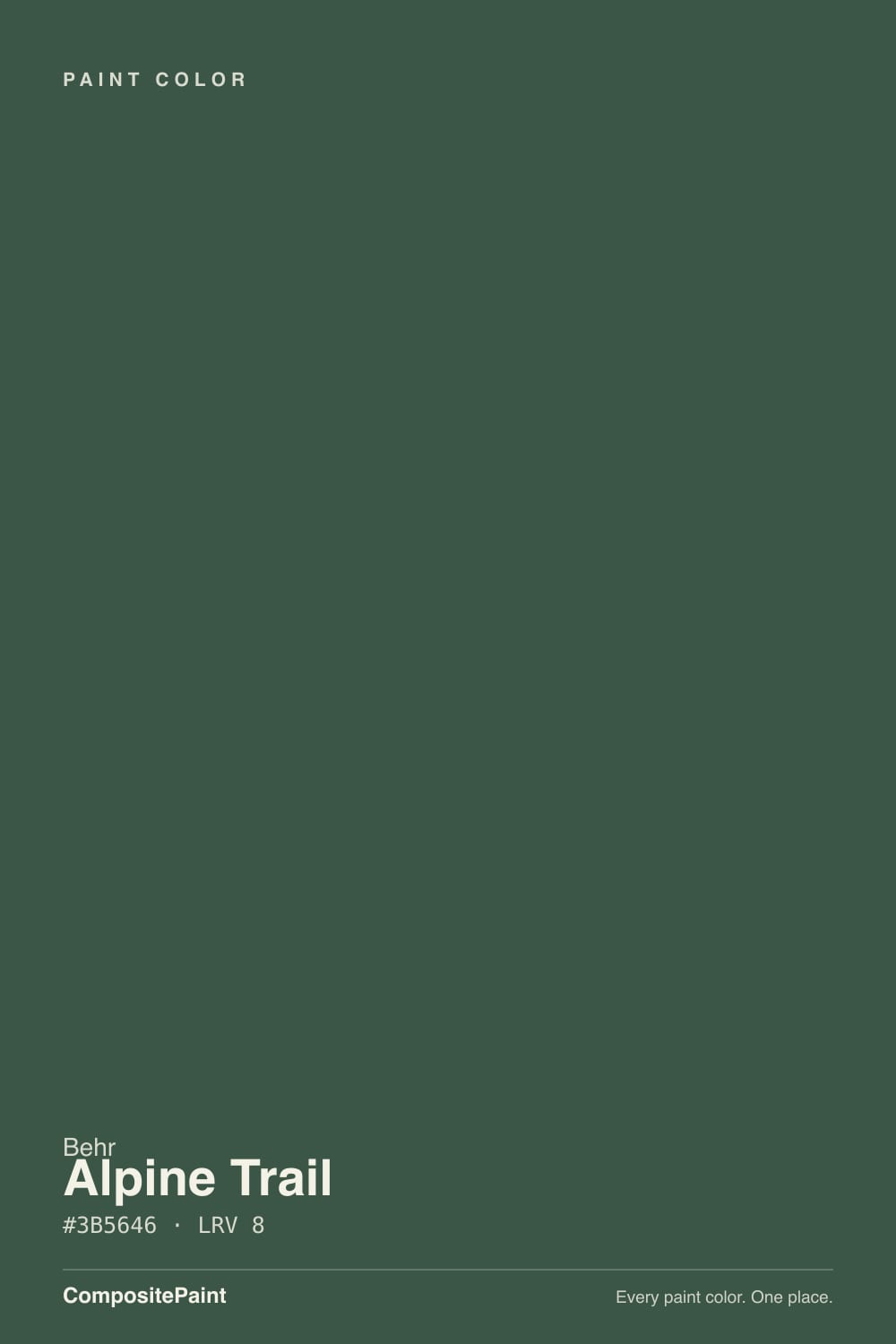
Alpine Trail is a dark, low-chroma pine green with a heavy charcoal-gray base and a soft olive undertone underneath. It is not a saturated "forest green" in the Essex Green sense — the gray is doing most of the work, which is exactly what makes it read as sophisticated rather than costume-y. Behr built it to sit in that narrow band of near-black colors that behave like a neutral on trim and cabinetry: dark enough to anchor a room, colored enough that it is never quite mistaken for plain black.
At LRV 10 it is genuinely dark — deeper than almost anything you'd choose for open wall space, but a few points brighter than true near-blacks like Essex Green (LRV 4) or Wrought Iron (LRV 6). That gap matters: those colors go essentially black indoors regardless of light, while Alpine Trail's slightly higher LRV means good daylight or a warm lamp can still coax the pine green forward. In flat or artificial light, though, it drops to the same place the darker colors live — a soft charcoal-black with the green mostly gone.
Undertone in one line: pine green with an olive lean, never blue. If your sample reads flat charcoal-black, that's dim or cool light doing exactly what a color this dark does; if it reads faintly blue-gray, check for cool LED bulbs nearby — warm light is what keeps the olive honest.
Where It Shines
This color is built for one strong feature, not a whole room of exposure. Lower kitchen cabinets under white uppers, a front door with real porch or sky light, a den built-in near a lamp — all of it lets Alpine Trail hold its pine-green identity while doing the visual-weight job a near-black is supposed to do. It photographs best in daylight or under warm 2700K bulbs, where the olive underneath comes forward instead of flattening to soot.
Where It Fails
Almost every disappointed review of Alpine Trail comes from one of three situations, and all three are predictable before the first coat goes on. None of them are the paint's fault — but if your project matches one, this is not your color, or at least not for that surface.
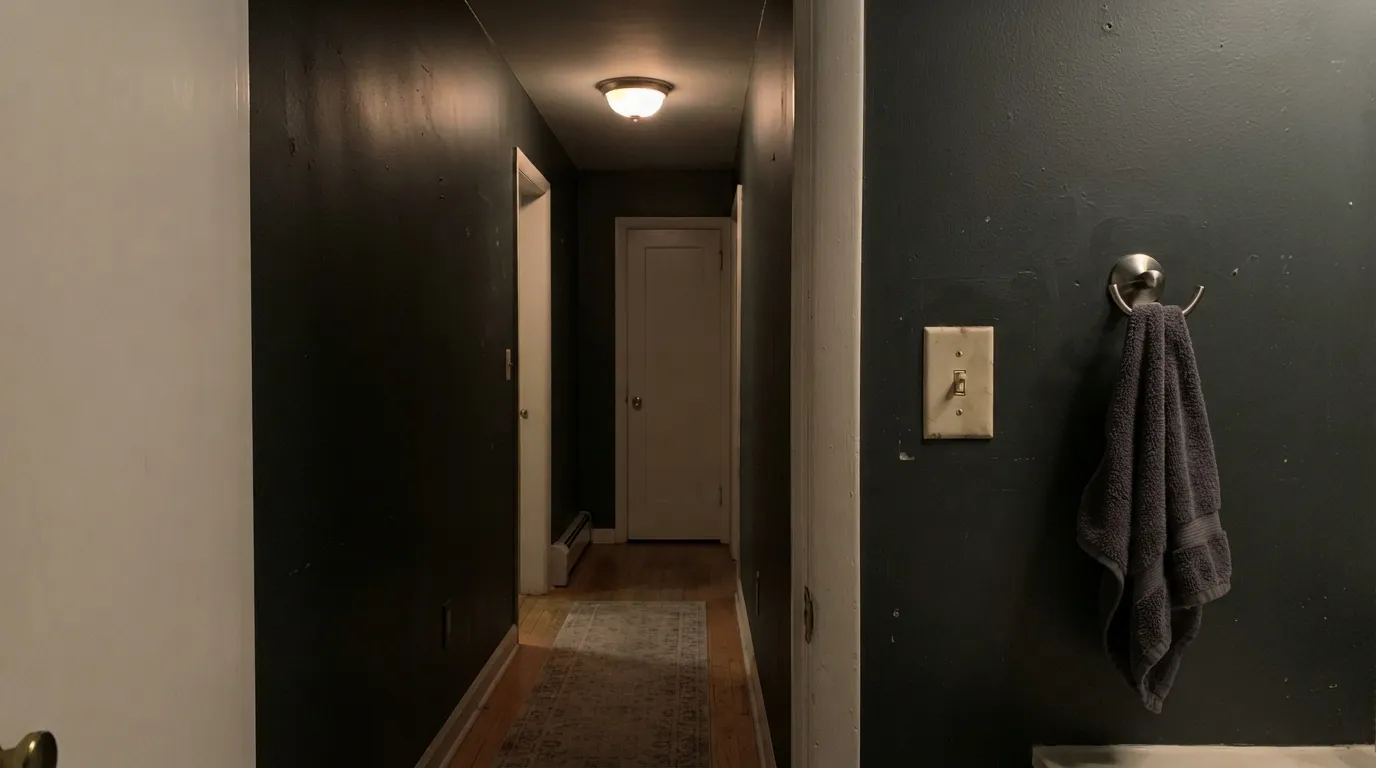
With no daylight and no lamp doing the work, LRV 10 has nothing to bounce off of and the room goes flat, cave-like black. This is the single most common regret with Alpine Trail on full walls — it was never built to be a no-window paint.
Going from a light color to Alpine Trail in standard Behr paint typically needs three coats for even coverage — the low LRV means it fights the underlying color hard. If one-coat hide matters, have it tinted into Behr Dynasty or Marquee, which Behr backs for one-coat coverage even at this depth.
Cold artificial light strips the warmth that keeps the olive visible and leaves a charcoal-black with no green left to read. If the room runs on cool LEDs after dark, swap to 2700K bulbs near the painted surface or accept that it reads black at night.
Room by Room
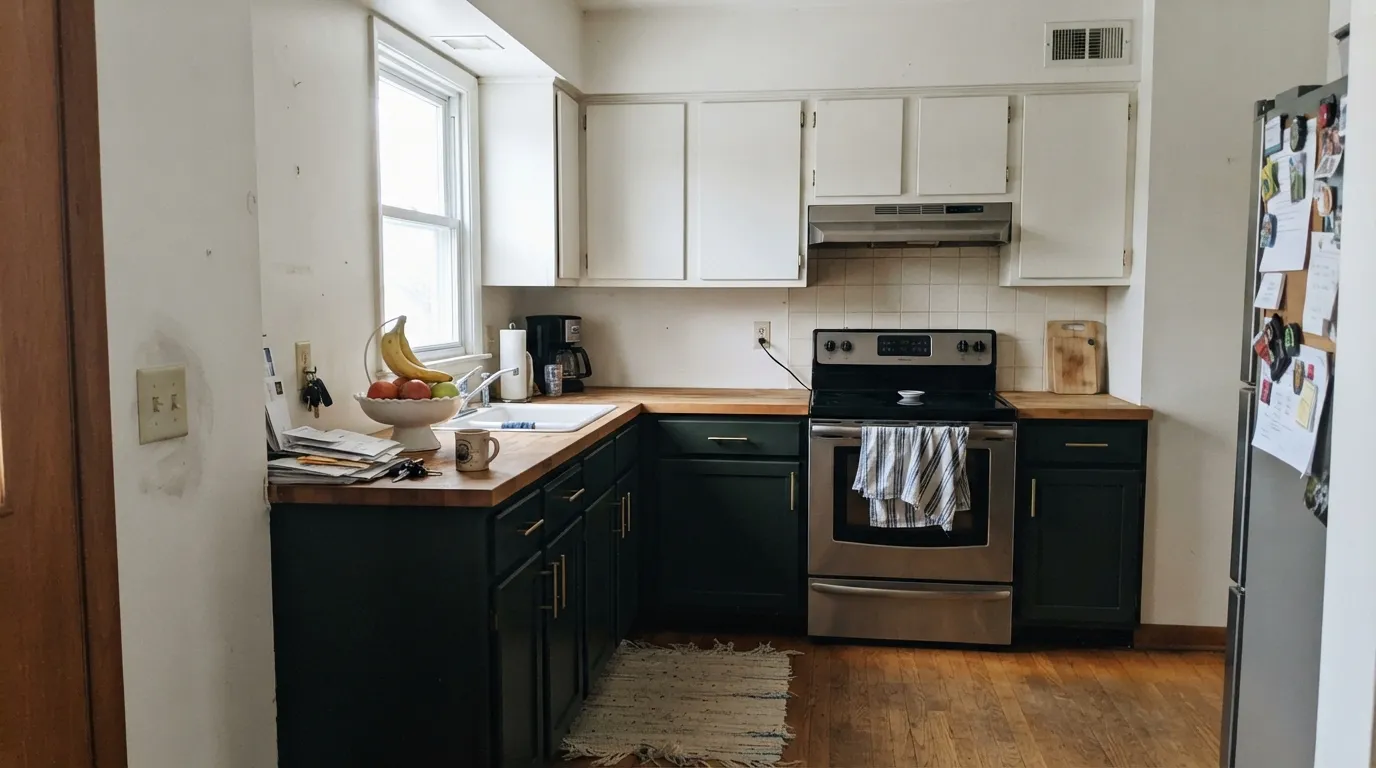
Under white or off-white uppers, with brass or matte-black hardware, this is where Alpine Trail earns its reputation. Satin cabinet enamel wipes clean and the green reads clearly against a light countertop and backsplash.
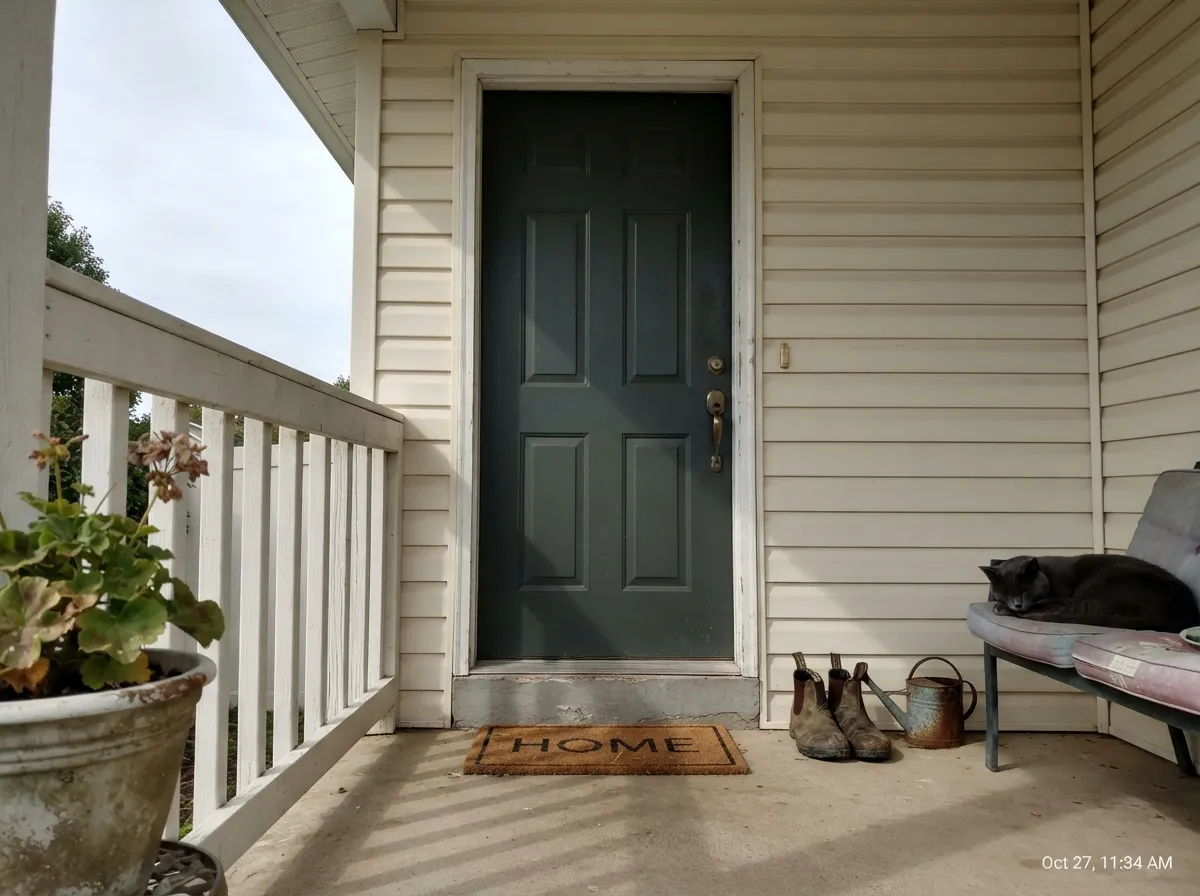
A covered porch that still catches some daylight is ideal. In full shade all day it can read as flat black, which some owners want anyway — decide before you commit which one you're buying.
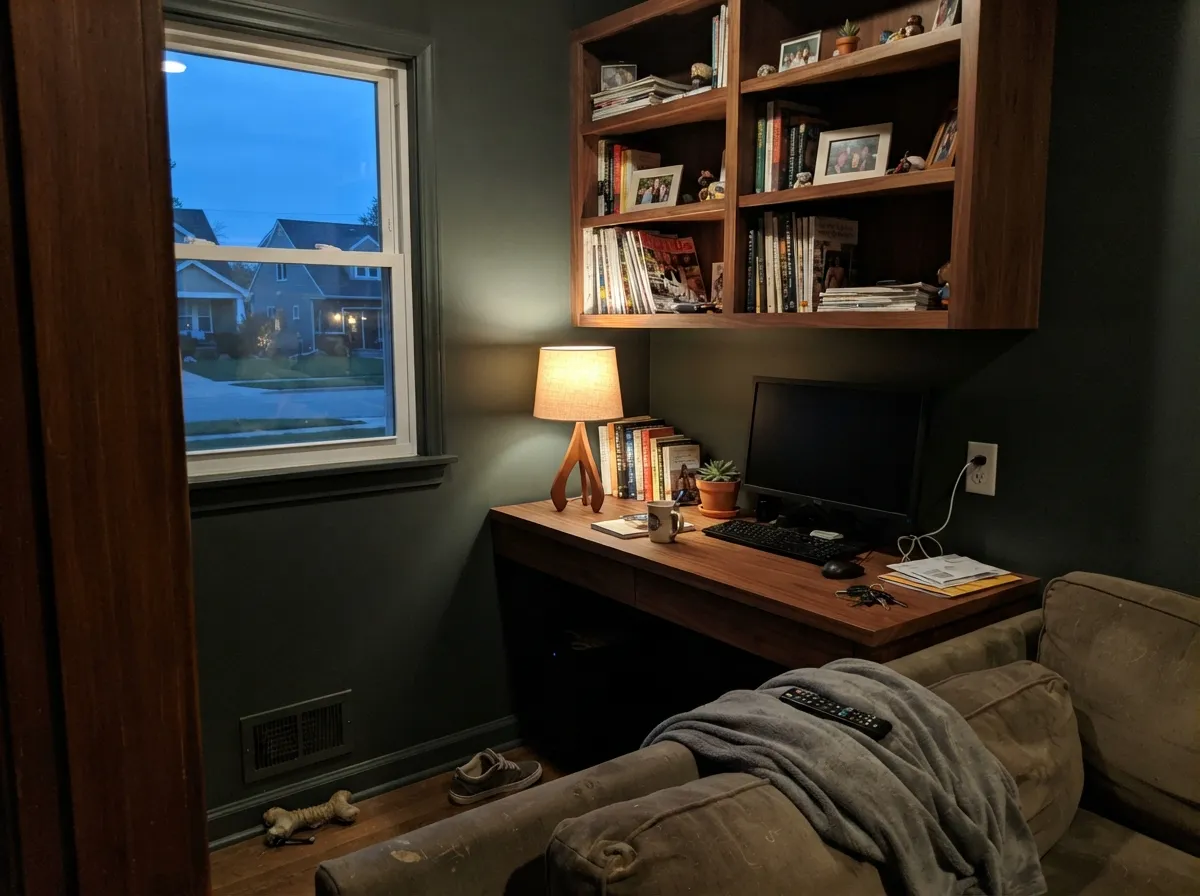
Built-ins and a single accent wall next to walnut shelving and a warm lamp are where the pine green feels intentional and expensive. Skip it if the room is north-facing with no supplemental light.
A drenched dining room under a warm chandelier is a strong, moody look. It needs real light sources in the room — no window, no evening lamp plan, no Alpine Trail dining room.
Small, often windowless rooms are exactly where the color's low LRV turns into a liability. Reserve it for a vanity in a bathroom that has a real window, not the whole room.
A full living room in Alpine Trail is a big bet — most rooms don't have the consistent daylight to keep it reading green all day. An accent wall opposite a bright window is the safer version of the same idea.
Your Light Is the Risk
A north-adjacent room with real ambient light — or any room at midday — is where the olive-pine green shows clearly instead of dropping to black.
With nothing to bounce light off of, LRV 10 goes flat and cave-like. This is the color's one real trap — never use it on a windowless room's full walls.
Clearly pine green at midday, it deepens toward near-black as the light fades — most owners like the shift; know it's coming before you paint a whole wall.
Warm bulbs keep the olive undertone alive at night. Cool white LEDs flatten it to charcoal-black — swap the bulb near the painted surface before you swap the paint.
Most complaints about Alpine Trail are a light mismatch. Upload a photo of your actual room and see it on your walls — then ask for the same wall in north light or evening lamps before you buy a single sample.
Need It From Another Brand?
Any paint counter can custom-tint Behr N420-7 directly. If you would rather stay in one brand's own deck, these are the closest stock matches, measured as ΔE2000. Under 2 is a difference you will not see on the wall.
| Brand | Closest color | ΔE | LRV | |
|---|---|---|---|---|
| Sherwin-Williams | Rookwood Dark GreenSW 2816 · Sherwin-Williams | 4.7 | 10 | Color page → |
| Benjamin Moore | Ashwood Moss1484 · Benjamin Moore | 3.7 | 10 | Color page → |
| Valspar | Sherwood Forest8003-34G · Valspar | 1.8 | 10 | Color page → |
| PPG / Glidden | Evergreen BoughsPPG1129-7 · PPG / Glidden | 1.1 | 9 | Color page → |
| Glidden | Evergreen BoughsPPG1129-7 · Glidden | 1.1 | 9 | Color page → |
| Dunn-Edwards | Hidden ForestDE6301 · Dunn-Edwards | 1.1 | 9 | Color page → |
Similar Behr Colors
The nearest shades to Alpine Trail within Behr's own range, ranked by perceptual color distance — useful when you want the same look a touch lighter, darker, or warmer.
WCAG 2.1: AA is 4.5 : 1 for normal text, 3 : 1 for large text, AAA is 7 : 1.
Alpine Trail vs the Colors You're Also Considering
Every Alpine Trail sample board has the same rivals on it. The numbers show the real lightness gap — then it comes down to which risk you would rather live with.
Pick this for more visual weight and a more convincing near-black on cabinets, doors and trim.
Sherwin-Williams SW 6187 · LRV 12RosemaryPick this for a slightly lighter, more clearly green dark green that still needs real light to pay off.
Pick this when you actually want the green to show up indoors — Alpine Trail's higher LRV gives daylight more to work with.
Benjamin Moore PM-11 · LRV 4Essex GreenPick this for an exterior classic that goes essentially black indoors regardless of light — the deeper, more committed choice.
The closest comparison is inside Behr itself. Evergreen Bough 700F-7 lists the same hex, #3B5646, and the same LRV of 8, so there is nothing to choose between them on color. North Woods N410-7 at hex #3F5645 is a hair warmer and Secluded Woods S420-7 at #355745 is a hair cooler; on a wall these differences are hard to see.
Across brands, PPG and Glidden Black Spruce PPG1137-7 at LRV 8 is a deltaE of 1.04, which is visually identical in normal room light. Valspar Wilderness 6009-5 at LRV 7.7 sits at 1.77 and behaves the same way.
Sherwin-Williams Isle of Pines SW 6461 and Dutch Boy Forestlawn 228-7DB are both a deltaE of 1.92 at LRV 8. Benjamin Moore Gondola Ride 602 at LRV 9 is 3.37 away and slightly more teal, so it is very close but worth sampling first. Farrow and Ball Duck Green No. W55 at LRV 8 sits at 3.45 and leans yellower.
Alpine Trail Coordinating Colors
The rule for coordinating with Alpine Trail: give it a bright, clean partner to stand out against, and keep any second dark color in the same warm-neutral family rather than a true cold black. It pairs cleanly with whites, warm off-whites and one other dark green or near-black for a tonal accent — these are the partners that keep showing up in rooms that work:
Alpine Trail on Exteriors
Outside, Alpine Trail does its best work as a door, shutter or accent color rather than full siding, and mostly because full siding removes the one thing it depends on: contrast with a bright partner. On a front door or shutters against light siding, some porch or sky light reaches the surface most of the day, and the pine green stays visible even from the curb. Push it to a full dark-green exterior and it behaves like most deep exteriors — reading close to black except at direct midday sun.
The safe combination is a clean or warm white body color with Alpine Trail reserved for the door and shutters, plus brass or matte-black hardware. Full shade all day — a north-facing porch under deep overhangs — is the one situation to sample carefully first, since that's where it reads flattest and closest to solid black.
Alpine Trail With Wood Tones and Metals
Walnut, espresso and warm mid-tone oak all sit comfortably against Alpine Trail — the wood's warmth balances the paint's cool charcoal base and keeps the whole combination from feeling flat. Very pale, cold-toned floors can make the green look colder than it is; a warm rug or wood accent nearby fixes that in most rooms.
Metals split cleanly two ways. Unlacquered brass and warm bronze play up the olive undertone and are the classic cabinet-hardware pairing. Matte black hardware reads as a tonal, near-monochrome look rather than a contrast — both work, and the choice is really about how much the hardware should stand out against the door or cabinet face.
Three Ready Palettes Built on Alpine Trail
A color is never alone on the wall. These are complete combinations in the 60-30-10 pattern, with the reason each one holds together. Every one opens in the visualizer.
Keeping the uppers and walls in a clean white lets Alpine Trail carry all the visual weight down low, where it reads as a genuine dark green instead of a black. Cracked Pepper on the hood repeats the depth without competing for attention.
Try this palette in your roomA bright house white gives the door somewhere to stand out from, and porch light is what keeps the pine green visible instead of reading as plain black from the curb. Blank Canvas overhead warms the entry without competing with the door.
Try this palette in your roomOff White's green-yellow cast keeps the trim from fighting the wall's olive undertone, and a second dark green inside the bookcases reads as a deliberate tonal layer rather than two colors that happened to be dark.
Try this palette in your roomAlpine Trail FAQ
Is Alpine Trail green or basically black?
Both, depending on the light. In good daylight or under a warm lamp it is a clear, low-chroma pine green. In a dim or windowless room it drops to a flat near-black with the green mostly gone. Buy it knowing which one your room will show most of the time.
How dark is it, exactly?
LRV 10 — genuinely dark, but a few points lighter than true near-blacks like Essex Green (LRV 4) or Jasper (LRV 4). That gap is what lets real daylight bring the green back out, which those darker colors can't do indoors.
Is it good for kitchen cabinets?
Yes — it's one of the strongest uses for this color. On lower cabinets under white or off-white uppers, with brass or matte-black hardware, it does a black's visual-weight job while still reading as a genuine green. Use a satin cabinet-grade enamel.
Does it work on a front door?
Yes, especially with some porch or sky light reaching it. In full shade it reads close to solid black, which some owners are actually going for — decide before you paint which effect you want.
How many coats does it need?
Plan on three coats over a light existing wall in standard Behr paint — the low LRV makes it fight the color underneath. If one-coat coverage matters, have it tinted into Behr Dynasty or Marquee, which carry a guaranteed one-coat hide even at this depth.
What trim color goes with Alpine Trail?
A clean or warm white works best — Behr White or Polar Bear for a crisp look, Behr Off White or Blank Canvas if you want the trim to lean warmer and echo the green's olive undertone. Avoid stark blue-white trim, which pushes the green cooler than it wants to read.
Have you painted with Alpine Trail?
Rate it — one tap helps the next reader decide.
Ask a Question