Skin Tone Color Palette — Sunlit Skin
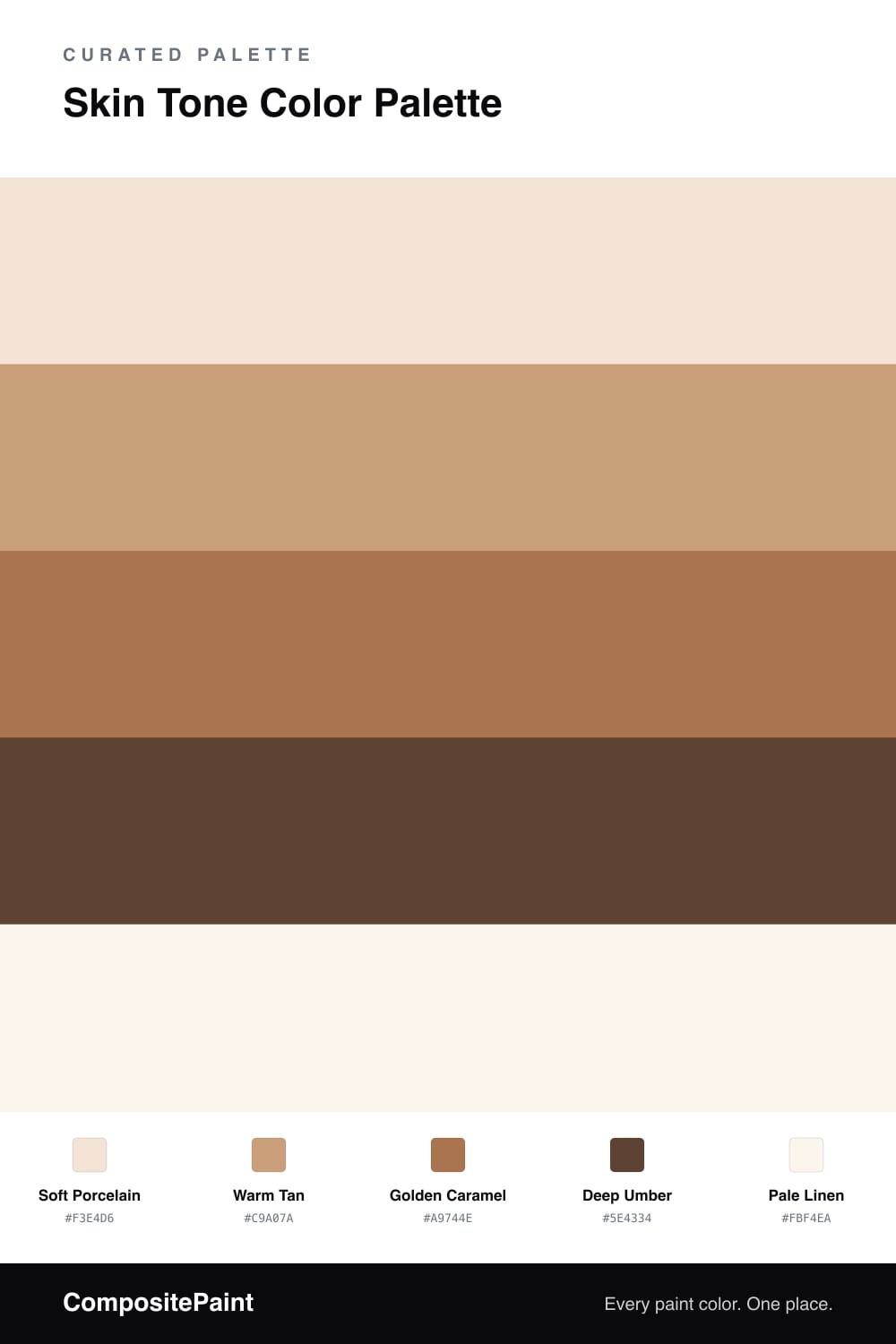
A warm five-color scheme moving from soft porcelain through tan and caramel into deep umber, balanced by a pale highlight — every color matched to real paint you can buy.
By David Chen · Formulation Lead & Resident Chemist
Skin tones make a quietly perfect palette because nature already sorted the ratios for us — a few pale highlights, a broad mid-range, and one grounding dark. This scheme walks that same gradient, from a Soft Porcelain base up through a confident Warm Tan and into a richer Golden Caramel.
A Deep Umber does the heavy lifting at the dark end, the single shade that gives every lighter tone something to push against. Without it the warmth would drift into beige; with it the whole range snaps into focus. The barely-there Pale Linen is your highlight, ideal for ceilings and trim where you want light to bounce.
For a 2026 feel, let Warm Tan lead the walls and keep the caramel and umber as deliberate moments rather than full coats — a painted door, a built-in, a band of color. These shades are easy to source because every one of them maps to a real, mixable paint in the warm-neutral family that brands stock year-round.
Buy These Colors
Each color matched to the closest real paint in every brand, by ΔE2000. Kompozit first; take any SKU to the store — these mix on demand.
Questions
Spread them across the value range instead of clustering. Let the pale Soft Porcelain and Pale Linen carry the big surfaces, use Warm Tan as the main color, and save Golden Caramel and Deep Umber for trim, doors, or one feature wall so the eye has a clear dark to land on.
Warm Tan is the safest lead for walls because it reads as a true neutral in most light. If a space gets little sun, drop back to Soft Porcelain so the room stays airy, and bring the deeper Golden Caramel and Deep Umber in through smaller painted pieces.
Similar Palettes
Closest schemes by color — not by label.