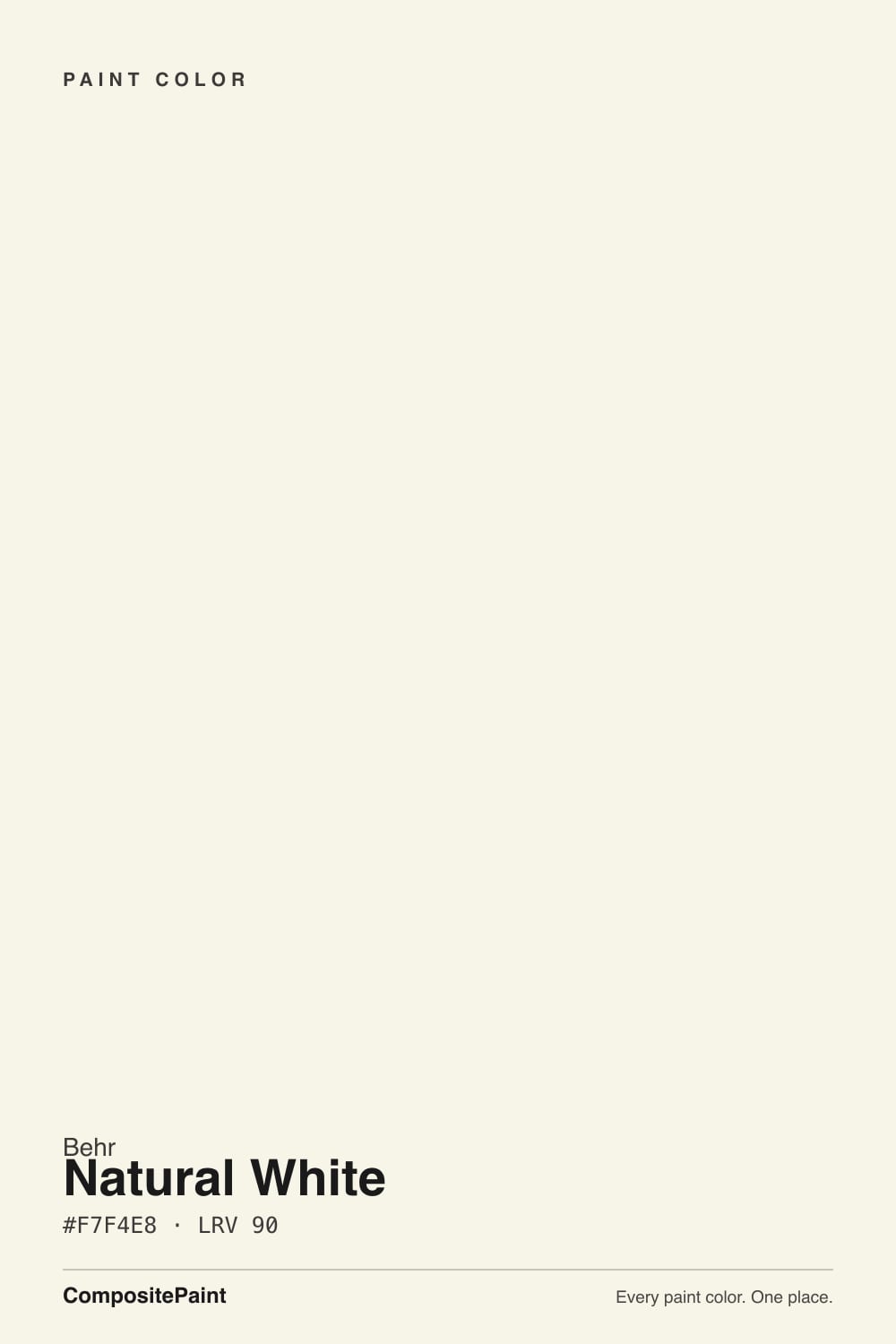
Natural White
Behr's Designer Collection Simply White, reviewed honestly: the ceiling-bright warmth that kills blue-white glare, the west sun that turns it cream, and what to pick instead.

Jessica has spec'd whites and neutrals for more than 300 rooms and keeps a sample wall of painted drawdowns in her studio. Every color review is checked against real reader rooms in the comments and re-tested when a formula changes. About the testing process →
- 1Classic Gray74
- 2Alabaster82
- 3Natural White90
- 4Ultra Pure White97
The Fast Verdict
Natural White is the near-white you pick when Ultra Pure White feels like a doctor's office and Swiss Coffee feels like cream. At LRV 90 it throws light like a true white; the yellow in it is a whisper, not a pour, so most rooms read finished and warm rather than painted. Treat it like Benjamin Moore Simply White, because that is the color Behr built it to sit next to: brilliant in north light, visibly creamy the minute hard western sun or a cooler trim white shows up.
Ceilings that should not go blue-white · trim, doors and cabinets in a warm house · north and east rooms that need a little sun · one-color walls + trim with only a sheen change
Your main room takes hard western afternoon sun · trim stays Ultra Pure White · counters or floors are cool grey · you want a crisp gallery white
- LRV 90 — bright enough for ceilings without blue-white glare
- Warm enough to feel finished, not as creamy as Swiss Coffee
- One-color rooms (walls + trim + ceiling) work; the sheen change is enough
- Flatters oak, walnut, brass, and honey oak instead of turning them orange
- Genuinely good in north light, where cooler whites go grey and flat
- Turns visibly creamy-yellow in hard western and late-afternoon sun
- Looks dingy the moment Ultra Pure White or Chantilly Lace sits next to it
- Clashes with cool grey quartz, Carrara-look stone, and grey LVP
- High-LRV whites hide poorly — two coats over light, primer plus three over dark
What Color Is Natural White, Really?
A near-pure warm white with a barely-there cream tint — yellow, not grey, not peach. Most Behr off-whites either dump the warmth (Ultra Pure White) or lean into it (Swiss Coffee). Natural White sits in the thin band between them: bright enough to pass as white on a ceiling or a whole wall, warm enough that the blue edge never shows. Behr files it in the Designer Collection as DC-005 and stamps it as comparable to Benjamin Moore Simply White, which is the useful way to think about it. Same job, same LRV 90, same yellow that only becomes a problem when the light or the neighboring white gives it away.
At LRV 90 there is almost no headroom above it. Chantilly Lace also sits at LRV 90, and Ultra Pure White at 97 is the only common Behr white that is clearly brighter. That is why this color is a natural ceiling and trim white — it reflects like the top of the deck — and also why you cannot rescue it with a whiter trim. A cooler or brighter neighbor does not add contrast; it just makes Natural White look like unwashed cream. The one-color rule is not a style preference here. It is physics.
Undertone in one line: delicate yellow, cream-range, never pink and never green. In north light the yellow is mostly cancelled and the wall reads as a quiet white. In west sun and under 2700K lamps the yellow is the whole story. If your sample looks dingy, look at the trim next to it before you blame the gallon.
Where It Shines
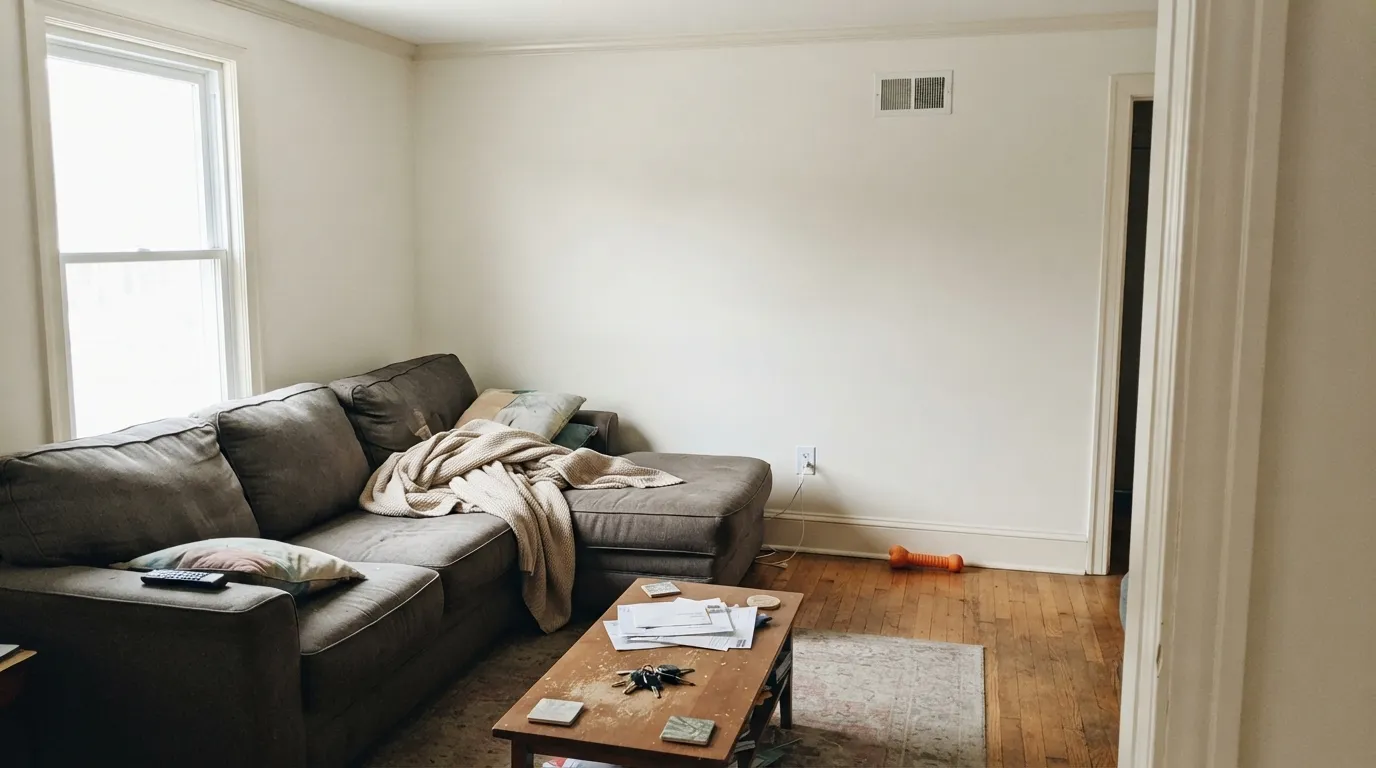
Give it north or east daylight, wood, and no brighter white nearby, and it does the rare thing a warm white is supposed to do: look white, not cream, while still keeping the room from going cold. Ceilings are the job it was quietly built for. Flat Natural White overhead stays bright without the blue-white glare builder ceiling paint throws against warm walls, and the same gallon in satin on cabinets or semi-gloss on trim will carry a whole house if you let the sheen, not a second white, make the edge.
Where It Fails
Almost every unhappy Natural White story is a Simply White story in a Behr can. The yellow is real, it is small, and three situations make it loud. None of them are a bad mix — but if your room matches one, this is not your white, and another coat will not hide it.
This is the same complaint that follows Simply White around Houzz: from about four o'clock the warm flood has nowhere to hide, and owners describe the walls as creamy, too warm, almost yellow. Natural White's yellow is quieter than Swiss Coffee's, but west light does not care. If the room you live in faces west, sample at 5pm or pick a cleaner white — Chantilly Lace (OC-65, LRV 90) holds the sun without going cream.
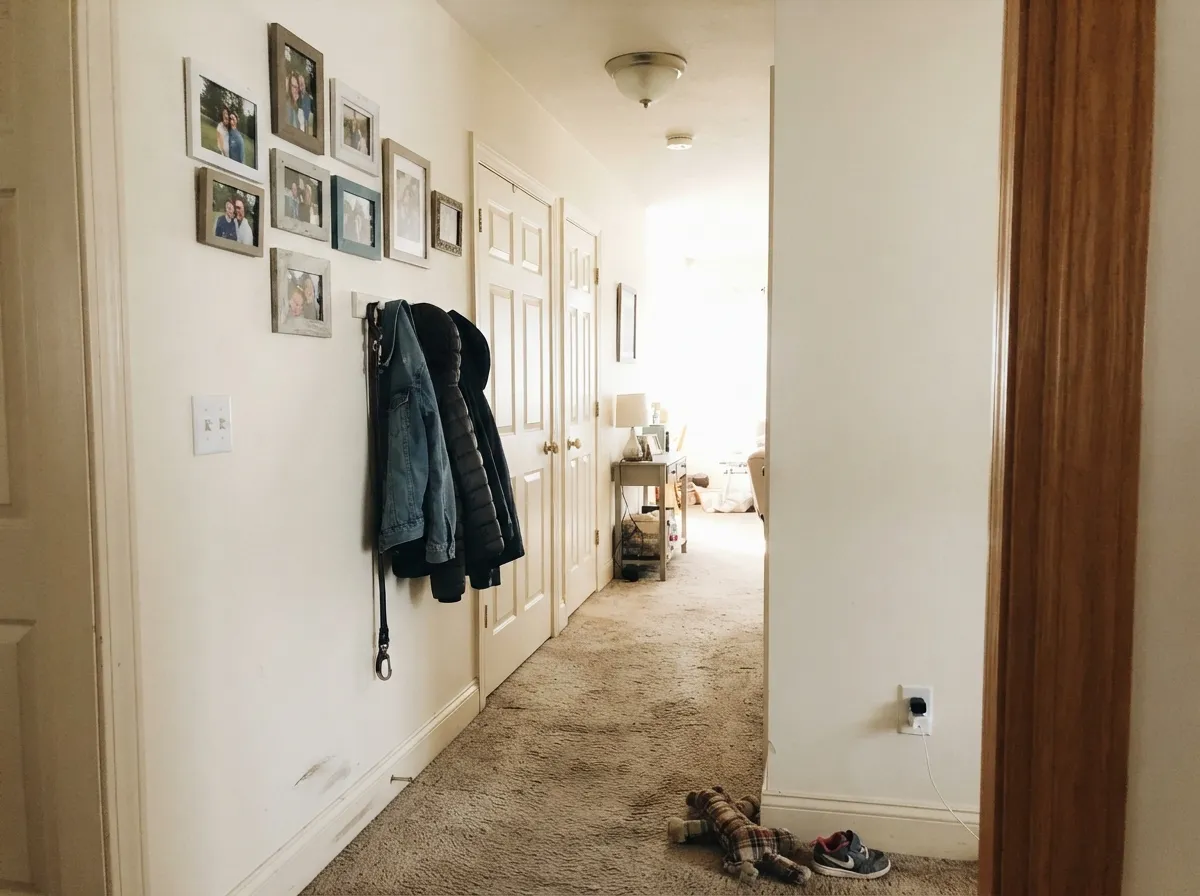
The most common pairing mistake in a Home Depot house: Natural White walls, Ultra Pure White (W-B-500, LRV 97) on the trim or ceiling. The brighter white wins, and Natural White looks dingy. Chantilly Lace trim does the same trick at the same LRV — the temperature gap, not the brightness, is enough. Run Natural White on walls, trim, and ceiling and let eggshell / semi-gloss / flat separate the planes, or drop it and paint the whole room the cleaner white.
Cool stone and grey plank sit at the opposite temperature and shove the yellow into the open. Cabinets that looked softly white on the chip read cream next to grey-veined quartz and stainless; walls above grey LVP pick up a faint nicotine cast. With cool floors and counters, use a cleaner white — Ultra Pure White on cabinets, or Chantilly Lace if you want the gallery version — and keep Natural White for a warmer room.
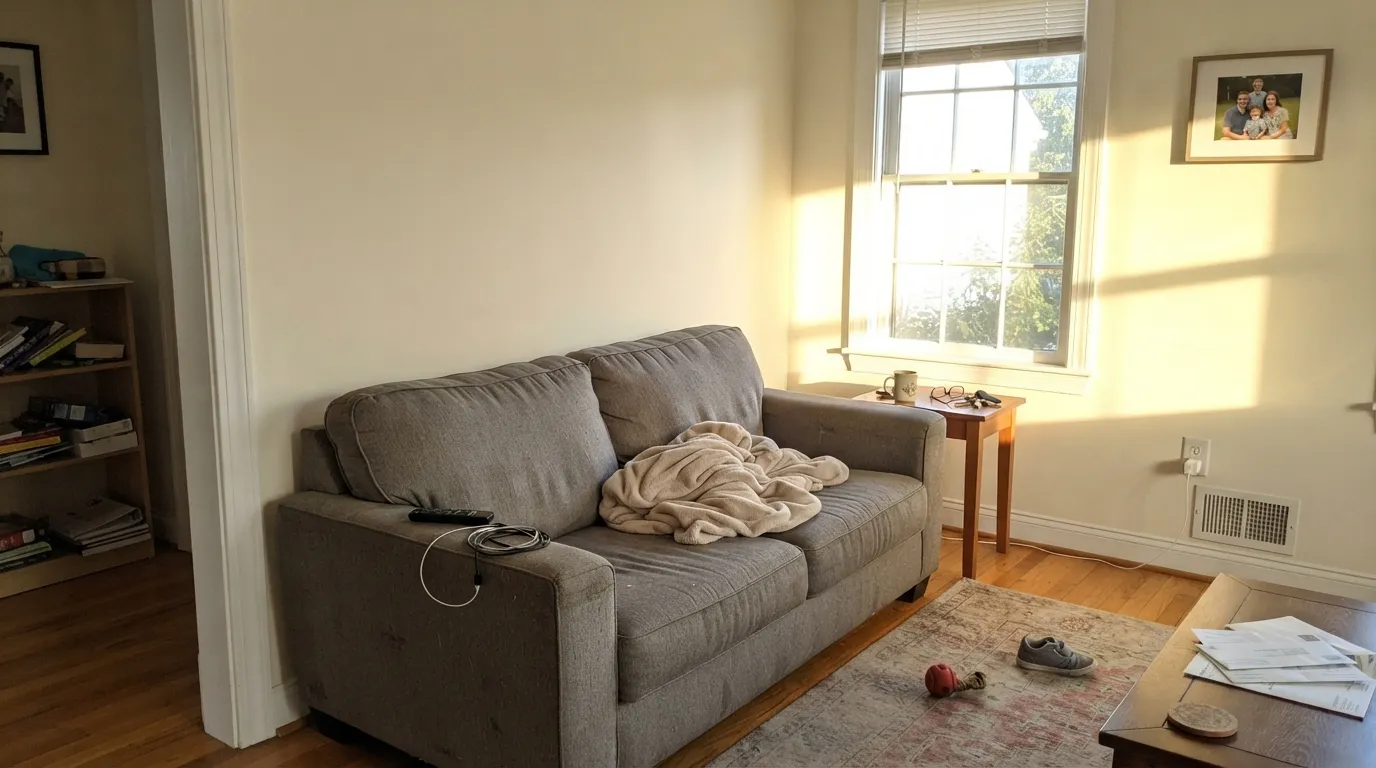
Room by Room
Home Depot even sells this SKU as a ceiling flat, and that is the tell. At LRV 90 it is bright enough to disappear overhead, and the whisper of yellow stops the plane from reading blue against warm walls — the exact complaint with builder-grade Ultra Pure White ceilings. Flat sheen; same color as the walls if you can.
Semi-gloss on casings and doors, satin on cabinets. It reads as painted woodwork rather than plastic-bright, and it is kind to oak, walnut, and brass. The rule is the same as for Simply White: do not park a cooler white next to it. One color, two sheens.
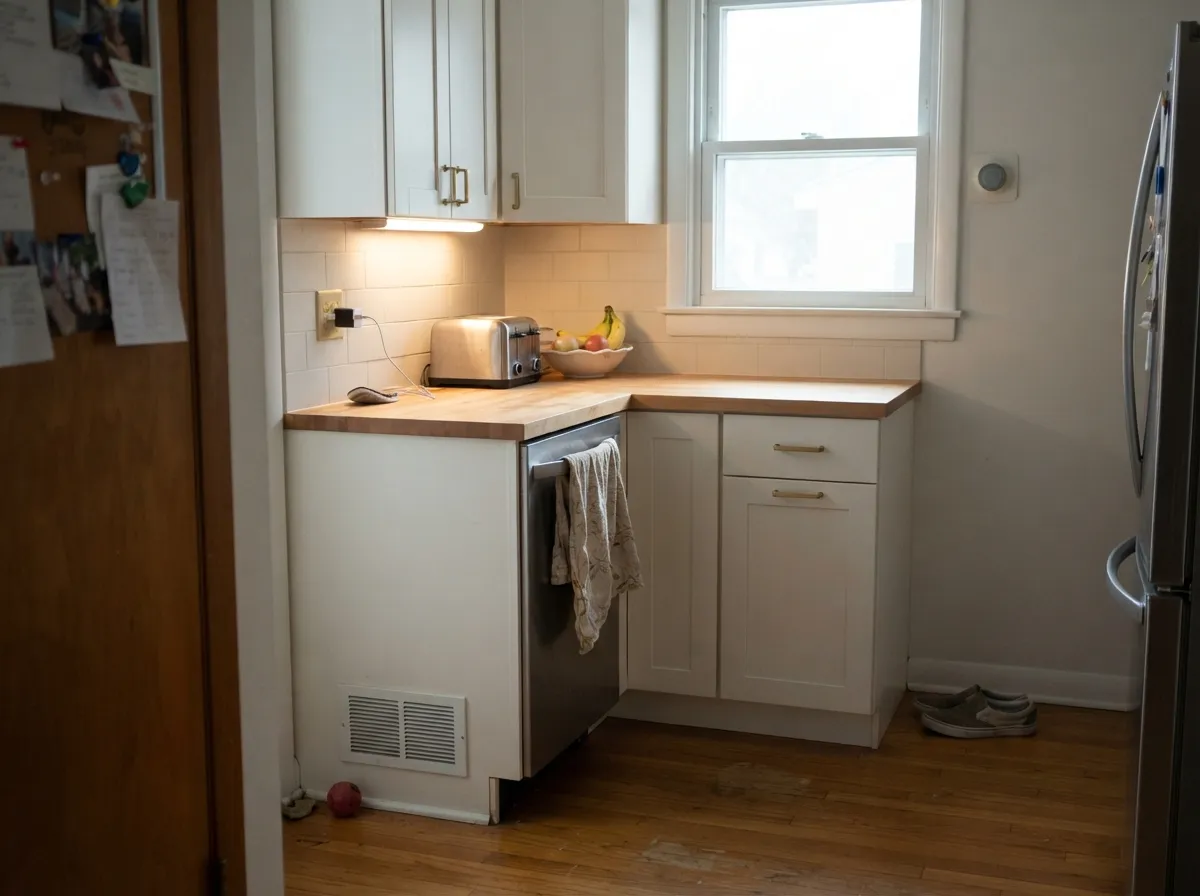
On walls or cabinets it brightens a wood-and-brass kitchen without the clinical edge of Ultra Pure White. Warm quartz, butcher block, soapstone, terracotta: all fine. Grey quartz and a wall of stainless: the yellow shows, and you will wish you had sampled a door against the slab.
East and north living rooms are its home turf: bright, quiet, slightly warm. South is lovely until mid-afternoon, when it creams up a step. A west living room is the skip. Eggshell walls; same color on trim in semi-gloss so the room does not grow a dingy halo around the casings.
North and east bedrooms stay clean and restful. Under 2700K lamps it turns creamier at night, which some people want and some people call dingy. 3000K–3500K keeps it closer to white after dark. If the bedroom faces west, this is not the gallon.
Warm marble, cream tile, wood vanities, brass: it looks settled and expensive. Grey porcelain, blue-grey subway, chrome-and-Carrara: it argues, and the wall goes yellow. Satin or a bath-rated eggshell for wipe-down either way.
Your Light Is the Risk
Cool grey daylight cancels most of the yellow and leaves a clean, quietly warm white. This is the exposure the color was built for.
From about four o'clock the yellow lands hard and the walls go cream. Sample this hour or skip the color in a west room.
East rooms glow softly in the morning and settle to a quiet white by noon. South rooms cream up through the afternoon; west rooms make the shift all at once at golden hour.
2700K lamps pull the yellow forward — cozy to some, dingy to others. 3000K–3500K keeps it closer to true white. Cool LEDs flatten it. Swap bulbs before you swap paint.
Most complaints about Natural White are a light mismatch. Upload a photo of your actual room and see it on your walls — then ask for the same wall in north light or evening lamps before you buy a single sample.
Need It From Another Brand?
Any paint counter can custom-tint Behr DC-005 directly. If you would rather stay in one brand's own deck, these are the closest stock matches, measured as ΔE2000. Under 2 is a difference you will not see on the wall.
| Brand | Closest color | ΔE | LRV | |
|---|---|---|---|---|
| Sherwin-Williams | CheviotSW 9503 · Sherwin-Williams | 1.2 | 89 | Color page → |
| Benjamin Moore | Mountain Peak White2148-70 · Benjamin Moore | 0.9 | 91 | Color page → |
| Valspar | Abel8007-8C · Valspar | 0.9 | 90 | Color page → |
| PPG / Glidden | White ChipPPG15-06 · PPG / Glidden | 1.5 | 87 | Color page → |
| Glidden | Linwood Beach White71YY 87/078 · Glidden | 1.6 | 87 | Color page → |
| Dutch Boy | Brightened Cream005W · Dutch Boy | 0.6 | 89 | Color page → |
Similar Behr Colors
The nearest shades to Natural White within Behr's own range, ranked by perceptual color distance — useful when you want the same look a touch lighter, darker, or warmer.
WCAG 2.1: AA is 4.5 : 1 for normal text, 3 : 1 for large text, AAA is 7 : 1.
Natural White vs the Colors You're Also Considering
Every Natural White sample board has the same rivals on it. The numbers show the real lightness gap — then it comes down to which risk you would rather live with.
Pick this when you are at Home Depot and want the same bright, faintly yellow white without crossing brands.
Benjamin Moore OC-117 · LRV 90Simply WhitePick this if you want the Benjamin Moore formula and a painter who already knows this yellow — it is the color Behr built Natural White to sit next to.
Pick this when you still want the wall to read as white, not coffee-with-milk.
Behr W-B-700 · LRV 87Swiss CoffeePick this when you actually want cream — it is the warmest of the safe off-whites, and it shows.
Pick this when you need the extra bounce of LRV 90 and a color that still passes as white on a ceiling.
Behr DC-003 · LRV 85Blank CanvasPick this for a slightly deeper warm white whose tell is peach, not yellow — kinder to honey oak, less ceiling-bright.
Pick this when Ultra Pure White would go blue-cold against warm walls and you want the ceiling to stay quietly warm.
Behr W-B-500 · LRV 97Ultra Pure WhitePick this for the brightest possible ceiling and trim — unbeatable there, risky on four walls, and a terrible neighbor to this color.
Inside the Behr deck, Divine Pleasure W-B-210 at LRV 90 and hex #F5F4E7 is the closest sibling, a touch less yellow. Calla Lily PWN-11 at LRV 91 is very slightly brighter and cleaner. These differences will not survive on a wall, so pick on availability rather than on the chip.
Across brands the matches are unusually tight. Dunn-Edwards Swiss Coffee DEW341 and Diamond Vogel Sugar Dust 0011 come in at deltaE 0.21 and 0.87, effectively the same color, though published LRV figures differ by brand because each measures its own way. Benjamin Moore Mountain Peak White 2148-70 at LRV 91 is 0.89, also effectively the same. Farrow and Ball Wimborne White No. 239 at LRV 89 sits at 0.71.
Stepping out further, Magnolia Home True White JG-21 at LRV 92 is 3.3, very close but worth sampling first since it leans cooler, and Rust-Oleum Chiffon Cream 329598 at LRV 92 is 3.75, close but visibly different side by side and clearly more yellow.
Natural White Coordinating Colors
Stay on the warm side of the fence and never introduce a brighter, cooler white. Natural White flatters warm greiges, easy sages, deep navies, and near-blacks — and it argues with icy greys, blue-grey stone, and any trim white that out-brights it. These are the partners that keep showing up in rooms that work:
The Home Depot Simply White
Behr's Designer Collection is a set of colors aimed at the names people actually walk into Home Depot asking for. Natural White is the Simply White slot: same LRV 90, same delicate yellow, same job on ceilings, trim, cabinets, and whole-house walls. Independent spectrophotometer readings put the two on top of each other — Natural White is a hair less chromatic, which is why some rooms read it as slightly more restrained than the Benjamin Moore original. It is not a Color of the Year and it does not have a viral kitchen. It is the gallon you buy when the target is Simply White and the store is Home Depot.
That inheritance includes the weakness. Simply White's loud, predictable problem is west sun and a brighter neighbor; Natural White has the same problem, just with a Behr label. If you already ruled Simply White out because of western windows or grey quartz, do not expect DC-005 to behave differently. If you already loved Simply White in a north kitchen, this is the closest Behr gets without crossing brands.
Natural White With Wood Tones and Floors
Warm wood is the easy yes. Oak — red, white, honey — walnut, butcher block, and cedar all sit comfortably against it because the yellow in the paint meets the yellow in the wood halfway. Icy whites make honey oak look aggressively orange; Natural White softens that orange instead of amplifying it, which is why it is kinder to a 1990s trim-and-floor package than Ultra Pure White will ever be.
The floor that needs a sample first is cool grey LVP or grey-washed oak. Grey plank pulls the yellow into relief, and the wall can read faintly nicotine against it. It is not always a dealbreaker — a large warm rug and brass lamps pull it back — but tape a big sample above the actual floor and look at 5pm before you paint the room. White oak and natural maple are safe; orange builder oak is safer here than it is next to a true bright white.
Metals are straightforward: unlacquered brass, antique bronze, and matte black all agree with it. Polished chrome and stainless are the ones that lean cold and make the yellow show, which is why a stainless-heavy kitchen is a skip.
Three Ready Palettes Built on Natural White
A color is never alone on the wall. These are complete combinations in the 60-30-10 pattern, with the reason each one holds together. Every one opens in the visualizer.
One white at three sheens is how you use LRV 90 without inventing a dingy halo around the trim. Cracked Pepper on the door is the single dark note the scheme needs — Behr's chameleon black, not a second white.
Try this palette in your roomClary Sage is an easy, slightly greyed sage that stays calm next to a warm white; Natural White on the cabinets keeps the kitchen bright without the blue hit of Ultra Pure White. Hale Navy on the island grounds the room and loves brass.
Try this palette in your roomAgreeable Gray is the safest greige in decent light, and a warm ceiling white is what keeps it from going cold overhead. Even Better Beige next door stays on the warm side without adding yellow, so the handoff between rooms does not fight.
Try this palette in your roomNatural White FAQ
Is Natural White warm or cool?
Warm — the quiet kind. The undertone is yellow, but at LRV 90 it is spread so thin that most rooms read as a finished white rather than cream. North light cancels the yellow; west sun and 2700K bulbs put it back. It is never icy and never grey.
Is it the same as Benjamin Moore Simply White?
Behr built it as the comparable color, and they sit on top of each other: both LRV 90, both a bright white with a delicate yellow. They share the same west-sun problem and the same rule about brighter trim. They are not a pixel-perfect match, and BM's formula still hides and levels differently, but if Simply White is the target and Home Depot is the store, this is the gallon.
What trim white goes with Natural White walls?
Natural White itself, in semi-gloss. Ultra Pure White or Chantilly Lace next to it makes the walls look dingy — the most common mistake with this color. There is almost no brighter white that still matches its temperature. If you want contrast, go darker on the door, never brighter on the casing.
Is it good for ceilings?
That is its best job. LRV 90 is ceiling-bright, and the whisper of warmth keeps the overhead plane from going blue-white against warm walls, which is the usual complaint with Ultra Pure White on the ceiling. Use flat. If the walls are also Natural White, even better — one color, two sheens.
Will it look yellow?
In west afternoon sun, yes. Under 2700K lamps, a little. Next to a cooler white, it will look cream even if the light is fine. In north or east daylight on its own, most people never call it yellow. Sample a big board at 5pm in the actual room before you buy gallons.
How many coats does it take?
Two over any light existing color, after a white primer if you are covering something dark or saturated. High-LRV whites have almost no hiding power of their own — stretching the first coat thin is how you get flashing. Keep a wet edge and do not skip the primer over red, navy, or patched drywall.
Have you painted with Natural White?
Rate it — one tap helps the next reader decide.
Ask a Question