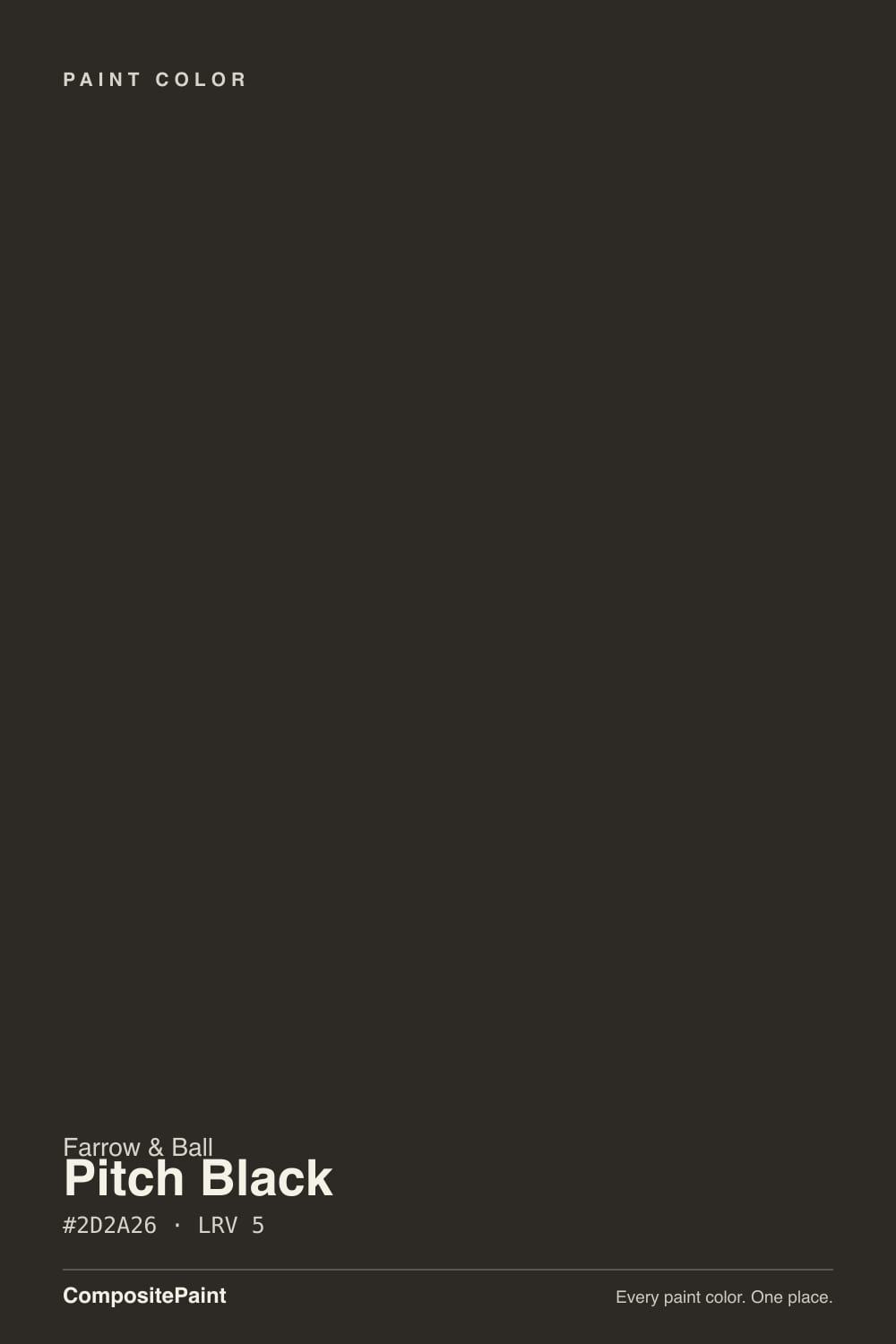
Pitch Black
Farrow & Ball's actual black, reviewed honestly: the velvet front door it was built for, the four-wall cave it becomes, and when Off-Black is the smarter tin.

Jessica has spec'd whites and neutrals for more than 300 rooms and keeps a sample wall of painted drawdowns in her studio. Every color review is checked against real reader rooms in the comments and re-tested when a formula changes. About the testing process →

- 1Cordovan Brown0
- 2Pitch Black5
The Fast Verdict
Pitch Black is the rare Farrow & Ball dark that is actually black — not a blue-black, not a charcoal, not a greige in a tuxedo. Named for coal-tar pitch, it sits at LRV 5 and barely moves in different lights, which is the whole point: on a door, a radiator, or ironwork it reads as one decisive, slightly warm void. Put it on four walls in a dim room and the void wins. If you wanted a black that flatters the colors next to it, that tin is Off-Black.
Front doors, ironwork, and painted woodwork · color-drenched powder rooms and dining rooms with real lamps · anyone who wants a true black, not a charcoal
You actually wanted a soft charcoal · the room is dim and you refuse lamps · you need a wipeable high-traffic wall · three coats of an expensive paint is a dealbreaker
- A true black — warm, not blue, and it barely chameleon-shifts
- The Farrow & Ball door, ironwork, and window-frame standard
- Dead Flat color-drench looks custom in a small, lamplit room
- Holds its own against Pointing, All White, and Setting Plaster
- Uncomplicated in mixed daylight — the opposite of a moody gray
- LRV 5 on four walls in a dim room is a cave, not a mood
- Dead Flat shows every fingerprint, scuff, and pet hair
- Coverage: Dark Tones primer plus three finish coats is the real spec
- Stronger and less flattering to neighbors than Off-Black
What Color Is Pitch Black, Really?
A true black with a faint warm, almost brown body — the coal-tar namesake, not a fashion charcoal. Farrow & Ball treats it as the dark counterpart to All White: the color you reach for when the job is ironwork, window frames, skirting, a radiator, or a front door that should look like it was always that color. Railings is the blue-black; Off-Black is the softer, flattering cousin. Pitch Black is the one that does not negotiate.
At LRV 5 it absorbs nearly every lumen that hits it. The chip can look like a very dark gray; on a sunlit door it snaps to black; on four walls it subtracts the room. That is not a lighting trick you can sample away — it is physics. Plan Dark Tones undercoat and at least three coats of the finish color. Farrow & Ball's coverage on deep colors is the complaint decorators repeat, and Pitch Black is as deep as the deck gets.
Undertone in one line: warm, slightly brown-black — never blue. If your sample flashes navy or steel, you are looking at Railings, not this. West sun can pull a faint tobacco warmth for an hour; cool LEDs can ash it out. In decent mixed light it just sits there, velvet and uncomplicated, which is why it shows up in so many Farrow & Ball editorial spreads as the dark that lets every other color behave.
Where It Shines
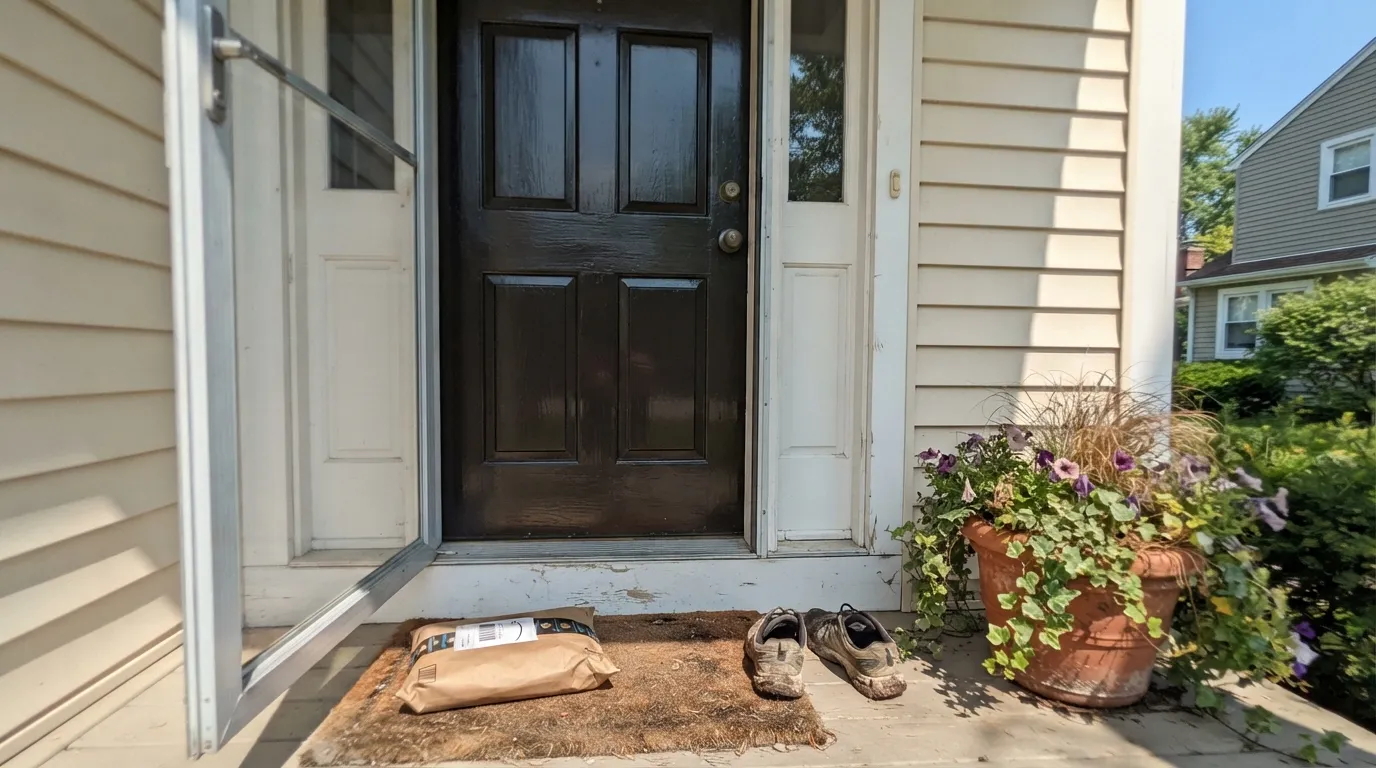
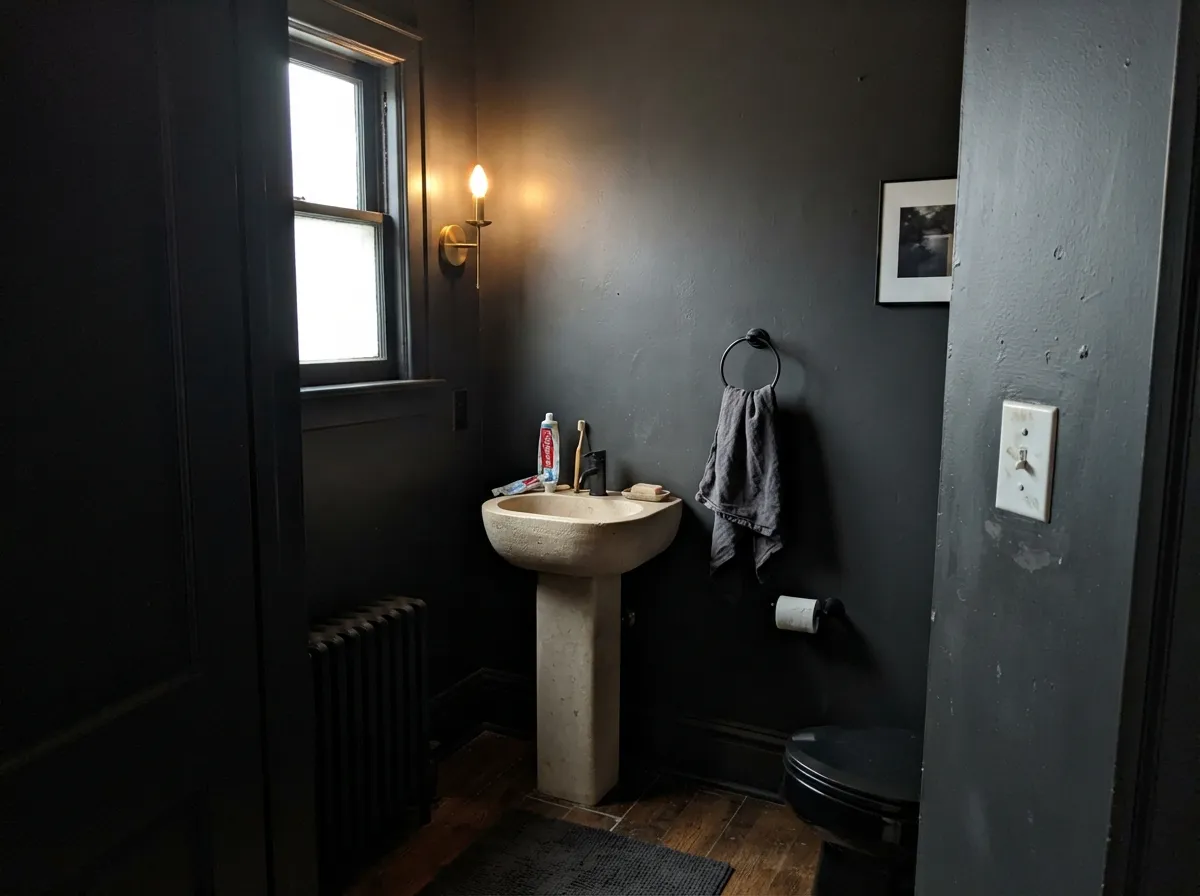
Give it a job with an edge — a front door, window frames, a radiator, a run of interior doors — and it is one of the most reliable blacks in any deck. Full Gloss on an exterior door in this color is the Farrow & Ball calling card: wet-looking, slightly warm, and sharp against Pointing or All White. Its second life is the color-drench: Dead Flat on walls, woodwork, and ceiling in a small dining room or powder, with warm lamps, so the room reads as one velvet volume instead of a painted box. Brass, unlacquered, and pale stone all look more expensive against it.
Where It Fails
Almost every regret story about Pitch Black follows one of three scripts, and all three are visible on the chip if you are honest. None of them are a surprise after the first sample board — but if your room matches one, this is not your black, and a bigger sample will only confirm it.
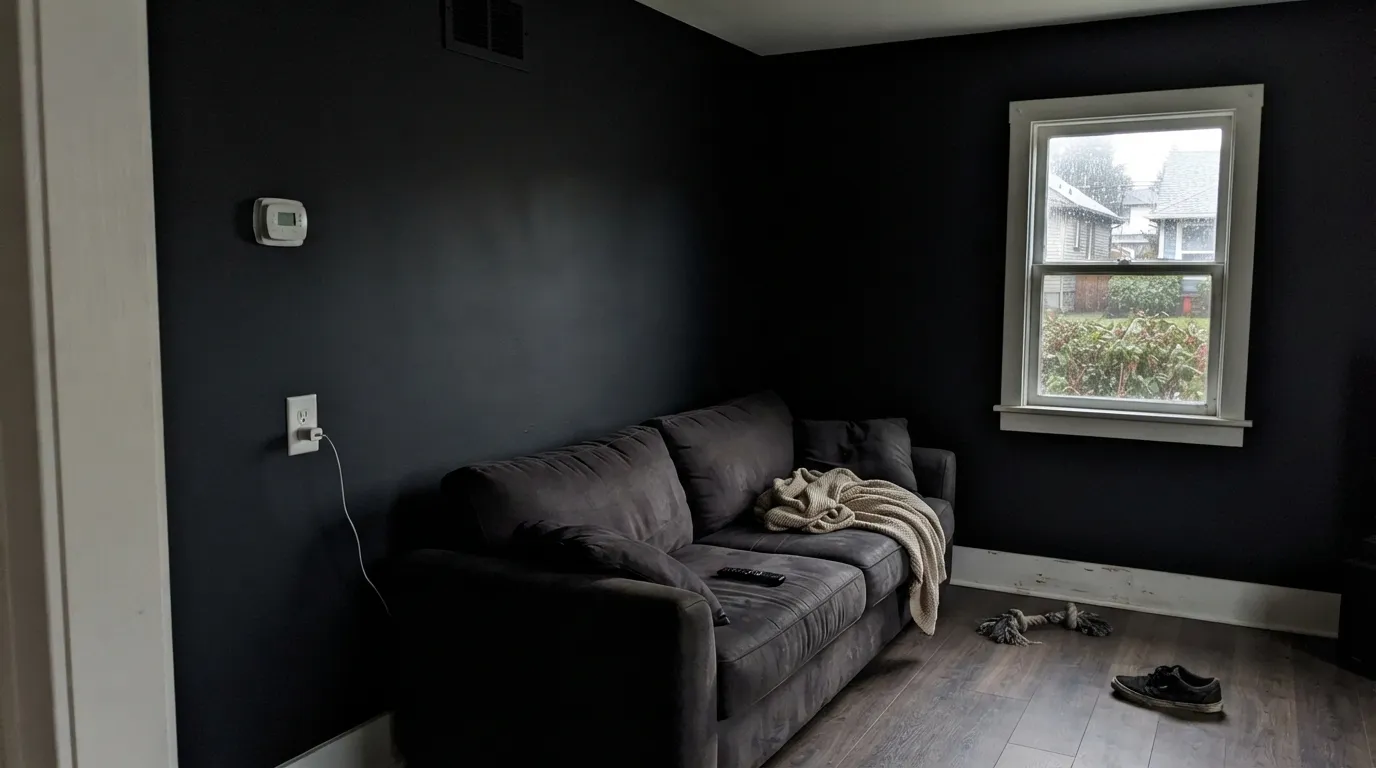
LRV 5 on every surface with one north window and no lamps is a cave, not a mood. Corners disappear, faces go muddy in photos, and the room feels smaller than the floor plan. Dead Flat makes it worse because there is no sheen to bounce light. If you want the drama, keep a window, add 2700K lamps, or drench a powder room — not the living room you actually sit in after 5pm.
On the strip they look like two depths of the same idea. On a door next to pale walls, Pitch Black is the stronger, slightly warmer punch; Off-Black (LRV 6) is the softer black that Farrow & Ball itself calls more flattering to adjacent colors. If your trim, sofa, or stone looked a little dirty next to the sample, you sampled the wrong black. Switch tins rather than adding another coat.
The velvet is real, and so are the fingerprints, pet hair, and chair-rail scuffs. Matte black is the least forgiving surface in the house. Pair that with Farrow & Ball's known coverage on deep colors — Dark Tones primer, then three finish coats is the working number, not two — and a whole-room drench becomes an expensive, high-maintenance object. Use Modern Eggshell or Full Gloss on anything hands will touch.
Room by Room
This is the color in its natural habitat. Full Gloss or Exterior Eggshell on a sunlit door reads as a true, slightly warm black against Pointing brick, pale render, or All White trim. It does not flash blue the way Railings can, so it stays black from the curb. Expect heat on a south-facing door in summer, and know every black exterior will chalk and fade — recut the sheen before you blame the pigment.
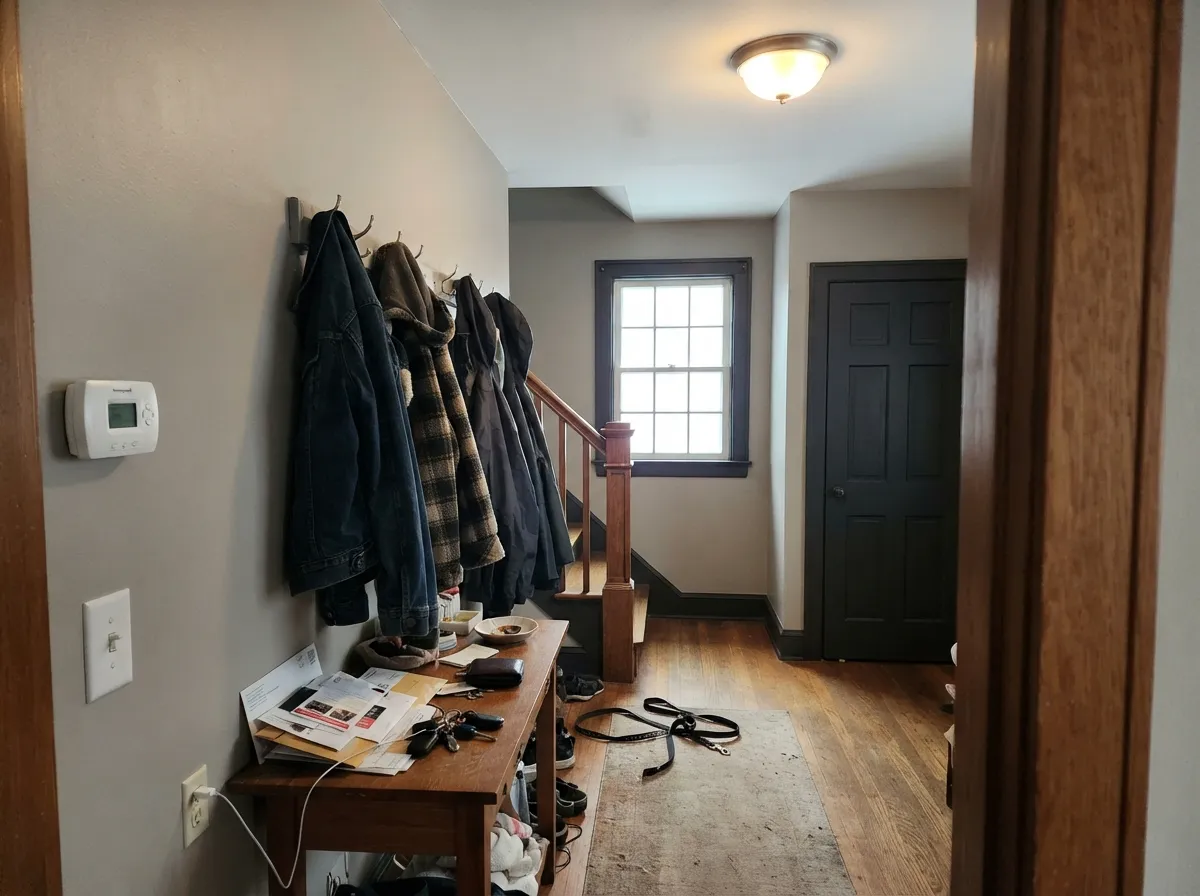
Window frames, skirting, radiators, stair spindles, a run of six-panel doors: this is where Pitch Black earns the editorial reputation. Estate Eggshell on woodwork, Full Gloss if you want the wet Farrow & Ball look. Against Ammonite or Pointing walls it is graphic without going goth. Dust shows on the matte; gloss shows every ding — pick the problem you can live with.
A Pitch Black island or a run of base cabinets under Pointing walls is the grown-up black-kitchen move, and Modern Eggshell is the finish that will actually wipe. A whole kitchen of this color needs serious light and a high-hide primer or you will still see primer flash at the inside corners after coat three. Honey oak floors make the black look costume; pale oak or stone is the pairing that works.
Small rooms with a door you can close are the only interiors where four walls of LRV 5 feel intentional. Dead Flat on walls, woodwork, and ceiling, warm lamps, a pale stone or Setting Plaster adjacent room so you can come up for air. A powder is the low-risk version; a dining room is the dinner-party version. Skip both if the only light is a builder can.
An accent wall behind a sofa in a bright south room can work; a full drench in the room you watch TV in usually does not. The color eats lamplight and makes the corners a black hole on camera. If you want a dark living room, Iron Ore or Off-Black will still read dark without the same void. Keep Pitch Black on the window frames and let the walls stay Pointing or Ammonite.
A Pitch Black bedroom is a sleep cave: restful for people who like hotels with blackout shades, oppressive for everyone else. If you try it, Dead Flat, 2700K lamps on dimmers, and a pale ceiling — All White or Pointing — so the room has one escape hatch. Most people who think they want this actually want Off-Black or Studio Green, which still go dark at night without erasing the architecture.
Your Light Is the Risk
A sunlit door, a dining room with a real window, late-morning south or west light: the black reads velvet instead of empty. This is the light the editorial photos are taken in.
Cool, weak daylight plus LRV 5 equals a void. Corners vanish, faces look underexposed, and the room feels unfinished rather than dramatic. Do not test this color in that room and hope evening will save it.
Unlike Railings, it does not flash blue. Low warm sun can pull a faint brown-tobacco edge for an hour, then it drops back to black. The stability is the selling point — sample at 4pm anyway so the warmth does not surprise you.
2700K lamps keep the warm body and make Dead Flat look like cloth. Cool 4000K LEDs ash it toward a basement gray-black and make a drenched room feel institutional. The bulbs are part of the paint job.
Most complaints about Pitch Black are a light mismatch. Upload a photo of your actual room and see it on your walls — then ask for the same wall in north light or evening lamps before you buy a single sample.
Need It From Another Brand?
Any paint counter can custom-tint Farrow & Ball No. 256 directly. If you would rather stay in one brand's own deck, these are the closest stock matches, measured as ΔE2000. Under 2 is a difference you will not see on the wall.
| Brand | Closest color | ΔE | LRV | |
|---|---|---|---|---|
| Sherwin-Williams | ArmorySW 9600 · Sherwin-Williams | 1.9 | 5 | Color page → |
| Behr | Raven BlackPPF-59 · Behr | 0.7 | 5 | Color page → |
| Benjamin Moore | Black Jack2133-20 · Benjamin Moore | 0.9 | 5 | Color page → |
| Valspar | Black HeronV120-3 · Valspar | 1.9 | 4.5 | Color page → |
| PPG / Glidden | Starless SkyPPG0995-7 · PPG / Glidden | 1.3 | 5 | Color page → |
| Glidden | Starless SkyPPG0995-7 · Glidden | 1.3 | 5 | Color page → |
Similar Farrow & Ball Colors
The nearest shades to Pitch Black within Farrow & Ball's own range, ranked by perceptual color distance — useful when you want the same look a touch lighter, darker, or warmer.
WCAG 2.1: AA is 4.5 : 1 for normal text, 3 : 1 for large text, AAA is 7 : 1.
Pitch Black vs the Colors You're Also Considering
Every Pitch Black sample board has the same rivals on it. The numbers show the real lightness gap — then it comes down to which risk you would rather live with.
Pick this when you actually want black, not a charcoal that plays nice — Pitch Black is the stronger, slightly warmer punch.
Farrow & Ball No. 57 · LRV 6Off-BlackPick this when the black has to live next to pale walls, stone, or a sofa you still want to look clean — it is the softer, more flattering Farrow & Ball black.
Pick this when blue is the dealbreaker and the black should stay black from every angle.
Farrow & Ball No. 31 · LRV 7RailingsPick this if you want the blue-black that only shows its blue in real light — richer, slightly nautical, less absolute.
Pick this when you want the Farrow & Ball finish and the slightly warmer, less bottomless version of the same idea.
Sherwin-Williams SW 6258 · LRV 3Tricorn BlackPick this if your painter is already in Sherwin-Williams and you want the reference true black — darker than Pitch Black, equally uncomplicated.
Against other F&B darks the differences are about warmth and hue, not lightness, since most share a similar LRV. Off-Black No. 57 (LRV 7) is exactly what it sounds like: a softer, slightly lifted near-black that reads gentler on trim, where Pitch Black commits fully to black. If you want unmistakable black, choose Pitch Black; if you want a quieter version, Off-Black.
Railings No. 31 (LRV 6) carries a cool blue-gray lean instead of Pitch Black's warm one, so it looks more like a very dark slate. Use Railings when you want a hint of blue-black; use Pitch Black when you want warm black.
Black Blue No. 95 (LRV 5) matches Pitch Black for depth but leans clearly blue, showing its color in daylight. It suits rooms where you want moody navy-black; Pitch Black stays the more neutral, versatile true black.
Pitch Black Coordinating Colors
Pitch Black wants pale, warm neighbors and one other dark with a different job. It is not a mixer the way Off-Black is — it is an anchor. Pointing and All White are the whites that keep showing up next to it in rooms that work; Setting Plaster is the pink that makes a black dining room feel candlelit instead of severe; Studio Green is the other Farrow & Ball near-black if you want the dark to stay green when the sun hits it.
Why This Is the Black in Every Farrow & Ball Spread
Farrow & Ball did not invent black paint, but they did give this one a job: it is the dark that lets the rest of the archive behave. Named for the sticky coal-tar residue once used on roofs, Pitch Black is the brand's uncomplicated true black — the same role All White plays at the other end of the card. That is why it keeps turning up on iron railings, window bars, radiators, and glossy doors in the catalog, even when the walls are Setting Plaster, Hague Blue, or Ammonite.
It is not a Color of the Year and it does not need to be. The useful distinction is inside the Farrow & Ball darks: Railings is the blue-black that only shows its blue in real light, Off-Black is the soft black that flatters whatever sits next to it, Studio Green is the original studio color that reads green when you give it sun. Pitch Black is the one you buy when those nuances would be a distraction. Use it like hardware, not like a wall color, and the editorial look is suddenly a specification rather than a mood board.
Wood Tones, Floors, and the Sheen Decision
Pale oak, white oak, stone, and painted floors are the easy yes. Walnut can work if the room has light; the warm black and the red-brown start to merge in a dim space and you lose the edge. Honey oak and orange builder stain are the honest no — the black goes costume and the floor goes louder. A large rug is a patch, not a fix.
Metals are straightforward: unlacquered brass and antique bronze look expensive against it; polished nickel is fine on a front door; chrome can go showroom. The sheen decision matters more than the metal. Dead Flat is the velvet in the photos and the scuff magnet in real houses. Full Gloss on a door is the Farrow & Ball move and will show every sanding skip. Modern Eggshell is the adult compromise on cabinets and interior woodwork you will actually touch.
Budget the system, not the gallon: Dark Tones undercoat, then three finish coats on anything previously a mid-tone. That is not fussiness. It is how you stop primer flashing at the inside of a sash or the panel of a door after the photographer leaves.
Three Ready Palettes Built on Pitch Black
A color is never alone on the wall. These are complete combinations in the 60-30-10 pattern, with the reason each one holds together. Every one opens in the visualizer.
This is the pairing Farrow & Ball photographs constantly: a true-black door against the warm off-white that holds most of their houses together, with All White as the brighter trim note. Pointing keeps the black from looking costume; All White keeps the edges crisp.
Try this palette in your roomA closed dining room can take LRV 5 if the next room is plaster-pink and warm. Setting Plaster is the trend color that started a thousand hallways; against Pitch Black it reads candlelit rather than cute. Pointing is the relief so the scheme does not become a black box.
Try this palette in your roomAmmonite is the greige that made Farrow & Ball famous outside the UK, and it is the right temperature under black frames — not as creamy as Pointing, not as cool as Wevet. Pitch Black on the architecture, not the walls, is how most houses should actually use this color.
Try this palette in your roomPitch Black FAQ
Is Pitch Black a true black or a dark charcoal?
True black, with a faint warm brown body. At LRV 5 it reads as black on a door or in a photo; look closely in strong sun and it is not a cold, blue-based black. If you want charcoal that still has gray in it, that is Iron Ore or Off-Black, not this.
Should I use Pitch Black or Off-Black?
Pitch Black if the object should look black — a front door, iron railings, a glossy interior door. Off-Black if the black has to sit next to pale walls, upholstery, or stone without making them look dingy. Off-Black is one LRV point lighter and noticeably softer; Farrow & Ball designed it to flatter neighbors. Pitch Black does not.
Is it a good front-door color?
It is one of the best in the Farrow & Ball deck. Full Gloss or Exterior Eggshell, Dark Tones undercoat, and a pale house behind it. It will not flash the blue that Railings does from the street. Budget for heat on a south door and for recutting the sheen as the black weathers — every true black exterior does this.
Can I paint a whole room Pitch Black?
A powder room or a closed dining room with lamps, yes. A living room, open kitchen, or north bedroom, almost never. LRV 5 on four walls removes the corners of the room; Dead Flat removes the last bit of bounce. If you color-drench, keep a pale adjacent space and treat 2700K bulbs as part of the specification.
What sheen should I use?
Dead Flat on walls only if you are color-drenching a low-traffic room and you like velvet more than wipeability. Estate or Modern Eggshell on woodwork you will touch. Full Gloss on a front door if you want the wet Farrow & Ball look; Exterior Eggshell if you want less drama and easier upkeep. Matte black in a household with kids or dogs is a fingerprint magnet.
What white goes with Pitch Black?
Pointing is the default Farrow & Ball pairing — warm enough that the black does not look costume. All White if you want a brighter, still slightly warm trim line. Wevet if you are after a cooler, more delicate contrast. A builder stark white will make Pitch Black look like appliance black; stay in the Farrow & Ball whites or a soft warm white in that range.
Have you painted with Pitch Black?
Rate it — one tap helps the next reader decide.
Ask a Question