Black Forest Green
The blackened green everyone reaches for instead of black, reviewed honestly: the light it needs to prove it's green, and where it just goes flat.

Jessica has spec'd whites and neutrals for more than 300 rooms and keeps a sample wall of painted drawdowns in her studio. Every color review is checked against real reader rooms in the comments and re-tested when a formula changes. About the testing process →
- 1Cordovan Brown0
- 2Black Forest Green5
The Fast Verdict
Black Forest Green is what you buy when you want the drama of a black door or a black island but can't quite commit to black. At LRV 5 it behaves like a near-black everywhere that matters — it reads charcoal-black in shade, at dusk, and under cool bulbs. Give it real direct light, though, and a cool, teal-leaning green surfaces that a true black could never do. It is a color that rewards the exact rooms with good light and disappoints in every room without it.
Front doors, shutters and exterior trim · kitchen islands and cabinets under real light · a single moody accent wall or a home office · anyone who wants black's drama with a green secret
Your room gets no direct light · you want a true saturated emerald, not a near-black · you're painting more than one wall of a small room with it · you actually just want black — buy black and skip the guessing
- A near-black with a real, visible green identity — not just a marketing name
- Reads sophisticated instead of flat on a sunlit front door or shutters
- Kitchen islands and cabinets look custom against brass and white stone
- Holds its color reliably outdoors, where light is rarely a problem
- Cooler, teal-leaning alternative to BM's warmer dark greens like Essex Green
- Reads as plain black in any room without direct light
- Too dark and light-hungry for a full small room
- Cool LED bulbs erase the green at night
- Buyers hoping for a visible everyday green are often disappointed indoors
What Color Is Black Forest Green, Really?
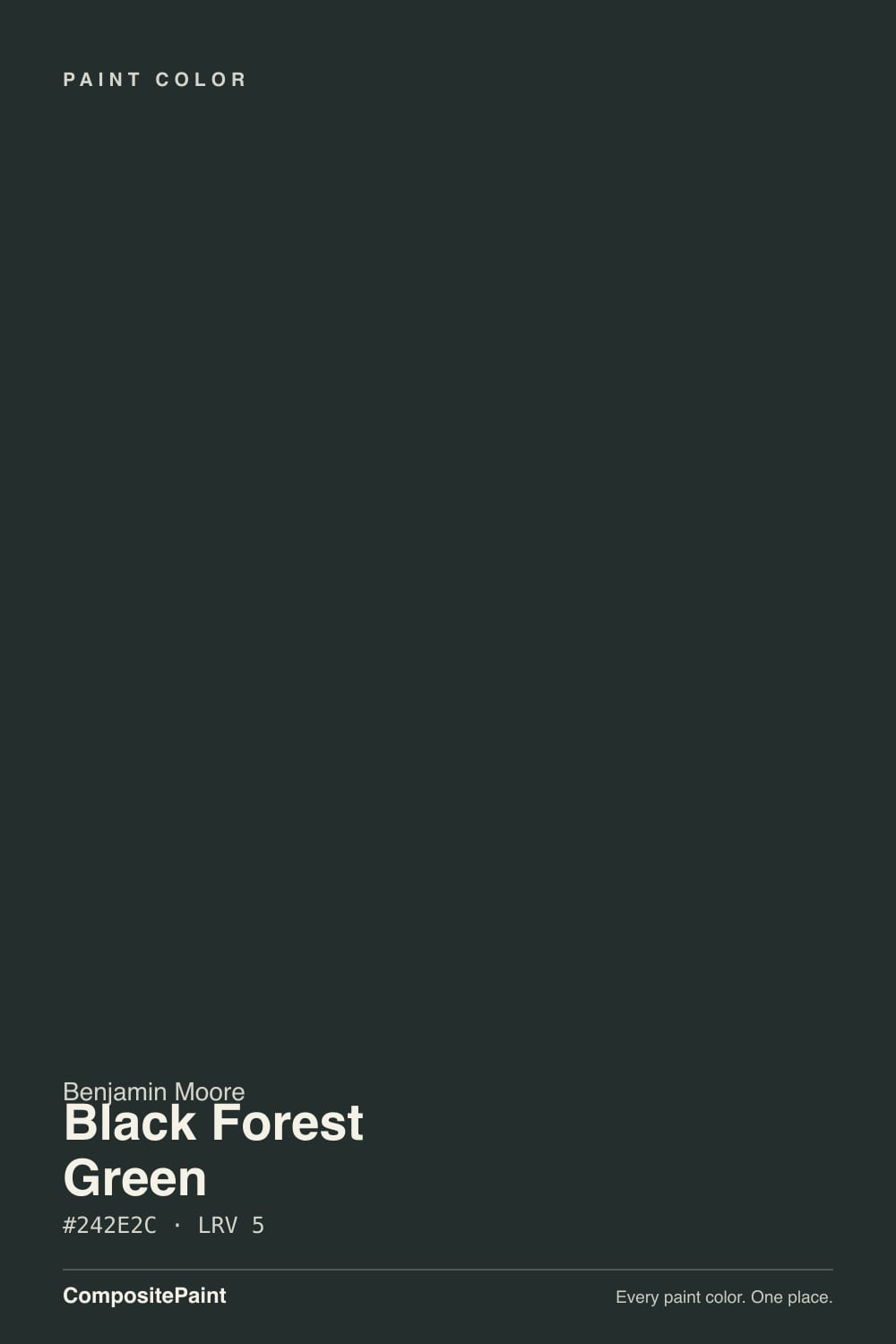
A deep, blackened green built on a cool, teal-leaning base rather than a warm one — the detail that separates it from most of Benjamin Moore's other dark greens. It sits in the Historical Colors Collection, the same family that gave us Essex Green and Hunter Green, but where those read as classic, saturated evergreen, Black Forest Green is pulled further toward black and given a blue-green, almost teal cast instead of a straightforward grass-green one. That cool lean is the whole identity of the color.
At LRV 5 it reflects almost no light, which puts it in true near-black territory alongside colors like Wrought Iron and Tricorn Black. That matters practically: in shade, at dusk, or under a cool bulb it will read as flat black to most eyes, full stop. Only in strong, direct daylight — a sunlit front door, a kitchen island under a window, an accent wall that actually gets sun — does the green (and the teal underneath it) come forward. Buyers who pick it expecting a visible green in every light are the ones who end up disappointed.
Undertone in one line: blue-green and cool, never warm olive, never true black-black. If your sample looks plain black on the wall, that is a light problem, not a paint problem — walk it to the brightest window in the room before deciding.
Where It Shines
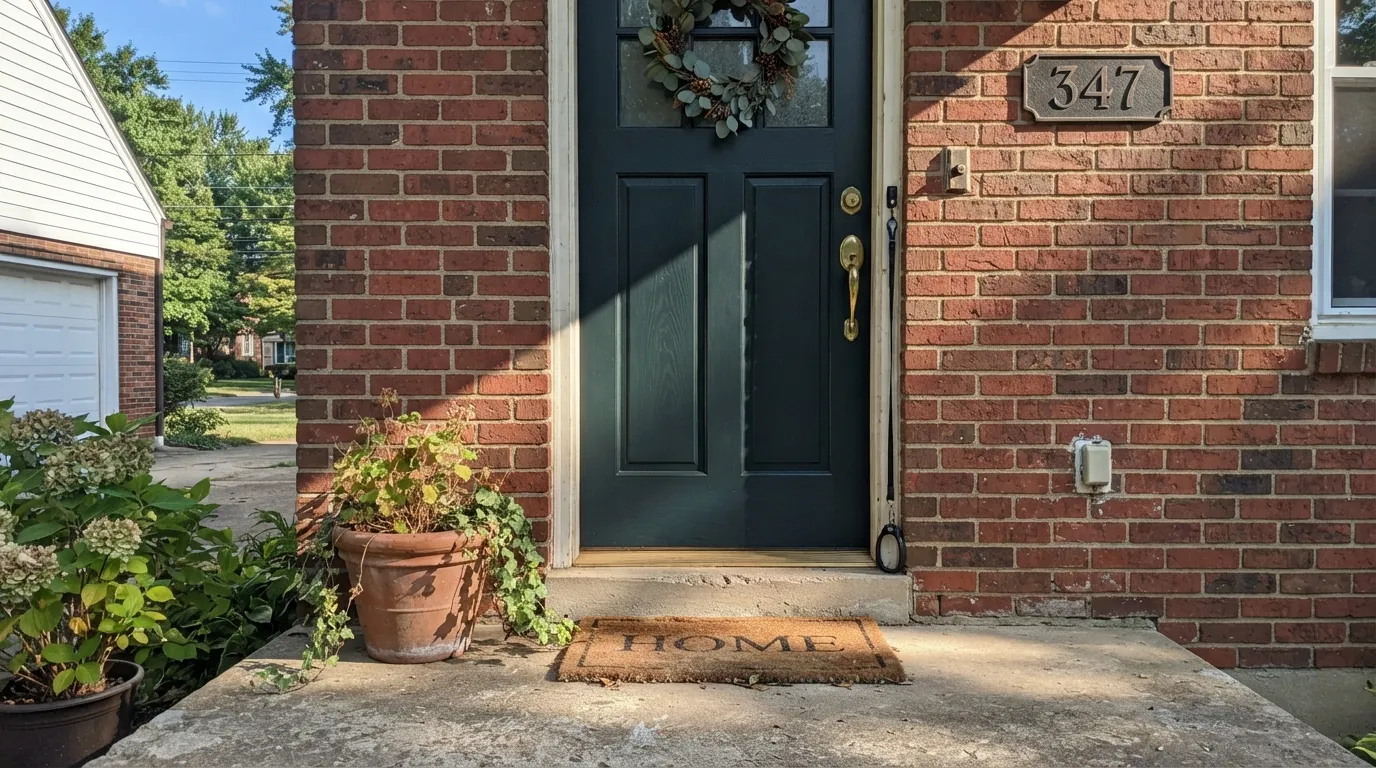
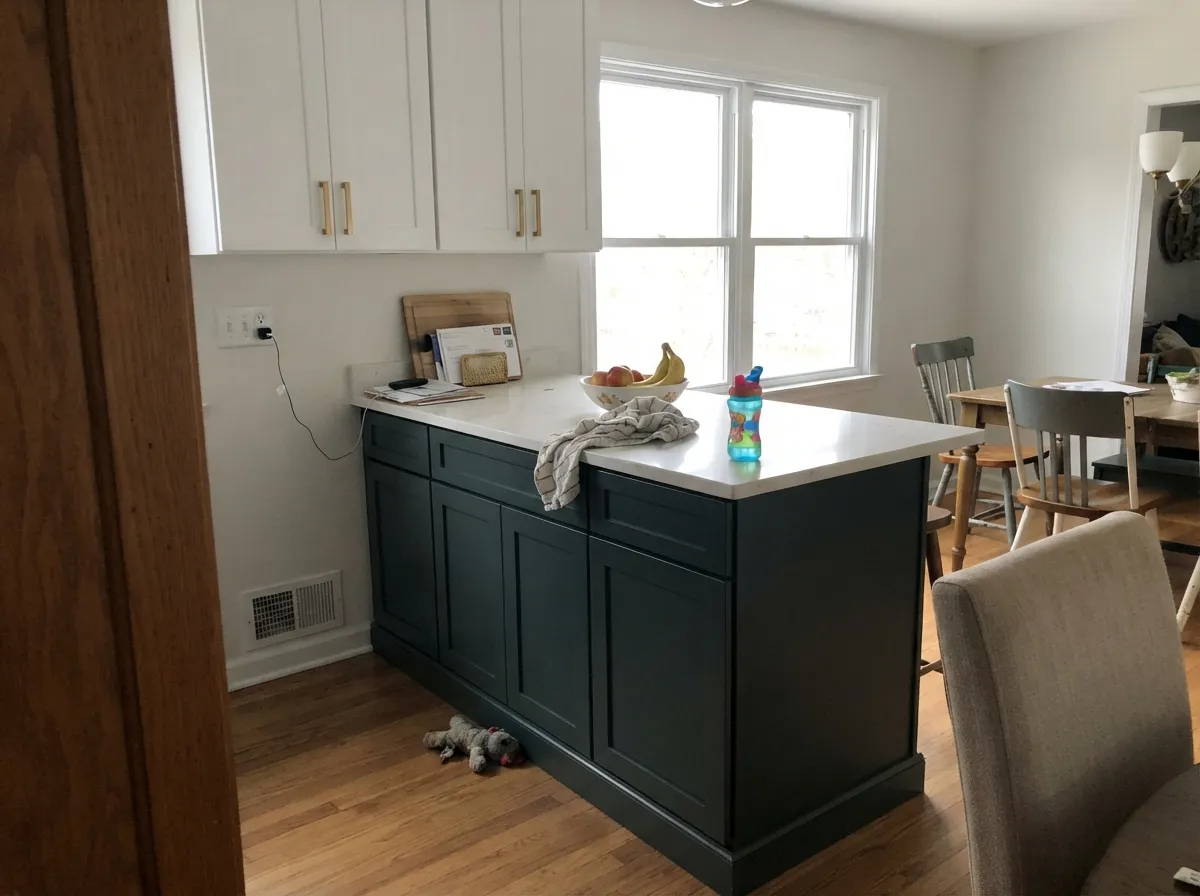
This is a trim-and-accent color first, a whole-wall color a distant second. On a sunlit front door or exterior shutters it does exactly what people buy it for: reads as a rich, almost-black green instead of ordinary black, and it holds that color consistently outdoors because exterior light is rarely as dim as an interior room. Indoors, its best job is a kitchen island or a full run of cabinets under real window light, where the cool green plays beautifully against white countertops, brass or unlacquered hardware, and pale walls. As a single accent wall in a room that actually gets sun, it is genuinely striking — the kind of dark color that makes a room feel intentional instead of just dim.
Where It Fails
Almost every disappointed review of Black Forest Green comes down to one of three predictable mismatches, and none of them are the paint's fault — but if your situation matches one, sample a lot bigger before you commit a whole door or a whole kitchen to it.
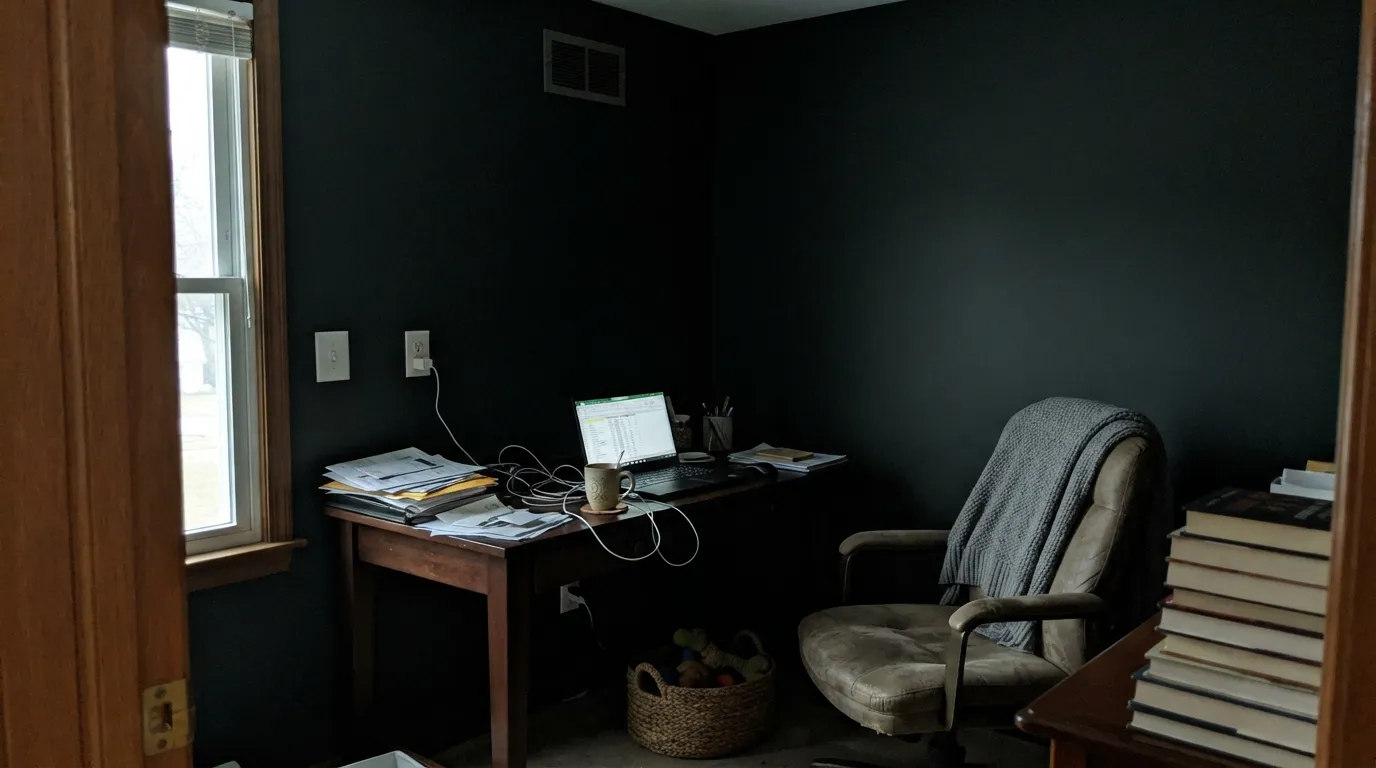
This is the single most common regret: a north-facing room, a shaded stairwell, a kitchen with one small window. Without direct sun hitting it, Black Forest Green reads flat, characterless black — which defeats the entire reason most buyers chose green over black. If the space is dim, buy black on purpose instead.
At LRV 5 on four walls in a small room with low ceilings, it stops feeling moody and starts feeling like a cave — no light bounces back at all. It is built to be one wall, one door, one island, or a room with generous windows, not a small enclosed box.
Cool-white LEDs push the color's blue-green lean further toward inky blue-black after dark, which reads as "just black" to most people and erases the point of choosing this over a straight black. Warm 2700K bulbs keep the green identity intact after sundown; cool LEDs do not.
Room by Room
Semi-gloss on a sunlit door reads as a sophisticated near-black green instead of ordinary black, and exterior daylight is reliable enough that the color almost never falls flat. Works especially well on Tudor, cottage and traditional brick homes.
Full sun brings out the teal-green clearly against most siding colors, and it pairs cleanly with white, warm greige, or brick exteriors. Shaded elevations of the house will read noticeably blacker than the sunny side — expect that, don't fight it.
Under real daylight it looks intentional and expensive against white marble or quartz and brass hardware; in a windowless galley kitchen it collapses into plain black. Satin, urethane-fortified cabinet enamel for durability.
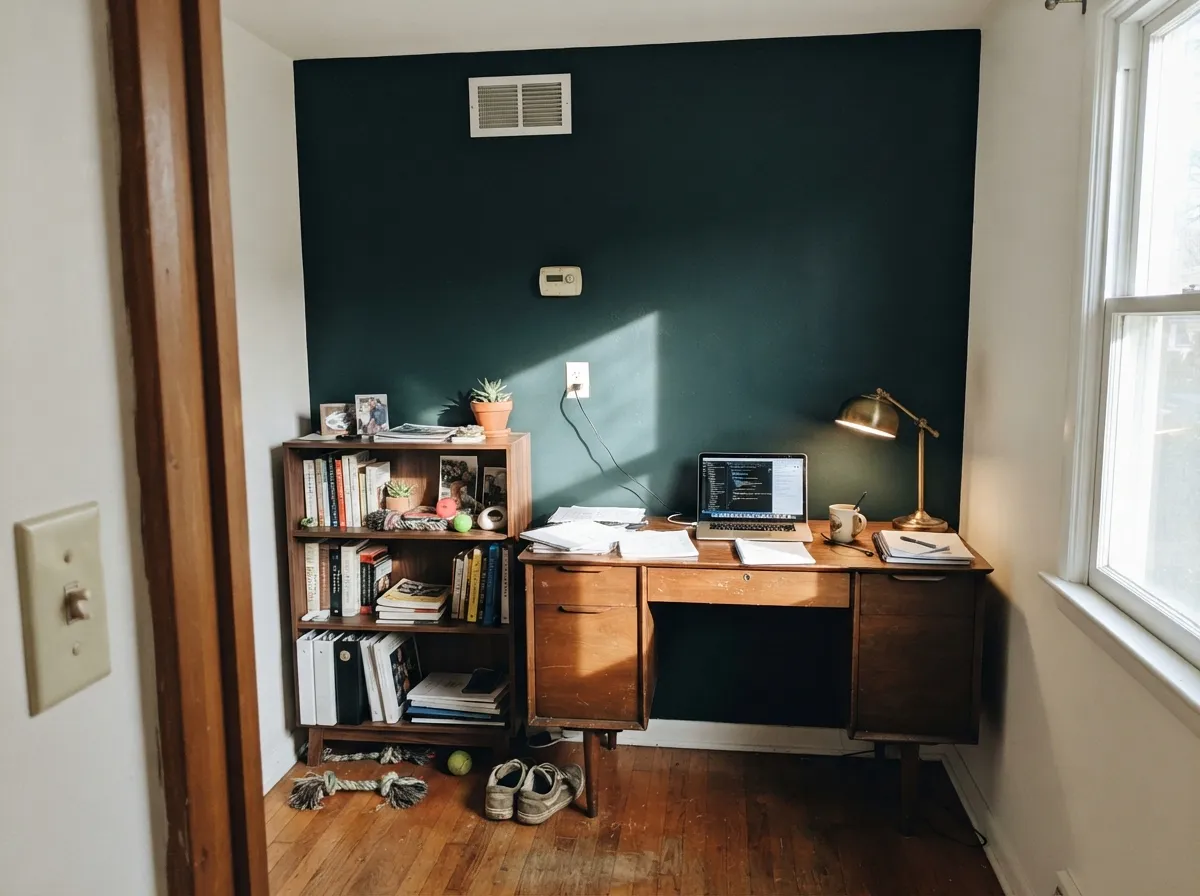
One wall behind a desk or shelving, with a lamp nearby, gives a room gravity without swallowing it. Best paired with warm wood, leather, and a pale ceiling and trim to keep the room from feeling closed in.
A single accent wall that catches afternoon sun can be striking; the same wall in a north-facing living room will just look like a black wall. Confirm your light before you commit to more than a sample.
The near-black depth plus low light is a common combination for feeling closed-in rather than cozy. If you want the mood without the risk, a deep charcoal-green like SW Rosemary at LRV 12 gives more usable light in the same family.
Your Light Is the Risk
Strong direct daylight — full sun on a front door, a sunlit kitchen window — is the only light where the teal-green reliably shows. This is the light to sample it in before you decide.
Without direct sun it reads as flat, ordinary black. Fine if that's what you actually want; a letdown if you paid for "green."
Clearly green-black at midday sun, quietly slides toward plain black as the light fades toward dusk. The shift is real and most owners come to expect it.
Warm 2700K lamps keep a trace of green alive after dark. Cool white LEDs push it to inky blue-black — swap the bulb before you blame the paint.
Most complaints about Black Forest Green are a light mismatch. Upload a photo of your actual room and see it on your walls — then ask for the same wall in north light or evening lamps before you buy a single sample.
Need It From Another Brand?
Any paint counter can custom-tint Benjamin Moore HC-187 directly. If you would rather stay in one brand's own deck, these are the closest stock matches, measured as ΔE2000. Under 2 is a difference you will not see on the wall.
| Brand | Closest color | ΔE | LRV | |
|---|---|---|---|---|
| Behr | Beluga770F-7 · Behr | 2.4 | 3 | Color page → |
| Valspar | Tempest's TeapotM250 · Valspar | 4.6 | 2.5 | Color page → |
Similar Benjamin Moore Colors
The nearest shades to Black Forest Green within Benjamin Moore's own range, ranked by perceptual color distance — useful when you want the same look a touch lighter, darker, or warmer.
WCAG 2.1: AA is 4.5 : 1 for normal text, 3 : 1 for large text, AAA is 7 : 1.
Black Forest Green vs the Colors You're Also Considering
Every Black Forest Green sample board has the same rivals on it. The numbers show the real lightness gap — then it comes down to which risk you would rather live with.
Pick this for the cooler, blue-leaning near-black — Black Forest Green sits closer to black in most light.
Benjamin Moore PM-22 · LRV 4Essex GreenPick this for a warmer, more saturated, more classic evergreen — Essex Green commits harder to "green" and less to "black."
Pick this if you specifically want that green to show up in the right light — Wrought Iron never will.
Benjamin Moore 2124-10 · LRV 6Wrought IronPick this if you want a true near-black with a soft warm lean and no green ambition at all.
Essex Green HC-188 at #27362E and LRV 6 is the comparison that matters most. It is slightly lighter and carries more visible green, so it reads as a dark green that happens to be very deep, where Black Forest Green reads as a black that happens to be green. If you want people to notice the color, Essex Green is the safer pick. Chrome Green PM-10 shares that same hex at LRV 4 and takes the idea a step darker. Benjamin Moore also lists Black Forest Green under PM-12 at the same hex of #242E2C but at LRV 3.
If you want no green at all, Black HC-190 and Black 2132-10 at #313132 and LRV 5 are the neutral versions at the same lightness.
Across brands the options are limited. Behr Beluga 770F-7 at #273031 and LRV 3 is a deltaE of 2.37, very close but worth sampling first, and it sits a little darker and bluer. Valspar Tempest's Teapot M250 at LRV 2.5 is a deltaE of 4.57, close but visibly different side by side, reading noticeably more blue than green.
Black Forest Green Coordinating Colors
The rule for coordinating with Black Forest Green: pale, warm whites to bounce light back at it, and brass or unlacquered metals rather than chrome, which reads cold against its already-cool base. It layers well with its own near-black relatives and with a warm mid-tone neutral for furniture or trim. These are the partners that keep showing up in rooms that work:
Black Forest Green as a Black Alternative
Most people who reach for Black Forest Green were shopping for black and got talked into it — usually correctly. Compared with a true black like Tricorn Black, it offers exactly one advantage: in strong direct sun, it reveals a cool teal-green depth that a real black can never show. Everywhere else — in shade, at night, under a cloudy sky — the two colors are close to indistinguishable to most eyes.
That trade-off means the decision comes down to the room, not taste. A sunlit front door, a window-adjacent kitchen island, an exterior with real daylight exposure: pick Black Forest Green and get the bonus. A dim entry, a north-facing room, an interior hallway with no windows: the bonus never arrives, so a true black is the more honest choice and will not disappoint anyone hoping for a visible green.
Black Forest Green With Wood Tones and Metals
Warm woods are the easy pairing: walnut, white oak, and butcher block all sit comfortably against the cool green-black, and the contrast reads as deliberate rather than clashing. Brass and unlacquered bronze are the metal of choice — their warmth balances the color's cool lean, which is why island-and-brass kitchens are the pairing that shows up again and again in real homes.
Chrome and cool nickel are the one metal pairing to test carefully; against an already blue-leaning near-black they can push the whole combination cold and stark rather than rich. White or pale-veined marble and quartz countertops are safe and popular; heavily gray-veined stone will double down on the cool lean and can read a little clinical without a warm wood or brass element to soften it.
Three Ready Palettes Built on Black Forest Green
A color is never alone on the wall. These are complete combinations in the 60-30-10 pattern, with the reason each one holds together. Every one opens in the visualizer.
White Dove keeps the house body warm and soft so the door reads as the one intentional dark note. Wrought Iron on the shutters is close enough in depth to Black Forest Green that the two near-blacks read as a family, not a mismatch, even though one has green and one doesn't.
Try this palette in your roomA crisp white kitchen with one near-black green island is the most reliable way to use this color indoors, because the island usually sits closest to a window. Chantilly Lace's brightness bounces light back onto the island and helps the green actually show.
Try this palette in your roomOne sunlit wall carries all the color while White Dove trim and ceiling keep the room from closing in. Pashmina gives a warm mid-tone bridge for furniture or built-ins so the room doesn't jump straight from near-black to bright white.
Try this palette in your roomBlack Forest Green FAQ
Is Black Forest Green actually green, or does it just look black?
Both, depending on the light. At LRV 5 it is a true near-black, and in shade, at dusk, or under cool bulbs most people will call it black. Give it strong direct daylight and a cool, blue-green cast becomes clearly visible. Buy it expecting an everyday green and you may be let down; buy it expecting a green-black that occasionally shows its color and it will not disappoint.
What's the undertone — blue, brown, or straight green?
Blue-green, leaning toward teal — that is the detail that separates it from Benjamin Moore's warmer dark greens. It is not a brown-based near-black and not a true grass-green; in direct light it reads as a cool, blackened teal-green.
Is it a good front door color?
Yes — this is its strongest use. Exterior light is rarely as dim as an interior room, so the green shows up consistently, and it reads as a more sophisticated alternative to plain black. Semi-gloss holds up best.
Can I use it on kitchen cabinets or an island?
Yes, especially an island near a window. It pairs beautifully with white countertops and brass or unlacquered hardware. In a windowless galley kitchen with no direct light nearby, expect it to read as plain black rather than green.
Black Forest Green or Essex Green — which one?
Essex Green is warmer, more saturated and more classically "evergreen" — it commits harder to reading as green. Black Forest Green is cooler and pulled further toward black; pick it when you want the near-black drama first and the green as a bonus in good light.
Will it work in a north-facing or low-light room?
Not well as a full wall or room. Without direct sun it just reads as black, which some buyers are fine with but most are not, since they picked a green for a reason. In a dim room, either commit to it as intentional black or choose a lighter dark green like SW Rosemary (LRV 12) that still shows color without direct sun.
Have you painted with Black Forest Green?
Rate it — one tap helps the next reader decide.
Ask a Question