The Renter-Safe Painting and Patching Kit
Ten things that fix rental walls without losing the deposit, tested across two move-outs. Top pick: the DAP Wall Repair Patch Kit with DryDex — plus what each piece of the kit is actually for.

Disclosure: Some links below are affiliate links. We earn a commission if you buy through them, at no extra cost to you.
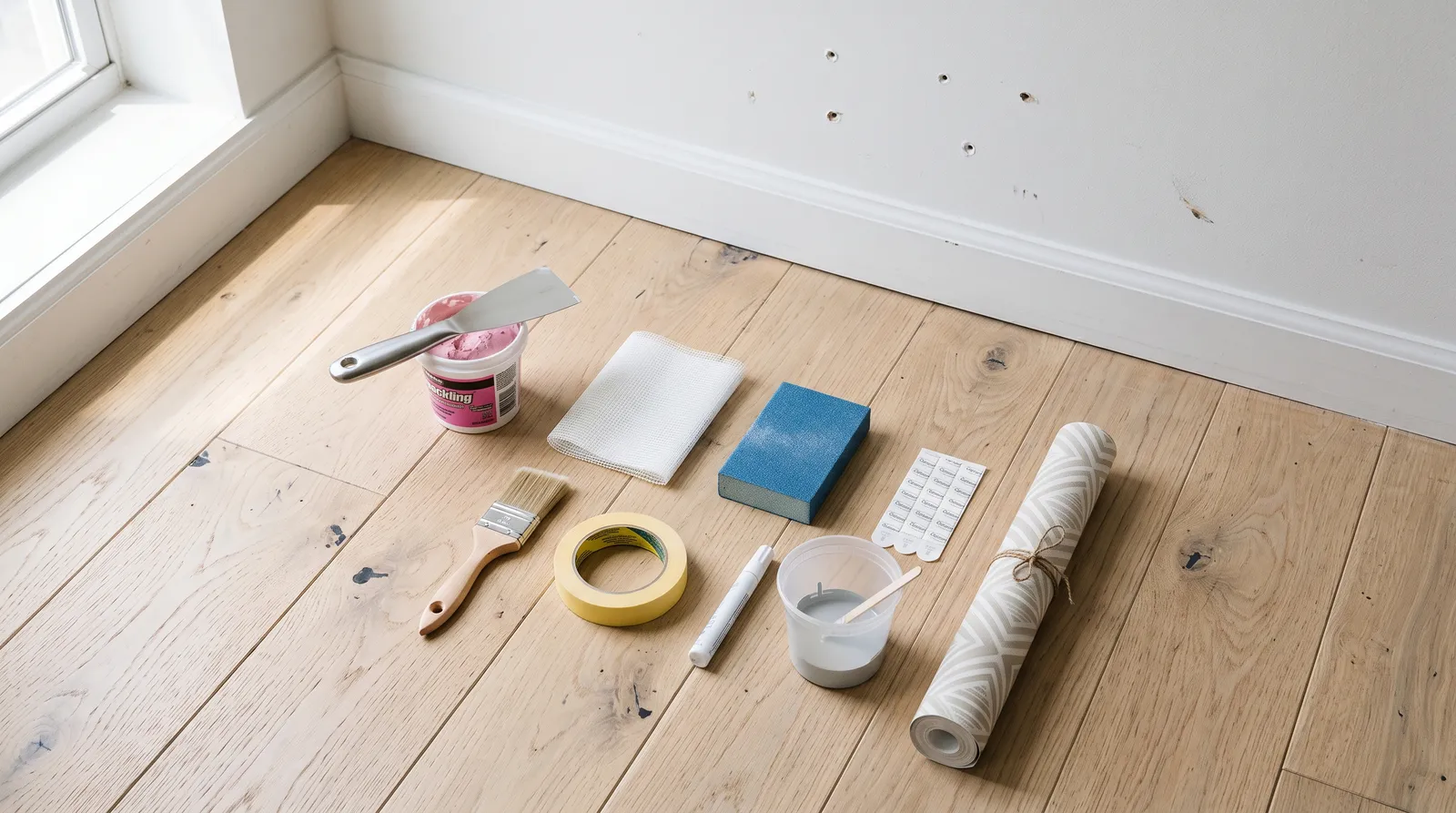
Top pick: the DAP Wall Repair Patch Kit with DryDex Spackling, about $10 for spackle, a 5x5 fiber patch, sandpaper, and a putty knife in one box. It wins on the one thing renters keep getting wrong, which is knowing when the fill is dry. The compound goes on pink and turns white, so nobody sands a wet patch and tears the paper face off apartment drywall. It falls short on the putty knife, which flexes like a butter knife on anything wider than three inches. Everything else in this kit exists because the DAP box alone does not cover a whole move-out.
This is a shopping list, not a tournament.
Ten items, roughly $60 to $95 all in, and each does a job the others can’t. The patch kit fills the holes. The sanding sponge makes them disappear. The touch-up pen and the storage cup keep the landlord’s exact paint alive for two years. The delicate tape protects trim that’s been painted eleven times and has no film strength left. The Command strips mean next year’s holes never happen. The peel-and-stick is the one item about wanting the apartment to look different rather than about the deposit.
What a Rental Repair Actually Has to Survive
A property manager walks the unit with a clipboard and a flashlight. That’s the test. Not whether the patch is structurally sound, whether it’s invisible under a raking light from the doorway at 9 a.m.
Three things make rental walls harder than walls in a house you own.
The paint is thin and old. Builder-grade flat sprayed once at turnover has almost no film strength. It chalks under a fingernail, and standard blue tape can pull it off. That’s why the tape pick here is a delicate-surface tape and not the general-purpose roll I’d hand anyone painting their own living room. For what each tape adhesive actually does, see the painter’s tape round-up and our head-to-head on FrogTape versus ScotchBlue.
You don’t know the color. Most renters find out on move-out Friday that the flat white in the hallway isn’t the flat white in the bedroom. Solve it in month one. Two of the ten items here exist purely to store and apply the original paint.
No dust, no power tools. You’re patching in a furnished room with a laptop on the desk and a cat somewhere. A sanding sponge you can rinse in the bathroom sink is the whole sanding program. If your job is bigger than that, the sandpaper round-up covers grits and blocks properly.
The deposit math drives every pick. A wall-repair-and-repaint line on a move-out statement runs $150 to $400 per room in most US metros. The kit costs less than one room.
How I Tested This Across Two Move-Outs
Two real move-outs and one mid-lease repaint, over about five months.
The first was a 620 sq ft one-bedroom with builder-flat walls and 34 nail holes, most from a gallery wall that seemed like a good idea in year one. The second was a two-bedroom with a doorknob hole punched through the drywall behind a bedroom door and two anchor blowouts where a floating shelf came down. The third was a smooth-drywall studio where the tenant wanted an accent wall and had permission for nothing permanent.
Patch compounds got scored on shrink-back at 24 hours. Fill, scrape flush, wait a day, then run a straightedge across each repair to see whether it sat proud, flush, or dished. Then the light test: a work light held flat against the wall, beam raking across the surface. It’s the most brutal way to look at a patch and exactly what afternoon sun through a west window does.
Tape came off three surfaces at 24 hours and again at 7 days: builder-grade flat, semi-gloss trim, and a lightly textured hallway. The failure I was watching for was lift, not bleed.
Touch-up applicators all got loaded with the same gallon of Behr Premium Plus flat and compared at 48 hours from 6 ft, straight on and at a raking angle. A touch-up that reads matched from straight on will often still flash at an angle.
Command strips held a 12 lb framed mirror for 60 days before removal. The peel-and-stick wallpaper stayed up nine weeks. The pass mark on every item: a repair the property manager couldn’t find.
The Kit at a Glance
| Item | What it’s for | Price tier |
|---|---|---|
| DAP Wall Repair Patch Kit with DryDex | Nail holes, small dings, the everyday fill | $ |
| 3M Patch Plus Primer 4-in-1 | Patch and prime in one pass when you’re painting same-day | $ |
| Hyde Wet and Set Repair Patch | Doorknob holes, anchor blowouts, ceiling damage | $ |
| 3M Pro Grade Precision Sanding Sponge | Feathering the patch flat with no dust storm | $ |
| Wooster Shortcut 2 in. Angle Sash | The one brush: cut-ins, closets, behind radiators | $ |
| Touch Up Cup 3-Pack | Storing the landlord’s paint so it’s alive in year two | $$ |
| Slobproof Touch-Up Pen | Scuffs, patch spots, chair rail marks | $$ |
| FrogTape Delicate Surface | Masking old rental paint and over-painted trim | $$ |
| Command Picture Hanging Strips | Hanging without making holes at all | $ |
| Tempaper Removable Wallpaper | Changing a wall you don’t own, reversibly | $$$ |
1. DAP Wall Repair Patch Kit with DryDex, Top Pick
Buy this first. It is the only item on the list that turns a full apartment of nail holes into a one-hour job with nothing else in the cart.
The kit is four pieces: a tube of DryDex spackling, a 5x5 fiber wall patch, a strip of 100-grit paper, and a putty knife. The DryDex is the reason it’s here. It goes on pink and turns white as it dries, and that color change is worth more to a first-time patcher than any spec on the label. The most common rental patch failure I see is sanding a fill that’s still soft underneath. The compound smears into the surrounding paint, the paper face of the drywall fuzzes up, and now you have a five-inch problem where you had a one-inch problem.
On the 34-hole apartment, one tube filled every hole with about a third left. Shallow fills went pink to white in roughly 40 minutes at 70°F. I scraped each one flush with the knife on the first pass, which is the part people skip. Leave a mound and plan to sand it later and you’re sanding compound off painted wall. That’s how halos happen.
Shrink-back is real on anything deeper than a nail hole. Two anchor holes on the second apartment needed a second fill after the first dished at 24 hours. Normal for a lightweight compound, not a knock.
The putty knife is the weak link. Fine for pressing compound into a small hole, useless for scraping a wide patch flat. If you’re doing more than one apartment, put a real 3 in. stainless knife in the drawer.
| Spec | Value |
|---|---|
| Contents | DryDex spackling, 5x5 in. fiber patch, 100-grit paper, putty knife |
| Dry indicator | Pink when wet, white when ready to sand |
| Typical dry time | 30–60 min on a shallow fill; overnight on a deep one |
| Covers | Roughly 20–30 nail holes plus one patch area |
| Approx. price | $9–$12 |
Buy it if: you’re patching a rental and you own no other tools. Skip it if: the hole is bigger than a quarter. Go to the Wet and Set below.
2. 3M Patch Plus Primer 4-in-1, Best for Same-Day Painting
The trade-off against the DAP kit is time versus certainty.
Patch Plus Primer has primer mixed into the compound, so a shallow patch takes paint without a separate priming coat. On the one-bedroom, patches filled at 10 a.m. took flat paint at 2 p.m. and vanished under a single coat.
What it gives up is the dry indicator. You’re judging by feel, and the compound is thinner than DryDex, so it slumps out of ceiling holes before it sets. I filled two ceiling holes with it and both got redone with DryDex.
Know what “primer” means here. It seals the porous fill so the topcoat doesn’t flash dull over it. It’s not a stain blocker. Nicotine, water rings, and marker still ghost through, and those need a shellac primer. The primer explainer covers which primer solves which problem, and the primer round-up names the ones worth buying.
Buy it if: you’re painting the same day and the holes are shallow and on a wall, not a ceiling.
3. Hyde Wet and Set, Best for a Hole Bigger Than Your Thumb
The doorknob hole is the classic rental disaster. Someone throws the bedroom door open, the knob punches through, and now you’re looking at a repair a property manager will charge $200 to fix.
Wet and Set is a fiber patch impregnated with plaster. Cut a piece an inch larger than the damage on every side, run it under the tap, press it over the hole, smooth it down. It hardens into a rigid shell in about half an hour. No backing board, no drywall square, no tape and three coats of mud.
It leaves a raised footprint, maybe a sixteenth of an inch proud of the wall, and under a raking light that edge shows as a soft rectangle unless you feather it. Feathering means a thin skim of spackling out past the patch edge, sanded to nothing with the fine side of the sponge. Budget twenty extra minutes and the repair genuinely disappears.
One shot at placement. Once the fibers wet out, moving the patch tears it.
Verdict: the item you hope you never need and are grateful for at 9 p.m. the night before the walk-through. The drywall hole guide covers what to do when the damage is bigger than a patch can bridge.
4. 3M Pro Grade Precision Sanding Sponge, Best for Feathering
Small item, outsized effect.
A rental patch fails at the edge, not the middle. The fill is fine. The ring of compound smeared onto the surrounding paint is what shows. A soft sanding sponge follows the slight crown of the patch and knocks it flush without flattening a divot into the wall around it, which is what a rigid block does.
Medium side to take the fill down, fine side to polish the transition. Rinse it in the sink, squeeze it, keep going. On the two move-outs I used one sponge for everything and it still cuts. It rounds over inside corners if you push it into a wall-to-trim junction, so use a folded quarter-sheet of paper there instead.
Vacuum the dust and wipe the wall with a damp cloth before you paint. Sanding dust under flat paint reads as a gritty patch and no touch-up fixes it.
5. Wooster Shortcut 2 in. Angle Sash, Best Single Brush
If a renter owns one brush, this is it. About $9.
The Shortcut has a stubby Shergrip handle, and the short handle is the feature. Behind a radiator, inside a closet, in the eight inches between a door casing and a corner, a full-length sash brush can’t turn. This one can. On the studio accent wall it cut the ceiling line clean, and after a dozen reloads the tip still held an edge instead of splaying into a broom.
Where it falls short is leverage. A full baseboard run wants a longer handle and a wider brush, and 2 in. is small for anything with real square footage.
Wash it in warm water with a drop of dish soap the same day, comb it out, hang it. It’ll outlast the lease. If you’re buying more than one brush, the brush round-up has the full lineup, and if your touch-ups leave ridges, brush marks explains why.
| Spec | Value |
|---|---|
| Width | 2 in. angled sash |
| Handle | Short Shergrip, flexible |
| Best for | Cut-ins, closets, tight spaces, patch touch-ups |
| Cleanup | Water |
| Approx. price | $8–$11 |
6. Touch Up Cup, Best Paint Storage
This is the item people skip and then regret in year two.
The landlord hands you a half-full gallon at move-in, or you buy a sample to match, and eighteen months later it’s a rusted can with a dried skin and a rim you can’t pry. A Touch Up Cup is a 13 oz clear plastic container with a mixing ball inside. Shake it and paint. No stir stick, no rust, no skin.
The clear body matters more than it sounds. On move-out day you’re not opening three cups to find out which one is the hallway. You look.
Three cups for about $19 is real money for what is functionally a jar with a marble in it. I’d still buy it, because the alternative is paying a paint counter to match a chip you scraped off a closet wall at the last minute. Label each cup with the room and the sheen the day you fill it, and wipe the rim before you close it. Dried paint on the rim kills the seal and the whole cup skins over.
7. Slobproof Touch-Up Pen, Best Applicator
Top-shelf idea, mid-shelf price.
You fill the pen with the actual paint off your wall, which is the entire point. Every pre-filled “wall repair pen” at the hardware store is a generic white that won’t match a builder flat, and a near-match is more visible than the scuff you were covering. The brush tip lays a thin, even film instead of the thick dab you get from a foam applicator.
I loaded one with Behr Premium Plus flat and compared it at 48 hours against a foam dauber and a fingertip smear. From 6 ft straight on, all three were invisible. At a raking angle the dauber showed as a glossy spot and the smear showed as a ridge. The pen showed nothing.
Loading it is fiddly. Thick wall paint doesn’t want to go down a narrow barrel, and skip the rinse and the tip clogs. And $20 buys one pen; flat walls plus semi-gloss trim means two, because sheen mismatch shows even when the color is dead on. The sheen guide explains why a flat touch-up on eggshell reads as a dull patch from across the room.
Skip this if: your marks are bigger than a business card. Past that size you want the Shortcut brush and a feathered edge, not a pen.
8. FrogTape Delicate Surface, Best Tape for Rental Walls
Yellow, not green. The distinction matters here more than on any other job.
Delicate Surface uses a lower-tack adhesive built for freshly painted walls, wallpaper, and old chalky paint. Rental walls are usually all three at once. I pulled it off builder-grade flat at 24 hours and at 7 days with no lift. The standard green FrogTape lifted a flake of that same flat at the 7-day pull.
The PaintBlock edge still works at this tack level, which is what separates it from generic low-tack tapes. Those come off clean and let paint bleed under. This one seals against waterborne paint.
Two cons. It won’t hold on texture; on the lightly textured hallway the tape released itself as it dried. And it costs more per roll than the blue standard, which stings because delicate work burns tape faster.
| Spec | Value |
|---|---|
| Adhesive | Low-tack, delicate surfaces |
| Widths | 0.94, 1.41, 1.88 in. |
| Clean removal window | Up to 60 days |
| Best for | Aged flat paint, over-painted trim, fresh paint |
| Approx. price | $9–$13 per roll |
Buy it if: you’re taping anything you didn’t paint yourself.
9. Command Picture Hanging Strips, Best Prevention
Cheapest item on the list and the one that saves the most money, because a hole you never make is a hole you never patch.
Large strips are rated at 16 lb per set of four pairs, which covers most framed prints and small mirrors. I hung a 12 lb framed mirror for 60 days and pulled the strips at the end. Wall came away clean under a raking light, no divot, no flake.
That result depends on conditions people ignore. The paint has to be cured, not fresh; a wall painted last week hands you a coin-sized flake on the back of the strip. Textured and chalky walls fail outright. And the release tab gets pulled slowly and straight down along the wall, never out at an angle. Pull it wrong and you tear the paper face, a repair worse than the nail hole would’ve been.
Rule I’d give any renter: strips under 15 lb, a real anchor above it, and never a strip on a wall you painted in the last two weeks.
10. Tempaper Removable Wallpaper, Best Reversible Change
The only pick here that isn’t about the deposit. It’s about the apartment being tolerable to live in.
Peel-and-stick wallpaper goes up dry, repositions during install, and comes off with no steamer and no scoring. On the smooth-drywall studio it stayed up nine weeks and peeled off in one piece in about twenty minutes, leaving nothing behind. Tempaper’s patterns look least like a decal from across the room, which is worth something when the alternative is a beige box.
Two hard limits. The wall has to be smooth; orange peel and knockdown texture push the panel off within weeks. And the paint underneath has to be sound and cured. Over cheap flat sprayed thin at turnover, removal can lift the film with it.
Test before you commit. One small piece inside a closet, left a week, then pull it and look. Comes off clean, the wall’s a candidate. Lifts paint, that wall is out, and no install technique changes the answer.
At $4 to $6 per square foot, a single 10 ft accent wall lands near $250. That’s a furniture-sized decision, not a hardware-store one. If you inherited wallpaper you want gone instead, wallpaper removal covers the real stuff.
What I Cut From the Kit
- Pre-filled white touch-up pens. The paint inside is a generic white that matches no rental wall in America. A visible white dot is worse than the mark you covered.
- Stick-on mesh patches. They flex, the joint cracks, and the crack shows three weeks after the landlord already inspected. Wet and Set costs the same and hardens rigid.
- Spray texture in a can. Matching an existing knockdown pattern from a rattle can is a skill, not a product.
- Magic-eraser melamine pads on flat paint. They do remove scuffs. They also burnish the flat into a shiny patch, and the shiny patch is what the property manager notices.
- A full drop cloth set. For patch-and-touch-up work an old towel handles it. Painting a whole room, the drop cloth round-up is the right read.
Move-Out Weekend, in Order
Do it in this sequence and nothing has to be redone.
- Walk the walls with a flashlight held flat. Mark every hole and scuff with a pencil dot. You’ll find twice what you expected.
- Fill everything. Big damage gets Wet and Set first because it needs the longest cure. Nail holes get DryDex, scraped flush on the first pass.
- Wait. Pink to white on the DryDex, overnight on anything deep. Rushing this step costs you the whole afternoon’s work.
- Sand and dust. Medium side, then fine, then vacuum and wipe with a damp cloth.
- Touch up. Pen for scuffs, Shortcut brush for anything bigger, feathered well past the patch edge. Two thin coats beat one thick one.
- Look again the next morning. Patches that flashed dull need a second pass, and a patch that drinks paint needs spot priming first. The repaired drywall guide covers that step.
Give the touch-ups a full day before the walk-through if you can. Flat paint keeps darkening slightly as it cures, and a patch that looks light on Friday night often matches by Sunday. The drying-time chart has the humidity adjustments.
Mistakes That Cost Deposits
- Leaving white spackle unpainted. The most-charged item on move-out statements. Bare spackle is more visible than the hole was. Always touch up.
- Sanding a wet patch. You smear compound into the paint and fuzz the drywall face. Wait for the color change.
- Using blue tape on chalky rental flat. It pulls the paint. Delicate surface tape or no tape.
- Painting an accent wall you can’t return to white. A deep saturated color takes three coats of white to bury, and landlords charge for all three. If the lease requires restoration, use peel-and-stick.
- Guessing at the paint color on the last day. Scrape a chip in month one, get it matched, put it in a Touch Up Cup, write the room on the lid.
- Hanging heavy art on adhesive strips. A 22 lb mirror on a 16 lb strip set comes down at 3 a.m. and takes a chunk of drywall with it. Weigh the frame.
What to Buy First
If you’re at the store right now with $25: the DAP patch kit, the sanding sponge, and the Wooster Shortcut. That’s the working core, and it fixes 90% of what a normal tenancy does to a wall.
Add the Touch Up Cup and the Slobproof pen in month one, not month twenty-three, and fill them the week you get the keys. Add the delicate tape when you have a project. Buy Command strips before you own a hammer.
Skip the peel-and-stick unless the wall is smooth, the paint is cured, and you’ve run the closet test.
Ask a Question