Paint Drying Time Chart: Latex, Oil, and Spray
A paint drying time chart for latex, oil-based, and spray paint, with recoat windows in hours and full cure in days, plus what humidity and temperature change.

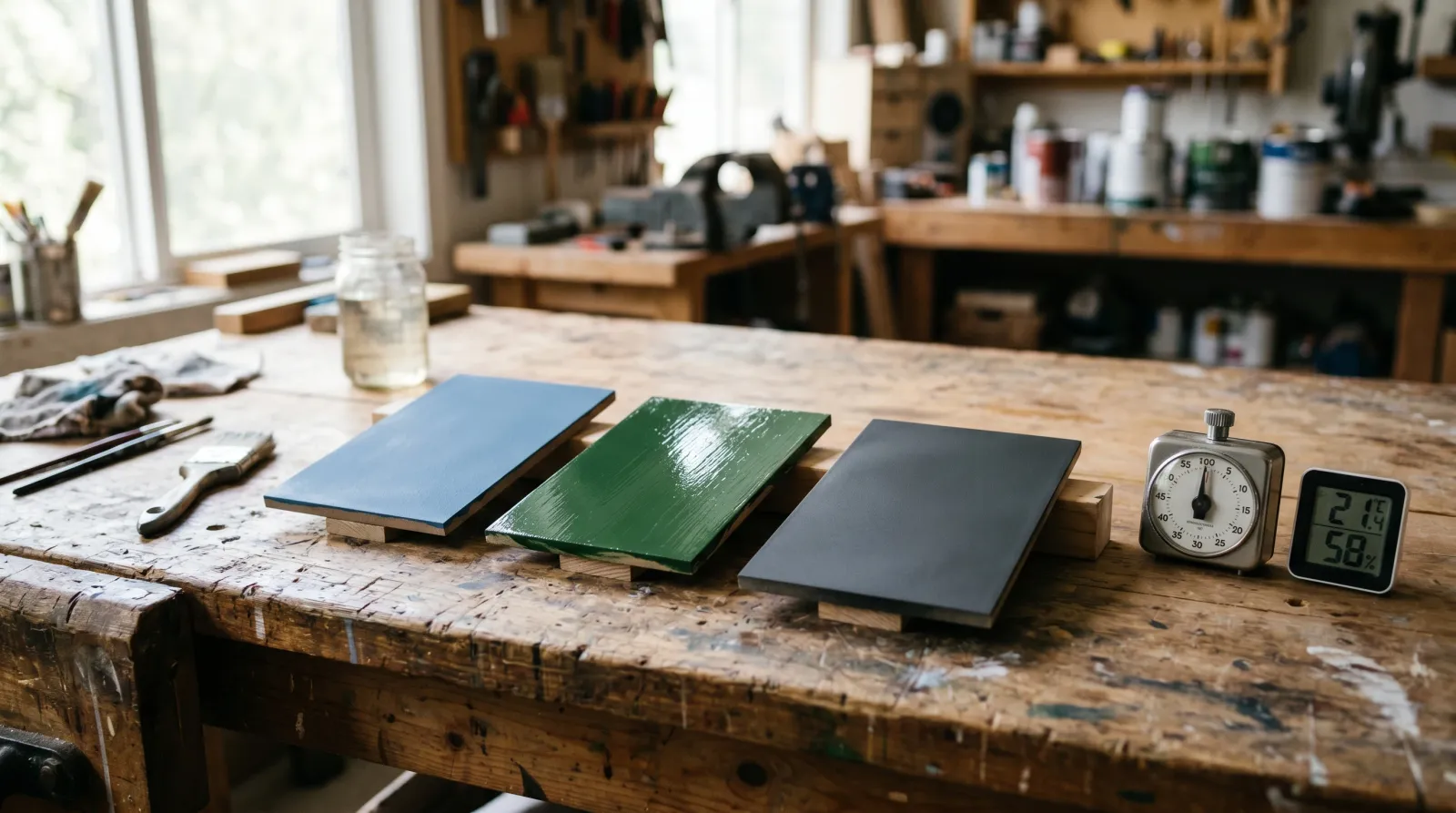
You can touch a latex wall in an hour and tell yourself it’s dry. It isn’t. The surface has lost its water, but the binder underneath is still pulling itself into a continuous film, and that process runs for weeks. Drying time is really two clocks running at different speeds: the surface clock (touch-dry and recoat, measured in hours) and the film clock (full cure, measured in days). Most painting mistakes come from reading the fast clock and ignoring the slow one.
Here are the working numbers, at the reference conditions every can assumes: 70°F and 50% relative humidity.
TL;DR
- Latex/acrylic: touch-dry in 1 hour, recoat in 2–4 hours, full cure in 2–4 weeks.
- Oil-based/alkyd: touch-dry in 6–8 hours, recoat in 16–24 hours, full cure in 7 days to several weeks.
- Spray paint (aerosol): touch-dry in 10–30 minutes, handle in 1 hour, full cure in 24 hours to 7 days.
- Recoat too early and you trap solvent, lift the first coat, or get wrinkling. Recoat too late on oil and the new coat won’t bond.
- Cold and humid air slows everything. Below 50°F, latex may never form a proper film.
The Drying Time Chart
The reason these three families dry so differently is what’s leaving the film. Latex loses water plus a small fraction of coalescing solvent. Oil-based paint doesn’t really “dry” at all in the evaporative sense; the alkyd binder cross-links with oxygen from the air, a chemical reaction that’s slow by nature. Spray paint carries fast solvents engineered to flash off in minutes.
| Paint type | Touch-dry | Recoat | Handle / light use | Full cure |
|---|---|---|---|---|
| Latex / acrylic wall paint | 30–60 min | 2–4 hr | 24 hr | 2–4 weeks |
| Oil-based / alkyd enamel | 6–8 hr | 16–24 hr | 24–48 hr | 7 days–several weeks |
| Aerosol spray paint | 10–30 min | 5 min OR 48 hr | 1 hr | 24 hr–7 days |
| Latex primer | 30–60 min | 1–2 hr | — | n/a (recoat, don’t cure) |
| Oil / shellac primer | 30 min–1 hr | 1 hr (recoat fast) | — | n/a |
| Chalk-style paint | 20–30 min | 1 hr | 24 hr | 30 days (wax/seal) |
| Floor / porch enamel | 1–4 hr | 4–24 hr | 24–72 hr foot traffic | 7–14 days |
That spray-paint recoat column isn’t a typo. Aerosol enamel has a narrow window: either recoat within about 5 minutes while the first pass is still wet (wet-on-wet), or wait a full 48 hours until it’s hard. Hit it in the middle, while the surface has skinned but the underneath is soft, and the solvent in your second coat re-dissolves the first one. The result is the orange-peel wrinkling everyone has seen on a spray-painted chair.
What Moves the Numbers
The chart assumes 70°F and 50% humidity. Real rooms aren’t that obliging.
Temperature. This one’s a hard floor for latex, not a slope. A latex film forms when the acrylic binder particles soften enough to fuse together, and that softening has a minimum temperature (the minimum film-formation temperature, usually 40–50°F). Below it, the water evaporates but the particles stay separate, so you get a powdery, weak film that wipes off. Don’t paint exterior latex when the overnight low will drop under 50°F, even if the daytime high is fine. Oil-based paint slows in the cold too, since cross-linking is a chemical reaction and reactions slow as they cool, but it doesn’t have the same cliff.
Humidity. Latex dries by evaporation, and evaporation stalls when the air is already saturated. At 80% relative humidity, a 2-hour recoat window can stretch to 6 or 8. Oil is less sensitive to humidity but more sensitive to temperature. A muggy basement is the worst case for latex: cool and damp at once.
Film thickness. A coat twice as thick takes much longer than twice as long to dry, because the solvent at the bottom has to migrate up through everything above it. This is why two thin coats beat one heavy one for total project time, and why a sagging drip can still be soft a week later when the flat areas cured days ago.
Substrate porosity. Bare drywall pulls water out of latex fast, so it can feel dry early. A glossy or previously oil-painted surface holds the solvent in and dries slower. For the chemistry behind why some surfaces fight the film, the film-formation explainer goes deeper.
Touch-Dry, Recoat, and Cure Aren’t the Same Thing
These three milestones get collapsed into one word, and that’s where people get burned.
Touch-dry means the surface won’t transfer to a light finger touch. It tells you nothing about whether you can recoat.
Recoat-ready means the first coat has released enough solvent that a second coat won’t disturb it. This is the number that matters most during a job. On latex it’s short. On oil it’s long, and it has a back end too: oil-based paint keeps cross-linking and hardening, and after about 72 hours the surface is glossy and slick enough that a fresh coat can’t physically grip it without a scuff-sand first.
Full cure is when the film reaches its final hardness, washability, and chemical resistance. A latex wall is touch-dry in an hour but won’t survive scrubbing for two to four weeks. This is why a freshly painted bathroom shouldn’t get wiped down, and why new trim dents if you lean something against it. The full breakdown lives in the dry time vs cure time guide.
When NOT to Trust the Touch-Dry Time
- Before a wash or scrub. The film isn’t cured. Wiping a 3-day-old latex wall burnishes it and leaves shiny streaks.
- Before stacking or leaning objects on trim and shelves. Soft oil enamel will print the texture of whatever touches it for days.
- Before reoccupying a bedroom or nursery. Touch-dry says nothing about off-gassing. Match the wait to the paint’s VOC level (the VOC numbers guide puts real figures on the off-gassing curve).
- Before recoating oil past its window. If oil-based paint has cured past 72 hours, sand it before the next coat or the coat will peel.
Common Mistakes
- Recoating latex at the touch-dry time instead of the recoat time. The surface feels dry at 45 minutes, but the underlying coat is still soft. A second coat applied then can drag, lift, or leave lap marks. Wait the full recoat window.
- Painting in a cold garage in winter. Latex below 50°F doesn’t form a film; it dries chalky and fails. Heat the space and the paint to room temperature first, and keep it there through the recoat window.
- One thick coat to save time. A heavy coat skins on top and stays wet underneath, which causes blistering, wrinkling, and a cure that runs days longer than two thin coats would have.
- Aerosol recoat in the dead zone. Spray within 5 minutes or after 48 hours, never in between. The middle window wrinkles the finish.
- Closing the windows to “let it dry.” Latex needs moving air to carry water away. A sealed humid room slows drying and concentrates whatever the paint is off-gassing.
How to Speed It Up Safely
Move air, drop humidity, hold temperature. A box fan aimed across the room (not at the wall) refreshes the boundary layer of saturated air sitting against the wet film. A dehumidifier in a damp basement can cut recoat time in half. Hold the room at 65–75°F. For a deeper dive on application choices that affect dry time, the spray vs roll vs brush comparison covers how each method lays down film thickness.
What doesn’t work: a heat gun or hair dryer on a wall. Concentrated heat skins the surface and traps wet paint underneath, the same failure as a too-thick coat. Sun on fresh exterior latex does the same thing, which is why you paint the shaded side of a house and chase the shade around as the day moves.
Where to Buy
Fast-recoat formulas exist for a reason. If you need to two-coat a room in an afternoon, a quality acrylic with a 1-hour recoat saves real time. For specific picks by use, see the best interior trim paint round-up and the oil vs water-based paint comparison before you choose a chemistry. The recoat number is on every can. Read it, then add a margin if your room is cold or damp.
FAQ
How long should I wait between coats of paint?
For most latex wall paint, wait 2–4 hours before recoating at 70°F and 50% humidity. Oil-based paint needs 16–24 hours between coats. Spray paint recoats fast (within 5 minutes wet-on-wet) or slow (after 48 hours), but rarely in the window between. Always go by the recoat time on the can, not the touch-dry time.
Why is my paint still tacky after 24 hours?
Tackiness after a full day usually means the film can’t release its solvents. The three common causes are high humidity (above 70%), low temperature (below 50°F), or a coat applied too thick. Oil-based paint over a glossy surface that wasn’t sanded also stays tacky because it can’t grip. Raise the heat, drop the humidity with a fan, and give it more time before assuming the paint is bad.
Does paint dry faster in heat or cold?
Heat, up to a point. Latex film formation stalls below about 50°F because the binder particles can’t coalesce, so the paint dries chalky or not at all. The sweet spot for both latex and oil is 60–80°F. Above 90°F, latex can skin over too fast and trap solvent underneath, which causes blistering.
How long before I can sleep in a freshly painted room?
Touch-dry doesn’t mean safe to occupy. With a low-VOC latex and 72 hours of windows-open ventilation, the room is reasonable for most people. Oil-based paint off-gasses far longer; give it a week with strong airflow. For nurseries and bedrooms, check the VOC numbers before you set the dose.
Can I speed up paint drying time?
Yes. Move air across the film with a fan, drop the relative humidity with a dehumidifier, and hold the room at 65–75°F. Thinner coats dry faster than thick ones, so two thin coats beat one heavy one for total time. Don’t aim a heat gun at a wall, since that skins the surface and traps wet paint underneath.
Ask a Question