What Are VOCs in Paint? Numbers, Rules, and What Actually Off-Gasses
Volatile organic compounds in paint, explained in g/L and µg/m³. EPA, OTC, SCAQMD, and GreenGuard thresholds, plus what 'zero VOC' actually means at the can.

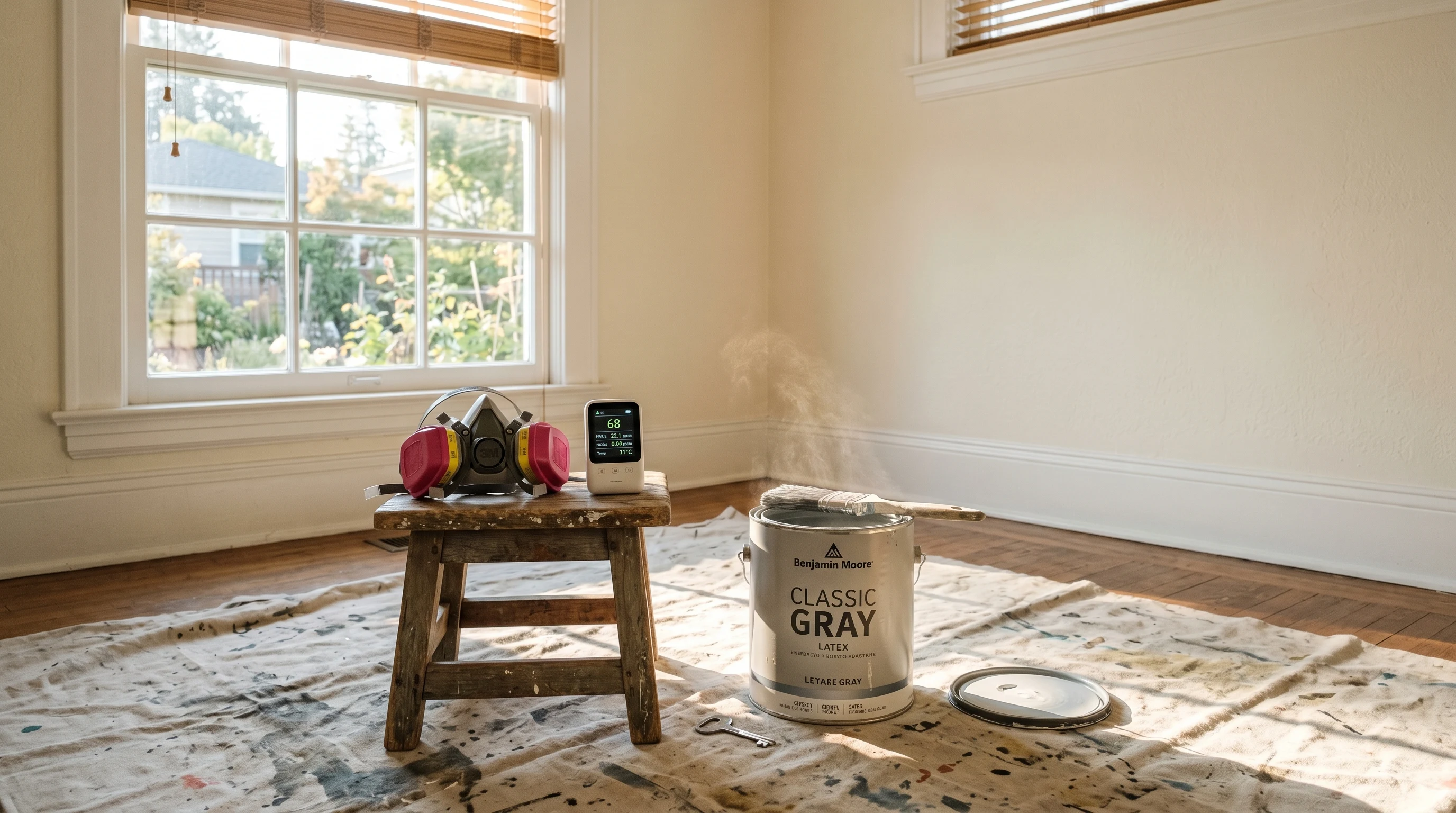
Open a fresh can of latex paint in a closed bedroom and within ninety seconds you can smell it across the hall. That smell is mostly volatile organic compounds — small carbon-based molecules with enough vapor pressure to leave the wet film and enter your air. The acronym is VOC, the unit is grams per liter (g/L) on the can and micrograms per cubic meter (µg/m³) in the air, and the gap between those two numbers is where most of the consumer confusion lives.
A VOC, regulatorily speaking, is any organic compound with a vapor pressure above 0.1 mm Hg at 20 °C that participates in atmospheric photochemical reactions (EPA 40 CFR 51.100). In architectural latex, that mostly means three families. Glycol ethers like propylene glycol and 2-butoxyethanol act as coalescing aids, helping the binder particles fuse during film formation. Aliphatic and aromatic hydrocarbons appear as residual solvents in alkyd-modified latex and as carriers in oil-based paints. And formaldehyde shows up indirectly, released over time by certain biocides and from residual monomers in lower-quality acrylic dispersions.
How the Numbers Get Assigned
The number you see on a can is determined by EPA Method 24, a gravimetric test that bakes a paint sample, measures the mass loss attributable to volatiles, subtracts the water, and reports the rest as VOC content per liter of coating minus water. It’s a flawed proxy (it can’t distinguish toxic from benign volatiles) but it’s the one all major U.S. regulations reference.
The thresholds, from loosest to tightest:
| Standard | Flat (g/L) | Non-flat (g/L) | Notes |
|---|---|---|---|
| EPA federal (40 CFR 59) | 250 | 380 | Baseline. Most of the country. |
| OTC Phase II (Northeast states) | 100 | 150 | NY, NJ, PA, MA, MD, others |
| SCAQMD Rule 1113 | 50 | 50 | LA basin; effective national ceiling |
| GreenSeal GS-11 | 50 | 100 | Voluntary certification |
| GreenGuard Gold | n/a | n/a | ≤220 µg/m³ TVOC at 14 days indoor air |
GreenGuard Gold is the one to anchor on for indoor air quality. Instead of measuring VOC content in the can, it measures total volatile organic compound (TVOC) concentration in a controlled chamber after fourteen days, which is closer to what a sensitive occupant actually breathes. The 220 µg/m³ ceiling is roughly an order of magnitude below the WHO indoor air guideline for short-term TVOC exposure.
What “zero VOC” Leaves Out
The “zero VOC” claim is an at-the-can claim measured before tinting. Universal colorants — the liquid pigments dispensed at the store — typically contain glycol-based vehicles and run anywhere from 5 to 15 g/L per fluid ounce added. A deep accent base tinted with five ounces of universal colorant can land at 30–60 g/L in the final mixed gallon, regardless of the “zero” sticker on the lid. Some brands (Benjamin Moore Aura, Sherwin-Williams Emerald) now ship with proprietary low-VOC colorants that hold the tinted product under 50 g/L. Most don’t.
The other footnote: Method 24 exempts certain compounds the EPA classifies as photochemically non-reactive (acetone, t-butyl acetate, parachlorobenzotrifluoride). A formula reformulated around exempt solvents can show a low Method 24 number while still off-gassing aggressively.
When the VOCs Actually Leave the Film
Roughly half the total volatile mass evaporates with the water in the first 24 to 72 hours. The remaining fraction, mostly the higher-boiling coalescing aids, releases slowly over 14 to 30 days as the latex binder finishes coalescence and cross-linking. The reason for that staggered release is straightforward: the high-volatility solvents are what dries the paint to the touch, and the slower ones are what let the film form a continuous layer instead of a cracked one.
Indoor TVOC concentrations after a single-room repaint with a 50 g/L paint typically peak around 1,000–3,000 µg/m³ at hour 4 and decay to background (under 200 µg/m³) within 7 to 14 days with normal ventilation. Cut the air change rate in half and you double the integrated exposure.
Low-VOC Doesn’t Mean Odorless
Latex paint contains plenty of non-VOC components that smell. Ammonia stabilizes the pH of the dispersion. Surfactants carry their own faint sweetness. Biocides (isothiazolinones in most modern cans) have a sharp note some people register as plastic. None of these contribute meaningfully to the Method 24 number, but all of them are in your air. A paint can test at 5 g/L and smell stronger than a 50 g/L paint with a different surfactant package.
Which Paints Actually Hit SCAQMD 50 g/L Tinted
Four U.S. lines reliably ship under the SCAQMD ceiling in the tinted state, not just at the base: Benjamin Moore Aura (reformulated 2018, GreenGuard Gold), Sherwin-Williams Emerald Interior (GreenGuard Gold), Behr Marquee Interior in the Zero VOC variant (GreenSeal GS-11), and Kompozit EKO Interior where the EU-spec low-VOC colorant system carries over to U.S. distribution. Premium pricing is a feature of the chemistry, not the marketing — proprietary low-VOC colorants and exempt-solvent coalescing aids cost more per gallon to formulate.
When the Number Actually Matters
VOC level matters most when occupancy follows quickly: nurseries painted the week before a baby moves in, hospital wings repainted on weekend turnarounds, small bathrooms with weak ventilation, and any room with a sensitive occupant (asthma, MCS, pregnancy). It matters less for an exterior repaint, an unconditioned garage, or a room you can leave windowed-open and unoccupied for two weeks.
The practical rule: under 50 g/L, GreenGuard Gold, and 72 hours of windows-open ventilation before reoccupancy. That combination drops the integrated TVOC dose by an order of magnitude versus a 250 g/L paint applied and immediately reoccupied. The numbers on the can are a real measurement of a real exposure. Read them.
Frequently asked questions
What does 'zero VOC' actually mean on a paint can?+
How long do VOCs off-gas from latex paint?+
Is low-VOC paint odorless?+
Which is the strictest U.S. VOC rule for architectural paint?+
Do I need low-VOC paint in a nursery or bedroom?+
- Paint sheen guide
- What is LRV? Light Reflectance Value, explained
- Whites — high-LRV color family
- Color matcher tool