Dry Time vs Cure Time: Why 'Dry to Touch' Doesn't Mean Ready
The five drying stages of latex, alkyd, and epoxy paint, in hours and days. The chemistry behind film formation and why full hardness lags touch-dry by a week or more.

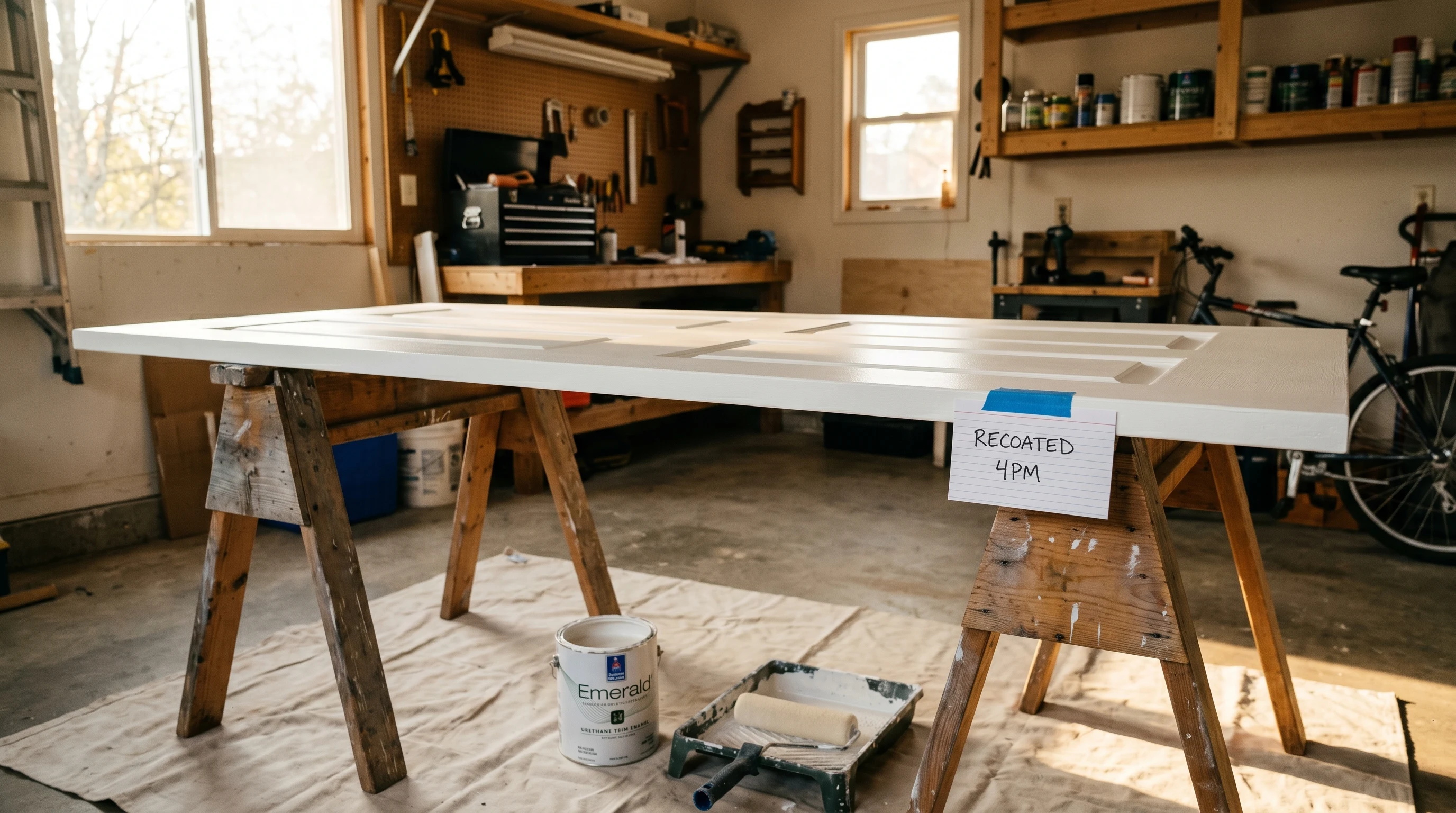
Press the back of your hand against a freshly painted door at hour four, and it feels firm. Press your thumbnail into the same door at hour forty-eight and you’ll leave a crescent. The paint is dry. It is nowhere near cured. The gap between those two states is where most homeowners get burned, because the can almost always lists the first number and almost never lists the second one in big type.
A paint film passes through five stages from wet to fully cured, and the stages run on different clocks. Stage one is flash off: the high-volatility carriers — water in latex, mineral spirits in alkyd — leave the wet film in the first 5 to 30 minutes. The visible sheen drops as the film thins. Stage two is tack-free, somewhere between 30 minutes and 2 hours, when the surface no longer transfers to a finger pressed lightly against it. Stage three is dry-to-recoat, 2 to 24 hours depending on chemistry, when the film is firm enough that a second coat won’t pull the first one with the roller. Stage four is full hardness, 7 to 14 days, when the film resists indentation, scrub, and impact. Stage five is full cure, 30 days for most acrylic latex and 60 days or more for traditional alkyd, when the binder has finished cross-linking into its final chemistry.
The reason for that staggered timeline is that two different processes are running in parallel, and the slow one is what most people miss.
The Chemistry, by Paint Type
Latex (acrylic) paint dries by a two-step process called coalescence. First the water evaporates, leaving the binder particles (tiny acrylic spheres) packed close together in the drying film. Then the coalescing solvents (glycol ethers, mostly propylene glycol and 2-butoxyethanol) plasticize the spheres just enough that they fuse into a continuous skin under the film’s own surface tension. Step one is what dries the paint to the touch. Step two is what makes the film actually durable, and it keeps running for two to four weeks after the surface feels firm. That’s why a freshly painted bathroom wall washed at week one shows the rag picking up faint pigment — the binder hasn’t finished coalescing.
Alkyd (oil-based) paint dries by oxidative polymerization. The vehicle is a linseed-oil-derived alkyd resin, and oxygen from the air reacts with the unsaturated bonds in the resin chains, cross-linking them into a hard, continuous film. The mineral-spirit solvent flashes off in the first 4 to 12 hours, but the oxidative cure keeps running for 60 days or more. That’s why an alkyd trim job painted in October still smells faintly of solvent at Thanksgiving and is finally fully hard around New Year’s.
Two-part epoxy cures by chemical cross-linking between resin and hardener. The two components are mixed at the can, the catalyzed reaction starts immediately, and the working time (pot life) runs 30 minutes to 4 hours depending on the formula. Walk-on hardness arrives at 24 to 72 hours, full hardness at 7 days, and full chemical resistance at 30 days. Garage-floor epoxy parked on at the manufacturer’s “walk-on” time often pulls hot tire marks where the soft film grips the rubber and lifts when the car cools.
Each chemistry has a different gap between dry-to-touch and fully-cured. Latex runs short on dry, long on cure. Alkyd runs long on both. Epoxy is fast on dry once it kicks but slow on the chemistry’s last 20%.
Worked Example: A Six-Panel Interior Door in Benjamin Moore Advance
Advance is a waterborne alkyd, the chemistry that’s eaten most of the trim-paint market over the last decade. The data sheet lists touch-dry at 4 hours, recoat at 16, and full cure at 30 days, with full hardness at 7 to 10 days. Here’s what that means on a Saturday-morning paint job, room conditioned to 70°F and 45% relative humidity.
Saturday 9 AM, you brush and roll the first coat onto the door laid flat on sawhorses. By 1 PM, four hours in, the surface is tack-free. You can lay a piece of paper on it and lift it without transfer. You cannot recoat yet. Roll a second coat at 1 PM and the brush will drag the first coat off the panels in streaks the moment the leveling agents start to flow.
Sunday 1 AM, sixteen hours in, the film is dry-to-recoat. In practice you sleep on it and do the second coat Sunday morning. By Sunday afternoon the door is touch-dry again and you can rehang it Monday morning with hinges, gentle handling, and no slam-test. The hardware can carry its own weight; the film cannot yet take a four-year-old slamming the door against the doorstop.
Monday through the following Sunday, the film passes through full hardness. Day 7, the door takes normal household impact without indenting. Day 14, you can wipe down fingerprints with a damp cloth and a drop of mild detergent. Day 30, the cure is chemically complete. Now you can scrub it.
Cabinet jobs are where this timeline bites people. A homeowner repainting kitchen cabinets in Advance often reassembles at 48 hours because the doors look and feel done. They stack the doors face-down on each other, pull them out a week later for installation, and find rectangular indentation marks where the slats of the next door pressed into the not-yet-hardened film. The door was touch-dry. The film hadn’t passed full hardness. The actual gate was day 7, not day 2.
Temperature and Humidity Move Every Clock
The numbers on the can assume 65 to 85°F at 30 to 50% relative humidity. Below 50°F, the binder particles in latex don’t have enough thermal energy to coalesce, and the film dries chalky or fails to form a continuous skin. Above 85% RH, the water can’t evaporate fast enough and the film stays gummy through every stage. In either case dry time and cure time both stretch — sometimes by 2 to 4 times the label spec.
Cold-weather formulas like Sherwin-Williams Duration in the 35°F variant and Benjamin Moore Aura Exterior Low Lustre with the LTL technology extend the wet-film application window down to 35°F. They do not change the cure window. The film still wants 60 to 70°F for at least 24 hours after application to develop full durability, which is why fall exterior repaints applied in a cold snap often look fine on day three and start chalking by spring.
The Mistakes That Come from Confusing the Two
Three failure modes show up over and over.
Stacking trim or doors at “dry to touch” prints them into each other. The film at hour 4 takes a fingerprint with no pressure; the film at hour 24 still indents under a slat’s edge weight. Wait for full hardness, day 7 to 10, before stacking anything against a freshly painted face.
Washing a freshly painted bathroom wall at week one softens the film. The binder is still coalescing. Detergent and a damp sponge lift pigment that hasn’t fully bound. Wait 30 days for the first real wash on any latex finish.
Parking on a garage floor at the epoxy’s “walk-on” time pulls hot tire pickup. Walk-on hardness is 24 to 72 hours. Tire-rated cure is 7 days minimum, 14 days for high-performance two-part systems. The hot tire grips the soft film as the rubber cools and lifts the coating in a roughly tire-shaped patch. The fix is patience, not a thicker coat.
Touch-dry tells you the solvent left. Cure tells you the chemistry finished. Until both are true, the film is still a work in progress.
Ask a Question