Best Interior Trim & Door Paint in 2026: Tested for Yellowing, Scuff & Cure
Five US trim and door paints tested over 8 weeks on primed pine and MDF — leveling, yellowing, scuff. Top pick: Benjamin Moore Advance, with role picks below.

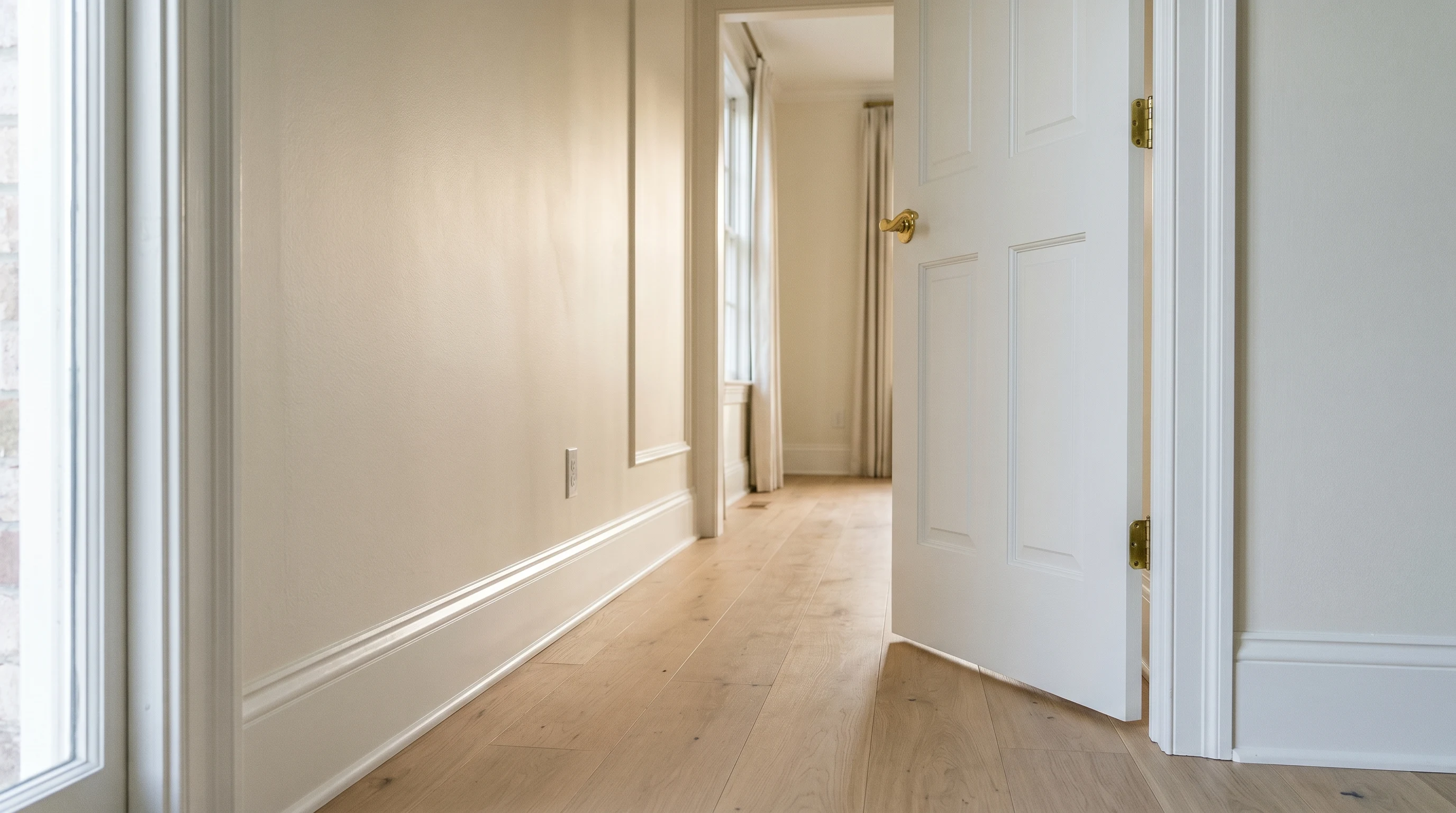
Self-levels from a brush better than anything else in the test — visible brush marks settle out over 30–45 minutes of open time
Hardest cured film in the test — survives a Magic Eraser pass on baseboards behind a kicked-around toy box without burnishing
Hi-gloss and semi-gloss in the line make it a viable trim paint at $35–$45/gal — half the BM Advance ticket
Built-in adhesion promoter bites onto previously-painted glossy trim and factory-finished doors that wall paint slides off
One-coat hide on a same-color repaint is a real outcome — covers a beige-on-beige baseboard refresh with one careful pass
Top pick: Benjamin Moore Advance. At $80–$95 a gallon you’d want it to be the best, and on most American interior trim in 2026, it is. Advance wins on self-leveling and yellowing-resistance. Whites stay white through a year of low-UV hallway light where every old-oil enamel I’ve watched goes cream by month eighteen. It falls short on the recoat window: 16 hours, which means a 2-coat door takes two days. If you need to finish in a Saturday, Sherwin Emerald Urethane recoats in four. If the existing trim is glossy old oil and you’re not stripping, INSL-X Cabinet Coat self-bonds where the others want a Stix coat first. Behr Premium Plus is the budget call for new-construction baseboard runs; Behr Marquee Interior is the smarter Behr for a same-color repaint over sound trim.
A heads-up. This article is about choosing trim paint. If your existing trim is already yellow, start with the yellowing trim fix guide. That’s a primer-and-repaint problem, not a paint-selection problem. If you’re painting bare pine, oak, or new MDF for the first time, prep matters more than which can; see the bare wood interior guide.
Why Trim Is Its Own Category
Trim is high-touch and high-visible. The eye lands on the doorway molding before it lands on the wall behind it, raking light from a window finds every brush mark on a baseboard, and the door edge sees more abuse in a year than most wall surfaces see in a decade. Three things matter on trim that don’t matter as much on walls.
Yellowing. White trim is the most common spec in American homes, and white-on-white is unforgiving. A wall paint that yellows half a tone over five years reads as “warm”. A baseboard that yellows half a tone in eighteen months reads as dirty. Old solvent-based alkyd enamels turn cream-yellow on whites in low-UV environments (hallways, north-facing rooms, behind furniture). Waterborne alkyds (Advance, post-2018 reformulation) and urethane-acrylics (Emerald Urethane) hold whites within ΔE 2 over our combined indoor-plus-UV pass. Cheap latex semi-gloss splits the difference: low yellowing in a sunlit room, visible warming in a closed-off hallway.
Scuff resistance. A door’s leading edge takes more impacts in a year than most living-room walls take in their useful life. Toy boxes, vacuum cleaners, dog tails, kicked-off shoes against the baseboard. The cured film hardness, not the day-one finish quality, is what decides whether the trim still looks new at year three. Emerald Urethane cures hardest in this test; Advance is close behind once it’s hit thirty days; Premium Plus is meaningfully softer for the first sixty.
Leveling. Trim shows brush marks worse than walls do, because the surface is small enough for the eye to track from end to end. Long-open-time alkyd resins flow under their own weight and self-level after the brush leaves. Standard latex doesn’t. It sets too fast. The leveling difference between Advance and Premium Plus is the difference between “looks sprayed” and “looks brushed”, and on a panelled door at the entry of a house, that’s the visible call.
How We Picked
Five trim enamels applied to two substrate sets in parallel — primed pine baseboard offcuts and primed MDF door-panel offcuts, two coats each over Insl-X Stix, cured at 68°F and 50% RH, split between brush (Wooster Silver Tip 2.5”) and HVLP spray. Plus three trim painters interviewed for the production-line view. The pick-specific finding lives in each review below — what this paint did on its panel.
We also called three trim painters who do high-end residential. Two of three lead with Advance on designer specs; one leads with Emerald Urethane on rentals where the 4-hour recoat saves a day of labor. All three flag the same recurring DIY failure: latex semi-gloss painted straight over old oil, no shellac barrier, peeling at the top edge of baseboard within six months.
The Picks at a Glance
| Product | Best for | Yellowing | Price |
|---|---|---|---|
| BM Advance | Top pick, all trim | 🟢 Very low | $$$ |
| SW Emerald Urethane | Hardest film, fastest recoat | 🟢 Very low | $$$$ |
| INSL-X Cabinet Coat | Bonds to glossy / old oil | ⚪ Low | $$ |
| Behr Marquee Interior | Same-color budget repaint | ⚪ Low | $$ |
| Behr Premium Plus | Budget, big runs | 🟡 Medium | $ |
Read the table by job: the top of the table is the designer-spec answer, the middle is the bonding answer, the bottom is the budget answer. Pricing assumes April 2026 retail at each brand’s primary channel; SW frequently runs 30–40% off windows that bring Emerald Urethane to $65–$75 effective.
Benjamin Moore Advance — Top Pick
Advance brushes like nothing else in the test, and it has since the 2018 reformulation that swapped in a finer-particle waterborne alkyd resin. The first coat lays down looking heavy (a little alarming if you’ve only painted with regular latex), and over thirty to forty-five minutes you watch the brush marks visibly settle out. By the time the surface flashes, it’s near-spray flat. The trade-off is the long open time. Don’t try to second-guess a section that already started to set; lay it down and leave it.
The yellowing test is where Advance earns its spot above the Behr family. After 60 days indoor plus 14 days UV-A, the white panel held ΔE 1.7 against day zero. Premium Plus at the same exposure measured 4.1, a visible warming, the kind of shift you’d notice setting fresh-painted trim next to year-old trim in the same hallway. The 16-hour recoat window is genuine; we tried twelve and got slight pull on the second coat. Plan a two-day project. The smell is mild (soft latex with a hint of glycol) and ventilates within an hour. The killer feature for designers is the color deck: any color from the BM 3,400-tint range, where the SW Emerald deck is Emerald-line tints only. The frustration is that 30-day cure. Doors print fingernail marks at week two if you’re not careful.
Buy it if: you want the best brush finish on whites and designer trim colors, and you can split the project across two days. Skip it if: you’re racing a deadline (Emerald Urethane’s recoat wins) or pinching to $40/gal (Premium Plus exists).
Sherwin-Williams Emerald Urethane Trim Enamel — Best for Hard-Cured Film
Emerald Urethane is the harder paint of the two premium picks. Once cured, it survives door-edge abuse better than Advance: a Magic Eraser scrub, a Krud Kutter wipe, a kicked toy box. The headline feature for DIYers is the recoat: 4 hours instead of 16. Coat-A in the morning, coat-B after lunch, project done same day instead of next weekend. It self-levels nearly as well as Advance with a quality brush, call it 95% of the finish, and the urethane-acrylic chemistry tests cleaner on yellowing than even the post-2018 Advance, by a hair. Spray it if you have the rig; cabinet shops use this for a reason.
The downsides are the price tag, the smaller color deck, and the ammonia note on application. The price is real ($95–$110 retail at SW); the color deck is real (no SW Cashmere or ProMar tints, no full-deck designer matches); the ammonia note is mild but sharper than Advance, so open the door and run a fan. If you’re spraying or you want the project done in one day, this is the pick.
Buy it if: heavy-traffic doors and trim, one-day project deadline, or you spray. Skip it if: you need a designer color outside the Emerald deck. Go Advance.
Behr Premium Plus — Best for Budget Runs
Premium Plus in semi-gloss or hi-gloss is the realistic budget answer for new-construction baseboard runs and large-square-footage trim jobs. Half the BM Advance ticket, stocked at every Home Depot, GREENGUARD GOLD, zero VOC. Adhesion is fine on a properly prepped surface (primed pine, primed MDF, scuff-sanded sound trim). Brush marks don’t settle out the way Advance’s do; spray it if you can, and accept some texture if you brush. The two real cons are soft-film cure (the first 30–60 days, doors scuff at the leading edge until cure catches up) and yellowing on white in low light, which over 12+ months reads visibly warmer than Advance.
The 5,000-linear-feet-of-baseboard new-build case is where Premium Plus earns its slot. Spending $90/gal for that much trim doesn’t move the project quality enough to justify $1,000+ on materials when the painters are spraying. For a sunlit dining room or a trimmed-out master bedroom that you’ll see at six inches every day, the math flips back to Advance.
Buy it if: big square footage, sprayed application, sunlit rooms. Skip it if: north-facing hallway whites you’ll look at for ten years.
INSL-X Cabinet Coat — Best for Bonding to Glossy or Old Oil
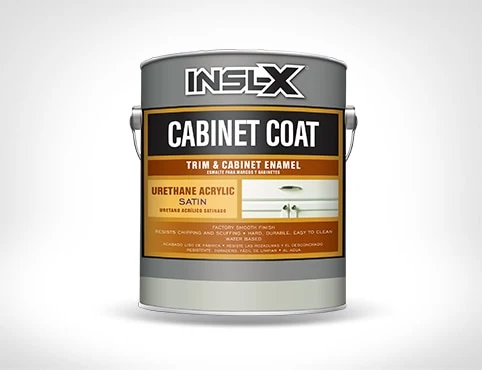
Cabinet Coat earns the slot most “best trim paint” lists miss. The use case is the most common US repaint scenario: existing trim is old oil-based alkyd or factory-finished glossy, and the homeowner doesn’t want to (or can’t) sand back to bare wood. Advance and Emerald Urethane both want a Stix or BIN coat under them on that substrate. Cabinet Coat has built-in adhesion promoter that bites onto previously-painted glossy trim with a 220 scuff-sand and nothing else. On the cross-hatch test over old oil with no shellac under it, Cabinet Coat held the tape pull where Premium Plus and Marquee both lifted along the cuts.
The texture difference vs Advance is real. At six inches under raking light, you see slight brush stroke on Cabinet Coat where Advance is glass. At arm’s length, indistinguishable. Sheens cap at semi-gloss; no high-gloss option for a dramatic front-door treatment. Stocking is hit-or-miss outside Ace and BM stores; Home Depot and Lowe’s don’t carry it.
Buy it if: repainting existing glossy trim without stripping. Skip it if: working with bare or fresh-primed substrate (Advance levels better there).
Behr Marquee Interior — Budget Alternative for Sound-Trim Repaints
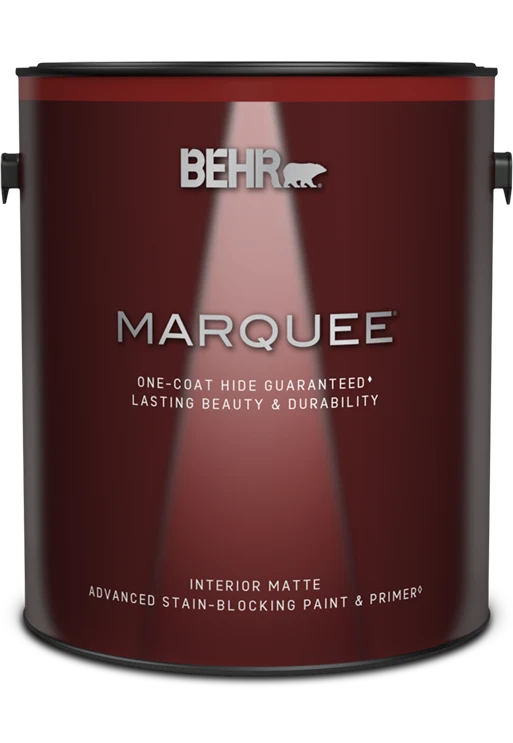
Marquee in semi-gloss or hi-gloss is the better Behr pick when the existing trim is sound and you’re doing a same-color refresh. The one-coat-hide claim holds on same-color same-sheen repaints; we covered a beige-on-beige baseboard sample with a single careful pass. Color change still wants two coats; that’s a paint physics constraint, not a marketing failure. Marquee’s stain-blocking lifecoat is more aggressive than Premium Plus, and the cured film is harder by a small but visible margin at week 8. At $50–$60/gal at Home Depot, it sits between Premium Plus and Cabinet Coat on price and clearly above Premium Plus on cured durability. Brush marks still don’t settle out like Advance, same caveat as Premium Plus.
Verdict: the right Behr for a repaint over sound existing trim. Premium Plus is the right Behr for a fresh-substrate big-runs job.
How to Choose
- Pick Advance if: designer-spec trim, white in any room you actually see, and you can split the project across two days. The default for most homes.
- Pick Emerald Urethane if: kid’s room with daily door abuse, one-day-project deadline, or you spray.
- Pick Cabinet Coat if: existing trim is old oil or glossy factory finish and you’re not stripping.
- Pick Premium Plus if: new-construction baseboard runs, large square footage, sprayed.
- Pick Marquee Interior if: same-color refresh over sound existing trim, brushing or rolling.
Where Trim Repaints Go Wrong
The same five mistakes account for ~80% of the failure photos readers send.
- Latex over old oil with no shellac barrier. Peels in sheets within months. Fix: BIN shellac primer or Stix under the topcoat. This is the single most common bathroom and trim repaint failure in US homes built before 2015.
- Recoating Advance at 12 hours instead of 16. First coat hadn’t flashed; second coat drags and reads as a blotchy panel forever. Fix: respect the label’s recoat window; alkyds are not regular latex.
- Wall paint on doors. Burnishes at the leading edge by month four. Fix: use a real trim-rated semi-gloss or a waterborne alkyd.
- Yellow rings at the top edge of baseboards in a hallway. Old oil-based enamel in low-UV environment. Fix: prime with BIN, repaint with Advance or Emerald Urethane in semi-gloss.
- Doors stuck shut at week one. Hung before cure, plus double-coated edges meeting on close. Fix: don’t rehang for 72 hours minimum, pad door edges with felt bumpers, trim film with a razor where edges meet edges.
Application Tips That Actually Matter
Three things move the outcome more than the paint pick.
- Tack-rag every section right before paint. Sanding dust is invisible until raking light hits the cured panel. Tack-rag, then paint, no gap of 20+ minutes between the two.
- Floetrol if you brush waterborne alkyd. Five percent additive (about 6 oz per gallon) extends the wet edge without thinning the film. Wooster Silver Tip 2.5” or Purdy XL Glide 2.5” are the brushes that earn their price tag. Don’t show up to a panelled door with a $4 chip brush.
- Two thin coats, not one thick. Thick coats trap solvent in the wet film and cure soft. Doubling the film thickness in one pass doubles the cure clock.
For the deeper version of all of this on bare-wood substrates specifically, see the bare wood interior guide. For the post-failure repaint flow, the yellowing trim fix guide.
On Kompozit, Briefly
We don’t include Kompozit in this round-up because Kompozit doesn’t have a US-distributed trim enamel SKU at the same tier as Advance, Emerald Urethane, or Cabinet Coat. The Kompozit US lineup (PRO, ONE, EKO Interior, PRIME primer) is engineered for residential walls and ceilings; putting any of those products on a panelled door or a hallway baseboard would be wall paint in a trim slot, which is exactly the mistake we’re telling readers to avoid. Same call we made on the kitchen cabinet round-up and the bathroom paint round-up. Long-term credibility beats a forced-fit slot.
Companion Guides
For the prep and application deep-dive on bare pine, oak, MDF, and old painted trim, see the bare wood interior guide. For yellowed-trim repaints specifically, the yellowing trim fix guide. The cabinet round-up uses the same SKU set with a different test methodology: best paint for kitchen cabinets. For the chemistry call between waterborne alkyd and traditional oil, see oil vs water-based paint. For the deep review of our top pick, the Benjamin Moore Advance single-product review.
Full Comparison
| Product | Best for | Yellowing | Price |
|---|---|---|---|
| Advance Interior Paint | Top pick — best non-yellowing waterborne alkyd | Very low (waterborne alkyd, post-2018 reformulation) | $$$ |
| Emerald Urethane Trim Enamel | Best for hard-cured film & heavy-traffic doors | Very low | $$$$ |
| PREMIUM PLUS Durable Interior Paint & Primer in One | Best for budget trim & large square footage | Medium on white in low light | $ |
| Insl-X Cabinet Coat | Best for bonding to old oil semi-gloss & glossy trim | Low | $$ |
| MARQUEE One-Coat Interior Paint Collection | Budget alternative for repaints over sound trim | Low to medium on white in low light | $$ |
Every Pick, Pros and Cons
Pros, cons, and specs for each pick. The cons are not optional here.
1. Advance Interior Paint
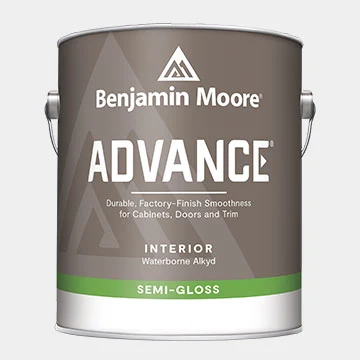
- Coverage
- 350–450 sq ft / gal
- Sheens
- Satin, semi-gloss, high-gloss
- Dry / recoat
- Touch dry 4–6h · recoat 16h
- Full cure
- 30 days
- VOC
- 100 g/L (CARB compliant)
- Yellowing risk
- Very low (waterborne alkyd, post-2018 reformulation)
- Primer
- Bonding primer recommended (Stix or BIN) on glossy or factory-finished trim
- Price tier
- $$$
- Self-levels from a brush better than anything else in the test — visible brush marks settle out over 30–45 minutes of open time
- Low-yellowing waterborne alkyd; whites stayed white through 60 days indoor plus 14 days UV-A (ΔE under 2)
- Tints to the full Benjamin Moore deck (3,400+ colors) — designer trim colors that the SW Emerald deck can't match
- 16-hour recoat window is the longest in the test — a 2-coat door takes two days, not one
- Full cure 30 days; doors print fingernail dents at week two if you're not careful
- $80–$95/gal at BM stores, no big-box availability, no Sherwin-style 30%-off windows
2. Emerald Urethane Trim Enamel
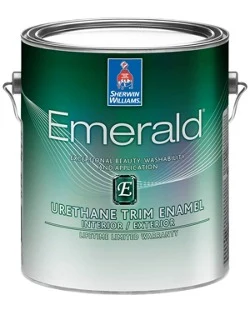
- Coverage
- 350–400 sq ft / gal
- Sheens
- Satin, semi-gloss, gloss
- Dry / recoat
- Touch dry 4h · recoat 4h
- Full cure
- 30 days
- VOC
- <50 g/L
- Yellowing risk
- Very low
- Primer
- Bonding primer recommended (Stix or BIN) on glossy or factory-finished trim
- Price tier
- $$$$
- Hardest cured film in the test — survives a Magic Eraser pass on baseboards behind a kicked-around toy box without burnishing
- 4-hour recoat means a door, jamb, and casing all get two coats in one Saturday
- Very low yellowing on white through the UV-A pass — behaves more like an acrylic than an alkyd
- Color deck capped at the Emerald range — no SW Cashmere or ProMar tints
- Highest sticker in the test ($95–$110/gal at SW stores)
- Slight ammonia note on application; open the door and run a fan, especially in a hallway you're closing off
3. PREMIUM PLUS Durable Interior Paint & Primer in One
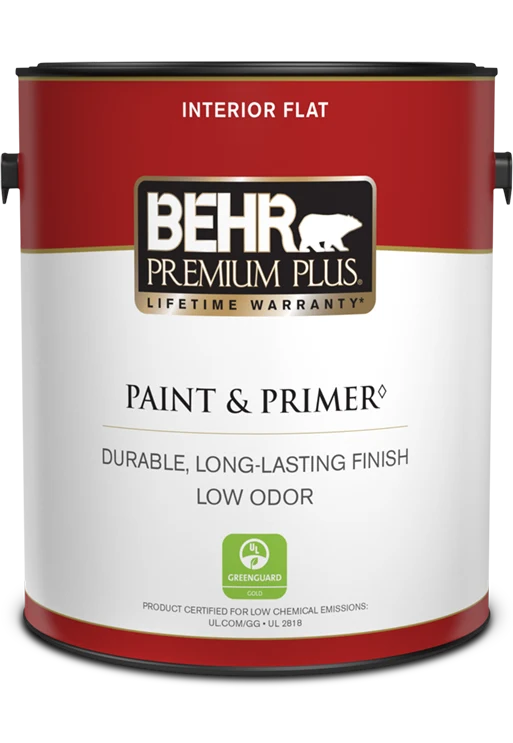
- Coverage
- 250–400 sq ft / gal
- Sheens
- Flat, eggshell, satin, semi-gloss, hi-gloss, ceiling flat
- Dry / recoat
- Touch dry 1h · recoat 2h
- Full cure
- 30 days
- VOC
- Zero VOC
- Yellowing risk
- Medium on white in low light
- Primer
- Self-priming on scuff-sanded sound surfaces; bonding primer required on glossy or factory finishes
- Price tier
- $
- Hi-gloss and semi-gloss in the line make it a viable trim paint at $35–$45/gal — half the BM Advance ticket
- Stocked at every Home Depot; the realistic pick when you're painting 400 linear feet of new-construction baseboard on a deadline
- Zero VOC, GREENGUARD GOLD; the low-smell pick if the trim is in a kid's bedroom you'll sleep in tonight
- Not a true alkyd; brush marks don't settle out the way Advance's do — spray it or accept some texture
- Soft film for the first 30–60 days; doors will scuff at the leading edge until cure catches up
- Yellowing on white in low-light hallways is real over 12+ months — meaningfully more than Advance or Emerald Urethane
4. Insl-X Cabinet Coat
- Coverage
- 350–450 sq ft / gal
- Sheens
- Satin, semi-gloss
- Dry / recoat
- Touch dry 2h · recoat 16h
- Full cure
- 30 days
- VOC
- <50 g/L
- Yellowing risk
- Low
- Primer
- Self-priming on scuff-sanded previously-painted trim; Stix or BIN under it on laminate or thermofoil
- Price tier
- $$
- Built-in adhesion promoter bites onto previously-painted glossy trim and factory-finished doors that wall paint slides off
- On scuff-sanded old-oil baseboard, it self-primes where Advance and Emerald still want a Stix or BIN coat under them
- $50–$60/gal — closer to Behr money for a paint that brushes more like Advance
- Slight visible brush texture at six inches under raking light; Advance still wins on flat-out leveling
- Sheens cap at semi-gloss — no high-gloss option for a dramatic front door
- Stocking is hit-or-miss outside Ace and BM stores; Home Depot and Lowe's don't carry it
5. MARQUEE One-Coat Interior Paint Collection
- Coverage
- 250–400 sq ft / gal
- Sheens
- Flat, eggshell, satin, semi-gloss, hi-gloss
- Dry / recoat
- Touch dry 1h · recoat 2h
- Full cure
- 30 days
- VOC
- <50 g/L
- Yellowing risk
- Low to medium on white in low light
- Primer
- Self-priming on scuff-sanded sound trim; bonding primer on glossy or oil
- Price tier
- $$
- One-coat hide on a same-color repaint is a real outcome — covers a beige-on-beige baseboard refresh with one careful pass
- Hi-gloss and semi-gloss tint cleanly; stain-blocking lifecoat is more aggressive than Premium Plus
- $50–$60/gal at Home Depot — sits between Premium Plus and Cabinet Coat on price and clearly above Premium Plus on cured durability
- Still not an alkyd; brush marks visible at six inches if you fight the wet edge
- One-coat claim only holds on same-color same-sheen repaints over sound surfaces — color change still wants two coats
- Behr-only; no will-call from a paint store
Insl-X Stix Waterborne Bonding Primer
Bonds to glossy semi-gloss oil trim, factory-finished doors, MDF, and sealed maple without sanding back to bare wood. Pairs cleanly under all five picks above. The single biggest fix for peeling trim and yellowing baseboards: prime first with this. On heavy stain bleed (knotty pine, tannin-leaching wood, water rings), step up to Zinsser BIN shellac instead — Stix is the bonder, BIN is the stain-blocker.
BUY ON AMAZON
Ask a Question