What Is Paint Film Formation?
Paint film formation is a two-stage process: water evaporates, then binder particles coalesce into a continuous film. Why 50°F matters and why full cure takes 30 days.

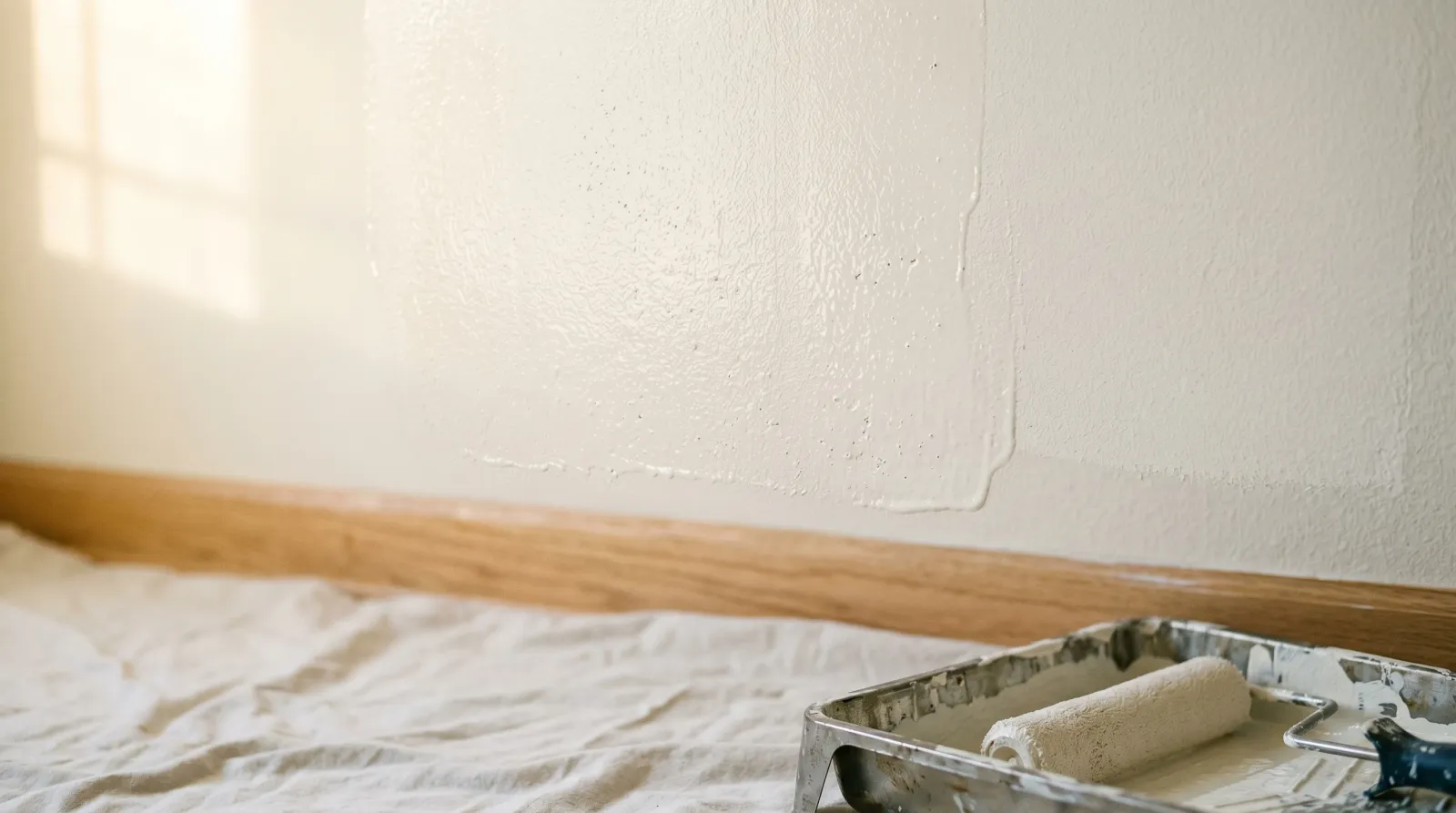
Most people judge a paint job at the end of the first day. The wall is dry, the color reads right, the roller stipple has settled, and the job feels done. Three weeks later, the same wall takes a scrub and the paint comes off in a streak. That’s the gap between dry and cured, and it’s a story about film formation.
The reason for that is paint doesn’t dry the way water on a counter dries. A latex paint film forms in two distinct stages, and the second stage decides everything you actually care about: hardness, washability, gloss retention, adhesion. Skip the first stage’s conditions, and the second stage never happens. The film stays soft, porous, and chemically incomplete for the rest of its life on the wall.
Stage One: Water Leaves
A waterborne paint hits the wall as a suspension. Pigment particles and binder particles (tiny spheres of acrylic, vinyl-acrylic, or PVA resin, roughly 0.1 microns across) are floating in water with a handful of additives. The wet film sits there until the water starts to leave, partly by evaporation into the air and partly by absorption into the substrate.
There is less material here than people assume. A normal rolled coat of interior latex goes on at about 4 mils wet — four thousandths of an inch. At 35 to 40% volume solids it dries to roughly 1.4 to 1.6 mils, because dry film thickness equals wet film thickness times volume solids. Everything else in that wet coat was water and additives, and all of it has to leave before stage two can begin. The mil thickness guide covers what those numbers mean for coverage.
This is the stage homeowners watch. The film loses its wet sheen, the color darkens slightly as the binder spheres pack closer together, and within an hour the surface no longer transfers to a finger. Touch-dry.
The binder particles at this point are still discrete spheres, packed tight but not fused. Picture a jar of ball bearings: they’re touching, but each one is still a separate ball. Pull a damp rag across the surface and you can still smudge it. The film exists, but it has no real strength.
Stage one is also where the substrate can quietly steal the outcome. A porous patch pulls water out faster than the wall around it, so the binder there loses its working time early. You see that later as flashing — the same paint reading duller exactly where the wall drank fastest.
Stage Two: Binder Particles Coalesce
This is where the chemistry happens, and where most paint failures are born.
Coalescence is the process of those packed binder spheres softening, flowing into each other, and fusing into one continuous polymer film. The driving force is surface tension plus residual moisture; coalescing solvents in the formula soften the particle surfaces enough to let them deform and merge. Picture the ball bearings turning into warm honey and flowing together into a single sheet.
Under a microscope the spheres don’t melt so much as squeeze. They press against their neighbors and deform into flat-sided cells — dodecahedra, packed with no voids — because that shape has the lowest surface energy. The boundaries between particles are still there. The film is void-free but not yet one material.
Coalescence needs three things: time (hours to days), temperature above the binder’s minimum film-formation temperature, and enough residual moisture to keep the particle surfaces soft long enough to merge. Take any of the three away and the spheres stay as spheres. The cured film looks the same to a casual eye but is chemically a layer of unfused particles loosely held together, not a continuous polymer.
The Step Nobody Mentions: Chains Cross the Boundary
The last part of coalescence is the one that actually delivers durability, and it has a name most homeowners never hear: interdiffusion, or autohesion.
Once the particles are packed and deformed, individual polymer chains start wriggling across the old particle boundary and tangling with the chains next door. The wall between two particles doesn’t just disappear visually — it disappears mechanically. That entanglement is what turns a stack of squashed spheres into one sheet of polymer that can flex without splitting along its old seams.
Interdiffusion runs for days after the film stops feeling wet, which is the real reason the can asks for weeks before washing. It’s also why the gap between a coalesced and an uncoalesced film is so wide in testing. A properly coalesced acrylic film survives 500+ scrub cycles in the ASTM D2486 test. The same paint applied below MFFT can fail at 50. Same can, same chemistry, different stage-two outcome. The scrubbability and washability guide explains what those cycle counts mean on a real hallway wall.
Why 50°F Matters
Every waterborne binder has a minimum film-formation temperature, or MFFT — the temperature below which the particles are too hard to deform and flow into each other. It’s a measured spec, not a rule of thumb. Labs run it on a temperature-gradient bar under ASTM D2354 and read off the point where the film turns from clear and continuous to cracked, crazed, or powdery. Most general-purpose latex publishes an MFFT near 50°F. Low-temp formulations (BM Aura Exterior, SW Duration, SW Resilience) push it to 35°F using softer co-monomers or heavier coalescing-solvent loads.
The application temperature range on the back of the can is that spec in plain clothes; the bottom of the range is the MFFT. Painting a porch railing in 45°F October air looks fine for three days. By Thanksgiving the paint hand-rubs off, because the binder never coalesced.
The trap that catches more people than the daytime number is the overnight one. A 62°F afternoon feels safely above MFFT. If the temperature drops to 41°F at 2 a.m., coalescence simply stops and the still-soft film sits open to dew for hours. That’s the mechanism behind most cold-weather paint failures — surface staining, blotchy sheen, adhesion that gives out the following spring. Painting at the edges of the season means checking the low, not the high; the cold weather painting guide covers dew point. When the forecast won’t cooperate, a genuine 35°F-rated product from the cold-climate exterior paint round-up buys real weeks, not marketing weeks.
How Different Binders Finish the Job
Not every film forms the same way. Some coalesce, some cross-link, and the practical waiting times differ:
| Binder family | Typical MFFT | Recoat | Practical full cure | What it buys you |
|---|---|---|---|---|
| Vinyl-acrylic (PVA) | 50-55°F | 2-4 hr | 14 days | Cheap, easy to sand; softest film, poorest scrub |
| 100% acrylic interior | 45-50°F | 2-4 hr | 14-21 days | Best all-round flexibility, color and scrub retention |
| Low-temp exterior acrylic | 35°F | 4 hr | 21-30 days | Extends the painting season into spring and fall |
| Waterborne alkyd enamel | 50°F | 4-6 hr | 21-30 days | Hardens by oxidation after coalescing; trim-grade hardness |
| Traditional oil alkyd | n/a (solvent) | 16-24 hr | 7-30 days | No coalescence at all; cross-links with oxygen, yellows over time |
| Two-part epoxy / urethane | per TDS | per pot life | 5-7 days | Chemical cross-link, hardest and most chemical-resistant film |
The oil row is the important contrast. Oil-based paint has no coalescence stage at all — the resin is already dissolved, so the film forms as solvent leaves and oxygen cross-links what remains. That’s why cold slows oil paint down but doesn’t wreck it the way it wrecks a latex film, and it’s one of the real differences behind oil-based versus water-based paint. If the label wording is what confuses you, the latex vs acrylic breakdown sorts out which is which.
Why Full Cure Is 30 Days
Touch-dry in an hour. Recoat-safe in two to four. Why does the can also say “wait 30 days before washing”?
Because coalescence doesn’t finish when the surface stops feeling tacky. The coalescing solvents that softened the binder particles enough to fuse them have to evaporate back out of the now-continuous film. They run from a fraction of a percent up to several percent of the formula by weight, and they are deliberately high-boiling — designed to hang around long enough to do the job. As they leave, the polymer hardens, and the film keeps gaining hardness and chemical resistance for weeks after it stops looking wet.
For 100% acrylic interior paint, the curve flattens around day 14 to 21. For waterborne alkyd trim enamel, it’s closer to day 21 to 30. For two-part urethanes and epoxies, cross-linking finishes in 24 to 72 hours but full hardness still lands around a week. The deep version of dry-versus-cured is in the dry time vs cure time guide.
Water-soluble surfactants left in the film get pushed out during the same window. On an exterior wall hit by dew before cure is done, they show up as translucent brown runs — surfactant leaching, which is a film-formation timing problem wearing a scary costume.
What This Means When You Buy Paint
The chemistry above is only worth knowing if it changes what you put in the cart. Three things do.
Read the volume solids, not the price. Volume solids is the percentage of the can that stays on the wall. At 30% you need more coats to reach a protective dry film; at 40 to 45% one coat does more work, and there is more binder per gallon to form the film with. It’s printed on the technical data sheet, which every major brand publishes as a free PDF.
Check where the binder sits against the pigment. Too much pigment relative to binder and there isn’t enough resin to wrap every particle when the film forms. That’s the porous, chalky, scrub-through result you get from bargain flat paint, and it’s measured by pigment volume concentration. A ceiling flat deliberately runs high PVC because it never gets washed. A kitchen wall paint should not.
Match the MFFT to your actual weather, not the calendar. For a mid-summer interior job any general-purpose latex is fine. For an October exterior, the low-temp line is not an upsell — it is a different resin. In a humid bathroom or an August basement the constraint flips to water leaving the film at all, which is the subject of why paint won’t dry in humidity.
One thing that is not a useful buying signal on its own is the VOC number. Low-VOC formulation makes film formation harder, not easier, because the classic coalescing solvents are themselves counted as VOC. Good manufacturers solve that with resin design. Weak ones solve it with a soft binder that fuses easily and never hardens. Read the scrub rating next to the VOC number, not instead of it.
Common Mistakes
- Painting an exterior in late afternoon when temps drop below 50°F overnight. The wet film catches the cold during coalescence. Paint in the morning when ambient is climbing, not falling.
- Closing up a room with poor airflow. Evaporation slows, the surface stays tacky for hours, and dust embeds in the soft film. Crack a window even at 50% RH.
- Recoating on the label minimum in bad conditions. The 2-to-4-hour recoat window assumes 77°F and 50% RH. At 60°F and 75% RH the first coat is nowhere near ready, and sealing it under a second coat traps the water that stage two still needs to release.
- Washing the wall on day five. The film is dry and looks ready. The binder is still coalescing. You’ll burnish or pull paint off and blame the brand. Wait three weeks.
- Assuming a primer or a “paint and primer in one” finishes the same way. Self-priming formulations carry higher solids and need slightly longer for the coalescing solvents to clear. Add a day to your cure estimate.
- Thinning by eye to make the roller move easier. Water past the manufacturer’s limit dilutes the binder, and a binder-starved film has fewer particles to fuse. If flow is the problem, fix it properly — see thinning paint.
The Practical Takeaway
Film formation is the difference between a paint that lasts a decade and one that fails inside a year. Get the temperature right (above MFFT, with a margin), get the humidity into the 40-70% window, give the film airflow and time, and the binder finishes the job the chemistry was designed for. Skip any of those, and no amount of premium paint or a second coat will recover what the first stage lost.
Buy paint by the binder. Apply it by the weather. Judge it at day 30, not day three.
Ask a Question