What Is the Binder in Paint?
The binder is the glue. PVA, vinyl-acrylic, 100% acrylic, alkyd, urethane, epoxy — each binder type sets the film's hardness, flex, washability, and where the paint belongs.

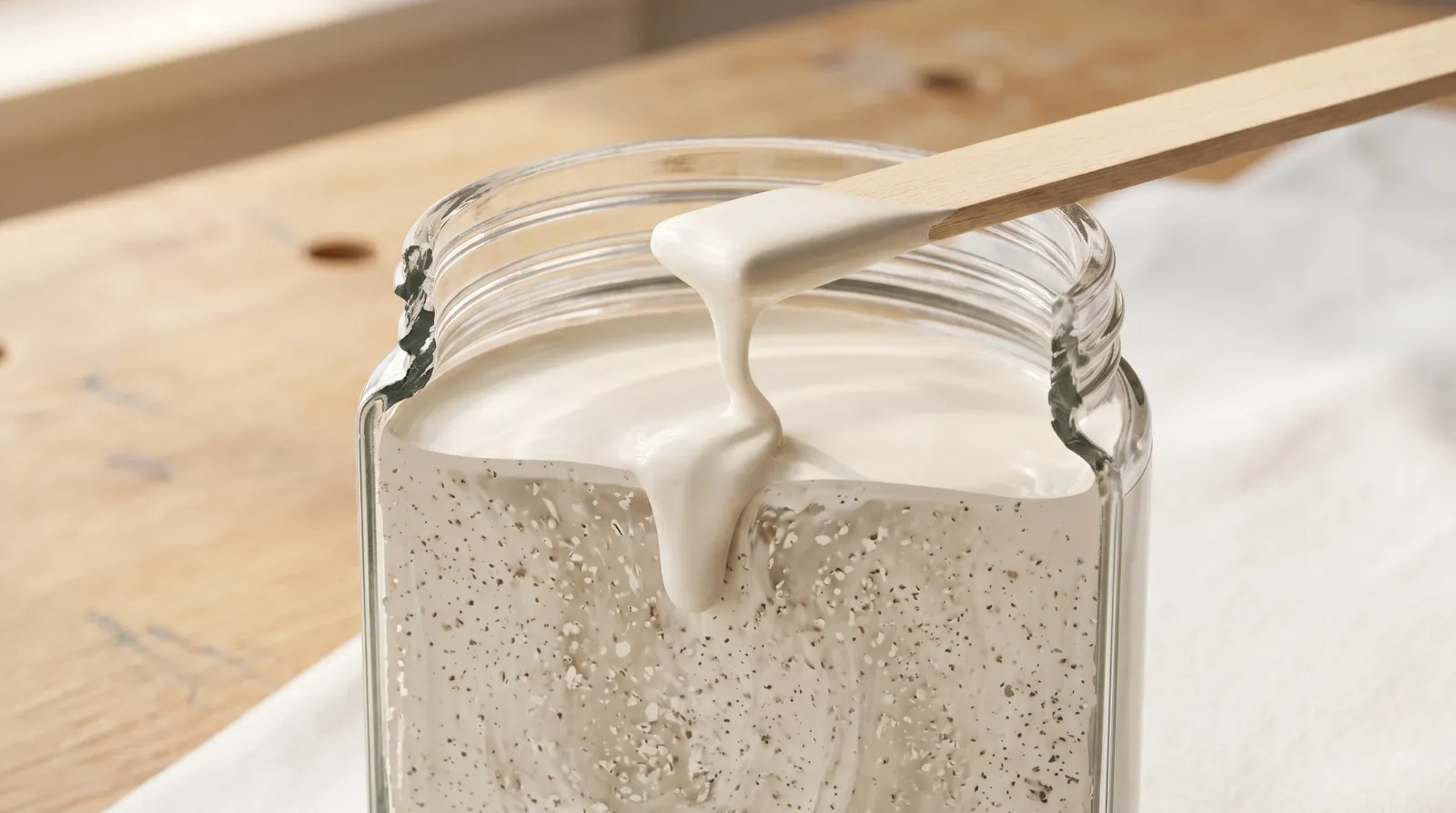
Most paint problems people blame on color or sheen are actually binder problems. The wall looks chalky a year in. The bathroom paint burnishes after the second cleaning. The trim cracks at the miter inside two seasons. None of that is the pigment’s fault. The pigment is just sitting there. The binder is the part of the formula that holds the pigment down and sticks it to the wall, and it’s the single biggest variable separating a $32 gallon from an $85 one.
The reason for that is the binder does almost all the work that matters in the cured film. Adhesion to the substrate, flexibility through humidity swings, washability under a sponge, gloss retention through UV — those are binder properties. Pigment provides color and opacity. Solvent (water in waterborne paint, mineral spirits in alkyd) is just the truck that carries everything to the wall and then leaves. Once the truck drives away, only pigment and binder are left, and the binder is what makes them stay.
What’s Actually in the Can
Every architectural paint is four things. Knowing the rough proportions makes the price ladder stop being mysterious.
| Component | Share of the wet paint | Does it stay on the wall? |
|---|---|---|
| Binder (resin) | 20–40% by weight | Yes — it is the film |
| Pigment (prime + extender) | 20–40% | Yes, held by the binder |
| Solvent (water, glycols, spirits) | 20–40% | No, it evaporates |
| Additives (thickeners, defoamers, biocides) | 2–8% | Trace amounts remain |
Only the first two rows survive. That’s why the number worth finding on a data sheet is volume solids — the percentage of the wet gallon that is left behind once the carrier is gone. A premium interior wall paint runs 35–42% volume solids. A bargain contractor flat can run under 25%. Roll both at the same 4 wet mils and the premium paint leaves roughly 1.6 dry mils of film while the cheap one leaves about 1.0. The mil thickness explainer covers why that difference decides whether a color covers in two coats.
The Common Binder Types, in Plain English
Every paint can on the shelf uses one of a half-dozen binder families. The trade-offs are well understood. Match the binder to the surface and the abuse it’ll see.
PVA (polyvinyl acetate). The cheapest waterborne binder. Soft film, decent adhesion to drywall, poor washability, no real flex. Lives on contractor flat ceiling paint and bargain interior wall paint. Fine on a closet wall, wrong on a bathroom.
Vinyl-acrylic. A blend of PVA and acrylic, usually 30–70% acrylic. Mid-tier interior paint sits here. Better washability than straight PVA, decent adhesion on sound primed drywall, embrittles under sun and seasonal cycling. Honest for bedroom and hallway walls, wrong for exteriors or wet rooms.
100% acrylic. The all-acrylic resin film. Harder, more flexible, bonds to chalky and glossy substrates that vinyl-acrylic slides off of. Every premium interior and every legitimate exterior line is built on this binder. The deep version of why is in the 100% acrylic explainer, and the naming confusion between “latex” and “acrylic” is untangled in latex vs acrylic paint.
Alkyd. The traditional oil-based binder, cured by oxidation rather than coalescence. Self-levels beautifully on trim, dries to a hard glossy film, yellows on whites under low light over 12–18 months, throws real VOCs while it cures. Waterborne alkyds (Benjamin Moore Advance, Sherwin-Williams ProClassic, PPG Break-Through) marry alkyd film properties to a waterborne carrier and dodge most of the yellowing — the trade-offs are laid out in waterborne alkyd vs traditional alkyd.
Urethane (and urethane-modified acrylic). The hardest of the room-temperature-cure binders short of epoxy. Survives daily scrubbing and abrasion. Sherwin-Williams Emerald Urethane Trim Enamel and Benjamin Moore Command sit here. Trim, doors, vanity cabinets, banisters — anywhere the film takes contact. See urethane vs acrylic for where the extra cost stops paying off.
Epoxy. Two-part, chemically cross-linked, the hardest binder available. Consumer garage floor kits from Rust-Oleum and similar run 50–100% solids because the amine hardener, not evaporation, forms the film. Aggressive smell while curing, almost indestructible after.
Binder Families Side by Side
| Binder | Cure mechanism | Film hardness | Flex | Typical scrub class | Belongs on |
|---|---|---|---|---|---|
| PVA | Coalescence | Soft | Poor | III or below | Ceilings, closets |
| Vinyl-acrylic | Coalescence | Medium | Fair | II | Bedrooms, hallways |
| 100% acrylic | Coalescence | Hard | Excellent | I | Everything exposed or washed |
| Alkyd | Oxidation | Very hard | Poor, embrittles | I | Traditional trim, metal |
| Waterborne alkyd | Coalescence + oxidation | Very hard | Good | I | Trim, doors, cabinets |
| Urethane / urethane-acrylic | Coalescence + cross-link | Hardest waterborne | Good | I+ | High-contact trim, cabinets |
| Two-part epoxy | Chemical cross-link | Extreme | Rigid | Off the chart | Concrete floors, tanks |
Tg and MFFT: Why the Binder Sets Your Painting Weather
Here’s the part almost nobody explains, and it’s the reason a perfectly good gallon can fail on a cold Saturday.
A waterborne binder arrives in the can as microscopic polymer spheres suspended in water. Film formation happens when the water leaves and those spheres deform, pack, and fuse into one continuous sheet — that’s coalescence. Whether the spheres are soft enough to fuse depends on a number called Tg, the glass transition temperature. Below Tg the polymer is rigid and glassy; above it, rubbery and deformable.
Architectural acrylic binders are engineered with a Tg somewhere between about −15°C and +40°C (roughly 5°F to 104°F), and formulators dial it by mixing monomers. Butyl acrylate has a Tg near −45°C and makes the film soft and flexible. Methyl methacrylate sits at +105°C and makes it hard and glossy. A trim enamel leans hard; an elastomeric exterior coating leans soft so it can bridge hairline stucco cracks through summer expansion.
Because a high-Tg binder wouldn’t fuse at room temperature on its own, formulators add coalescing solvents that temporarily soften the spheres and then evaporate. The practical output of all that chemistry is one printed number: MFFT, minimum film formation temperature. Most standard latex paints list 50°F as the application floor. Cold-weather exterior formulas carry extra coalescent and film down to 35°F. Paint below the MFFT and the spheres never fuse — you get a powdery, weakly bound film that looks fine for a week and then washes off in the first hard rain. That failure is not the applicator’s technique and it can’t be fixed by a second coat. More on the field side of this in painting in cold weather.
PVC: Why Cheap Paint Feels Chalky
The single most useful binder concept the back of the can won’t tell you is pigment volume concentration, or PVC. It’s the ratio of pigment to binder in the dried film, expressed as a percentage. A premium interior wall paint runs around 30–40% PVC. A contractor ceiling flat runs 70–80%.
Every paint has a critical PVC — CPVC, usually landing between 45% and 55% depending on binder chemistry and pigment particle packing. Below it, the binder fully wraps every pigment particle and locks it into a continuous film. Above it, there isn’t enough binder to go around. Pigment particles sit at the surface only partially bonded, and the film goes porous, chalky, and matte.
Most manufacturers tune PVC deliberately to hit a sheen and a price. Flat paint runs high PVC on purpose — extra pigment at the surface scatters light and kills sheen. Semi-gloss runs lower PVC because a smoother, denser binder film reflects light cleanly. So PVC sets both sheen and washability at the same time. That’s why a flat paint is harder to scrub than a semi-gloss in the same product line: not because flat paint is “weaker,” but because the same binder chemistry was used at a higher PVC ratio to hit the flatter look. Within one line, eggshell typically survives 5 to 10 times more scrub cycles than flat.
Budget paint cuts the binder fraction further to make the gallon cheaper, usually by swapping real binder volume for cheap extender pigments like calcium carbonate and clay. The PVC creeps above critical, the cured film loses cohesion at the surface, and a damp finger picks up chalk. The pigment is fine. There’s just not enough binder around it. Outdoors the same mechanism produces the white bloom homeowners call exterior chalking. The full PVC breakdown has the sheen-by-sheen numbers.
What It Looks Like on a Spec Sheet
The front of the can almost never tells you the binder. The technical data sheet (TDS) does — every premium manufacturer publishes one as a PDF on the product page. Look for the vehicle or composition section.
- “100% acrylic resin” / “all-acrylic emulsion” — high-tier waterborne. Trust the can.
- “Vinyl-acrylic copolymer” / “acrylic-vinyl latex” — mid-tier blend. Honest for low-abuse interiors.
- “Polyvinyl acetate” / “PVA latex” — budget waterborne. Fine for ceilings, wrong for walls you’ll touch.
- “Alkyd resin” or “modified alkyd” — oil-based film chemistry. Hard, glossy, yellows.
- “Waterborne alkyd” / “urethane-alkyd hybrid” — modern trim enamel. Best of both, more expensive.
- “Polyurethane dispersion” — pure urethane waterborne. Premium trim and cabinet category.
- “Two-component epoxy” — industrial coating. Garage floors, not bedroom walls.
A line saying simply “acrylic” with no qualifier is hedging. Check the manufacturer’s TDS or assume it’s a vinyl-acrylic blend. Premium lines advertise the binder loudly because the binder is what justifies the price.
What This Means When You’re Standing in the Paint Aisle
Three checks, in order, and you can skip everything on the front label.
1. Read the vehicle line, not the tier name. Brands rename tiers constantly. The binder doesn’t move. A “premium” line built on vinyl-acrylic is a mid-tier paint with a premium sticker; a quiet contractor line built on 100% acrylic is a bargain. Two data sheets, two minutes.
2. Compare volume solids at the same sheen. Within a sheen, higher volume solids means more binder and pigment per gallon. A 40% solids eggshell genuinely covers in two coats where a 24% solids eggshell needs three, so the cheaper gallon often costs more per finished wall once you count the extra coat and the extra Saturday.
3. Buy the binder the surface will actually test. Nothing tests a closet wall. Everything tests a stair rail. Bathroom steam tests flex and adhesion; south-facing siding tests UV and gloss retention; a kitchen wall behind the range tests scrub resistance. Pay for binder where the wall will ask a question of it, and stop paying where it won’t.
That last point is where most overspending happens. People buy a $90 gallon of top-tier acrylic for a formal dining room that gets wiped twice a decade, then buy builder flat for the hallway their kids drag backpacks along. Reverse it. Put the strongest binder — a waterborne alkyd or urethane from any of the major lines — on trim and cabinets, a solid 100% acrylic on anything wet or sunlit, and let the low-traffic rooms take the mid-tier blend.
The Practical Takeaway
The whole binder conversation collapses into one rule: match the binder family to what the wall will actually do. Closet wall that nobody touches — PVA or vinyl-acrylic is honest paint. Bedroom wall in low traffic — vinyl-acrylic. Anything that gets washed, hit by sun, or moves with humidity — 100% acrylic, no exception. Trim, doors, cabinets, banisters — urethane or waterborne alkyd. Garage floor, pool deck, industrial concrete — epoxy.
Then give the binder time to finish. Coalescence keeps going for about a month after the wall looks dry, and the difference between dry and cured is exactly the difference between a film that survives its first scrub and one that doesn’t.
Buy paint by the binder, not by the brand on the front of the can. The brand mostly tells you who tuned the formula. The binder tells you what the cured film will actually do on your wall in year three.
Ask a Question