Spray vs Roll vs Brush: Which Method Wins by Job
A jobsite-tested verdict on the three application methods. Where airless and HVLP genuinely beat a 9-inch roller, and where the sprayer is the wrong tool.

The 30-Second Answer
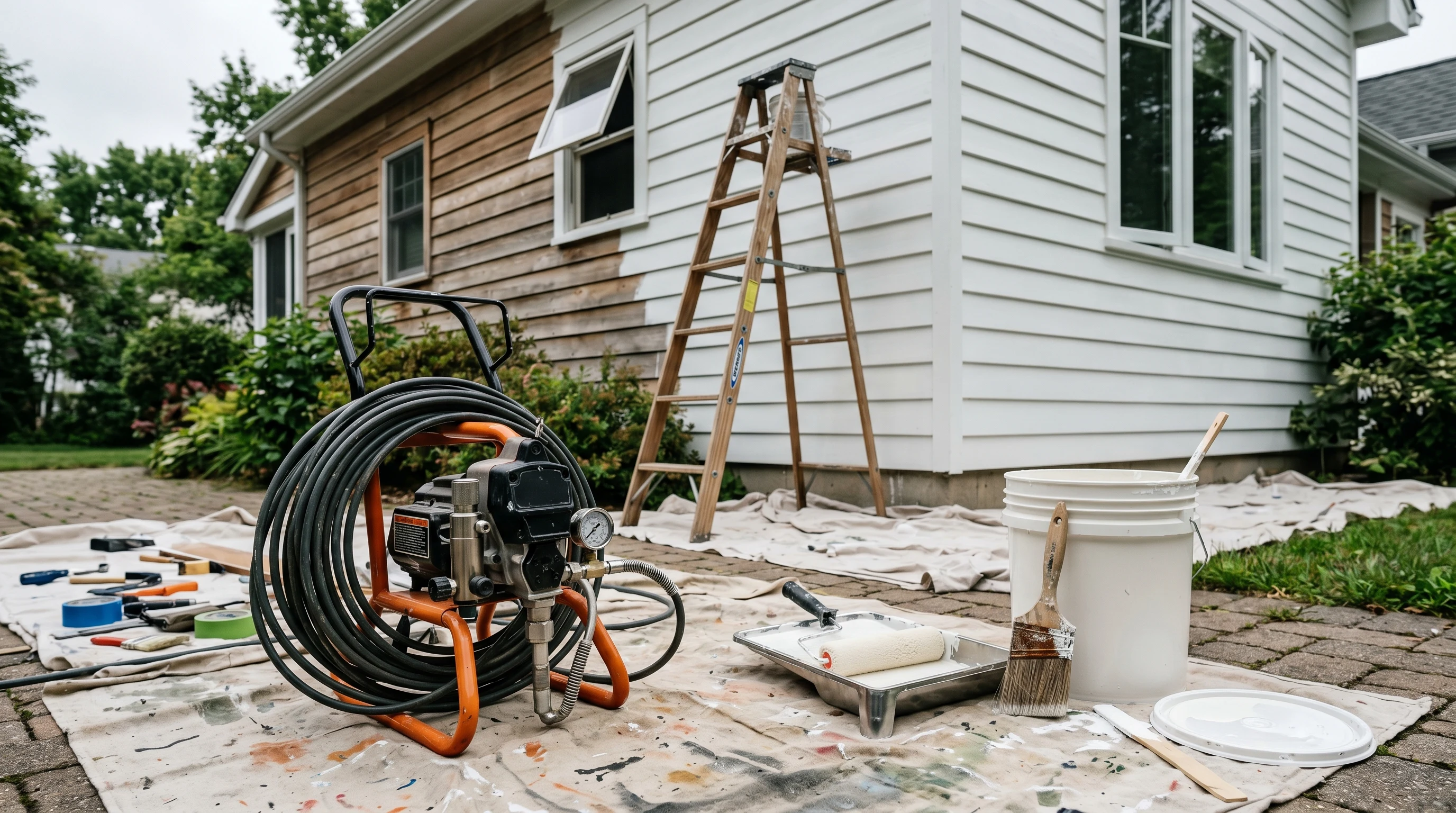
If you’re spraying a 12×14 bedroom you’re chasing the wrong efficiency. Spray wins on big bare surfaces: exterior siding, fences, garages, cabinet doors off the hinge. Roll wins on interior walls and ceilings. Brush wins on cut-in, trim profiles, and touch-ups. Most pro repaints are roll and brush. The sprayer comes out for bare siding over 1,500 sq ft and for full-cabinet jobs in a garage. Mid-size interior jobs almost never justify it.
At a Glance
| Spray (airless / HVLP) | Roll & brush | |
|---|---|---|
| Speed on large surfaces | ✓✓ (4–8× faster) | ✓ |
| Finish quality on flat panels | ✓✓ (HVLP wins) | ✓ (stipple from roll, marks from brush) |
| Prep & masking time | ✗ (huge) | ✓ (minimal) |
| Transfer efficiency | ✗ (airless 30–50%, HVLP 65–80%) | ✓✓ (roller 90%+) |
| Reach into trim profiles | ✓ (airless w/ small tip) | ✓✓ (brush wins) |
| Tool cost | ✗ ($300–1,500 + maintenance) | ✓ ($30 of consumables) |
| Cleanup | ✗ (30–45 min airless) | ✓ (5 min) |
| Learning curve | ✗ (real) | ✓ |
The Three Methods, Plain
Airless spray atomizes paint by forcing it through a tiny tip at 1,500–3,000 PSI. Graco Magnum X5 and X7 are the entry-level homeowner units; Graco TrueCoat handhelds work for spot jobs. Big tip sizes (.015–.021) move a lot of paint fast on siding, fences, masonry. Small tips (.009–.013) handle cabinets and trim if you can hold a steady hand.
HVLP (high-volume, low-pressure) atomizes with a turbine. Wagner FlexiO is the consumer line. The spray pattern is gentler, the overspray cone is tighter, and finish quality on flat panels is the best the three methods can produce. The trade-off: it’s slow on big surfaces. You won’t paint a house with one.
Roller is what most rooms want. A 9-inch frame with a 3/8” or 1/2” microfiber cover (Wooster Pro/Doo-Z is the workhorse) lays paint at 90%+ transfer efficiency. Mini-rollers handle cabinets and trim where you can’t fit the big one.
Brush is the cut-in tool, the trim tool, and the touch-up tool. A Purdy XL Glide 2.5-inch sash brush does most of what a residential painter needs for the next ten years. Spend the $25.
Speed on Large Surfaces
This is where spray earns its place. On bare exterior siding with no windows to mask, an airless lays paint 4 to 8 times faster than a roller. A two-person crew can shoot a 2,500 sq ft house in a day where rolling would take three. Same math on a 200 ft fence: half a day with a sprayer, two days with a roller.
That speed evaporates the moment you have to mask. Two hours taping and tarping a furnished kitchen to spray walls cancels the speed advantage and then some.
Winner: Spray, but only when masking is minimal.
Finish Quality
HVLP wins on cabinet doors and fine furniture, full stop. The tight overspray cone and the low atomization pressure lay an even film with no stipple and no brush marks. This is why every cabinet shop owns one.
Airless on siding produces a finish indistinguishable from a roller at three feet, which is the only distance anyone will ever look at it. On interior walls, airless leaves a slightly smoother surface than a roller, but you almost never spray interior walls (see masking, above).
A roller leaves stipple. A 3/8” microfiber leaves less; a 1/2” nap leaves more. On walls, stipple is fine. It’s what walls look like. On a flat cabinet door, stipple is a defect.
A brush leaves marks. Self-leveling waterborne alkyd (Advance, Emerald Urethane) makes those marks disappear within a few minutes if the temperature and humidity cooperate. Cheap latex doesn’t level, and the marks lock in.
Winner: HVLP on cabinets and trim. Roller on walls. Tie on siding.
Prep & Cleanup Time
Spray prep is the hidden cost. Every horizontal surface gets tarped. Every vertical surface that isn’t getting paint gets masked: windows, doors, light fixtures, outlets, soffits, gutters, anything within ten feet of the gun. Indoor spray also means sealing rooms with plastic and running a fan.
Roll-and-brush prep is a drop cloth and ten minutes of taping the trim line if you’re picky about it.
Cleanup mirrors the same gap. Airless takes 30–45 minutes if you do it right: flush the line, pull the tip and filter, soak both, run a pump-saver shot. Skip steps and the gun seizes within a week. HVLP cups clean in 20 minutes. A roller and brush clean in five.
Winner: Roll & brush, by a wide margin.
Paint Waste
Transfer efficiency is paint that lands on the surface versus paint that becomes overspray. Outdoors with an airless, 30–50%. Indoors, 50–65%. HVLP runs 65–80%. A roller is 90%+. A brush is essentially 100%.
That math hits hardest with expensive paint. Spraying $80-a-gallon cabinet paint at 50% transfer efficiency means half your gallon is on the floor.
Winner: Roll & brush.
Reach into Trim Profiles
A brush gets into the bead on a Colonial casing, the lip of a panel door, the inside corner of a window stool. Nothing else does, cleanly. Airless with a small tip can shoot trim profiles, but you’ll over-spray the wall behind it. HVLP is too slow to do the trim of a whole house.
Winner: Brush, then airless with a small tip, then HVLP last.
Tool Cost & Learning Curve
A Wooster roller frame, a Doo-Z cover, a Purdy XL Glide 2.5-inch sash brush, a tray, and a five-in-one. Thirty bucks. Anyone can use them in an hour.
A Graco Magnum X5 is $300–400. An X7 with a longer hose is $500–700. A pro-grade Graco airless is $1,500–3,500. A Wagner FlexiO HVLP is $150. All of them have a learning curve (tip selection, pressure setting, gun distance, overlap pattern) that takes a weekend on cardboard before you should point it at someone’s house.
Winner: Roll & brush.
Where Each Method Genuinely Wins
- Airless spray: exterior siding 1,500+ sq ft, fences, garage interiors, masonry walls, soffits — anywhere masking is minimal because there’s not much that isn’t getting painted.
- HVLP spray: cabinet doors off the hinge, interior trim and doors disassembled in a garage, fine furniture refinishing. Small surfaces with finish-quality demands.
- Roller: interior walls, ceilings, exterior siding under 800 sq ft, anywhere masking would dominate spray prep.
- Brush: cutting in walls and ceilings, trim profiles, doors that have to stay installed, touch-ups, small repairs.
The hybrid jobsite reality: most pro repaints are roll-and-brush. Spray shows up for bare exterior siding and full-cabinet jobs. That’s it. Don’t let the existence of the tool talk you into using the tool.
Verdict by Use Case
- Pick spray (airless) if: you’re shooting bare exterior siding, a long fence, a garage interior, or masonry. Job is over 1,500 sq ft of surface, masking is minimal, you have the gun and you’ve used it before.
- Pick spray (HVLP) if: the job is cabinet doors off the hinge, interior trim and doors disassembled, or furniture refinishing. Finish quality is the whole point and you can work in a controlled space.
- Pick roll if: interior walls, ceilings, smaller exteriors, anywhere a sprayer would mean two hours of masking to save twenty minutes of paint time.
- Pick brush if: cutting in, trim profiles, doors that have to stay installed, touch-ups.
Top Picks by Side
Going with spray? See best paint sprayers → for the airless and HVLP shortlists. Going with roll & brush? See best paint rollers → and best paint brushes →.
What’ll Bite You in Two Years
Two failure modes show up after a few seasons. First: a sprayed exterior with thin coverage on the lap edges, because the operator didn’t back-roll behind the gun. Backrolling forces paint into the substrate; spraying alone lays it on the surface. By year two on a south-facing wall, the un-backrolled film has chalked and the lap shadows show. Second: a sprayer left dirty for a week. The pump’s check valves gum up, the packings dry out, and the next job starts with a $200 repair kit. If you don’t have time to clean it the day you used it, you don’t have time to own one.
Ask a Question