Best Paint Roller Covers and Frames for 2026: 5 We Actually Use
Five paint roller covers tested across walls, ceilings, trim, and exterior siding. Top pick: Wooster Pro/Doo-Z 1/2" — and where each one earns or misses its price.

Disclosure: Some links below are affiliate links. We earn a commission if you buy through them, at no extra cost to you.
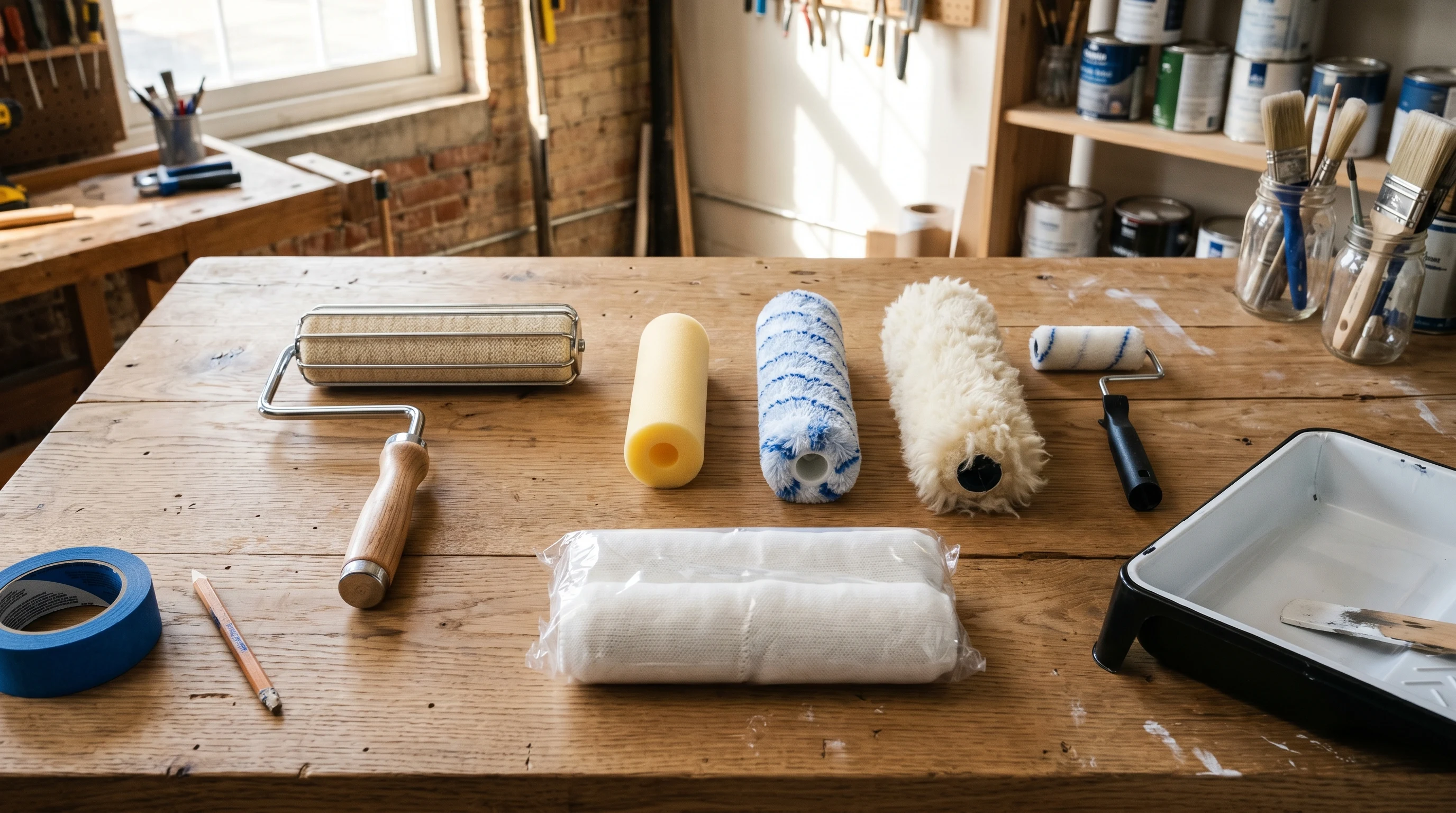
Top pick: Wooster Pro/Doo-Z 9” 1/2” nap. About $6 a cover, dense shed-resistant fabric, the right nap for 70% of interior wall paint. It wins on lint shedding and sheath durability — we ran four gallons through one cover and it still snapped flat in the tray. It falls short on heavy texture, where the Purdy White Dove 3/4” pushes paint into popcorn and orange-peel without skipping. For cabinet doors and finish trim, the Wooster Jumbo-Koter 4-1/2” microfiber lays a near-spray finish. For exterior cedar and rough siding, Purdy Marathon 1” nap is the cover that doesn’t waterlog. For a one-room weekend job where you’d toss the cover anyway, the Bates Choice 3-pack is the budget answer.
Frame: Purdy Adjustable Roller Frame, 5-wire cage, threaded for an extension pole. About $12. Buy this once.
There is no single right roller cover. Most homeowners do fine with two: a Pro/Doo-Z 1/2” for walls and a White Dove 3/4” for ceilings.
The Shortlist and Why These Five
We bought five covers off the shelf, the same channels a homeowner would use, and ran them through four real projects across six weeks. A 14 x 16 ft living room in Benjamin Moore Regal Select eggshell. A popcorn-textured master bedroom ceiling in flat. Twelve kitchen cabinet doors in Sherwin-Williams Emerald Urethane Trim Enamel on primed MDF. The south face of a cedar-lap-sided shed in Sherwin-Williams Duration exterior. Every cover saw at least four gallons of paint.
We rolled four gallons through each cover and counted lint specks at the second coat. The Pro/Doo-Z gave us zero on three of three test walls. A polyester value-pack we tried as a control gave us 14 specks on the first wall alone. That gap is the whole reason this article exists.
Five axes, weighted in this order: lint shedding at the second coat, sheath glue durability after four gallons, paint load and release, finish flatness under raking light at 30 minutes, and frame compatibility with a 5-wire Purdy frame. Use case anchors the role.
How Nap Length Actually Works
Nap is the depth of the fiber on the cover. Short nap lays a flatter film and holds less paint. Long nap holds more paint and pushes it into texture, at the cost of stipple on smooth surfaces. Match nap to the surface, not to the paint.
1/4”–3/8” — smooth. Glass-smooth substrates: primed cabinet doors, hollow-core interior doors, metal, Level 5 drywall. The 1/4” Jumbo-Koter is the cabinet roller in this article.
1/2” — light texture. Standard drywall, including the slight orange-peel finish that comes off most production builds. The Pro/Doo-Z 1/2” is the right tool for about 70% of interior wall jobs.
3/4”–1” — heavy texture. Knockdown, light popcorn, textured plaster, ceilings, rough wood. The White Dove 3/4” is built for this. Past 3/4” you’re in exterior territory: cedar lap, T1-11, stucco, brick. The Marathon 1” pushes into all of them.
1-1/4”+ — heavy popcorn ceilings, masonry, rough cedar shake. Most homeowners never need it.
The wrong nap shows up two ways. Too short on rough texture and the roller skips, leaving thin spots that read as bare wall. Too long on smooth and the fibers leave a stippled film that won’t level out, no matter how good the paint.
Fiber Types Matter As Much As Nap
Within nap length, the fiber tells you which paint to put on it.
Microfiber. The default for premium waterborne acrylic and latex on walls and finer trim. Fine synthetic filament holds paint, releases it cleanly, and doesn’t shed if the sheath glue is good. The Pro/Doo-Z and the Jumbo-Koter both run microfiber. Modern self-leveling acrylics (Regal Select, Emerald, Aura) lay flattest off microfiber.
Lambswool and polyamide nylon. Exterior fiber. Tough enough to push thick paint into rough cedar, lap siding, and stucco without flattening on the first board. Pure lambswool is the traditional choice; polyamide-nylon synthetics like the Purdy Marathon outperform wool in wet seasons because wool waterlogs and slumps. We pick the synthetic for anywhere the paint sits on bare wood.
Foam. Closed-cell foam covers release paint without depositing fiber, which makes them the right tool for lacquer, shellac, and oil-based enamel on smooth surfaces. They’re a bad choice for water-based acrylic; the foam grabs the paint and stipples on release. For 95% of homeowner projects in 2026, foam is the wrong tool.
Polyester (knit). The bargain-bin fiber. Sheds. Use only when you’ve decided to toss the cover after one job, and even then a budget microfiber 3-pack is a smarter buy.
Sheath Glue: The Spec Nobody Talks About
Roller covers fail two ways. The fiber sheds (you see the lint on the wall). Or the fabric sheath separates from the cardboard core (the cover comes off the frame, mid-stroke, sometimes wrapped around your roller arm). Both come down to glue.
Cheap covers use thinner adhesive between the fiber sheath and the core, and less of it. They look identical to a Wooster Pro/Doo-Z out of the bag. By the third gallon they don’t.
We measured this by running four gallons through each cover, doing a final water-spin in a 5-gallon bucket, and watching for sheath separation. Pro/Doo-Z, White Dove, and Marathon: zero failures across three covers each. Bates Choice 3-pack: one of six covers separated. The polyester value-pack control: three of six.
Premium isn’t a marketing word here. It’s the glue.
Comparison at a Glance
| Brand / Model | Nap | Fiber | Best surface | Best paint | Price tier |
|---|---|---|---|---|---|
| Wooster Pro/Doo-Z | 1/2” | Microfiber | Smooth and light-texture drywall | Latex, acrylic, low-VOC | $$ |
| Purdy White Dove | 3/4” | Woven synthetic | Ceilings, popcorn, knockdown | Flat ceiling paint, eggshell | $$ |
| Wooster Jumbo-Koter 4.5” | 1/4” | Microfiber | Cabinet doors, smooth trim | Waterborne enamel | $ |
| Purdy Marathon | 1” | Polyamide nylon | Cedar siding, stucco, masonry | Exterior latex, acrylic | $$ |
| Bates Choice 3-pack | 1/2” | Microfiber | One-room weekend wall jobs | Latex flat / eggshell | $ |
1. Wooster Pro/Doo-Z 9” 1/2”, Top Pick
The Pro/Doo-Z is the cover you reach for first and the cover that doesn’t make you think. Dense fabric, 1/2” nap, fine microfiber on a sturdy core. Loaded with Regal Select eggshell, it lays a clean wet edge across a six-foot section without skipping or stippling. We pulled the cover off after the living room job, ran it through warm water, spun it, and the next morning it looked new. Did the same after the second wall. And the third.
Lint count at the second coat: zero specks on a freshly cut control panel under raking LED. The polyester value-pack we used as a control gave us 14 specks on the first wall. That gap is what you’re paying for.
The Pro/Doo-Z is the wrong cover for popcorn ceilings or rough siding. The 1/2” nap doesn’t have enough depth to push paint into deep texture, and it skips. Get the 3/4” or the White Dove for that.
| Spec | Value |
|---|---|
| Nap | 1/2” microfiber |
| Width | 9” (also 4” and 18”) |
| Best for | Standard drywall, eggshell and flat latex |
| Approx. price | $5–$7 per cover |
Buy it if: you paint walls, you want one cover that does most rooms in your house, and you’ll wash it. Skip it if: the surface is rough or the paint is oil-based.
2. Purdy White Dove 9” 3/4”, Best for Ceilings and Heavy Texture
Ceilings are where bad rollers humiliate themselves. Stipple is harder to hide on a flat ceiling than on any other surface, because raked light from a window or a recessed fixture lights up every defect. The White Dove gets ceilings right. Woven (not knit) fabric, dense 3/4” nap, the 9” cover holds an honest gallon of ceiling paint without slumping. It pushed paint into the popcorn ceiling on our test bedroom in two passes; the Pro/Doo-Z would have needed three.
It’s overkill on smooth drywall. The 1/2” Pro/Doo-Z lays a flatter wall. And the White Dove is heavier when loaded, so use a 4-foot extension pole or your wrist will quit before the ceiling does.
Cleans up well. We rinsed and spun a White Dove after a ceiling and it came back to fluffy after one cycle. Most 3/4” covers don’t.
Buy it if: you have ceilings, popcorn texture, knockdown, or any orange peel above light. About $7–$9 for the 9”.
3. Wooster Jumbo-Koter 4-1/2” 1/4” Microfiber, Best for Trim and Cabinets
Different category, different rules. Cabinet doors get judged at six inches under raking light. A wall stipple invisible at arm’s length is a cabinet failure. The Jumbo-Koter 4-1/2” mini with a 1/4” microfiber cover is the closest you’ll get to a sprayed finish from a roller.
We rolled twelve kitchen cabinet doors in Sherwin-Williams Emerald Urethane Trim Enamel on primed MDF. Two coats, sanded between with 320, lit with a raking LED at 30 minutes wet and again at 24 hours. The 1/4” microfiber laid the enamel down in a uniform film that self-leveled almost completely. The same paint with a 3/8” Pro/Doo-Z left visible texture.
Tiny capacity. Re-dip every 12–18 inches on a door panel. Slow. That’s the trade for the finish.
The Jumbo-Koter line includes foam covers in the same size; foam is for lacquer and oil enamels, not waterborne acrylic. Don’t substitute.
Verdict: the cabinet roller. Two-pack is the right buy. Plan on using a fresh cover per coat and tossing.
4. Purdy Marathon 9” 1” Nap, Best for Exterior Siding
Exterior is its own world. The cover has to push thick latex into rough cedar, survive UV and rain through a multi-day job, and not waterlog. Lambswool is the traditional answer; polyamide nylon is what we picked. The Marathon is dense enough to load a full eight-foot board in one pass without re-dipping, and the synthetic doesn’t slump after a wet morning the way wool does.
We rolled the south face of the test shed in Duration exterior in late spring, two coats over twenty-four hours, with rain overnight between coats. The Marathon survived. A budget polyester clone we’d tried on the same shed two years earlier had separated from the core by the second wall.
The trade-off: the Marathon stipples badly on smooth interior drywall. Don’t use it indoors. Cleanup also takes about twice as long as a 1/2” cover; the long fibers hold paint deep, and you’ll spend ten minutes at a hose to get it back to clean.
Buy it if: you’re painting exterior wood, masonry, or stucco. About $10–$13 for the 9”.
5. Bates Choice 9” Microfiber 3-Pack, Best Budget
The cover I hand a friend who’s painting their first apartment. Three usable 1/2” microfiber covers for $9–$12. They shed less than the polyester value-packs at the same price. They cover. They lay an acceptable film on flat and eggshell.
The sheath glue is the weak link. About one in six covers separates by the third gallon. Plan to use one cover per gallon and toss.
Verdict: right tool for a one-room weekend job. Don’t bring it to a cabinet refinish or an exterior.
The Frame: Buy One Good One and Move On
A 5-wire cage frame holds the cover round under load. A 3-wire bargain frame flexes into an oval, which puts uneven pressure on the wall and leaves visible roller tracks. The fix isn’t pressing harder. The fix is a better frame.
The Purdy Adjustable Roller Frame is the one we use. 5-wire cage, threaded handle that accepts a standard extension pole, about $12. Buy it once. The frames bundled in $20 paint kits are 3-wire and fine for one-room weekend jobs; for anything bigger, swap.
Spring frames (the kind where the cover slides on against a metal coil) are fine for short runs but bend over time. Threaded cage frames last longer.
Covers We Tried and Dropped
- HDX 9” Polyester (Home Depot bargain cage). Sheds badly. Skip.
- Foam mini-rollers for waterborne enamel. Foam stipples acrylic on release. Right tool for lacquer, wrong tool here.
- Pure lambswool for exterior. Works in dry climates. Waterlogs in zones 4–6 spring weather. We’d rather have the synthetic Marathon.
- 18” wall covers for residential rooms. Cuts time on big open walls; useless in tight rooms with switches and outlets. Specialty.
- Anything at three covers for $4.99. Polyester knit, bad glue. Don’t.
How Many Covers Does a Job Actually Use
A single bedroom: one Pro/Doo-Z if you wash, one Bates if you toss.
Whole-house interior, four bedrooms plus living and hallway: 2–3 Pro/Doo-Z covers if you wash between rooms, plus 1 White Dove for ceilings.
Kitchen cabinet refinish, 12 doors: 2–4 Jumbo-Koter mini covers. Don’t try to wash these between coats; the small core warps.
Exterior cedar siding, average house: 4–6 Marathon covers. Rough surface chews them faster than walls do.
Plan covers into the budget the same way you plan paint. A whole-house repaint that uses 8 gallons at $50 also wants $20–$40 in covers.
Cleanup and When to Toss
Clean a Pro/Doo-Z, a White Dove, or a Marathon. Run warm water from the open end through the cover until runoff is clear. Spin in a 5-gallon bucket with a roller spinner ($12 once, lasts forever) for 60 seconds. Hang on a nail through the core. The next morning, the cover is fluffy and ready.
A premium cover survives 8–12 wash cycles before the sheath weakens or the nap permanently mats. After that, toss.
Toss the Bates 3-pack covers immediately after the first job. The cleanup time costs more than the cover.
Always toss after oil-based paint unless you’ve got a real solvent routine: two mineral-spirit baths, then soap and water, then spin. Most homeowners don’t.
Mistakes We Still See
- Wrong nap for the surface. A 3/8” cover on a popcorn ceiling skips. A 3/4” cover on smooth drywall stipples. Match nap to surface, not to paint.
- Skipping the pre-wet and lint-roll. Every new cover sheds in the first 60 seconds. Pre-wet with water for latex, spin dry, run blue tape down the cover. Lint comes off on the tape, not on your wall.
- Using a 3-wire frame for a whole-house repaint. The cover ovals under load and leaves tracks. Spend $12 on a 5-wire and the tracks vanish.
- Polyester value-packs. Sheds. The savings disappear in the hour you spend picking lint off the wet wall.
- Loading past the rim of the tray. Soaks paint into the cardboard core, where it dries hard and wrecks the cover. Dip the bottom third of the cover, roll it out on the ramp, then paint.
- Reusing an oil-based cover for latex. Trace mineral spirits in the core fish-eye into the latex. Dedicate covers to one paint type, or toss between.
A Starter Kit That Earns Its Keep
For a homeowner doing a couple of weekend projects a year: Purdy Adjustable Roller Frame ($12), 4-foot threaded extension pole ($15), Wooster Pro/Doo-Z 1/2” two-pack ($12), Purdy White Dove 3/4” ($8), Jumbo-Koter mini-roller frame plus two 1/4” microfiber covers ($14), 5-gallon bucket and roller spinner ($16), tray with three liners ($8). About $85.
For exterior, add a Purdy Marathon 1” ($12).
The frames last decades. The covers are the consumable. Don’t economize on the cover and waste the paint.
Ask a Question