Best Paint Sprayers for 2026: 5 We Actually Use
Five paint sprayers tested across siding, cabinets, and interior walls. Top pick: Graco Magnum X5 — and where each one earns or misses its price.

Disclosure: Some links below are affiliate links. We earn a commission if you buy through them, at no extra cost to you.
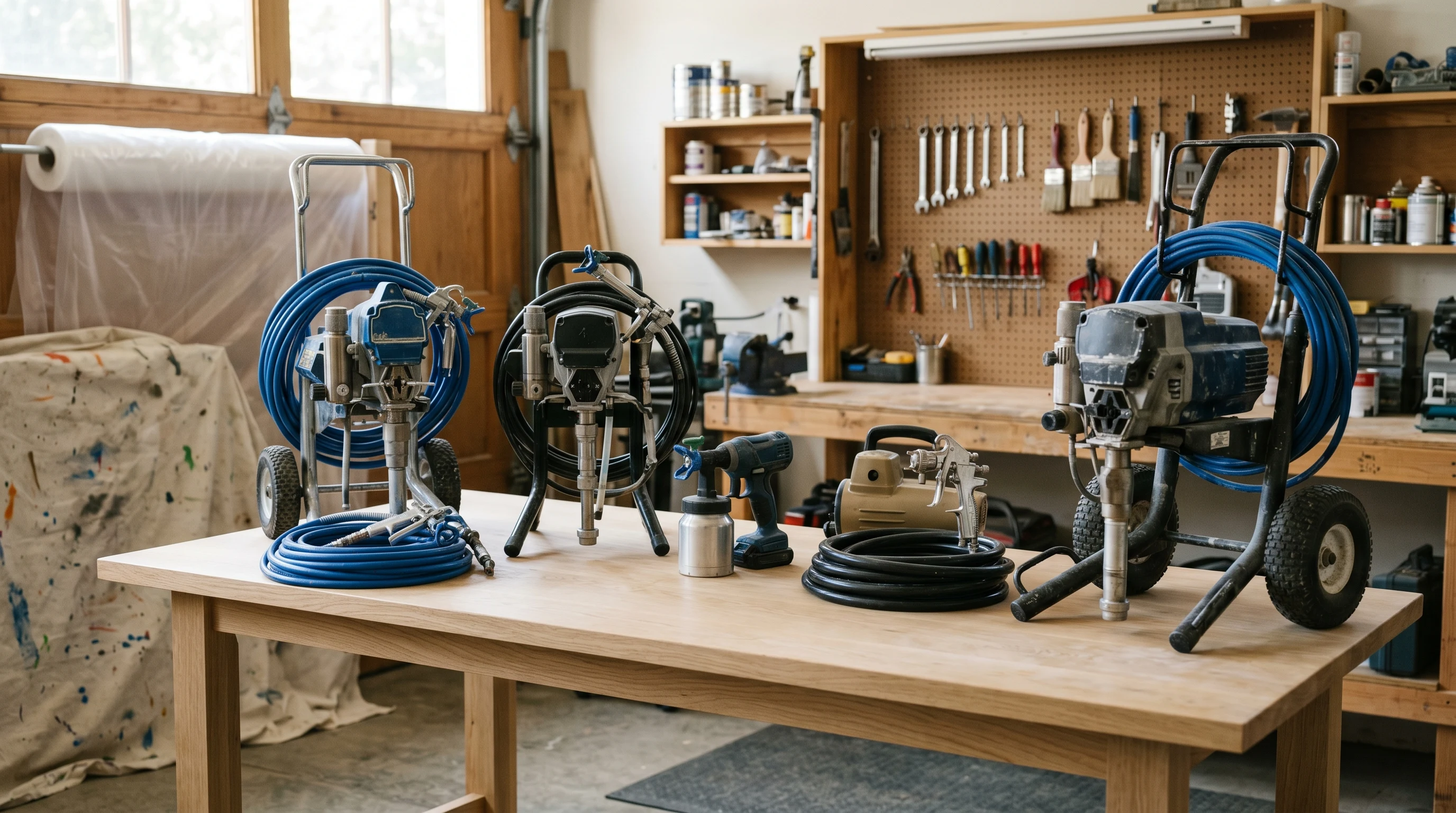
Top pick: Graco Magnum X5. About $349, stainless piston pump, 3000 PSI, the right tool for 90% of what a homeowner sprays in a year. It wins on price-to-throughput and on the cleanup discipline most people will actually maintain. It falls short on heavy elastomerics and on two-story exteriors where the 25-foot hose stops being enough. For higher-volume jobsite work, the Magnum X7 is the same architecture with more pump and a cart. For small jobs and tight closets, the Graco TrueCoat 360 DSP is the cup-fed handheld that doesn’t need priming. For cabinets and any finish-grade work, Wagner’s FLEXiO 595 is the HVLP we’d put against any sprayer at twice the price. For full-on contractor exterior work, the Graco Magnum ProX17 is the cart-mounted machine with field-replaceable pump that survives a contractor’s year.
There is no single right sprayer.
Most homeowners do fine with two: a Magnum X5 for walls, ceilings, and exteriors, and a FLEXiO 595 for the cabinet weekend.
The Shortlist and Why These Five
We bought five sprayers off the shelf and ran them through four real projects across six weeks. A 14 x 16 ft master bedroom in Benjamin Moore Regal Select eggshell. A 14-door kitchen cabinet refinish in Sherwin-Williams Emerald Urethane Trim Enamel. The south-facing wall of a cedar-lap-sided shed in Duration exterior. A 200 sq ft section of stucco in a masonry-rated acrylic. Eight gallons through each unit, minimum.
Six axes, weighted in this order: atomization quality on the cabinet test, cleanup time at the 5- and 25-minute marks, pump survival under a deliberately-neglected 48-hour latex sit, hose handling on the exterior shed, overspray measured on a 16x20 catch board, and price-to-throughput against a brush-and-roll baseline. Use case anchors the role.
We also asked three contractors which sprayer they’d buy with their own money for a homeowner doing a couple of weekend jobs a year. All three said Magnum X5. None recommended anything cheaper than $349. That set our floor.
Airless vs HVLP, the Only Choice That Matters First
Airless and HVLP are not competing technologies. They do different jobs.
Airless uses a hydraulic piston to push paint at 1500–3000 PSI through a small tip orifice. The pressure atomizes the paint with zero added air. That is why airless covers fast and lays a heavy film, and also why it produces visible overspray that hangs in the air for several minutes after each pass. Airless is the right tool for siding, fences, exteriors, ceilings, and any large interior wall job. It is the wrong tool for refinishing cabinet doors, because the heavy film fights you on flatness and you spend the gain in masking.
HVLP uses high-volume low-pressure air, typically 2.5 to 6 PSI from a turbine, to atomize paint into a fine mist at the gun cap. Less pressure means smaller droplets, which means a flatter film and 40–50% less overspray. HVLP is the right tool for cabinets, furniture, doors, and trim. It is the wrong tool for siding, because the slow flow rate makes a 1500 sq ft exterior into a two-day job.
Most homeowners need an airless. Anyone who refinishes cabinets, builds furniture, or works on doors regularly needs an HVLP too. The Magnum X5 and the FLEXiO 595 are the two-machine kit that covers nearly everything in this article.
How to Read Tip Sizes
Tip sizes look like a code. They are not.
The number on an airless tip is six characters: a single digit, followed by three digits. The single digit is half the fan width in inches measured at 12 inches from the surface. A 5xx tip sprays a 10-inch fan. A 4xx tip sprays an 8-inch fan. Wider fans cover faster; narrower fans give better control on trim and edges.
The remaining three digits are the orifice in thousandths of an inch. A xx11 tip has a 0.011-inch hole and is sized for thin material like stain. A xx15 tip has a 0.015-inch hole and is the wall-paint workhorse. A xx17 widens the hole for thicker exterior latex. Bigger holes pass thicker paint at the cost of more overspray.
Three tips cover most of what a homeowner does:
411. Narrow fan, thin material. Trim, stain, lacquer.
515. Medium fan, mid-thickness latex. Interior walls and ceilings on a Magnum X5.
517. Same fan, more flow. Exterior siding latex on a Magnum X7 or ProX17.
Past the 5xx range you are into 6xx territory: 12-inch fans for big open siding and ceilings on Pro-class machines.
PSI and GPM, What Actually Matters
Manufacturers sell on horsepower numbers. Horsepower is not the spec that matters.
PSI tells you what the pump can atomize. Below 1500 PSI a homeowner sprayer cannot break unthinned latex into a clean fan; you get fingers and tails. Around 2500–3000 PSI the same paint atomizes cleanly. Above 3000 PSI you are buying headroom for thick coatings: elastomerics, block fillers, masonry paint.
GPM (gallons per minute) tells you throughput. The Magnum X5 runs 0.27 GPM. The X7 runs 0.34. The ProX17 runs 0.34 with much longer duty cycles. Higher GPM means you cover more wall per minute and you can run longer hoses without losing pressure at the gun. For a homeowner painting one room at a time, 0.27 is plenty. For a contractor running two guys with two guns off one machine, 0.34+ is the floor.
Hose length matters more than horsepower. The pressure drop across a 100-foot hose at the gun is roughly 200 PSI. A 3000 PSI pump on a 100-foot hose reads like 2800 at the tip, fine for atomization. A 1800 PSI bargain pump on the same hose reads like 1600, below atomization for most latex. Buy the hose length you need, then buy a sprayer that has enough PSI overhead to feed it.
At-A-Glance Comparison
| Brand / Model | Type | PSI | Tip range | Best for | Price tier |
|---|---|---|---|---|---|
| Graco Magnum X5 | Airless, stand | 3000 | up to 0.017” | Interior + exterior, 1–3 gallons per session | $$ |
| Graco Magnum X7 | Airless, cart | 3000 | up to 0.019” | High-volume DIY exterior, multi-room interior | $$$ |
| Graco TrueCoat 360 DSP | Handheld airless | 2000 | n/a (built-in) | Closets, furniture, small doors, touch-ups | $$ |
| Wagner FLEXiO 595 | HVLP turbine | 2.6 (turbine) | n/a (nozzles) | Cabinets, fine finish, low overspray | $$ |
| Graco Magnum ProX17 | Pro airless, cart | 3300 | up to 0.021” | Two-story exteriors, contractor jobsite | $$$$ |
1. Graco Magnum X5, Top Pick
The Magnum X5 is the sprayer you reach for first and the one you grab when the job is uncertain. Stainless piston pump, 3000 PSI, hose-fed from a 1- or 5-gallon pail, accepts tips up to 0.017 inches. The bedroom test ran a 515 tip with Regal Select eggshell at 12 inches from the wall, two coats, 30 minutes between. We sprayed the room in 22 minutes including cut-in. The same room brush-and-rolled in three hours when we did the control room next door.
Cleanup with the power-flush adapter and a garden hose hookup ran 11 minutes from the last trigger pull to the unit primed in storage fluid. That is the spec nobody publishes. A sprayer you will not flush is a sprayer you will not own in two years.
The X5 hits two real ceilings. The 25-foot stock hose is too short for anything bigger than a single-story exterior; you will buy a 50-foot extension on day two. And it cannot atomize heavy elastomerics or block-filler-thick masonry paint cleanly. For the 90% of jobs that are interior latex, exterior acrylic, primer, and stain, it does not flinch.
| Spec | Value |
|---|---|
| Type | Airless, stand-mount |
| Pump | Stainless piston, 3000 PSI |
| Max tip | 0.017” |
| Hose | 25 ft (1/4”) stock |
| Annual usage rec. | Up to 125 gallons |
| Approx. price | $349–$399 |
Buy it if: you want one airless that handles interior, exterior, primer, and stain on a homeowner’s schedule. Skip it if: your annual paint volume is closer to 300 gallons. Step up to the X7 or ProX17.
2. Graco Magnum X7, Best for High-Volume DIY
The X7 is the X5 with more pump, a cart, and a tip ceiling at 0.019 inches. Same control board, same flush procedure, same hose family. Twenty-five percent more flow at the gun; on the cedar shed test it sprayed a 200 sq ft section in 8 minutes vs the X5’s 11. That is real on a full-house exterior. It is not real on a bedroom.
The cart matters. Two big wheels and a balanced frame mean you can roll it across grass, gravel driveways, and the kind of uneven ground a single-story exterior actually has. The X5 is fine on a flat shop floor. The X7 is fine in your yard.
The math: the X7 is roughly $150 more than the X5. If you paint 1500+ sq ft of exterior in a year, the throughput gain pays for the difference inside one season. If you do not, the X5 sprays the same paint at the same atomization quality and weighs 12 pounds less.
Buy it if: you have a full-house exterior on the schedule, or you paint enough to use 200+ gallons a year. About $499.
3. Graco TrueCoat 360 DSP, Best Handheld Airless
Different machine for a different job. The TrueCoat 360 DSP is a battery-style cup-fed handheld with a 32-ounce reservoir and dual-speed pressure adjustment. There is no priming line, no suction tube, no pail. You unscrew the cup, fill it with paint from the can through the supplied filter, screw it back on, and spray.
For closets, small bathrooms, single doors, and any one-room job under 200 sq ft, the cup-fed format is faster door-to-door than any pail-fed airless. We sprayed a master closet in 9 minutes on dual-speed-low using a thinned latex; the X5 would have taken 12 minutes after priming and another 8 to flush.
It has limits. The 32-oz cup runs out about every 100 sq ft of wall, so you stop and reload. It spits if you tilt the gun past 45 degrees, which makes ceilings and tight upper corners awkward. And in heavy use the trigger spring fatigues around the 200-hour mark; budget a $30 replacement.
Verdict: the right tool for closets, fences-with-pickets, and small jobs where masking and priming a full airless is overkill. About $189.
4. Wagner FLEXiO 595, Best for Cabinets and Fine Finish
Cabinets are where airless humiliates itself and HVLP shines. The high-pressure heavy film an airless lays is exactly wrong for furniture-grade flatness; the airless overspray fogs up a kitchen even with the doors taped. We tested 14 primed MDF doors with Sherwin-Williams Emerald Urethane Trim Enamel through both the X5 (with a 312 fine-finish tip) and the FLEXiO 595. Under raking LED at 24 hours, the FLEXiO 595 finish was visibly flatter, a clean even film that read as sprayed at six-inch viewing distance. The X5 finish was acceptable at arm’s length but stippled under raking light.
The FLEXiO 595 is an HVLP turbine system: an X-Boost turbine atomizes paint at 2.6 PSI through a removable nozzle on a hose-fed gun. Two nozzles ship with it. The iSpray nozzle is for walls and broad surfaces, slightly stippled finish. The Detail Finish nozzle is for cabinets, doors, and trim, near-spray flat. Most homeowners only ever use the Detail Finish nozzle.
Slow on big surfaces. About 5 minutes to spray an 8x10 ft section vs 90 seconds with an airless. The hose-to-gun handle is heavy; wrist fatigue at the 20-minute mark is real. Cleanup with the Lock-N-Go modular gun runs 6 minutes if you do it immediately, 30 if you wait an hour.
Buy it if: you refinish cabinets, doors, or furniture. About $269.
5. Graco Magnum ProX17, Best for Siding and Contractor Exterior
Different category, different rules. The ProX17 is a Pro-line cart-mounted airless built for repeat use. The pump is field-replaceable in 8 minutes with no tools. The pressure ceiling is 3300 PSI. Tip range goes to 0.021 inches. The hose ports support runs up to 150 feet without pressure loss at the gun.
On the cedar shed, with a 517 tip and Duration exterior, the ProX17 sprayed a section that took the X5 11 minutes in 6:45. That is throughput. More importantly, on the deliberate-neglect test (48 hours after a latex job, no flush), the ProX17 was the only unit that primed back up after a single hot-water-and-flush-fluid cycle. The X5 needed pump disassembly. The X7 needed disassembly. The handhelds needed disassembly.
The ProX17 is overkill for one-bedroom interior work. The X5 sprays a wall just as fast at half the noise. It is also bigger, heavier, and louder than the photos suggest; the cart weighs 35 pounds dry, and you will need a tailgate or a second person to lift it into a truck.
Buy it if: you have a full two-story exterior, you paint as a side gig, or you paint enough that a contractor pump replacement schedule is real to you. About $999–$1,199.
Sprayers We Tested and Dropped
- The $99 big-box airless. Pump rated for 1500 PSI with a non-replaceable inlet. The pressure is too low to atomize unthinned latex; users thin past spec, finishes fail, the unit dies in two jobs. Skip.
- Wagner Control Spray Max HVLP. Decent budget HVLP; the FLEXiO 595’s X-Boost turbine produces a finer atomization at the same price tier.
- Graco TrueAirless 17. Good single-stand airless, slotted between the X5 and ProX17. The X7 with its cart is more useful at the same price.
- Generic Amazon-brand handhelds. Cup glue separates inside 100 trigger pulls; pump packings fail in the first gallon. The savings disappear into trim mistakes.
Care, Cleanup, Longevity
The sprayers above last 5–10 years if you flush them after every job. They die in 6 months if you do not. The cleanup routine is the spec that matters.
Latex on an airless. Trigger the gun into the can to relieve pressure. Switch the prime valve to prime, move the suction tube to a clean-water bucket, pump until the return runs clear. Trigger the gun into a waste bucket until water runs clear. Pump 1 cup of Pump Armor or Graco TSL through until you see it at the gun, trigger that back into the storage bottle. About 11 minutes on the X5; 14 on the ProX17.
Latex on the FLEXiO 595. Pull the Lock-N-Go cup, dump paint back in the can, fill with warm water, spray clear into a waste bucket. Pull the air cap and rinse. About 6 minutes if you do it inside 10 minutes of the last spray.
Oil-based on any of them. Same procedure, mineral spirits instead of water, two flush cycles. Do not skip the storage-fluid step; oil residue gums valves harder than latex.
Realistic life with disciplined flushing: X5 5–7 years, X7 6–8, ProX17 8–12 with a pump rebuild around year 4. TrueCoat 360 200–400 hours of trigger time. FLEXiO 595 300–500 turbine hours.
Realistic life without flushing: all of them, 6 months. The pump gums, the inlet ball seizes, the unit moves to a corner of the garage. We have seen this in three homeowner kitchens this year.
Mistakes We Still See
- Buying the $99 big-box airless to save money. Wears out in two jobs. The $349 X5 outlives it by ten years.
- Skipping the pre-job prime. Always pump water through a clean unit before paint to seat the inlet ball. Skipping means you spend the first 2 minutes of every job dealing with prime failures.
- Using a 411 tip with thick exterior latex. The orifice cannot pass the paint cleanly; you get fingering and tails. Match the tip to the paint, not to the sprayer.
- Leaving paint in the gun overnight. “It’s only one night” is how a $200 spray gun becomes scrap. Strip the gun if you are not flushing the unit.
- Skipping the storage fluid step. The flush gets the paint out. The storage fluid is what keeps the seals supple and the inlet ball lubricated. Skip it and the next prime fails.
- Spraying without back-rolling on textured walls. Airless atomization lays the paint on top of the texture, not into it. On orange peel and stucco, two people work the wall together: one sprays, one rolls behind to push the paint into the texture.
A Starter Kit That Earns Its Keep
For a homeowner doing a couple of big jobs a year: Graco Magnum X5 ($349), 50-foot 1/4” airless extension hose ($60), three Graco RAC X tips (411, 515, 517) at $25 each, a quart of Pump Armor ($14), a 5-gallon bucket and a clean-water bucket. About $499.
For cabinet work, add a Wagner FLEXiO 595 ($269) and a Detail Finish nozzle replacement ($35). About $304 more.
For exterior contractor work, swap the X5 for a ProX17 ($999) and add a 100-foot hose ($120). About $1,119 base.
The sprayers are the consumable. Pumps wear, trigger springs fatigue, packings seal-out. Buy the right unit for your real volume. Flush it after every job. The X5 we have been running on test jobs for 18 months still primes on the first try.
FAQ
Airless or HVLP? Airless for siding, exteriors, ceilings, and large walls. HVLP for cabinets, furniture, doors, fine finish. Two different jobs.
What tip size for interior walls? A 515. Ten-inch fan, 0.015-inch orifice. Right for most interior latex on a Magnum X5 or X7.
Does an entry airless really matter vs a $99 unit? Yes. The $99 unit has a piston pump rated below atomization pressure for unthinned latex, a non-replaceable inlet, and packings that fail in the first two gallons. The X5 atomizes any homeowner paint cleanly and lasts a decade.
How long should a sprayer last? With disciplined flushing, the Magnum X5 lasts 5–7 years, the ProX17 lasts 8–12 with a pump rebuild around year 4. Without flushing, all of them die in 6 months.
Why does my sprayer leave fingers and tails on walls? Three causes: tip too small for the paint, pressure set too low, or the tip is worn (orifice has eroded out of round). Step up one tip size, push pressure to 2500+ PSI, or replace the tip. Tips are consumables. Figure 100 gallons of paint per RAC X.
Ask a Question