Best Wall Filler and Spackle in 2026: 5 Picks Tested
Five wall fillers and spackles tested on nail holes, dings, cracks, and a fist-through-drywall repair. Top pick: DAP DryDex for everyday holes; USG Easy Sand 20 for anything structural.

Disclosure: Some links below are affiliate links. We earn a commission if you buy through them, at no extra cost to you.
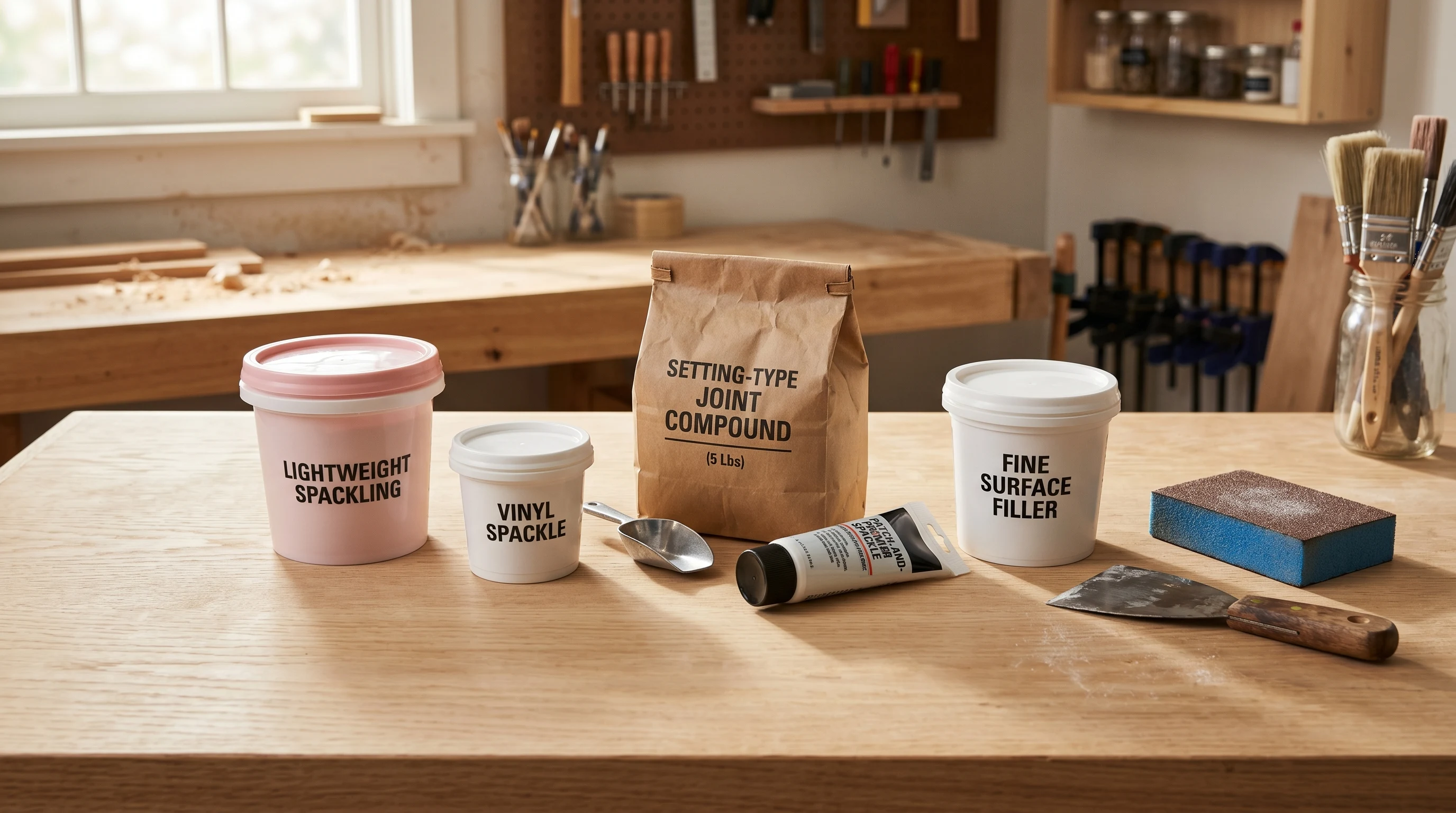
Top pick: DAP DryDex for the everyday punch list of nail holes, anchor holes, and small dings. The pink-to-white dry indicator pays for itself the first time you patch a 30-hole gallery wall and don’t have to guess. It falls short on screw pops, structural cracks, and any hole deeper than 3/8 inch. For that, USG Sheetrock Easy Sand 20 is the smarter pick because it sets chemically and doesn’t shrink. 3M Patch Plus Primer wins on speed and paint-ready chemistry for tube-format quick fills. Red Devil Onetime earns the no-shrink claim on hairline-crack walls. Crawford’s is the trim painters’ answer for carved casework and brad-nail fills in finish-grade wood.
A Wall Has Three Different Repairs in It
Most “best spackle” articles pick one tub and stop. That’s how you end up using lightweight vinyl on a screw pop and watching the patch re-open before the paint cures. A wall is three repairs with three failure modes. Nail holes are shallow and forgiving (lightweight spackle territory). Screw pops, hairline cracks, and drywall patches need a filler that sets hard and doesn’t shrink (setting-type joint compound territory). Brad-nail holes in carved casework need a dense paste that holds a crisp edge through 150-grit (dense vinyl paste territory). One product doesn’t do all three correctly. The picks below are sorted by the wall repair, not by brand.
If the wall has visible mold around the patch you’re about to fill, stop here. Patching over live mold means painting over it; see the fix mold on walls guide first.
How We Picked
Five fillers, applied to four real surfaces inside a working renovation. A smooth-roller painted drywall wall with 60 nail holes from a removed gallery wall. An MDF baseboard with brad-nail holes from a coped joint. A kitchen wall with seasonal screw pops. And a 4-inch fist-through-drywall patch with mesh-tape backing. Two coats where labels called for two. Sanded, primed where needed, topcoated with the same Behr Premium Plus eggshell across every panel. Tracked over 60 days, through one heating-season change, watching for flash-through, shrink cracks, and re-opening at the corners.
The pick-specific finding lives in each review below.
The Picks at a Glance
| Product | Best for | Shrinkage | Dry/Set | Price |
|---|---|---|---|---|
| DAP DryDex | Nail holes, dings, punch list | 🟡 Visible at ≥3/8 in. | 30 to 45 min | $ |
| 3M Patch Plus Primer | Paint-ready quick fills, no spot-prime | ⚪ Low on shallow fills | 30 min | $$ |
| USG Easy Sand 20 | Screw pops, cracks, drywall patches | 🟢 Effectively none | 20 min set | $ |
| Red Devil Onetime | Crack-prone walls, no-shrink claim | 🟢 Low to mid-depth | ~60 min | $$ |
| Crawford’s Spackling Paste | Finish-grade trim, brad-nail fills | ⚪ Low; dense paste | ~90 min | $$ |
The table is structured by wall repair, not by brand. DryDex and 3M Patch Plus Primer compete head-to-head on shallow nail holes; Onetime steals from that field when the wall has visible hairline cracks. USG Easy Sand 20 competes with no one else on screw pops and drywall patches. Crawford’s is the trim answer. Read the table as “pick the filler that fits the repair in front of you,” not as a ranked ladder.
DAP DryDex: Top Pick for the Punch List
DAP DryDex is the everyday answer for the wall-of-holes that comes after a tenant moves out, a gallery wall comes down, or a curtain rod gets relocated. The pink-to-white dry indicator is the headline feature, and it’s not a gimmick. On a 30-hole gallery wall we patched a column at a time, watching the first ones turn white while we filled the last ones. The timing meant we sanded the column in order, no guessing, no surprise wet patch under a 220-grit pass.
On paper DryDex is a vinyl lightweight spackle, mid-tier on shrinkage. In practice it does what a vinyl lightweight does. It sands at 30 to 45 minutes on nail-hole depths and leaves a paint-ready surface with one easy sponge pass. Where it falls short is depth. A 3/8-inch screw pop took two passes to come flush, and the second pass re-opened a hairline shrink crack at the rim three days later. Use DryDex for what it’s good at. Don’t use it as a structural filler.
The other small complaint is open-tub life. A pint dries out at the lid inside three weeks if you don’t press the surface with plastic wrap before closing. The quart container is honest contractor format and lasts longer, but it’s overkill for a homeowner kit. Buy the 1/2-pint for occasional use, the pint if you’re working through a punch list this month.
Buy it if: nail holes, anchor holes, small dings, drywall scuffs. Skip it if: the patch is deeper than 3/8 inch or the crack is structural.
3M Patch Plus Primer: Best When Speed Matters More Than Tub Size
3M Patch Plus Primer is the squeeze-tube format that wins on a different axis than DryDex. The selling point is the primer-in-the-fill chemistry. A sanded patch takes one coat of wall paint cleanly, no spot-prime, no flash-spot under a kitchen-window raking light. We tested this against a DryDex patch under the same Behr eggshell, walked the wall at 4 pm with the sun behind us, and the DryDex patch read at the spot we hadn’t primed; the 3M Patch Plus Primer patch did not.
The tube format is the other axis. For one anchor hole at a time, a tube is faster than opening a tub, dabbing a knife, and closing a tub. For 30 holes, the tube is the wrong tool. You’re squeezing for ten minutes and the spackle isn’t replenishing fast enough at the nozzle. The format defines the use case.
Cons are tube-format honest. About 3× the cost per ounce of tub spackle. Nozzles seize if you leave the tube in a hot garage with the cap cocked. And the tube isn’t a fill-deep-holes solution; the fill is shallow by design.
Buy it if: a handful of holes, a hurry, a topcoat that flashes. Skip it if: a patch list of more than ten holes.
USG Sheetrock Easy Sand 20: The Structural Answer
This is the pick most “best spackle” articles miss entirely, and it’s the most important one in the round-up. USG Sheetrock Easy Sand 20 isn’t a spackle. It’s a setting-type joint compound that cures by chemical reaction, not air-drying. It sets hard at 20 minutes, doesn’t shrink in any meaningful way on the first pass, and is the right answer for every repair the lightweights fail on.
Screw pops. We had eight screw pops on a kitchen wall, seasonal movement, the previous owner had filled them with DryDex and watched them re-open every winter. Easy Sand 20 closed all eight in two coats. Twelve months later, no re-opening, no flash under the eggshell topcoat. Drywall patches. The 4-inch fist-through patch on our test wall took mesh tape and Easy Sand 20 in two skim coats; the wall reads flat under raking light. Hairline cracks. Open with a utility knife, embed paper tape, skim with Easy Sand. Done.
The trade-off is the mix. Easy Sand comes as a powder. You hydrate what you need in a mud pan with a margin trowel, get it to the consistency of soft-serve ice cream, and use it before it sets. The 20-minute version is genuinely 20 minutes from mix to firm-in-the-pan, so mix small batches. If 20 minutes feels tight, USG also makes 45, 90, and 210 versions (same chemistry, longer working window). Sanding is harder than spackle; bring 120 and a sanding sponge, not 220. And the cured surface needs PVA primer before the topcoat or the paint flashes.
Buy it if: screw pops, cracks, drywall patches, anything that has to stay closed. Skip it if: a single nail hole and you don’t want to mix a batch of powder for it.
Red Devil Onetime: For Walls That Crack Again
Red Devil Onetime sits between DryDex and Easy Sand 20 in chemistry. It’s a lightweight vinyl paste with a more flexible cured film than DryDex. The no-shrink claim is the headline; on our 2/8 to 3/8-inch depth test holes, it lived up to it in a single pass. More usefully, Onetime tolerates wall movement better. The hairline crack we filled with DryDex re-opened at week 8 in a south-facing wall; the parallel Onetime fill stayed closed.
What it’s not good at is heavy traffic. Onetime cured to a soft enough surface that a thumb press at 60 minutes still left a dent, and that softness lasts through about the first hour after sanding. Filling a baseboard ding behind a kitchen door is the wrong move; the next boot scuffs it back open. Stickier on the knife than DryDex too. Wipe firmly or it tears at the edge.
Smaller tubs only. No contractor 1-gallon bucket, no 5-lb powder bag. The per-ounce price is closer to 3M Patch Plus Primer than to DryDex, and the format limits how big a job you’ll take it on.
Buy it if: walls with hairline-crack history. Skip it if: the patch is in a high-traffic zone, or the job is a 60-hole punch list (DryDex is cheaper per fill).
Crawford’s Spackling Paste: The Trim Answer
Crawford’s is what painters who do finish-grade trim use, and the reason is density. The paste is denser than the lightweights, holds a crisp profile on bead detail, fills a brad-nail hole in carved casework flush in one pass, and sands to a sharp edge through 150-grit rather than feathering out the way DryDex does on a 220-grit sponge. On our MDF baseboard panel and a profiled door casing, Crawford’s was the only filler that held the carved profile through paint; DryDex rounded the bead and read soft under raking light.
The chemistry is older-school. Solvent-based, real smell, longer dry-time at 90 minutes plus. Don’t use it in a closed room without ventilation. Cured fill is cream-tinted rather than white, so spot-prime under any pale flat topcoat or the cream reads through as a yellow ghost. Dries hard, closer to Easy Sand than to DryDex on knife resistance once it sets.
Trim painters reach for Crawford’s because the cured fill takes any topcoat (oil, alkyd, waterborne enamel) without flashing or telegraphing the patch. On a baseboard that’s getting recoated with a hard enamel like Emerald Urethane in the bathroom round-up, Crawford’s is the substrate answer.
Buy it if: finish-grade trim, doors, carved casework, brad-nail fills on woodwork. Skip it if: drywall, ceilings, or a job that needs a fast turnaround in a closed space.
Pick the Filler by the Repair, Not by the Brand
Stop asking “what’s the best spackle” and start asking “what’s the best filler for this repair.” Same wall, three different products. The table below is the working reference for matching repair to product.
| Repair | First pick | Why |
|---|---|---|
| Picture nail hole | DAP DryDex | Shallow vinyl spackle; fills cleanly in one pass |
| 30-hole gallery wall punch list | DAP DryDex | Dry-time indicator plus tub format wins on volume |
| Anchor hole, 1/4 in. drywall | DAP DryDex | Both DryDex and 3M Patch Plus fill at this depth |
| Screw pop | USG Easy Sand 20 | Sets chemically. Anything else re-opens at the next heating cycle |
| Hairline wall crack | USG Easy Sand 20 with paper tape | Tape carries the movement; setting compound holds the joint |
| 4-inch drywall patch | USG Easy Sand 20 with mesh tape | First skim and finish skim both setting-type; no shrink |
| Brad-nail hole in painted trim | Crawford’s | Dense paste holds the profile through paint |
| Carved casework, bead detail | Crawford’s | Sands to a sharp edge through finish-grade grit |
| MDF baseboard, coped joint nail | Crawford’s | Density matters more than dry-time on finish-trim |
| Recurring crack at corner | USG Easy Sand 20 with paper tape | Tape is doing the work; rigid compound bridges it |
The case the table doesn’t capture: a patch that fails in the same spot every time. That’s a substrate problem, not a filler problem. A recurring crack at a corner usually means structural movement in the framing, a missed nail, or a vibration source nearby. No filler fixes that. Fix the framing or the source first; then patch.
Sand, Prime, Paint: The Order Matters
Three steps where most patch jobs lose under raking light.
- Sand to the wall, not to the patch. Feather the edge of every fill at least an inch past the hole. A proud patch reads no matter how perfect the color match.
- Prime where the spec says to. Setting-type joint compound (Easy Sand) takes a PVA drywall primer before the topcoat. Unprimed, it flashes through every flat and most eggshells. Lightweight spackles vary; DryDex needs a spot-prime under thin matte, less so under satin. 3M Patch Plus Primer is the exception that doesn’t need one. Crawford’s needs spot-priming under any pale topcoat or the cream tint reads through.
- Paint the patch out, not just the hole. Cut a square around the repair when you topcoat, not a circle around the patch. The square hides the flash line under raking light better than a feathered circle, especially on flat ceilings.
A note on cleanup. Setting-type joint compound is the one product here you don’t want going down a drain. Rinse the mud pan into a bucket, let the bucket settle overnight, pour off the water, and trash the slurry.
Where Wall Patches Go Wrong
- Patch shows through topcoat at month one. Spackle wasn’t primed, or the topcoat was thin matte. Spot-prime with PVA, recoat.
- Screw pop re-opens at first heating season. Lightweight spackle used instead of setting-type. Reopen the pop, refill with USG Easy Sand 20, sand, prime, repaint.
- Hairline crack returns in the same place. Filler wasn’t bridging the movement. Open the crack to a V-groove, embed paper tape, skim with setting-type compound.
- Patch raised under raking light. Sanded the patch only, not the edge. Feather wider with 220.
- Trim patch reads cream/yellow under pale paint. Crawford’s not spot-primed. PVA or shellac primer over the patch, recoat.
- Patch deformed by a touch six months in. Onetime soft-cure issue, or DryDex on a high-traffic zone (behind a chair, near a baseboard). Refill with setting compound in those zones.
Two habits move more outcomes than the tub you bought. Sand wider than the hole; you’re looking for an invisible edge, not a flat patch. Pick the filler by the repair depth and stop trying to make one tub do every job. And when in doubt on anything deeper than a coin, mix Easy Sand 20.
Tools You’ll Want on the Bench
A patch job is a filler plus three tools. A 1.5-inch flexible putty knife for nail holes and detail fills. A 4- or 6-inch taping knife for skimming Easy Sand and small drywall patches. A sanding sponge with fine on one side, medium on the other, beats sandpaper on a block for feathering at the edge. Add a small mud pan and a margin trowel if you’re working with setting-type compound; trying to mix Easy Sand in a yogurt tub is a mess. The sandpaper round-up covers the grit progression for patch-finish sanding, and the paint brushes round-up has the cut-in tools for the post-patch repaint.
Also Tested, Also Passed Over
- Generic store-brand lightweight spackle (Home Depot / Lowe’s house labels). Functional on shallow nail holes; loses to DryDex on the dry-time indicator. Save the $2.
- DAP Fast ’N Final. Lightweight, no-shrink claim. Tested fine; gave the slot to Onetime because Onetime tolerates seasonal movement better on the same depth.
- All-purpose joint compound (pre-mixed Sheetrock blue tub). Shrinks on small holes and takes overnight to dry. Use it on a new-drywall install, not on a punch list.
- Two-part epoxy wood filler (Bondo). Exterior wood-repair territory. The right call for soffit and door-frame rot, not for interior walls.
Companion Guides
For prep and topcoat on the wall after the patch, see how to paint drywall and best interior wall paint. For the sanding progression, the best sandpaper round-up. For the cut-in tools, the best paint brushes round-up. When the recurring problem isn’t the filler but a deeper issue, see the why paint peels guide.
Frequently asked questions
What's the difference between spackle and joint compound?+
Setting-type vs lightweight — which one do I want?+
Do I have to prime over spackle before I paint?+
How do I fill a hairline crack so it stays closed?+
How long until the patch is paint-ready?+
Will spackle work outside?+
- How to paint drywall — prep, primer, and finish
- Best sandpaper for paint prep and patch sanding
- Best paint brushes for walls, trim, and cabinets
- Why paint peels — and how to stop it coming back
- Best interior wall paint — round-up for the room after the patch