Palette

Terracotta Color PaletteReed & Clay

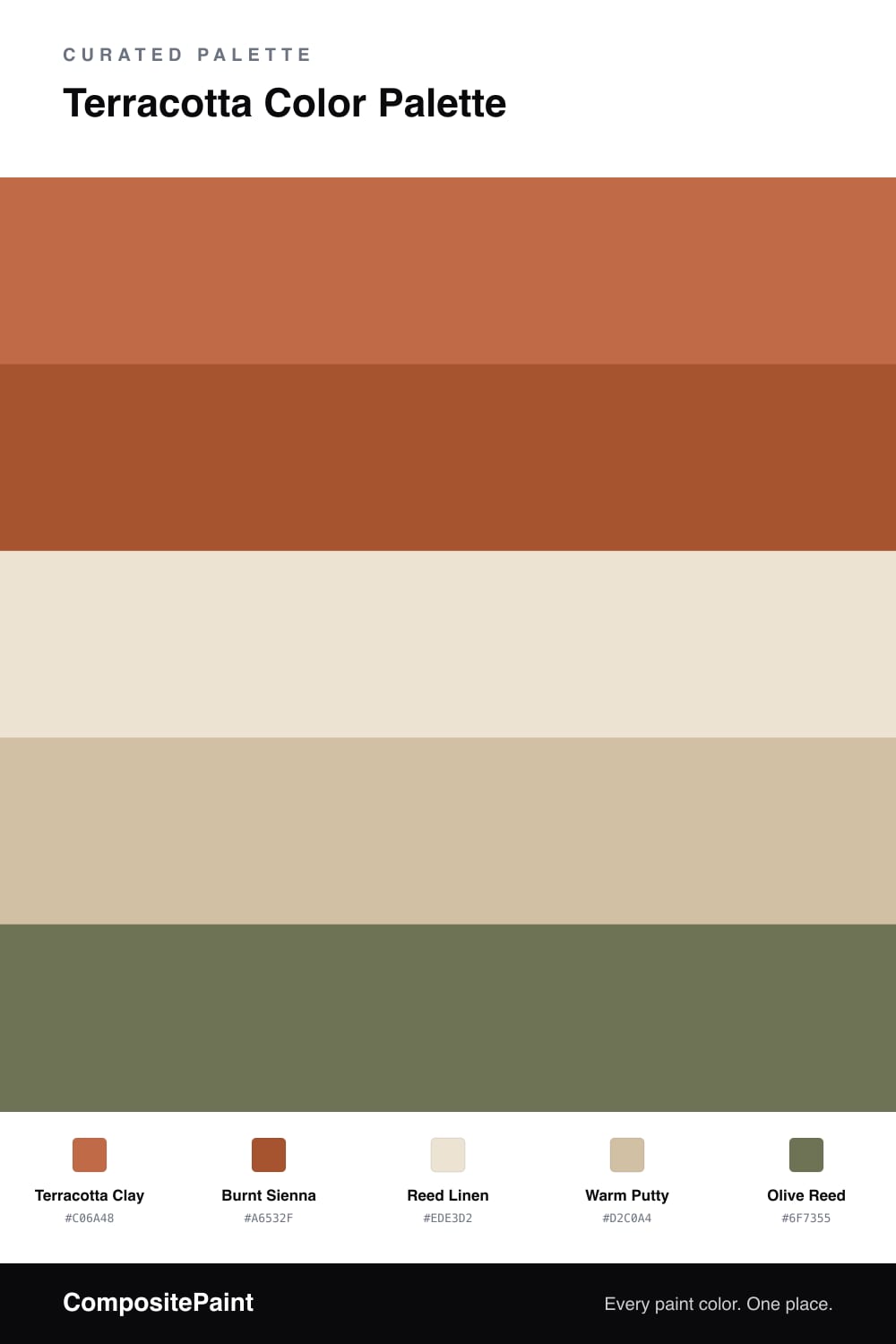
A warm five-color scheme led by earthy terracotta and grounded in soft reed and clay neutrals, with a quiet green accent — every color matched to real paint you can buy.

By David Chen · Formulation Lead & Resident Chemist
View palette in

Terracotta is one of my favorite pigments to talk about because it behaves like a slow-burning ember rather than a flame. Terracotta Clay leads this scheme as a soft red-orange, and Burnt Sienna sits just beneath it as a deeper, slightly browner relative. Think of them as two firings of the same clay — one cooler in the kiln, one hotter.

The neutrals do the patient work. Reed Linen is a near-white with a touch of warmth, and Warm Putty bridges the gap between the linen and the clay so nothing feels like a hard jump. That graduated middle is what makes the palette read as intentional instead of busy.

For 2026 I like adding one restrained note of cool, and Olive Reed is that note. A small amount of muted green keeps the warmth honest and stops the room from tipping into pure desert. Let terracotta dominate, keep the neutrals broad, and use the olive as a quiet punctuation mark.

Buy these colors

Every Color, Matched to Real Paint

Each color matched to the closest paint in every brand we track, by ΔE2000. Tap a swatch for its full guide. Take any code to the store, they mix on demand.

Questions people actually ask

Questions

Why does terracotta read as warm and calming at the same time?

Terracotta is a low-saturation red-orange, so it carries the cozy warmth of a fired clay pot without the alarm of a true red. The pigment leans earthy rather than candy-bright, which is why it relaxes a space instead of energizing it.

How do I keep a terracotta scheme from looking too rustic?

Lean on the linen and putty neutrals for most of the surfaces and let terracotta lead in measured doses. A thin slice of olive green keeps the whole thing feeling current rather than purely Southwestern.