Classic White
Dunn-Edwards' snowy high-hide white, reviewed honestly: the bright rooms where it stays clean, the north light that turns it gray-green, and what to pick instead.

Jessica has spec'd whites and neutrals for more than 300 rooms and keeps a sample wall of painted drawdowns in her studio. Every color review is checked against real reader rooms in the comments and re-tested when a formula changes. About the testing process →
- 1First Star69
- 2Classic Gray74
- 3Classic White84
- 4Chantilly Lace91
- 5Ultra Pure White97
The Fast Verdict
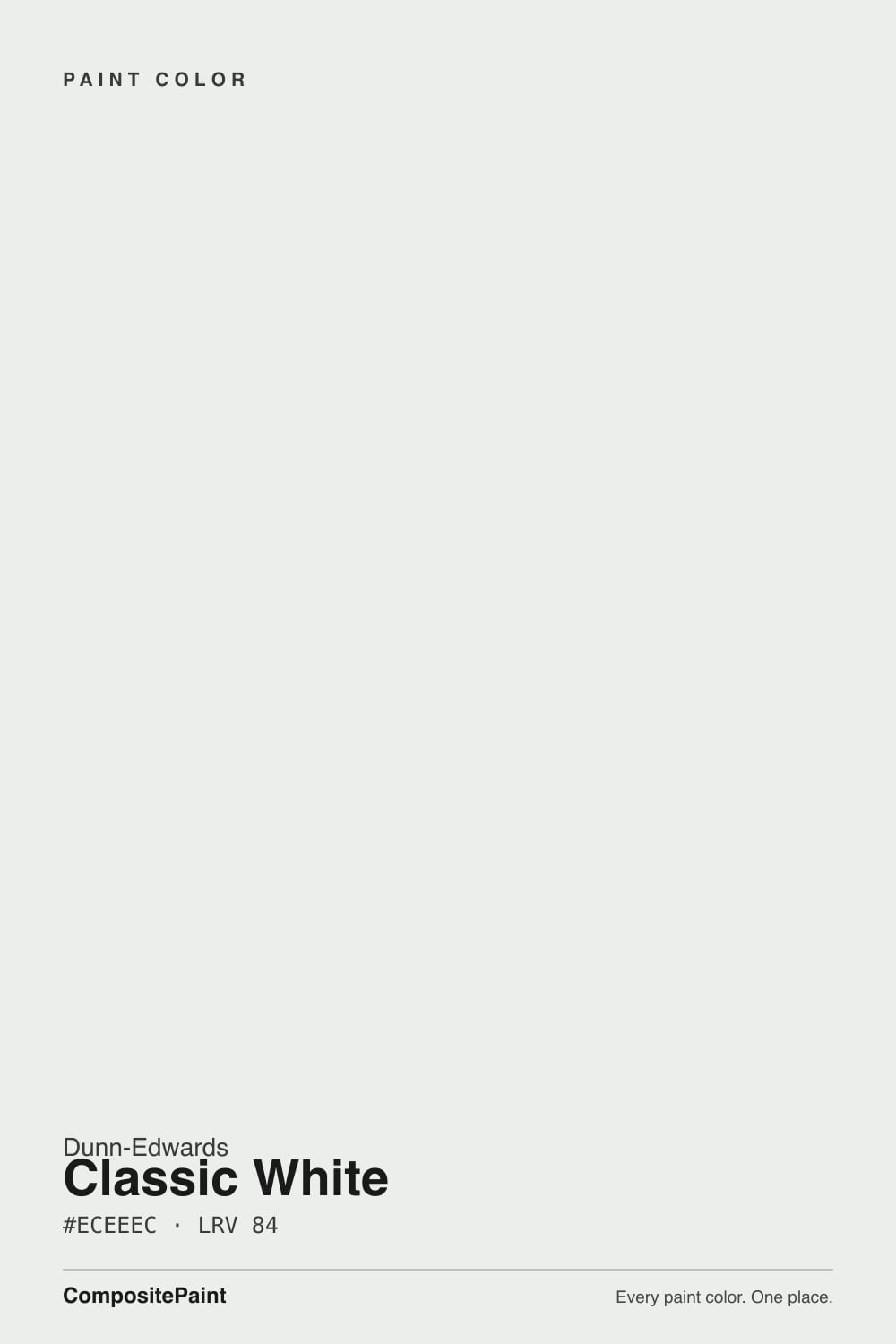
Classic White is a cool, snowy white — not the cream the name suggests. At LRV 84 it is bright enough for whole-house walls, cabinets, and millwork, and it sits in Dunn-Edwards' High Hide Whites collection because coverage is the actual job, not romance. In real daylight it reads clean and slightly icy; in a dim north room the green-gray base shows and it stops looking like white. If you wanted Whisper softness, this is the wrong can.
Kitchen cabinets and millwork · trim, doors, and ceilings that need real hide · bright living rooms and baths with cool stone · whole-house walls in real daylight
You wanted cream · the room faces north and stays dim · your floors are honey oak · a brighter white is staying on the trim
- Genuinely cool and snowy — not another cream wearing a white name
- High Hide formula: a cool white that is actually built to cover
- LRV 84 works on cabinets, trim, ceilings, and bright whole-house walls
- Flatters cool quartz, stainless, black hardware, and pale oak
- One of six Instant Designer go-tos — a real store-counter default in the West
- The name suggests cream; the can is cool — buyers who wanted Whisper are disappointed
- Goes gray-green in dim or north light
- Fights honey oak and golden wood
- Looks dirty next to any brighter true white you keep
What Color Is Classic White, Really?
A cooler, nearly achromatic white with a snowy read — the High Hide Whites can Dunn-Edwards mixed in 2019 so a white would actually cover, then dropped into the Instant Designer Collection in 2023 as one of six go-to hues. That double filing is the honest job description: it is a workhorse, not a personality color. Official copy calls it cool and snowy and points it at whole-home walls, trim, ceilings, and cabinetry. It is not a Color of the Year, not a national default, and not a viral paint. In the West it is the cool counterweight to Whisper and Swiss Coffee, the can a painter grabs when the client said white and meant white.
At LRV 84 it shares a number with Sherwin-Williams Pure White and sits just under Whisper (LRV 87) and a full nine points below Warm White (LRV 93). That gap is the useful part. There is enough bounce for cabinets and four walls without the empty glare of a 93-LRV true white, and enough pigment body — this is a High Hide formula — that it is not the three-coat headache of a Chantilly Lace. Park Warm White on the casings and Classic White suddenly looks gray. Park Whisper next to it and Classic White looks icy. On its own, in decent daylight, guests still call it white.
Undertone in one line: cool, with a whisper of green — never yellow, never pink. Dunn-Edwards publishes the Munsell as 3.5G at chroma 0.1, which is as close to no-color as a tinted white gets; the green only speaks when the light is cool or a warmer neighbor is in the room. If your sample looks creamy, that is bounce from oak, a terracotta overhang, or 2700K bulbs, not the paint. If it looks gray-green, the room is dim or north — that is the real undertone, and it is why this white is not the safe whole-house default Whisper is.
Where It Shines
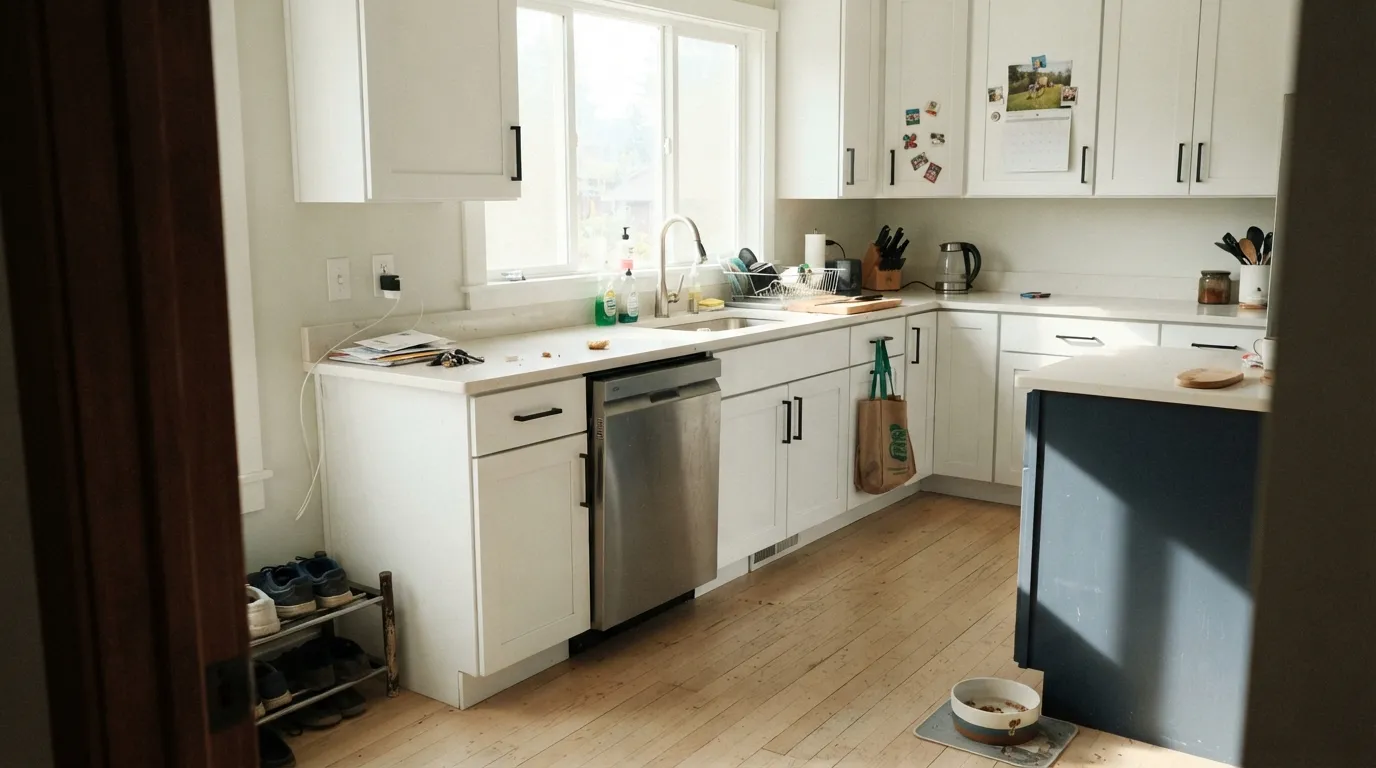
Give it real daylight, cool stone, and no creamier white nearby, and it does the rare thing a cool white is supposed to do: stay white without going hospital. Cabinets are the listing Dunn-Edwards keeps repeating — satin boxes that wipe clean and do not flash yellow next to stainless. Trim, doors, and ceilings are the High Hide reason it exists: a cool white that covers. Whole-house walls work in a bright, modern interior with black hardware and pale oak. Keep the bulbs honest and the wood from going orange, and it behaves.
Where It Fails
Classic White does not have a national complaint thread. What it has is three predictable mismatches, and all three are visible on the chip if you know what you are looking at. None of them are a bad batch — but if your room matches one, this is not your white, and another coat will not hide it.
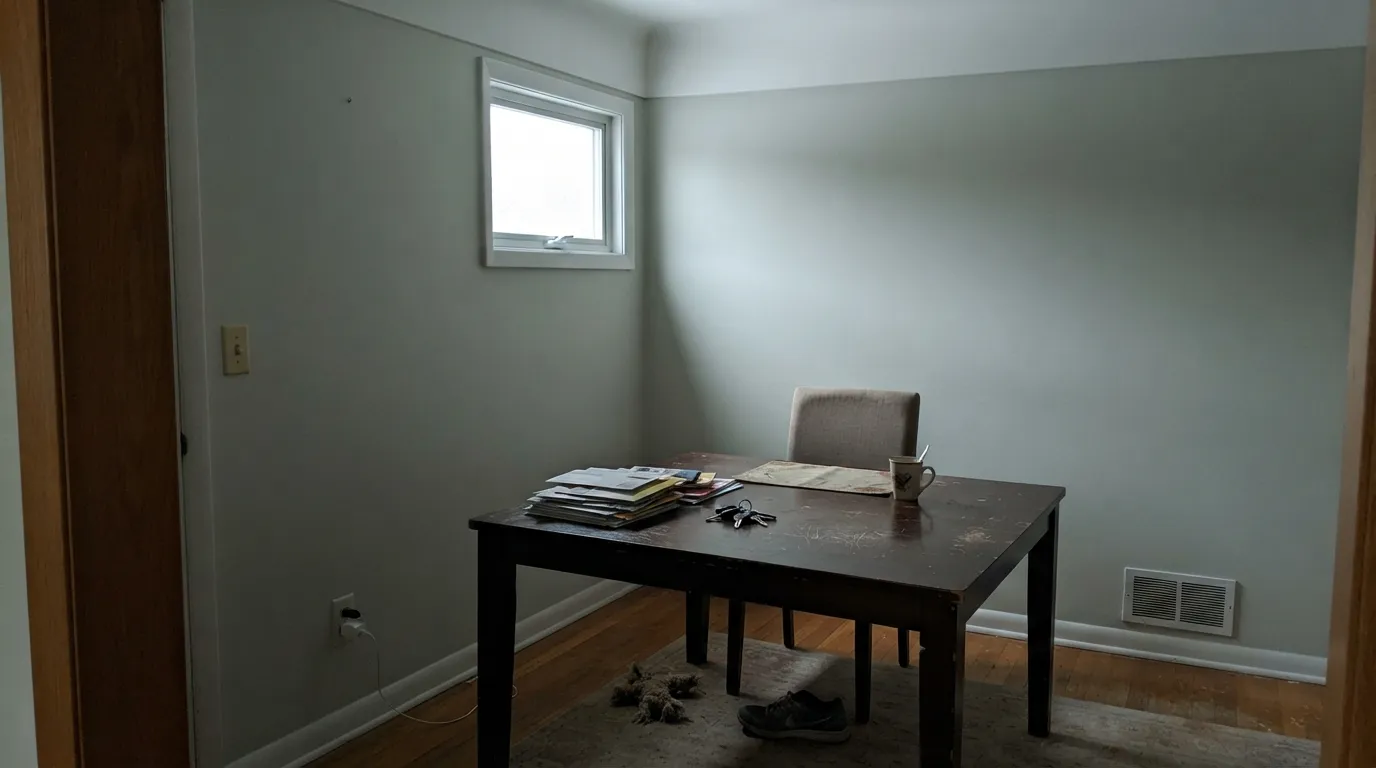
Cool whites have no cream reserve. North light is gray, and Classic White's 3.5G base has nowhere to hide: the wall drops the snow and goes faintly gray-green — dingy, not crisp. Warm lamps help after dark and do nothing at 2 p.m. Use Whisper or Dunn-Edwards Swiss Coffee in that room, or keep this can for spaces with real sun.
Orange-leaning oak and a cool white argue. The floor goes more orange, the wall picks up a sickly green-gray bounce, and both sides look worse. Pale white oak, walnut, espresso, and gray-washed floors sit comfortably; honey builder oak is the skip. A large rug is a patch, not a fix.
Warm White (LRV 93), Extra White, or leftover builder ceiling white will win the comparison, and Classic White will look unwashed — gray, not snowy. The fix is the one-color rule: walls, trim, and ceiling all DEHW08, sheen change only. If you want a snap, go darker (navy, iron, a greige), never brighter.
Room by Room
Satin Classic White on boxes is the job Dunn-Edwards wrote the color for: cool, clean, and high-hide enough to cover an old almond or builder-beige cabinet. Brass and black hardware both work; cool quartz and stainless sit quietly because there is no yellow to argue with. Honey-oak floors are the sample-first surface. Urethane-fortified cabinet enamel, two coats over primer.
This is why the collection exists. Semi-gloss on casings, doors, and baseboards; flat on the ceiling. Against a mid-tone cool wall it reads as painted wood, not plastic. Do not use it as the wall color under Warm White millwork — the walls will go gray. One color at two sheens is the safe house.
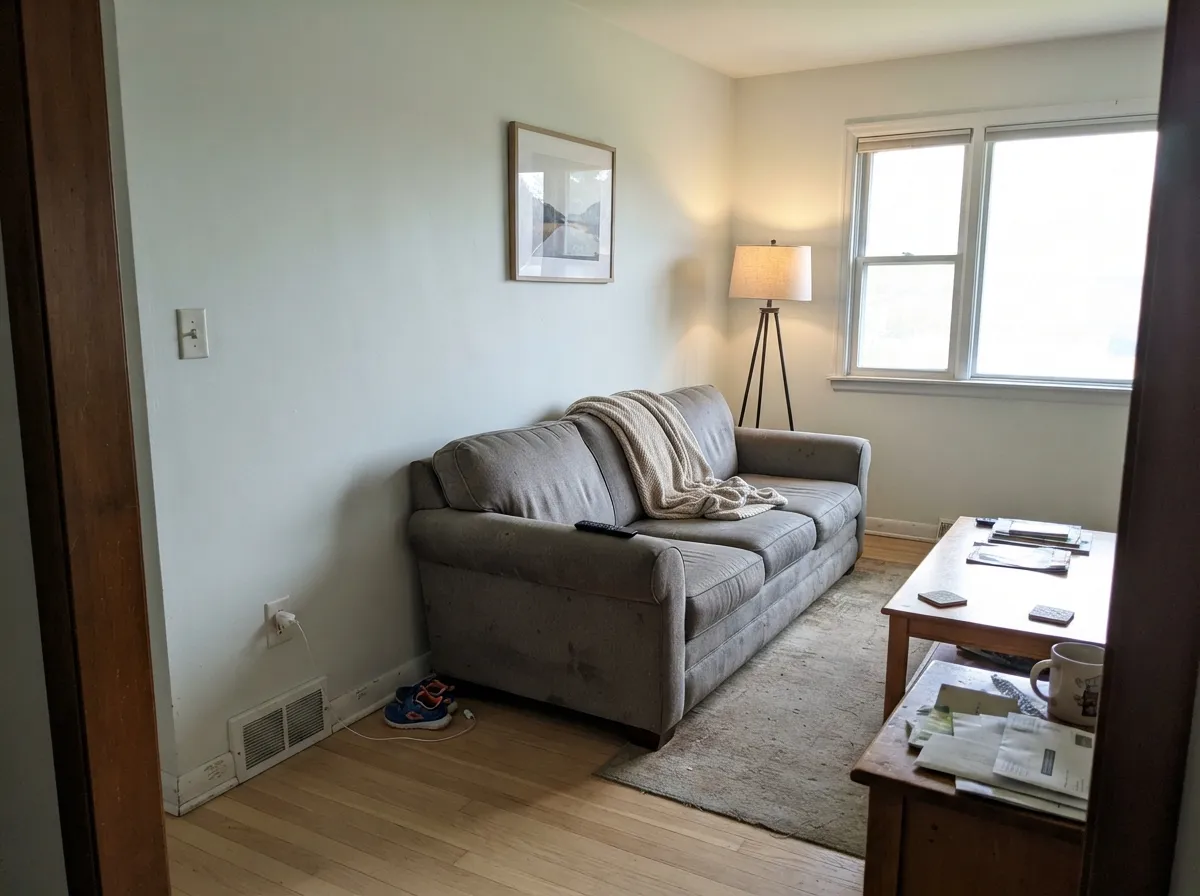
South- and west-facing living rooms are the light this white was mixed for: snowy without going empty, cool enough that black metal and pale oak look deliberate. Eggshell, same color on trim in semi-gloss. A closed, dim living room is the skip — it will read as unfinished gray.
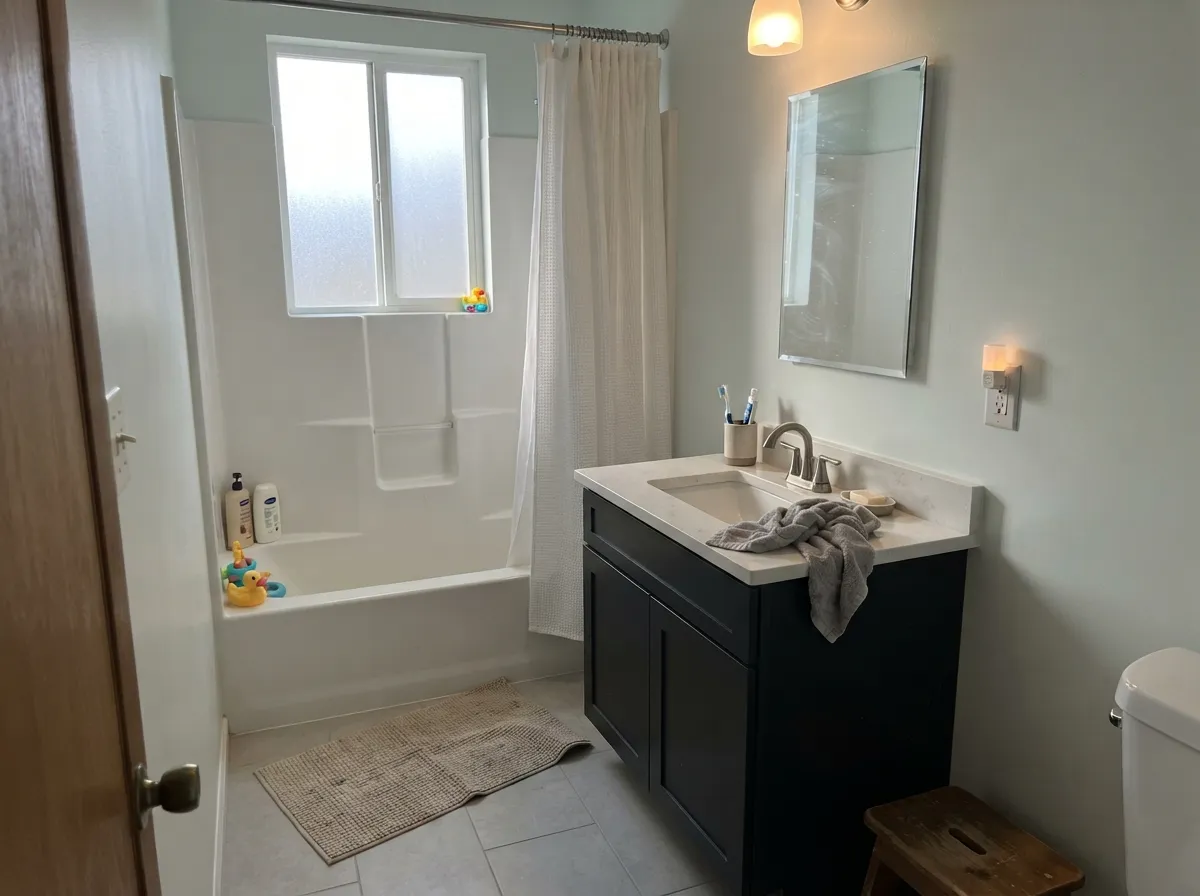
Chrome, matte black, white tile, Carrara-look quartz: this is the room a cool white earns. Small baths with a window love the LRV 84 bounce. Honey-oak vanities and beige tile will make it look colder by contrast. Eggshell or a bath-rated satin; a fan that actually runs, because bright whites show mildew faster than creams.
A sunlit bedroom stays restful and clean. Under 2700K lamps the chill comes off and it can look a little dull rather than cozy — there is not enough cream to go velvety. A north cave will go gray-green. If you want a bedroom that feels soft at night, Whisper is the Dunn-Edwards can.
On window frames, fascia, and a door surround under Western sun it is bright and clean. A full stucco body can pick up lawn and tree bounce — this white already leans 3.5G, and green landscape will finish the job. Walk the sunny and shaded sides with a large sample. Dark trim (Iron Ore, Black Tie) is what keeps a cool-white house from looking unfinished.
Your Light Is the Risk
Hard, clear sun keeps it snowy and clean without tipping yellow. This is the light the color was mixed for — whole-house walls are only safe here.
Cool gray daylight exposes the 3.5G base. The wall goes faintly gray-green and dingy — not cozy, not crisp. Sample here before you buy the gallon.
Morning east light is the coolest, most paper-white read. West afternoon takes a sliver of the chill off without turning it cream. Sample both ends of the day on the same wall.
2700K bulbs take the ice off and can leave it slightly dull rather than snowy. 3500–4000K LEDs keep it crisp and can flash the green-gray. If your nights run on warm lamps and you wanted cozy, pick Whisper instead of swapping bulbs forever.
Most complaints about Classic White are a light mismatch. Upload a photo of your actual room and see it on your walls — then ask for the same wall in north light or evening lamps before you buy a single sample.
Need It From Another Brand?
Any paint counter can custom-tint Dunn-Edwards DEHW08 directly. If you would rather stay in one brand's own deck, these are the closest stock matches, measured as ΔE2000. Under 2 is a difference you will not see on the wall.
| Brand | Closest color | ΔE | LRV | |
|---|---|---|---|---|
| Sherwin-Williams | Extra WhiteSW 7006 · Sherwin-Williams | 1.5 | 86 | Color page → |
| Behr | Day SpaPWN-16 · Behr | 1.4 | 85 | Color page → |
| Benjamin Moore | Ultra WhiteCC-10 · Benjamin Moore | 0.0 | 83 | Color page → |
| Valspar | Tambourine8007-3B · Valspar | 1.0 | 86 | Color page → |
| PPG / Glidden | Snow StormPPG1172-1 · PPG / Glidden | 1.0 | 85 | Color page → |
| Glidden | Moonlit SnowPPG1041-1 · Glidden | 0.9 | 85 | Color page → |
Similar Dunn-Edwards Colors
The nearest shades to Classic White within Dunn-Edwards's own range, ranked by perceptual color distance — useful when you want the same look a touch lighter, darker, or warmer.
WCAG 2.1: AA is 4.5 : 1 for normal text, 3 : 1 for large text, AAA is 7 : 1.
Classic White vs the Colors You're Also Considering
Every Classic White sample board has the same rivals on it. The numbers show the real lightness gap — then it comes down to which risk you would rather live with.
Pick this when you actually want a cool white, not a whisper of cream.
Dunn-Edwards DEW340 · LRV 87WhisperPick this if you wanted the Dunn-Edwards White Dove — warm, soft, and the safer whole-house default.
Pick this for walls and cabinets that need a little more body and a little less glare.
Dunn-Edwards DEW380 · LRV 93Warm WhitePick this for brighter trim, ceilings, and millwork — it is a true white, not a cream, and it will make Classic White look gray if they share a room.
Pick this for the snowier, slightly greener High Hide version that covers better and reads a touch more neutral.
Dunn-Edwards DEW385 · LRV 83LighthousePick this if you want the icier blue-gray cool white — crisper, more contemporary, and even more dependent on real daylight.
Classic White Coordinating Colors
Stay on the cool side of the fence, or keep Classic White on the millwork and let a greige do the walls. It loves black metal, pale oak, navy, and cool stone — and it argues with cream, honey oak, and any brighter true white. These are the partners that keep the snow looking intentional:
High Hide, Then Instant Designer
Classic White did not arrive as a marketing moment. Dunn-Edwards launched the High Hide Whites collection in late 2019 — ten whites mixed so property managers and painters could cover a wall without a third coat — and Classic White was the cool, illuminating one in that set, sitting between the warmer Almond Milk and the sparkly Be Cool. In 2023 the brand pulled it into the Instant Designer Collection, a six-color go-to card of top-selling whites and neutrals hand-picked for people who did not want two thousand chips. Whisper, Swiss Coffee, Stucco Tan, Crisp Muslin, and Whisper Gray are the rest of that six; Classic White is the only clearly cool white in the group.
That is the useful context and also the trap. Shoppers who grab Instant Designer expecting a White Dove house can land on Classic White by name and get a snowy cool wall. The collection is mixed-temperature on purpose. If the rest of your house is Whisper or Swiss Coffee, this is not the can that ties it together — it is the can that makes those creams look yellow and itself look icy. Use it as the cool program, or do not use it.
Classic White With Wood Tones and Floors
Cool whites live or die at the floor. Pale unstained white oak, gray-washed oak, walnut, and espresso all sit comfortably against Classic White because they do not shove orange into a green-leaning white. White oak with black metal is the pairing that makes this color look expensive rather than builder-flat.
The honest no is golden: honey oak, orange-stained trim, yellow pine, builder-beige carpet. Warm wood and a 3.5G white exaggerate each other — the floor reads more orange, the wall reads more gray-green, and no sheen change fixes geometry. If that floor is staying, Classic White belongs on a door or a vanity at most, not on four walls. Almond Milk or Whisper will meet the wood halfway.
Metals are easy if you stay cool or mixed: matte black, brushed nickel, chrome, and unlacquered brass all work. Polished gold against this white can look a little costume next to the snow; brass is safer when the wood is walnut, not honey.
Three Ready Palettes Built on Classic White
A color is never alone on the wall. These are complete combinations in the 60-30-10 pattern, with the reason each one holds together. Every one opens in the visualizer.
One cool white at two sheens is the pairing that keeps Classic White from looking dirty. The navy door is the single dark note the scheme needs — Hale Navy still reads navy in real light, and it loves black hardware and pale oak.
Try this palette in your roomFine Grain is the Dunn-Edwards workhorse greige; in a bright kitchen it stays quiet enough that Classic White boxes still read as white, not gray. Iron Ore on the island grounds the room at LRV 6 and matches the black hardware a cool white kitchen wants. Skip this palette over honey-oak floors.
Try this palette in your roomA cool white bath only looks expensive when something dark is in the room. Black Tie on the vanity under white or gray stone is the weekend move; Hale Navy on the door keeps the chrome and tile from floating. This is the hotel-bath read Classic White was mixed for — skip it if the vanity is honey oak.
Try this palette in your roomClassic White FAQ
Is Classic White warm or cool?
Cool. The name sounds traditional and creamy; the can is a snowy near-white with a whisper of green. In south light it still reads as white. In north light or next to Whisper, the cool side is obvious. If you wanted cream, buy Whisper or Dunn-Edwards Swiss Coffee instead.
What trim white goes with Classic White walls?
Classic White itself, in semi-gloss. A brighter trim white — Warm White, Extra White, leftover builder white — makes the walls look gray. If you want contrast, go darker on the door or the island, never brighter on the millwork.
Is it good for kitchen cabinets?
Yes — that is one of the jobs Dunn-Edwards lists, and High Hide is the practical reason to pick it over a typical cool white. Satin urethane-fortified enamel, primer over stained or dark boxes. It loves cool quartz and stainless; it fights honey-oak floors.
Does Classic White work with oak floors?
Depends on the oak. Pale white oak, gray-washed oak, and walnut are excellent. Golden honey oak is the clash: the floor goes orange and the wall picks up green-gray. If the honey floor is staying, put a large rug down or pick Almond Milk or Whisper instead.
How is it different from Whisper and Warm White?
Whisper (LRV 87) is the warm, White Dove-like default. Warm White (LRV 93) is Dunn-Edwards' brightest true white — a trim and ceiling workhorse whose name is a trap. Classic White sits between them in brightness and on the cool side of both. Do not put Warm White trim on Classic White walls.
Will it cover in two coats?
Better than a typical bright white, which is why it is in the High Hide Whites collection. Over a light existing color, two finish coats is the normal plan. Over a dark, red, or saturated wall, prime first — High Hide is not magic, and three finish coats of white over navy is still the expensive way to learn that.
Have you painted with Classic White?
Rate it — one tap helps the next reader decide.
Ask a Question