Best Stain-Blocking Primers
Six stain-blocking primers tested on water rings, nicotine, cedar tannin, marker, and grease. Top pick: Zinsser B-I-N Shellac-Base Primer for interior stains.

Only primer in the round-up that held every stain on our panel set through two topcoats — water ring, nicotine, cedar knot, red marker, and grease all stayed buried at one coat
Water cleanup and a mild latex smell with close to shellac-level blocking on water and tannin stains
Blocks heavy smoke, nicotine, and pet stains with water cleanup, which matters when the job is a whole apartment and not one ceiling ring
Alkyd film flexes with wood movement, so it survives cedar, redwood, and fir siding through freeze-thaw where shellac cracks
Does three jobs at once on a repaint: seals patched drywall, grips chalky old paint, and covers light water staining
Real oil-base stain blocking for around $30 a gallon, the lowest cost per square foot in the round-up
Disclosure: Some links below are affiliate links. We earn a commission if you buy through them, at no extra cost to you. Our picks come from the test panels described in “How we picked”. No brand pays for placement.
Top pick: Zinsser B-I-N Shellac-Base Primer. It’s the priciest can here at $22 to $28 a quart, and it was the only one of six that buried every stain we threw at it in a single coat. B-I-N wins on blocking power, on a 45-minute recoat, and on sticking to glossy surfaces nothing else grips. It falls short on odor, which is brutal, and on flexibility, which is why it belongs indoors only. Skip this if the job is exterior cedar; buy Zinsser Cover Stain for that. For a whole smoke-damaged apartment where you need water cleanup, KILZ Restoration is the smarter buy.
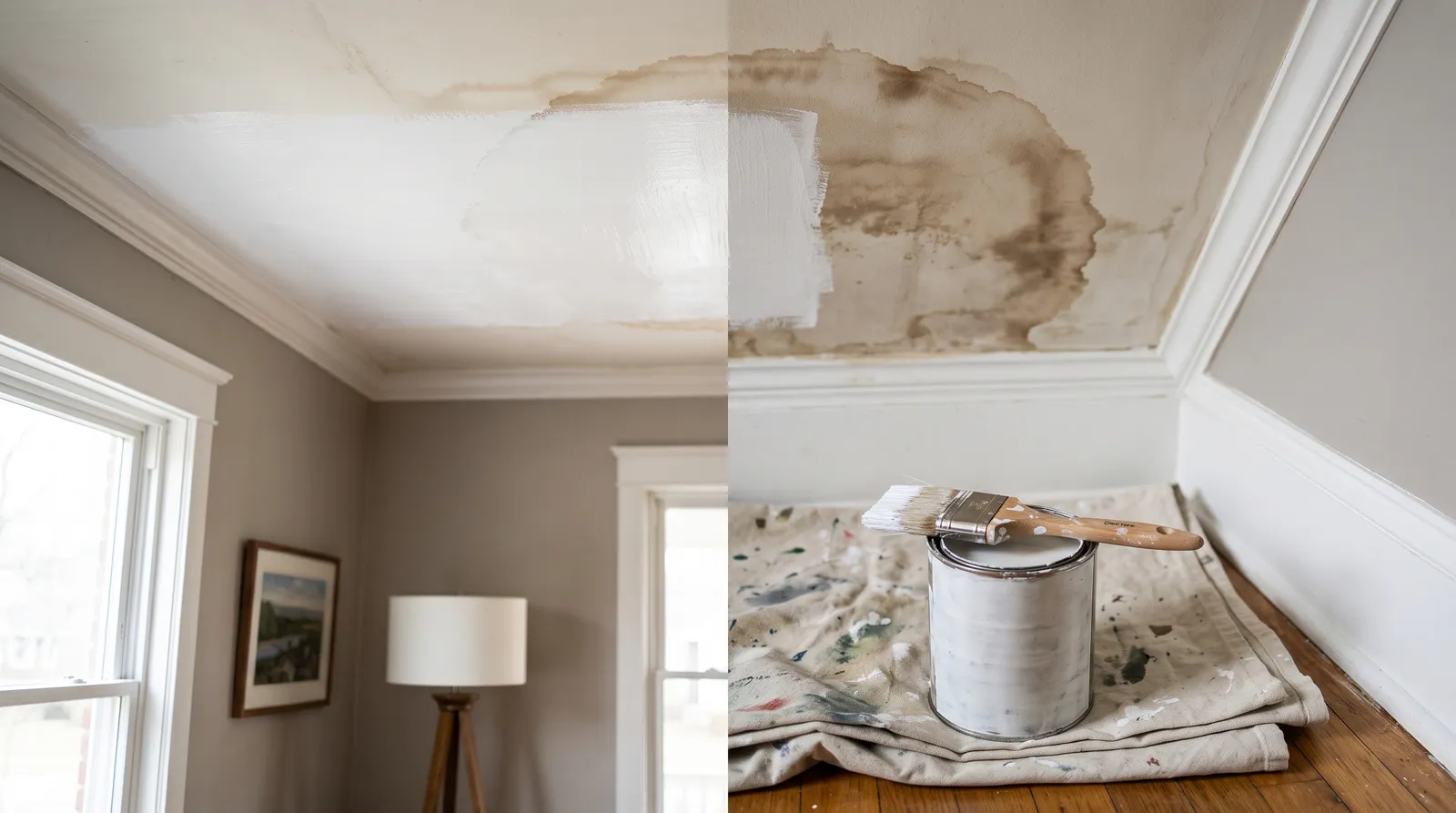
Stain blocking is a barrier problem, not a hiding problem. A brown ceiling ring isn’t dirt sitting on the surface, it’s dissolved tannin and mineral salts inside the drywall paper that reactivate every time your fresh latex puts water back into the substrate. That’s why three coats of ceiling paint keep failing on a stain a $9 spot of shellac would have ended.
How We Picked
Six primers, five stains, one raw cedar board each. We aged a brewed-tea water ring under a heat lamp, ran a nicotine wash from a sealed smoke chamber, drew a red permanent marker line, dropped a cooking grease blot, and added a ballpoint mark to identical 12-inch drywall panels. Each primer went on at its labeled spread rate, recoated per its own TDS, then took two coats of the same flat white latex. We read the panels at 24 hours, 7 days, and 30 days under 4000K shop light and again in north daylight, scored for any ghost visible at 18 inches. Odor got logged by three people at 1, 6, 24, and 48 hours in a closed 10 x 12 room, and flexibility got checked by bending coated hardboard strips over a half-inch mandrel. Pick-specific results sit in each review below.
The Six Picks at a Glance
| Product | Best for | Blocks | Cleanup | Price |
|---|---|---|---|---|
| Zinsser B-I-N Shellac | Top pick: any interior stain | 🟢 All five | Alcohol | $$$ |
| Zinsser B-I-N Advanced Synthetic | Low-odor rooms, exterior trim | 🟢 Four of five | Water | $$$ |
| KILZ Restoration | Smoke, nicotine, whole rooms | 🟢 Four of five | Water | $$ |
| Zinsser Cover Stain | Bare wood, tannin, exterior | ⚪ Water + tannin, weak on dye | Mineral spirits | $$ |
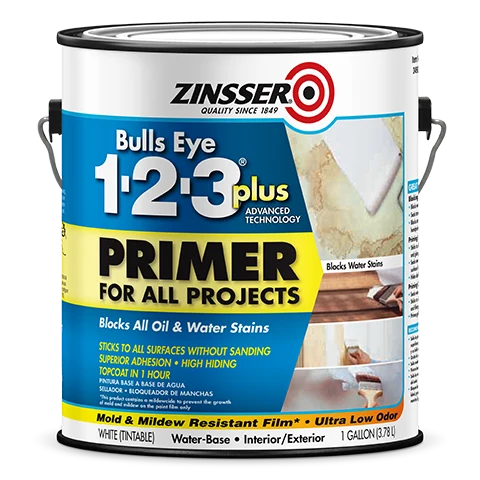
| Zinsser Bulls Eye 1-2-3 Plus | Light stains, patched drywall | 🟡 Water only | Water | $ |
| KILZ Original | Budget interior water and grease | ⚪ Water + grease | Mineral spirits | $ |
Prices move a lot by channel in this category. A gallon of Cover Stain runs $8 to $12 cheaper at a Sherwin-Williams or independent paint store than on Amazon, and B-I-N gallons are usually cheaper at Lowe’s than shipped. The Amazon links here are worth using for quarts and aerosols, which ship well and which most home centers stock in one size only.
Match the Primer to the Stain
| The stain | Buy this | Why |
|---|---|---|
| Ceiling water ring | B-I-N Shellac (quart or spray) | Tannin migrates through latex; shellac is a true barrier |
| Nicotine or smoke, whole room | KILZ Restoration | Blocks heavy smoke with water cleanup at gallon scale |
| Cedar, redwood, or knotty pine | Cover Stain | Alkyd flexes with wood movement; shellac cracks |
| Marker, crayon, ink, dye | B-I-N Shellac | Only chemistry here that stopped red dye cold |
| Cooking grease over a range | KILZ Original | Wash first, then oil-base seals it for $30 a gallon |
| Faint mark on patched drywall | Bulls Eye 1-2-3 Plus | Seals the patch and the light stain in one product |
| Occupied bedroom, any stain | B-I-N Advanced Synthetic | Shellac-class blocking without the alcohol fumes |
See the primer explainer if you’re not sure whether your problem is a stain, an adhesion issue, or a porosity issue. They get fixed by different products.
The Picks in Detail
Zinsser B-I-N Shellac-Base Primer, Top Pick
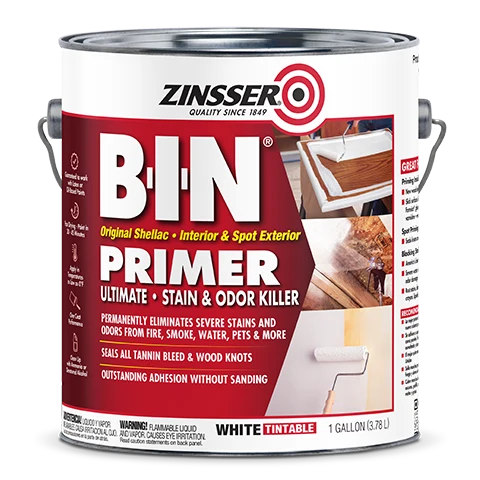
B-I-N is the can painters keep on the truck for the problem nobody else solved. Natural shellac resin in denatured alcohol, white pigment, and almost nothing else. It dries by evaporation instead of curing, which is why it’s touch dry in 20 minutes and recoats in 45.
On our panels it was the only clean sweep. The tea ring vanished at one coat. The nicotine wash, which ghosted through four of the six primers, stayed buried. The red marker line, which came back as a pink shadow under Cover Stain and KILZ Original at 30 days, never showed. Cedar tannin held. Grease held. We read the panel again at 30 days in north daylight looking for the slow bleed that shows up late; nothing.
The odor is the price of admission and people underestimate it. Opening a quart in a closed bathroom is genuinely unpleasant, and the smell moves through a house in under a minute. Our three-person odor log still rated the room as strong at 6 hours and noticeable at 24. Wear an organic-vapor cartridge, not a dust mask (see the respirator round-up), and open two windows for cross-flow. The smell is gone in a day and the film is odorless once it’s painted.
The other real limit is flex. On the mandrel bend, the B-I-N strip crazed at 7 days while Cover Stain took the bend without a mark. That’s the whole exterior story in one test. B-I-N on siding cracks through the first winter.
Brushes are consumable. Alcohol cleanup works but takes patience and the bristles never come back quite the same, so buy a pack of chip brushes and throw them out. A quart covers a lot of ceiling rings.
Buy it if the stain is interior and it has already come back through a previous paint job. Skip it if you’re painting exterior wood, or if you can’t ventilate.
Zinsser B-I-N Advanced Synthetic Shellac, Best Low-Odor Blocker
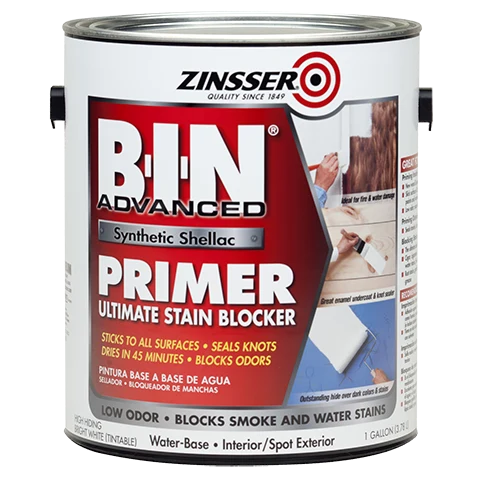
The water-cleanup version of the top pick, and a genuinely different formula rather than a marketing rename. Synthetic resin, waterborne carrier, mild latex smell. It’s rated for exterior use, which original B-I-N is not.
In practice it got about 85 percent of the way to B-I-N. Water ring, tannin, grease, and ballpoint all held at one coat. Nicotine ghosted faintly and the red marker showed a shadow at 7 days that a second coat killed. On the mandrel bend it took the bend cleanly, which puts it ahead of B-I-N on exterior sash and trim.
The application is the surprise. It rolls out smoother than any other pick here. B-I-N leaves a ropey, ridged film that needs a scuff-sand before an enamel topcoat; this one lays down flat enough to paint straight over. On a stained window sash we primed, the finish coat needed no sanding at all.
The trade-off is cost and stocking. It’s priced with B-I-N, needs two coats on the stains B-I-N handles in one, and it’s not on every shelf. Buy it when the room is occupied, when there’s an infant or someone with asthma in the house, or when the piece is going outside.
KILZ Restoration, Best Water-Based for Whole Rooms
The gallon-scale answer to smoke damage. Restoration (the old KILZ MAX) is a water-base primer engineered specifically for heavy stains and odor, and it’s the only water-cleanup product here that handled our nicotine panel at one coat.
The odor sealing is the underrated part. Our smoke-chamber panel still smelled at 48 hours under three of the six primers. Under Restoration, it was neutral by then. If you’ve bought a house from a smoker, this is the product that makes the second bedroom livable, and you can run it in a room you sleep in that night at under 50 g/L VOC.
Two honest complaints. It’s thick, closer to a light drywall mud than a primer, and rolling a ceiling with it is real work. Use a 3/4-inch nap and plan on it taking longer than the same square footage in wall paint; a good roller matters more here than on any other pick. And it lost to B-I-N on cedar tannin, ghosting through at one coat on the raw board.
It’s also gallon-only, which makes it an expensive way to fix one ceiling stain. Buy it for a room or a house, not for a spot.
Buy it if you’re priming a whole smoke-damaged interior with water cleanup. Skip it if the job is one stain, or bare cedar.
Zinsser Cover Stain, Best for Bare Wood and Exterior
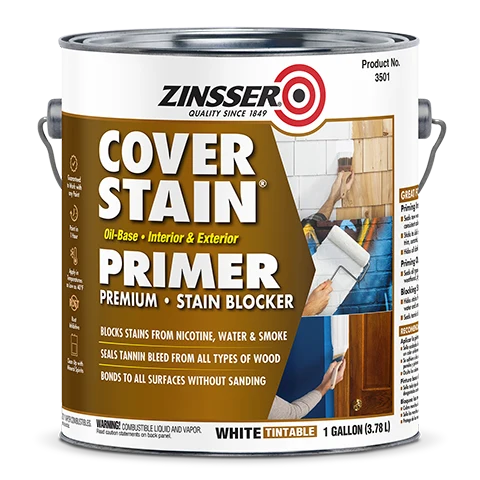
The oil-base workhorse, and the pick I’d hand someone painting cedar siding or new pine trim. Cover Stain stopped tannin bleed on our raw cedar board at one coat, matched B-I-N on that specific test, and took the mandrel bend without crazing.
It also sands better than anything else here. On a trim job where the topcoat is a semi-gloss or gloss enamel, the primer’s sandability decides how the finish reads, and Cover Stain knocks down to a flat, uniform base with 220 grit. B-I-N does not.
Where it falls short is dye. The red marker line came back through Cover Stain as a visible pink shadow at 30 days under two coats of white. Same story for ballpoint at a lighter grade. If the stain is a colorant rather than a wood extractive, this isn’t your can.
The 2-hour recoat reshapes the schedule. A door and casing you’d prime and topcoat in a morning with B-I-N becomes an afternoon and a next-day topcoat with Cover Stain. Factor in the mineral spirits cleanup and the oil smell, which is milder than shellac but lingers longer.
Cover Stain is cheaper at a paint store than on Amazon by a real margin. Buy the gallon locally; the Amazon link is worth it for the quart and the spray can.
Zinsser Bulls Eye 1-2-3 Plus, Everyday Water-Base
The all-purpose can most people already have, priced around $28 a gallon and stocked everywhere. On a repaint it does three jobs at once: seals fresh drywall patches so they don’t flash, grips chalky old paint, and covers a faint water mark.
Faint is the operative word. Our nicotine and grease panels both bled through at one coat and again at two. This is not a heavy-stain product and Zinsser doesn’t claim it is. What it is good at is the ordinary repaint where somebody patched four nail holes and there’s a pale mark near the window. It tints to two-thirds of the topcoat color, which saves a coat on a big color change, and it dries fast enough to prime and paint the same day.
One note for patched walls: it raises the drywall paper nap more than the oil picks do, so hit the patched areas with 220 grit after it dries. See our repaired drywall guide for the patch sequence.
Skip this if you can see the stain clearly from across the room.
KILZ Original, Budget Pick
Real oil-base stain blocking at roughly $30 a gallon, which is the cheapest honest blocking in this round-up. It handled the water ring and the grease blot at one coat and it comes in quarts and an aerosol, so a single ceiling repair doesn’t cost you a gallon.
It lost on tannin. Our cedar board ghosted amber under KILZ Original where Cover Stain stayed clean, and the marker line came back as a shadow. Interior only, too, and the exterior version is a separate can that people grab by mistake at the store constantly.
For a ceiling ring from a fixed leak, or a grease halo over a range, it’s the right amount of money. For anything harder, spend up.
How to Choose
- Pick B-I-N if the stain is interior, dark, dye-based, or has already bled through a previous paint job. Also the pick when you need the topcoat on within the hour.
- Pick B-I-N Advanced Synthetic if someone is living in the room, or the piece goes outside and you still want shellac-class blocking.
- Pick KILZ Restoration if the job is a whole smoke-damaged room or apartment and you want water cleanup at gallon scale.
- Pick Cover Stain if the substrate is bare cedar, redwood, or knotty pine, indoors or out, or the topcoat is a gloss enamel you need a sandable base under.
- Pick Bulls Eye 1-2-3 Plus if the wall is patched, chalky, or lightly marked and you want one product to do prep and priming.
- Pick KILZ Original if the budget is tight and the stain is a plain water ring or a grease spot.
Where Stain-Blocking Jobs Go Wrong
- The leak wasn’t fixed. Primer is a barrier, not a roof. A ring that returns after priming is an active leak, every time. Diagnose with our ceiling water stain fix before you buy anything.
- Nobody washed the nicotine off. Sealing over a sticky film hides the stain and destroys the bond. Wash first with a TSP substitute; read the TSP substitute explainer for the mix ratio.
- Latex primer on a tannin stain. Water-base primer puts water back into the substrate and reactivates the very thing you’re trying to bury. This is the single most common failure in the category.
- Spot-primed under a flat topcoat. The primed patch absorbs differently and flashes as a halo. Prime the full wall when the topcoat is flat.
- Topcoated before the recoat window. Painting B-I-N at 20 minutes instead of 45 traps alcohol under latex and the film wrinkles. Check the dry time chart and set a timer.
- Shellac used outside. It cracks at the first freeze-thaw cycle, under a topcoat that still looks fine, and the failure shows up as fine checking two winters later.
- One thick coat instead of two thin. Heavy primer skins over and stays soft underneath, which is worse than no primer at all.
Application Notes That Move Outcomes
- Test at 18 inches, in daylight. If you can see a ghost after the primer dries, the topcoat won’t fix it. Prime it again.
- Cut the stain, then feather. Brush the stained area, then feather the primer 4 to 6 inches past the edge so the flashing line lands somewhere the eye doesn’t go.
- Buy a chip brush for shellac. Cleaning a good brush in alcohol works once. It won’t be the same brush at the end.
- Aerosol for anything under a square foot. B-I-N and KILZ Original both come in spray cans, and a $10 can beats a $25 quart for a single ring.
- Sand oil primer, don’t sand shellac hard. Cover Stain wants 220 grit before enamel. B-I-N gets a light scuff at most; press hard and you’ll cut through it.
- Ventilate on a schedule, not a whim. Two windows and a fan blowing out, running the whole time and for two hours after.
For the wood-specific prep sequence, see the painting over stained wood guide.
What You’ll Actually Spend
| Job | Primer | Quantity | Cost |
|---|---|---|---|
| One ceiling water ring | B-I-N aerosol | 13 oz can | ~$12 |
| Bedroom ceiling, full prime | B-I-N | 1 gal | ~$70 |
| Smoker’s 2-bed apartment | KILZ Restoration | 3 gal | ~$135 |
| Cedar siding, one elevation | Cover Stain | 2 gal | ~$90 |
| Repaint with patched walls | Bulls Eye 1-2-3 Plus | 1 gal | ~$28 |
| Grease halo over a range | KILZ Original | 1 qt | ~$14 |
Also Considered, Also Rejected
- Zinsser Bulls Eye Zero. Genuinely zero-VOC and low-odor, and a good primer. It’s a sealer and bonder first; blocking is light-duty. Restoration covers this slot better.
- KILZ 2 All-Purpose. The water-base sibling of KILZ Original. Same verdict as Bulls Eye 1-2-3 Plus, with slightly less adhesion on glossy surfaces.
- Zinsser Gardz. Clear sealer for torn drywall paper and residual wallpaper adhesive. Different problem entirely; see our wallpaper removal fix.
- Zinsser Odorless Oil-Base Stain Blocker. Real product, real low odor, but the blocking sits below Cover Stain and it’s harder to find.
- Behr and Glidden all-in-one primer-sealers. Fine general primers, weak stain blockers. Every one of them failed our nicotine panel.
- Paint-and-primer-in-one topcoats. Not stain blockers under any brand’s label. If the can does color and blocking at once, it does neither well.
If the stain is inside a house and it beat you once already, buy the quart of B-I-N and stop losing weekends to it.
Full Comparison
| Product | Best for | Yellowing | Price |
|---|---|---|---|
| B-I-N Shellac-Base Primer | Top pick — best stain blocker overall (interior) | Very low over stains; the shellac itself ambers slightly if left unpainted for months | $$$ |
| B-I-N Advanced Synthetic Shellac Primer | Best low-odor blocker for occupied rooms | Very low | $$$ |
| KILZ Restoration Interior Primer | Best water-based for whole rooms and smoke damage | Low | $$ |
| Cover Stain Oil-Base Primer | Best for bare wood, tannin bleed, and exterior work | Low to medium if left unpainted | $$ |
| Bulls Eye 1-2-3 Plus Primer | Best everyday water-base primer for light stains | Very low | $ |
| KILZ Original Interior Primer | Budget pick — cheapest real oil-base blocker | Low to medium if left unpainted | $ |
Every Pick, Pros and Cons
Pros, cons, and specs for each pick. The cons are not optional here.
1. B-I-N Shellac-Base Primer
- Coverage
- 300–400 sq ft / gal
- Sheens
- Flat white (clear sealer sold separately)
- Dry / recoat
- Touch 20 min · recoat 45 min at 70F
- Full cure
- 7 days
- VOC
- High, roughly 400 g/L (alcohol carrier)
- Yellowing risk
- Very low over stains; the shellac itself ambers slightly if left unpainted for months
- Primer
- N/A — this is the primer
- Price tier
- $$$
- Only primer in the round-up that held every stain on our panel set through two topcoats — water ring, nicotine, cedar knot, red marker, and grease all stayed buried at one coat
- Recoat in 45 minutes at 70F, so a ceiling stain and its topcoat both happen before lunch
- Sticks to glossy trim, tile, glass, and old varnish without sanding, which is why it doubles as the cabinet and trim primer people already own
- Denatured alcohol carrier; the smell fills a house in seconds and needs an organic-vapor respirator plus open windows, not a box fan
- Brittle film with almost no flex, so it fails outdoors and on anything that moves seasonally
- Alcohol cleanup only, and brushes stiffen fast; most people burn a chip brush per session instead of cleaning one
- Quart price runs $22 to $28 and a gallon $60 to $75, the most expensive per square foot here
2. B-I-N Advanced Synthetic Shellac Primer
- Coverage
- 300–400 sq ft / gal
- Sheens
- Flat white
- Dry / recoat
- Touch 30 min · recoat 1h at 70F
- Full cure
- 7 days
- VOC
- Under 100 g/L
- Yellowing risk
- Very low
- Primer
- N/A
- Price tier
- $$$
- Water cleanup and a mild latex smell with close to shellac-level blocking on water and tannin stains
- Stays flexible where original B-I-N goes brittle, so it holds on exterior trim and window sash
- Rolls out far smoother than alcohol shellac; no lap ridges to sand off before the topcoat
- Lost to original B-I-N on nicotine and on a red marker line, both of which ghosted faintly after one coat
- Thinner in the can than B-I-N; two coats over heavy smoke damage, which erases the price advantage
- Spotty stocking outside of paint stores and Amazon
3. KILZ Restoration Interior Primer

- Coverage
- 300–400 sq ft / gal
- Sheens
- Flat white
- Dry / recoat
- Touch 30 min · recoat 1h at 70F
- Full cure
- 7 days
- VOC
- Under 50 g/L
- Yellowing risk
- Low
- Primer
- N/A
- Price tier
- $$
- Blocks heavy smoke, nicotine, and pet stains with water cleanup, which matters when the job is a whole apartment and not one ceiling ring
- Sealed odor better than any other water-based pick; the smoke panel stopped smelling at 48 hours
- Under 50 g/L VOC and low enough odor to run in a room someone sleeps in that night
- Thick, sticky, and heavy on the roller; it drags on a ceiling and wants a 3/4-inch nap
- Cedar tannin ghosted through at one coat where B-I-N did not
- One-gallon can only, so a single ceiling stain means buying $45 of primer for a 2-square-foot problem
4. Cover Stain Oil-Base Primer
- Coverage
- 300–400 sq ft / gal
- Sheens
- Flat white
- Dry / recoat
- Touch 35 min · recoat 2h at 70F
- Full cure
- 7 days
- VOC
- High (oil-base; check for the low-VOC SKU in OTC states)
- Yellowing risk
- Low to medium if left unpainted
- Primer
- N/A
- Price tier
- $$
- Alkyd film flexes with wood movement, so it survives cedar, redwood, and fir siding through freeze-thaw where shellac cracks
- Stopped tannin bleed on a raw cedar board at one coat, the same result as B-I-N at half the odor
- Sands to a genuinely flat base for enamel; the best of the six under a gloss trim topcoat
- Two-hour recoat and a slow full cure; a trim job that would be one day with B-I-N becomes two
- Mineral spirits cleanup, and the wet film smells like an oil paint job because it is one
- Weakest of the picks on red and pink dye stains; the marker line came back through as a shadow
5. Bulls Eye 1-2-3 Plus Primer
- Coverage
- 300–400 sq ft / gal
- Sheens
- Flat white, tintable
- Dry / recoat
- Touch 30 min · recoat 1h at 70F
- Full cure
- 7 days
- VOC
- Under 100 g/L
- Yellowing risk
- Very low
- Primer
- N/A
- Price tier
- $
- Does three jobs at once on a repaint: seals patched drywall, grips chalky old paint, and covers light water staining
- Tints to two-thirds of the topcoat color, which cuts a coat on a dark color change
- Cheapest gallon here that still handles a mild stain, and it is on every home center shelf
- Not a heavy-stain product; the nicotine and grease panels both bled through at one coat and at two
- Raises drywall paper nap more than the oil picks, so patched areas need a light sand after priming
6. KILZ Original Interior Primer

- Coverage
- 300–400 sq ft / gal
- Sheens
- Flat white
- Dry / recoat
- Touch 30 min · recoat 1h at 70F
- Full cure
- 7 days
- VOC
- High (oil-base)
- Yellowing risk
- Low to medium if left unpainted
- Primer
- N/A
- Price tier
- $
- Real oil-base stain blocking for around $30 a gallon, the lowest cost per square foot in the round-up
- Handled the water ring and the grease blot at one coat
- Sold in quarts, gallons, and an aerosol, so a small ceiling repair does not require a gallon
- Interior only; the exterior version is a separate can and people buy the wrong one constantly
- Tannin ghosted on the cedar panel where Cover Stain held clean
- Slower recoat than the water-base picks and the same mineral-spirits cleanup as Cover Stain
Krud Kutter Pre-Paint Cleaner TSP Substitute
The step before the primer, and the one that decides whether the primer works. Nicotine film, kitchen grease, and hairspray residue are surface contamination, not stains inside the substrate. Prime straight over them and you seal a slick, soapy layer under your topcoat; the bond fails in a year even though the stain stayed hidden. A no-rinse TSP substitute cuts the film in one wipe-and-scrub pass, dries in minutes, and does not need the rinse cycle real trisodium phosphate demands. One quart of concentrate mixes enough solution for a full smoker's apartment. On a plain ceiling water ring from a fixed roof leak, skip it; there is no grease to remove.
BUY ON AMAZON
Ask a Question