Best Wallpaper Removal Tools
Six wallpaper removal tools tested on vinyl-coated floral, painted-over paper, and grasscloth on plaster. Top pick: the Zinsser PaperTiger scoring tool, plus where each one quits.

Disclosure: Some links below are affiliate links. We earn a commission if you buy through them, at no extra cost to you.
Top pick: the Zinsser PaperTiger scoring tool, about $13. Nothing else in this test changes how a wallpaper job goes for so little money. Run it over a vinyl-faced wall, spray remover through the perforations, wait fifteen minutes, and paper that was coming off in nickel-sized chips starts coming off in sheets. It wins on depth control, because three floating heads ride over a wavy wall instead of digging into the high spots. It falls short on speed, since every square foot passes under your hand, and it does nothing at all on paper that has been painted over.
Wallpaper removal is a four-tool job, not a one-tool job.
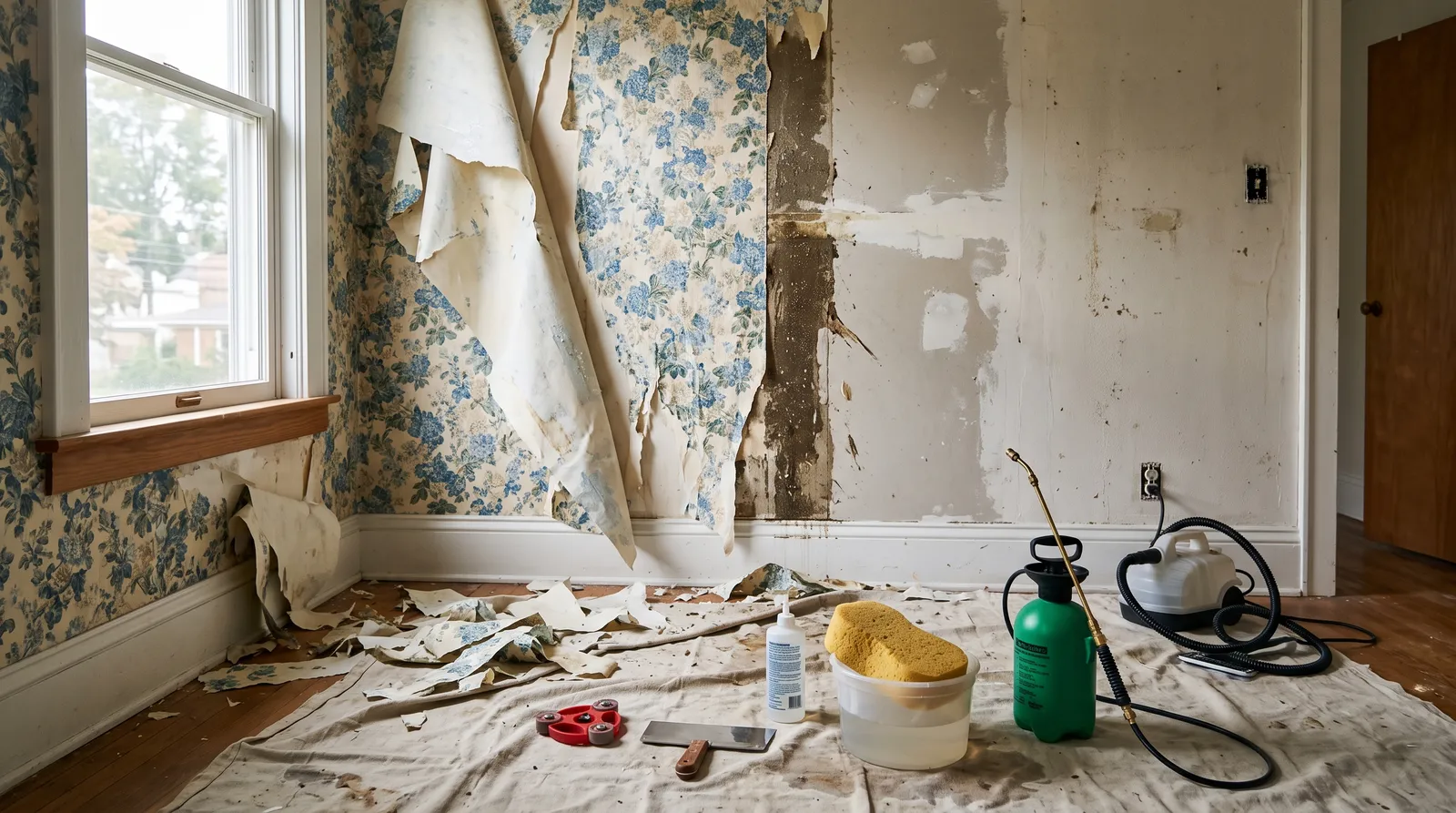
The scorer opens the face. ROMAN PRO-458 gel dissolves the paste and stays where you spray it instead of running to the baseboard. A 6-inch Hyde Pro Stainless taping knife lifts the wet paper without carving the wall. And a sponge with clean water takes off the residue nobody warns you about. If the paper was painted over, none of that works and you need the Wagner 725 steamer, about $75, which is the only tool here that gets heat past a paint film. If you have never done this before and want one box, the ROMAN Wallpaper Removal Kit at $29.99 bundles a scorer, scraper, sponge, and concentrate. If you are stripping a whole floor, add the Chapin 1990 sprayer so you stop refilling a spray bottle at the kitchen sink.
Four Rooms of Paper, Six Tools
We stripped four real rooms over five weeks, not test panels.
A 12 by 13 ft bedroom in a 1988 house: vinyl-coated floral over drywall that was never primed. That wall is the most common wallpaper situation in American housing, and it is the one that punishes you for skipping the scorer. A 1952 center-hall stair wall: ordinary paper painted over twice, on plaster and lath. A small den in grasscloth hung with clay paste. And a bathroom with a border at 6 feet over vinyl, twenty years of shower humidity baked into the adhesive.
Four axes, weighted in this order: square feet of wall stripped per hour of actual working time, sheets versus chips, damage left behind, and residue still stuck to the wall when the paper was off. Repair counted against the tool. Any gouge deeper than a paper cut had to be patched and sanded before the wall was called finished, and that time went on the tool’s ledger.
The gap between a scored wall and an unscored one was the biggest single number in the test. Same paper, same room, same remover. The unscored half of the bedroom gave up chips for forty minutes. The scored half came off in two-foot sheets.
That is a $13 tool doing that.
Why Wallpaper Jobs Turn Into Drywall Repair
Three failure modes, and they account for almost every horror story.
The wall was never primed. Wallpaper hung directly on bare drywall bonds to the paper face of the board. When you pull the covering, you pull the face with it, and now you are skimming an entire wall instead of painting one. You can feel this happening in the first ten minutes: the paper comes off too easily and the back of the sheet has grey-brown fuzz on it. Stop pulling and start soaking. Wet paste releases; dry paste takes the drywall with it.
The face is waterproof and nobody told you. Vinyl and vinyl-coated papers are designed to survive a wet sponge. Spray remover on an unscored vinyl wall and the liquid runs to the floor without touching the adhesive an eighth of an inch behind it. People conclude the remover is junk, buy a stronger one, and get the same result. Score first.
Somebody painted over it. Two coats of latex on top of wallpaper seals the whole assembly. No liquid gets through, and the paper will not release until the adhesive is heated. This is the steamer job, and it is the only situation where I would tell a homeowner to spend $75 before trying anything else.
A fourth one is a surprise rather than a failure: after the paper comes off, the paste is still on the wall. Half the people who strip a room think they are done at that moment. They are about two hours from done.
Matching the Tool to What Is Actually on Your Wall
Start with a corner test. Lift an edge with a putty knife at a seam near the floor and pull slowly.
It peels off dry in a full sheet. You have strippable paper and may not need a remover at all. Pull the top layer, then wash the backing paper and paste off with hot water and a sponge. If a paper backing stays behind, it soaks fast because it has no coating. Spray, wait, sponge.
It tears into small chips and the face feels plastic. Vinyl or vinyl-coated. Score with the PaperTiger, saturate with gel remover, give it the full fifteen minutes, then lift with the 6-inch knife. Re-wet any section that goes dull before you scrape it.
Water beads on it and nothing softens after twenty minutes. It has been painted over. Steam it. A scorer helps here too, because the perforations give the steam a way in, but the heat is what breaks the bond.
It is grasscloth, foil, or a fabric-backed commercial vinyl. The face comes off in one satisfying pull and the paper backing stays behind with clay paste under it. Clay is the hardest adhesive in residential work. Gel remover and patience, or steam if the gel stalls.
Substrate changes the rules on top of that. Drywall soaks up whatever you spray, so work in 4-foot sections and do not let solution stand at the baseboard. Plaster does not care about water but records every scorer track under flat paint. On plaster, lighten the scoring pressure and let the solution do more of the work.
Full Comparison
| Tool | Type | Best for | Price | Where it quits |
|---|---|---|---|---|
| Zinsser PaperTiger | 3-head scoring tool | Vinyl and vinyl-coated paper | ~$13 | Does nothing on painted-over paper |
| ROMAN PRO-458 Gel | Ready-to-use gel remover | Clinging to walls, paste residue | ~$20 / 32 oz | 32 oz covers less than one bedroom |
| Wagner 725 Steamer | Wallpaper steamer | Painted-over and multi-layer paper | ~$75 | Drives water into drywall if parked |
| Hyde Pro Stainless 6-inch | Stiff taping knife | Lifting wet paper, skimming after | ~$12 | Too wide for tight casing returns |
| ROMAN Removal Kit | Scorer, scraper, sponge, concentrate | First-time strippers, one room | $29.99 | Included scraper is light-duty |
| Chapin 1990 Sprayer | 2-gallon pump sprayer | Whole floors, repeat use | ~$90 | Overkill for a single bedroom |
1. Zinsser PaperTiger, Top Pick
The PaperTiger is a plastic puck with three scoring wheels on floating heads, and the floating part is the whole design. A single-plate scorer bridges the low spots on an old wall and digs into the high ones, so you get uneven perforation and a couple of blade tracks in the plaster. The three heads follow the surface independently. On the 1952 stair wall, which is nowhere near flat, coverage was even from the chair rail to the ceiling line.
On the drywall bedroom we scored one half of the room and left the other half alone, then treated both with the same gel at the same soak time. The unscored half came off in chips for forty minutes and I gave up on it. The scored half released in sheets that ran from the ceiling to the baseboard once I got a corner started. Same paper. Same remover. Fifteen minutes of scoring in between.
Two minutes per 8-foot section is the working pace, moving the tool in overlapping circles with almost no downward pressure. Pressure is the mistake. Push hard and the blades cut through the paper face into the drywall face, and the moment remover hits that cut, the gypsum swells. On the bathroom wall I got heavy in one spot and paid for it with a 6-inch skim patch.
Replacement heads cost less than a bottle of remover. Change them when the wheels start skating instead of biting, which for us was after roughly two rooms.
| Spec | Value |
|---|---|
| Type | Handheld 3-wheel scoring tool |
| Best for | Vinyl, vinyl-coated, washable, painted-over paper |
| Working pace | About 2 minutes per 8-foot wall section |
| Consumables | Replacement head kits |
| Approx. price | $12-$15 |
Buy it if: anything on your wall has a plastic feel or beads water. That is most wallpaper hung after 1980. Skip it if: your paper peels off dry in full sheets. You do not need it and you would only be cutting a wall for no reason.
2. ROMAN PRO-458 Gel, Best Remover Solution
Gel is the format that matters here, and it took me one wall to understand why. Liquid remover on a vertical surface has a countdown: you spray, it runs, and the top eighteen inches are dry again before the fifteen-minute soak is up. The PRO-458 gel body stays where you put it. On the bedroom walls I sprayed a 4-foot section, went and sprayed the next one, came back, and the first section was still visibly wet at the top.
It also handles the second half of the job. After the paper is off, the paste is still on the wall, and PRO-458 re-wets it so a sponge takes it off in passes instead of in scrubs. On the grasscloth den, where the clay paste had set hard, gel plus a fifteen-minute soak plus a stiff sponge cleared the backing when hot water alone had just polished it.
Coverage is the honest weakness. A 32 oz bottle at about twenty dollars does not do a bedroom. Between the first soak, the re-wets, and the residue pass, we used two bottles on the 12 by 13 room. For anything bigger than one room, buy the concentrate and mix it in a pump sprayer.
The other thing nobody mentions: it is slippery. It drips off the wall onto the floor continuously, and a plastic drop cloth under gel remover on hardwood is a genuinely dangerous surface. Canvas, always. See the drop cloth round-up for what stays put when it is wet.
Buy it if: you are stripping one or two rooms and you want the solution that stays on the wall long enough to work. Skip it if: you have a whole floor to do. Concentrate plus a sprayer costs a third as much per square foot.
3. Wagner 725 Steamer, Best for Painted-Over Paper
Different problem, different physics. When someone has rolled two coats of latex over wallpaper, the wall is sealed and no liquid remover will reach the adhesive. Heat will. The 725 puts about two hours of steam per fill through a 12-foot hose, ships with a small plate for corners and a large plate for open wall, and costs around seventy-five dollars, which is less than renting one for two days.
The 1952 stair wall was the test. Score lightly first so the steam has a path, hold the large plate against the wall for roughly thirty seconds, move it one plate-width over, and scrape the section you just did while the next one cooks. You fall into a rhythm: steam, step, scrape, step back. That wall took most of a Saturday and would not have come off any other way short of skimming the whole thing.
Now the part the box does not tell you. Steam is water, and drywall hates standing water. Park the plate in one place while you answer the phone and you will come back to a soft, swollen patch where the paper face has let go of the gypsum. Thirty seconds is the ceiling. On plaster you have more margin, which is lucky, because painted-over paper is mostly a plaster-era problem.
The hose runs hot along its full length and there is no insulating sleeve. Wear a glove. It is a rental-grade plastic tool that does one job well, and if your walls are drywall with ordinary vinyl paper on them, you will strip the room faster with a $20 sprayer and never plug this in.
Buy it if: somebody painted over the paper, or there are two layers, or the adhesive laughs at gel remover. Skip it if: your paper is strippable or vinyl-coated on drywall. Steam is slower and wetter than you need.
4. Hyde Pro Stainless 6-Inch Taping Knife, Best Scraper
The scraper is where walls get ruined, and the reason is width. A 2-inch rigid putty knife concentrates all the force you are pushing with into two inches of blade corner, and every corner leaves a divot. Six inches of stiff stainless spreads that same push across three times the edge. On the bedroom walls, wet sheets lifted cleanly under the 6-inch knife with zero gouging over one full wall. The 2-inch knife we used at the casing left four small dings in about ten feet of work.
Stiff-but-not-rigid is the spec that matters. The blade needs enough backbone to push under a wet sheet and enough give to follow a wall that is not flat. Hyde’s Pro Stainless line has that balance, and the hardwood handle takes a hammer-end tap when you need to start a stubborn corner.
Break the blade corners on a sanding block before the first use. New stainless comes with square corners sharp enough to score drywall on their own, and thirty seconds with 120-grit removes that risk permanently. Keep a narrow knife in your other pocket for the last four inches beside a door casing. More options in the scrapers and putty knives round-up.
5. ROMAN Wallpaper Removal Kit, Best Starter Kit
For someone who has never stripped a wall, the honest recommendation is a box with all four things in it. Scoring tool, scraper, removal sponge, and remover concentrate for $29.99. Bought separately those pieces run closer to forty-five dollars, and the concentrate mixes at 6 oz per gallon of hot water with a stated coverage of up to 300 sq ft per mixed gallon. That is one normal bedroom of wall.
The sponge is the piece I want to single out. It is the least exciting item in the box and the one most first-timers do not own. Paste residue does not scrape off, it washes off, and a large cellulose sponge with clean water in a bucket is the correct tool for that pass.
The included scraper is the weak link. Light plastic handle, thin blade, fine for a small room and outclassed by a stainless taping knife the moment the wall gets stubborn. Concentrate also wants hot water at around 120°F, so plan on refilling a bucket at a sink rather than mixing once and forgetting it.
Verdict: best first purchase in the category. One kit does one average room. Buy two if the walls are double-papered, or buy the kit and upgrade the scraper.
6. Chapin 1990 Sprayer, Best for Whole-House Jobs
Once you are past two rooms, the bottleneck stops being the wall and starts being the refill. A quart spray bottle empties in about a wall and a half, and you spend the day walking to the sink. The Chapin 1990 holds two gallons of mixed concentrate, has an open head so you pour hot solution straight in without a funnel, and rinses clean in half a minute.
The brass wand goes from a wide wetting fan to a stream you can lay along a seam or a border edge. Ten pump strokes give you a good fan for about thirty seconds, then you re-pump. That rhythm is the price of a hand sprayer, and it is fine when you are soaking and waiting anyway.
Ninety dollars is real money for a wallpaper job. For one bedroom, a twenty-dollar garden sprayer does the identical work. The 1990 earns its price if you are doing a whole floor, or if you already want a sprayer for deck cleaner and TSP substitute.
Skip this if you have one room to do. Buy the gel and a spray bottle and put the seventy dollars into primer.
Tools We Tried and Cut
- Fabric softener and water. The internet’s favorite trick. It performs about like plain hot water and leaves a film you have to wash off before priming. No.
- Single-plate scoring wheels. Cheap, and they gouge the high spots on any wall that is not dead flat. The floating-head design exists for a reason.
- Heat guns. A heat gun will loosen wallpaper adhesive, and it will also scorch drywall paper and cook lead paint on a pre-1978 wall into airborne dust. Use them on paint stripping jobs, not on wallpaper.
- Wallpaper shavers with razor inserts. Useful on a couple of stubborn dry patches, dangerous over a whole room. The blade only knows one depth.
- Steam from a household garment steamer. Not enough volume or heat retention to break adhesive. It wets the surface and stops there.
After the Paper Is Off, You Are Half Done
Wash the wall. This is not optional and it is the step people skip.
Wet the stripped wall with remover or hot water, let it soak fifteen minutes, then scrub with a cellulose sponge and rinse with clean water. Change the rinse water often; a dirty bucket just moves paste around. Run a dry hand over the surface when you think you are finished. Any tackiness at all means there is adhesive left. Paint over that and the paste re-wets under the coating, which shows up a week later as bubbles and blotchy sheen.
Then let it dry a full day. A wall that took twenty minutes of soaking is wetter than it looks, and primer over damp drywall bubbles.
Patch what the strip damaged. Torn drywall face gets a thin skim, gouges get filler, and both get sanded flat. The repaired drywall guide covers the sequence, and wall filler picks cover what to patch with.
Then seal it. A stripped wall has residual adhesive in the pores no matter how well you washed, plus fresh patches that suck up paint at a different rate than the surrounding surface. An oil-based or shellac sealing primer locks both down. Water-based primer over residual paste can re-activate it. If you are unsure which primer does what, start with what primer actually does, then pick from the primer round-up.
Mistakes That Cost You Drywall
- Spraying an unscored vinyl wall. The remover never reaches the paste. You will decide the product is junk when the problem is the sequence.
- Leaning on the scorer. Light pressure, overlapping circles. Cut through the paper face and you have made a patch out of a strip.
- Dry-scraping. If you are pushing hard, the wall is not wet enough. Re-wet and wait. Force is what gouges.
- Parking a steam plate. Thirty seconds, then move. Longer than that on drywall and the face lets go.
- Plastic drop cloths under a gel remover. Wet plastic on hardwood is the worst footing on a jobsite. Canvas.
- Painting over residue. Adhesive re-wets under a coating and bubbles the finish. Sponge and rinse until the wall feels squeaky dry.
- Scoring the whole room at once. Score only the section you are about to soak. Perforated wallpaper left dry overnight curls and hardens at every hole.
Start with the $13 scorer and a $20 bottle of gel. If the corner test says the paper has been painted over, put the gel back on the shelf and buy the Wagner steamer instead, because nothing else on this list will move that wall.
Ask a Question