Best Wallpaper Steamers
Five wallpaper steamers tested on painted-over vinyl, 1970s foil, and plaster. Top pick: the Wagner 725 Wallpaper Steamer, plus where each one runs out of steam.

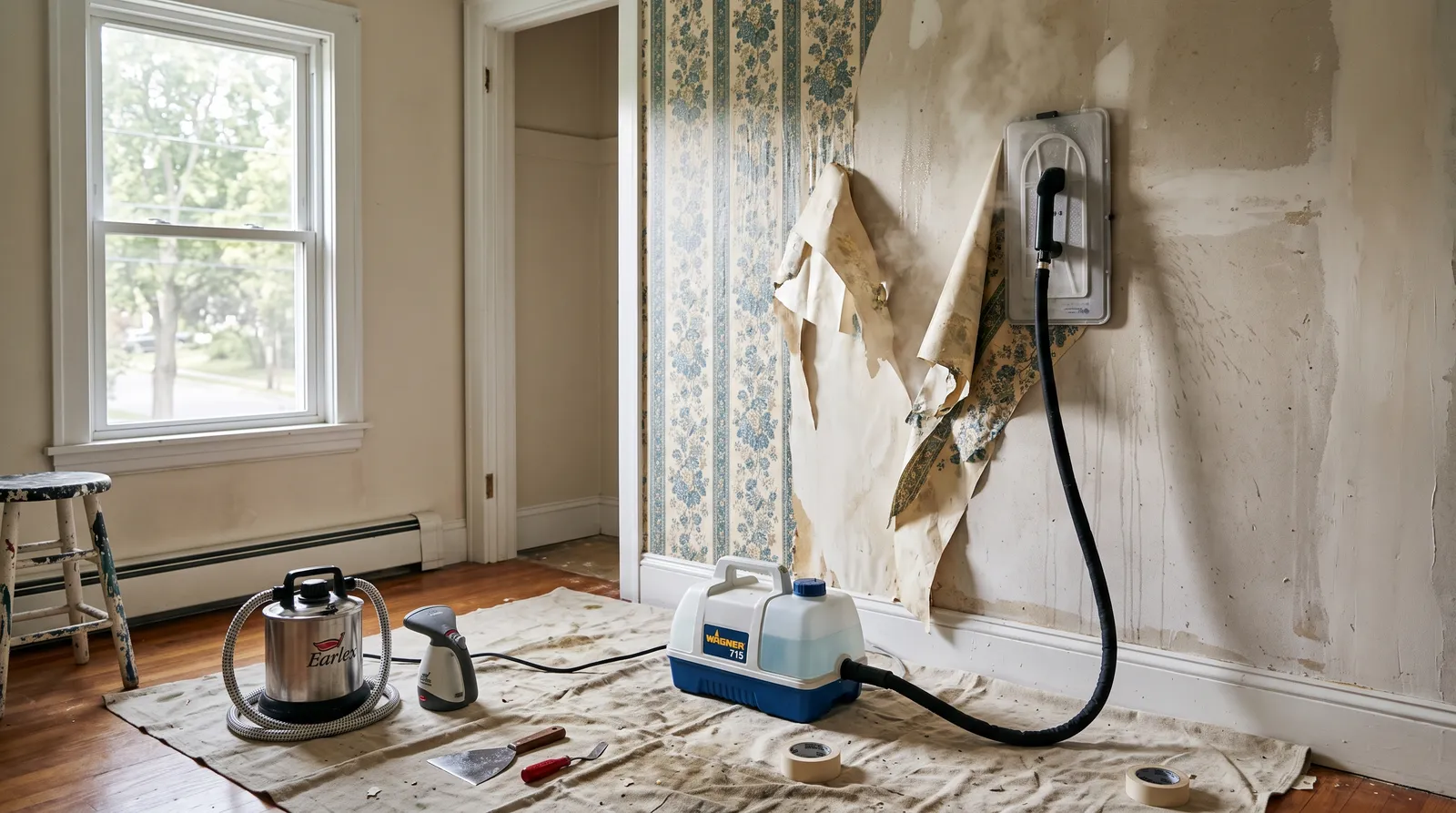
Disclosure: Some links below are affiliate links. We earn a commission if you buy through them, at no extra cost to you.
Top pick: the Wagner 725 Wallpaper Steamer. Seventy-five dollars, two hours of run time per fill, and both plates in the box, a small 3 by 6 inch for corners and an 8 by 11 inch for open wall. It wins on the spec that decides this whole category, which is how long you can keep steaming before you stop. It falls short on build quality, because the body is plastic and feels like it, and on hose heat, because there is no insulating sleeve anywhere on the 12 feet of it. For paper that somebody painted over, the Dupray Neat’s 275°F pressurized steam gets under an adhesive layer the Wagner only warms. For a lifetime warranty on a metal boiler, the Vapamore MR-100 Primo.
Skip this page entirely if you have one loose accent wall of uncoated paper. Warm water and a scoring tool will beat every machine here on setup time alone.
Why These Five Made the Cut
Wallpaper steamers split into two families that get shelved together and shouldn’t be.
The first family is a dedicated wallpaper steamer: a big low-pressure water tank, a boil-and-vent element, a long hose, and a flat perforated plate you hold against the wall. It does one job. It does that job with a large footprint and a run time measured in hours. The Wagner 725 is the surviving mainstream example in the US.
The second family is a pressurized steam cleaner. Stainless boiler, 50 psi, a trigger gun, a bag of nozzles. It was built for grout and oven racks, and it strips wallpaper as a side effect of being hotter than anything in family one. The Dupray Neat, the Vapamore MR-100 Primo, and the Kärcher SC 3 EasyFix all live here.
I tested across both families because the honest answer to “which steamer” depends on whether the wall is sealed. Uncoated paper needs volume and time. Painted-over vinyl needs heat and pressure. Those are different machines, and a round-up that pretends otherwise sells you the wrong one.
The Wagner 505e handheld is the fifth pick because plenty of people searching for a wallpaper steamer only have a bathroom border, and telling them to buy a $180 boiler for eleven linear feet of paper would be dishonest.
What Actually Makes a Steamer Work on a Wall
Four specs matter. Everything else on the box is noise.
Run time per fill. This is the one people ignore and then regret. The Wagner 725 runs about two hours. The Dupray and the Vapamore run fifty to sixty minutes. The Wagner 505e handheld runs eight to ten. A 10 by 12 foot wall of painted-over vinyl is not a fifty-minute job, so on the pressurized machines you are refilling mid-wall, and on a pressurized machine refilling means waiting for the boiler to depressurize first. That break costs more than the ten minutes it looks like it costs, because the wall cools and the adhesive re-sets while you stand there.
Plate size. A steam plate is a perforated flat panel that holds steam against a wide area of paper. An 8 by 11 inch plate covers roughly four times what a triangular detail nozzle covers per position. On a full room, that difference is the whole afternoon. This is the single biggest advantage a dedicated wallpaper steamer holds over a general steam cleaner, and it is why the Kärcher and the Dupray, both better machines in almost every other way, lose on open wall.
Temperature and pressure. Open-vent steamers put out steam at about 212°F with no meaningful pressure behind it. Pressurized cleaners run 50 psi and, in the Dupray’s case, up to 275°F. On ordinary paper the difference barely shows. On paper sealed under two coats of latex, it decides whether you get under the adhesive at all, because you are now heating the glue through a plastic film instead of soaking through a porous face.
Hose length. Twelve feet on the Wagner means the tank sits on the floor and stays there while you work an entire wall. A handheld with no hose means you carry a hot water tank at shoulder height for however long the job takes. That is a fatigue spec, and fatigue is what makes people gouge drywall at hour six.
Side by Side
| Model | Type | Tank | Run time | Heat-up | Plate included | Price tier |
|---|---|---|---|---|---|---|
| Wagner 725 Wallpaper Steamer | Dedicated wallpaper steamer | Plastic, open-vent | About 2 hours | Several minutes | Yes, 3 by 6 in and 8 by 11 in | $ |
| Dupray Neat | Pressurized steam cleaner | 54 oz stainless, 50 psi | Up to 50 min | 8 min | No | $$$ |
| Vapamore MR-100 Primo | Pressurized steam cleaner | 1.6 L stainless, 50 psi | 50-60 min | 11 min | No | $$$ |
| Kärcher SC 3 EasyFix | Household steam cleaner | 33.81 oz, max 3 bar | Refill any time | 40 sec | No | $$ |
| Wagner 505e Handheld | Handheld steamer | 250 ml, 55 psi | 8-10 min | Under 5 min | No | $ |
How I Ran the Test
Four rooms, two houses, one knife.
The bedroom was painted-over vinyl in a 1974 split-level, two coats of latex sealed over embossed paper. This is the case that breaks steamers and tempers. The hallway was 1970s foil-backed paper hung on drywall that nobody primed, where the face paper of the drywall tears if you lean on the blade. The bungalow had grasscloth over skim-coated plaster, a substrate that tolerates heat well but holds adhesive at the seams like it was engineered to. The bathroom was a border strip at ceiling height, standing in for the small job.
Every wall got scored the same way. Every machine got distilled water. Every strip got worked with the same 6-inch stiff taping knife, so the blade was never the variable, only the steam was. I timed heat-up from cold, counted refills per 10 by 12 foot wall, felt the hose at the plate end after twenty minutes of continuous work, and counted gouges in the drywall face when the wall came clean.
One finding shaped the whole ranking: on the painted-over vinyl, the Dupray got under the adhesive in a single pass per position, and the Wagner needed two. On the uncoated grasscloth, they were even, and the Wagner finished the room in half the wall-clock time because it never stopped. Heat wins on sealed walls. Endurance wins on everything else, and most walls are everything else.
For the full removal sequence, including the scoring step and the wash-down that comes after, see the wallpaper removal guide.
1. Wagner 725 Wallpaper Steamer, Top Pick
The 725 is what a wallpaper steamer is supposed to be. Fill the tank, plug it in, wait for steam, hold a plate on the wall, strip. There is no trigger, no pressure gauge, no accessory bag. It boils water and pushes the steam down a 12-foot hose to a plate, and it does that for about two hours before you refill.
The 8 by 11 inch plate is the reason it wins. On open wall I could steam one plate position, move the plate down, and strip the section I had just heated in the same motion, working a continuous band across the wall without ever setting the plate down. The pressurized machines can’t do that with a hand nozzle. The 24-foot working radius means the tank sits in the middle of the room and stays there for the whole wall, which sounds minor until you have moved a hot water tank forty times.
The small plate is not a throwaway. Window returns, door casings, and the six inches above a baseboard are where a big plate stops working, and having the 3 by 6 inch in the box saved me from finishing corners with a scraper and a spray bottle.
Where it falls short: the body is plastic, the fittings are plastic, and after four rooms the hose connection had developed a slow drip. The hose is hot along its entire length with nothing to grip but bare hose, so wear a glove on the plate hand. Above eight feet on a ladder, the hanging weight of the hose pulls the plate off the wall, and ceiling-line work means looping the hose over your shoulder.
| Spec | Value |
|---|---|
| Type | Dedicated open-vent wallpaper steamer |
| Plates | 3 by 6 inch and 8 by 11 inch, both included |
| Hose | 12 ft, 24 ft working area |
| Run time | About 2 hours per fill |
| Approx. price | $75 |
Buy it if: you are stripping a room or more of ordinary paper and you want the job over in an afternoon. Skip it if: the paper is painted over and heavily sealed, or you want a tool that still earns its shelf space after the job.
2. Dupray Neat, Best for Painted-Over Paper
Different problem, different machine. Paper that somebody rolled two coats of latex over is not a soaking problem, it is a heat problem, and the Neat’s stainless boiler running 50 psi at up to 275°F is the hottest thing in this test by a wide margin.
On the split-level bedroom it showed. One pass per position with the triangular tool and the paper released at the seam, where the Wagner wanted two passes and a longer dwell. Eight-minute heat-up from cold, and once it is up it holds pressure steadily instead of surging and fading the way an open-vent boiler does. Fifty-four ounces gets you close to fifty minutes.
Then it runs out, and you wait for it to depressurize before you can open the cap. On a full room that is two or three stops.
The bigger structural problem is the missing plate. Dupray sells this as a home steam cleaner, so the kit is nozzles and brushes, and stripping open wall with a hand tool means many more positions per square foot. On the grasscloth room the Neat took noticeably longer than the Wagner despite being the better machine, purely on footprint.
What buys it back is the second life: grout, oven racks, upholstery, sealed floors, and a two-year warranty. If wallpaper removal is a one-time event in your house and you were buying a steam cleaner eventually anyway, this purchase covers both.
Buy it if: the paper is vinyl, foil, or painted over, and you want a machine you will still use in five years. About $180 direct. Skip it if: you have three rooms of ordinary paper and no interest in steam cleaning anything else. The plate matters more than the pressure on that job.
3. Vapamore MR-100 Primo, Best Heavy-Duty
The Primo is the buy-it-once option. Metal boiler, metal fittings, 1.6 liters, 50 psi, fifty to sixty minutes per tank, and a lifetime warranty on the machine. Nothing else in this test offers that warranty and it is not close.
I like it for people who strip paper for a living, or for a landlord turning units. The extension tubes and steam gun reach a ten-foot ceiling line without a ladder, which on a hallway of foil-backed paper meant working the top band standing on the floor. The build survives being thrown in a van. The plastic-bodied Wagner does not.
Two honest limits. Steam runs 210 to 220°F, cooler than the Dupray, so on painted-over vinyl it behaves more like the Wagner than like the Neat. And the eleven-minute heat-up is the slowest here. On the first fill you don’t notice. On the third refill of a long day you notice.
Wallpaper is not in Vapamore’s marketing for this machine, and I’d rather say that plainly. It strips paper well because 50 psi of steam strips paper, not because the tool was designed for it. There is no plate.
Buy it if: you strip wallpaper more than once a year, or you want the last steamer you’ll buy. Skip it if: this is a one-house job. The lifetime warranty is worth nothing to someone who uses it twice.
4. Kärcher SC 3 EasyFix, Best for One Room Plus Everything After
Forty seconds. That’s the heat-up, and after the Vapamore’s eleven minutes it feels like a different technology.
The SC 3 is a household steam cleaner with an unpressurized tank, which is the design decision that matters. You can refill it mid-job without waiting for anything to cool or bleed down. On the bathroom border and on the plaster grasscloth, that meant near-continuous work with none of the depressurize-and-wait ritual the Dupray and Vapamore both impose.
Max 3 bar and 33.81 ounces put a ceiling on it. This is a cleaner doing a stripping job. On the painted-over vinyl it struggled honestly, needing long dwell times per position and still leaving adhesive behind for the wash-down. On uncoated paper over plaster it was fine, and the hand tool with the microfiber off gave decent contact.
One buying warning that is specific and worth the paragraph: Kärcher only authorizes the SC 3 EasyFix and the SC 3 Upright for US sale. SC 1, SC 2, SC 3 Deluxe, SC 4, and SC 5 units are 220V and show up constantly on marketplace listings from gray-market sellers. They will not run on a US outlet. Buy the model number, not the family name.
Verdict: the right pick for one room of ordinary paper in a house where a steam cleaner has a job waiting for it. Not the pick for a sealed wall.
5. Wagner 505e Handheld, Budget Pick
Fifty dollars, under five minutes to heat, and it fits in a kitchen drawer.
The 505e is here for one job: a bathroom border, a peeling seam, a two-foot patch behind where a mirror used to hang. At 212°F and 55 psi it has real output for a handheld, and on the bathroom border it lifted the strip in a single pass. Eleven attachments mean it keeps working on shower grout and range hoods after the border is gone, which is the only way a $50 steamer makes sense.
Two hundred fifty milliliters of water gives eight to ten minutes of steam. That is one border run and then a refill, and you are holding the entire machine, water and all, at head height the whole time. My shoulder had an opinion by minute six.
Do not buy this to strip a bedroom. I want to be blunt about that because the search results will put handhelds next to real steamers and the listings will not tell you the difference. Ten minutes of steam does not remove a wall of paper. It removes a border.
Buy it if: the whole job is a border, a patch, or a seam. About $50.
Steamers I Looked At and Left Out
- Wagner 905e Auto, 915e On-Demand, and 925e Steam Machine Elite. Wagner recalled all three in March 2026 because the hose can get excessively hot and the gun can expel hot water during and after trigger use, a burn hazard. Units sold from November 2018 forward are covered. If you own one, stop using it and check Wagner’s recall page. Don’t buy one secondhand.
- HomeRight SteamMachine. A genuine value pick for years. HomeRight’s current catalog is sprayers and heat tools with no steam cleaners listed, so anything you find now is old stock or a marketplace reseller.
- Kärcher SC 4 and SC 5. Better machines than the SC 3 and not sold for US power.
- Generic marketplace wallpaper steamers under $45. I bought one to see. The plate seals poorly against the wall, steam escapes at the edges instead of going into the paper, and the tank shell got hot enough to be unpleasant to move.
- Garment steamers. Forums suggest these constantly. Low-volume steam through a small head, no plate, no dwell. It lifts a corner and nothing else.
Technique That Saves You Two Hours
The machine is maybe a third of this job. Sequence is the rest.
Score first, and score lightly. A scoring tool cuts perforations so steam gets behind the face. On vinyl and painted paper it is not optional. Press hard enough to break the paper, not hard enough to cut drywall. The little wheeled scorers are made to be dragged, not shoved.
Ten to fifteen seconds per plate position. Not thirty. Not a minute. Longer dwell soaks the drywall face, which is when the face paper starts coming off with the wallpaper and you graduate from stripping to patching.
Strip the section you just steamed, then re-steam ahead of yourself. Work in bands. The plate heats the next section while your knife is on the current one. People who steam a whole wall first and then start stripping are stripping cold paper.
Six-inch stiff taping knife, low angle. A narrow scraper concentrates force on a point and that point goes through drywall. A wide blade at a shallow angle spreads it. For blade options, see the scraper round-up.
Protect the floor before you start. Steam condenses and runs down the wall carrying adhesive with it, and dried paste on hardwood is its own project. Canvas, not plastic. Wet plastic on a wood floor is a fall risk. The drop cloth round-up covers the difference.
Wash the wall down the same day. Hot water, a stripper solution, a sponge, and a squeegee. Adhesive left on the wall re-wets under latex and bubbles the finish. Then prime with an oil or shellac primer, never a latex one, because latex re-activates whatever glue you missed. The primer explainer has the full sequence.
Care, Descaling, and How Long These Last
Use distilled water. Every machine here, every time.
Hard-water minerals bake onto the heating element and stay there. A scaled element takes longer to reach temperature, produces weaker steam, and in a pressurized boiler it eventually fouls the safety valve, which is the part you actually care about. Kärcher ships the SC 3 with a descaling cartridge for exactly this reason and Dupray recommends periodic descaling on the Neat. A gallon of distilled water is about a dollar fifty.
After each job. Empty the tank completely while it is still warm and leave the cap off overnight. Water standing in a boiler between jobs is how you get scale and, on the cheaper plastic units, a smell you never lose.
Descaling. On the pressurized machines, follow the manufacturer’s interval. Every twenty to thirty tanks is a reasonable rule of thumb in hard-water regions. White vinegar works on the Wagner 725’s element; do not put vinegar in a stainless pressurized boiler unless the manual says you can, because it attacks the seals.
Hoses and gaskets. O-rings and hose gaskets fail first on every steamer at every price point. Vapamore ships a replacement o-ring set in the box, which tells you something. Wagner sells 725 hoses and filler caps as separate parts, which is why the plastic body is more tolerable than it looks.
Realistic service life: the Wagner 725 will do several houses and then leak at a fitting. The Kärcher will do a decade of household duty and one wallpaper job. The Dupray and the Vapamore are boilers, and boilers last as long as their elements stay clean.
Mistakes That Cost People Drywall
- Holding the plate in one place until the paper falls off. It will fall off, and so will the drywall face. Fifteen seconds, then move.
- Skipping the scoring step on vinyl. Steam cannot get behind a plastic face. You will stand there heating a wall for an hour and blame the machine.
- Using a 2-inch putty knife. Narrow blades gouge. Six inches, stiff, low angle.
- Buying a handheld for a whole room. Ten minutes of steam per fill against six hours of work. The arithmetic never works.
- Painting over leftover adhesive. The glue re-wets under latex and takes your new finish with it. Wash, dry, test with a bare hand, then prime with oil or shellac.
- Working a plaster wall like it’s drywall. Plaster takes heat far better, but soaked plaster on wood lath can let go of the lath. Keep the dwell short on ceilings especially.
- Running the tank dry. On an element-in-tank steamer this is how you kill it in one afternoon. Refill before it sputters, not after.
What I’d Actually Buy
For a house with two or three rooms of ordinary paper: the Wagner 725, a scoring tool, and a 6-inch stiff knife. Under a hundred dollars for the whole kit, and the run time is what gets you through a weekend.
For a 1970s house where somebody painted over the vinyl in every bedroom: the Dupray Neat. The heat is the only thing that solves that wall, and you’ll use the machine on grout for the next decade.
For one bathroom border: the Wagner 505e, or honestly, hot water and patience.
If the paper is uncoated and hung over primed drywall, put the credit card away, score it, soak it twice, and hand-strip it. The steamer is for the walls that fight back.
Ask a Question