The Furniture Flipping Starter Kit
The ten pieces of furniture flipping supplies I actually use on a flip, tested across six real pieces. Top pick for the color coat: Rust-Oleum Chalked Ultra Matte.

Disclosure: Some links below are affiliate links. We earn a commission if you buy through them, at no extra cost to you.
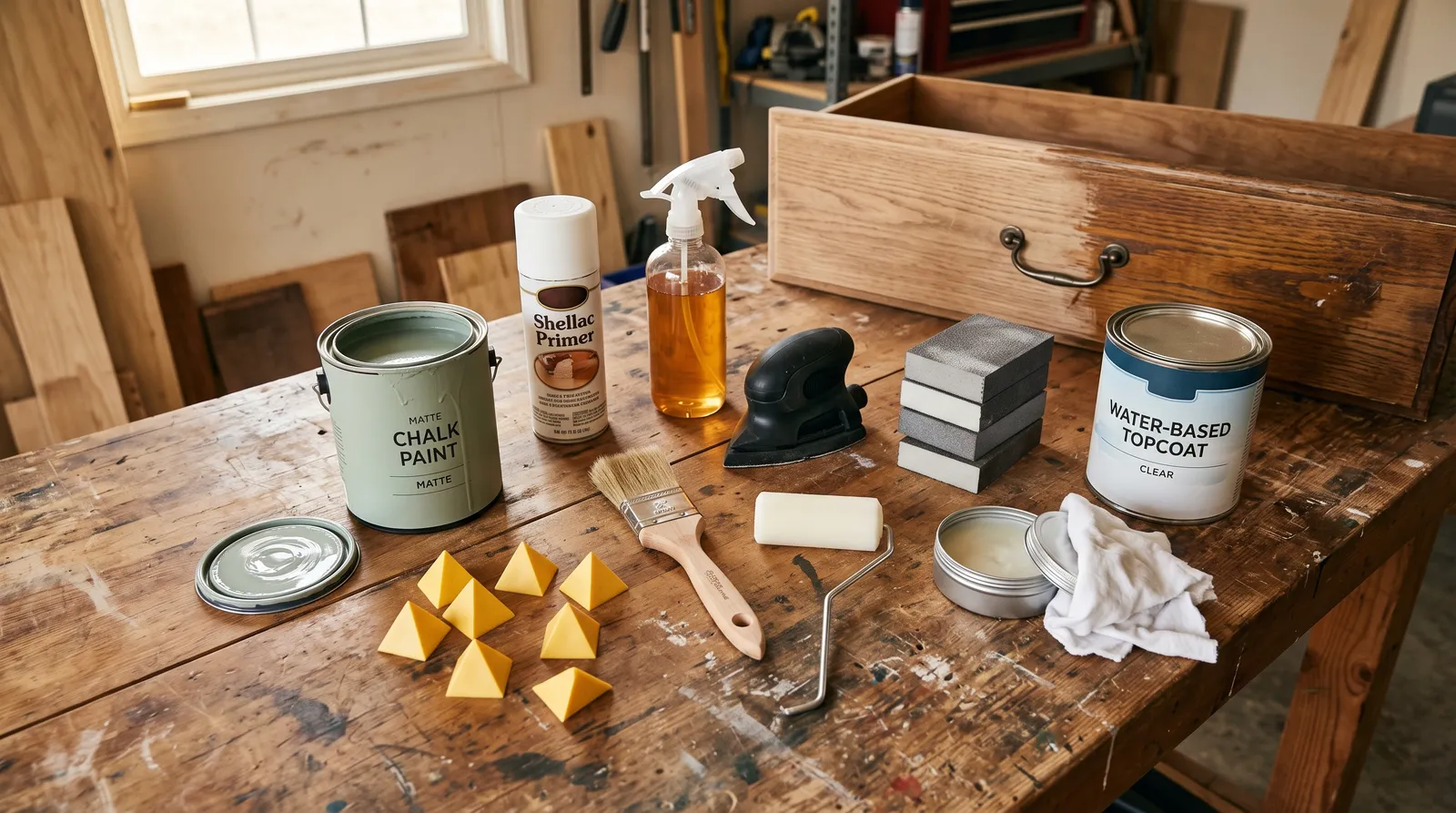
Top pick for the color coat: Rust-Oleum Chalked Ultra Matte, about 20 dollars a quart. It wins on adhesion over a scuffed factory finish and on self-leveling, which is the spec that keeps a beginner’s first dresser from looking like a beginner’s first dresser. It falls short on durability before topcoat, so it never travels alone. Around it sit nine other pieces that turn one can of paint into a repeatable system: a degreaser, sanding sponges, a detail sander, a shellac primer, one good angled brush, a foam mini roller, painter’s pyramids, and two topcoats that do different jobs. The whole kit runs about 190 dollars, and after that a dresser-size flip costs 20 to 30 dollars in consumables.
This is not a tournament. Nothing here beats anything else.
It is a shopping list, in the order you will touch each item, with the reason each one earns bench space.
What the Kit Costs and What It Replaces
Ten items, US retail, mid-2026 pricing:
| Item | Price tier | What it is for |
|---|---|---|
| Krud Kutter Original Degreaser | $ | Stripping polish, grease, and hand oil before anything else |
| 3M Pro Grade Precision Sanding Sponge | $ | Scuffing curves, spindles, and profiles by hand |
| BLACK+DECKER BDEMS600 Mouse | $$ | Power sanding corners, bevels, and slat gaps |
| Zinsser B-I-N Shellac Primer | $$ | Blocking tannin bleed and odor; gripping laminate |
| Rust-Oleum Chalked Ultra Matte | $ | The color coat |
| Purdy Clearcut Glide 2-inch | $$ | Edges, profiles, and cutting around hardware |
| Wooster Jumbo-Koter foam cover | $ | Flat panels and tops, stipple-free |
| Painter’s Pyramid Stands (10) | $ | Painting a drawer front and its edges in one pass |
| Minwax Paste Finishing Wax | $ | Matte topcoat with a soft hand |
| Minwax Polycrylic | $$ | Durable topcoat for surfaces that hold a drink |
A full kit lands around 190 dollars. Drop the sander and the second topcoat and you are at roughly 130, which is a fine place to start.
What it replaces: the 60 dollar all-in-one furniture kits sold at craft stores. Those bundle a small paint can, a foam brush, and a wax puck. The paint is usually fine. The applicators are the problem, and the applicators are what decide whether the finish reads as handmade or homemade.
How I Tested the Kit
Six flips over eleven weeks, in an unconditioned two-car garage between 68 and 84 degrees F. A 1974 solid-oak nine-drawer dresser with a heavy factory lacquer. A mahogany-veneer nightstand I bought specifically because it would bleed. A laminate three-drawer unit with a plastic wrap face. Four spindle-back dining chairs. A pine blanket chest carrying a decade of lemon polish. And a maple drop-leaf table that took the abuse tests.
Same degreaser on every piece, same scuff, same paint. The variables stayed in the tools.
Adhesion checked with a cross-hatch tape pull on a hidden drawer side at 24 hours and again at 7 days. Bleed-through logged by photographing the mahogany nightstand at 2, 24, and 72 hours under the same shop light. Topcoat durability judged on cured sample panels with a wet-glass ring left 4 hours, a denatured alcohol rub, and a fingernail scratch. The brush and roller covers ran all eleven weeks with normal washing between colors.
The mahogany nightstand is where the kit earned its keep. Two coats of white chalk paint straight over the scuffed veneer looked flawless at hour two and had pink shadows through the drawer fronts by the next morning. One coat of shellac primer and the same paint, on the same piece, still white at 72 hours.
That is the whole argument for buying primer you might not need.
1. Krud Kutter Original, the Step Everyone Skips
Furniture fails at adhesion more than any other painted surface in a house, and it fails because of what is on the piece rather than what is under it. Silicone furniture polish, cooking grease from a kitchen hutch, hand oil on a chair arm. Sanding does not remove those. It grinds them into the wood.
Krud Kutter goes on at spray strength, sits 60 to 90 seconds, and wipes off with a folded rag. On the pine blanket chest, the first pass turned the rag brown and I did three more before it came off clean. That chest would have rejected paint in patches.
It is water-thin and runs down vertical sides, so keep a second dry rag in your other hand. On old lacquer, do not let it dwell past two minutes or you will soften the finish. Neither of those is a reason to skip it.
Buy it if you paint furniture at all. If you would rather do a traditional prep wash, our TSP substitute explainer covers what those cleaners actually do differently.
2. 3M Pro Grade Precision Sanding Sponge
Scuff sanding is 90 percent of the sanding on a flip. You are not removing a finish, you are dulling it so the paint has something to bite.
The Pro Grade Precision sponge bends around a bun foot and a chair spindle without collapsing at the fold, which is the failure of every cheap sanding block I have used. It rinses in the sink and comes back at close to full cut. One sponge scuffed the entire nine-drawer dresser and still had life for the chairs.
It costs three to four times a paper sheet of the same grit, and it loads up fast on gummy varnish. Plan on rinsing it four or five times per piece.
For flats, paper on a block is still cheaper. Our sandpaper round-up covers the grit sequence in more depth.
3. BLACK+DECKER BDEMS600 Mouse, Best for Corners
The detail sander is the piece people leave out and then buy after their first chair set.
An orbital sander is faster on a tabletop and useless everywhere else on a chair. The Mouse has a pointed triangular pad that reaches into drawer face bevels, inside cabinet corners, and the shoulder where a spindle meets a seat. On the four dining chairs, it cut the hand-sanding time roughly in half, and the finger attachment got into the slat gaps that a sponge cannot reach without folding into a wedge.
At about 2.7 pounds it runs one-handed for twenty minutes without wrist fatigue. The paper is hook-and-loop, and the pad itself wears out faster than the paper does, so budget for replacement pads.
The dust collection is theater. Wear a respirator (our painting respirator picks cover cartridge choice) and expect to vacuum the bench after.
Buy it if: you flip chairs, carved case pieces, or anything with a profile. About 30 dollars. Skip it if: your pieces are all flat-panel modern boxes. A sanding sponge and an orbital sander handle those.
4. Zinsser B-I-N, the Insurance Policy
One quart, kept on the shelf, used on maybe one flip in three.
B-I-N is a shellac-base primer and it does two things nothing else in this kit does. It stops tannin bleed, the pink and amber blotching that comes up through white paint over mahogany, knotty pine, and old cherry. And it seals odor in a piece that has been living in a basement.
It also grips slick surfaces, which is what makes laminate flips possible. The laminate three-drawer unit got a light scuff and one coat of B-I-N; the cross-hatch tape pull at 7 days came off clean with no paint lift. The control panel with no primer failed at the first pull.
The smell is the price. Ammonia and alcohol, filling a two-car garage, gone in about an hour with the door up. Cleanup is denatured alcohol only, so use a cheap synthetic brush and treat it as consumable. Do not use your Purdy.
Spot-priming is the mistake I see most: one bleeding knot gets primed, the rest of the piece does not, and the sheen difference telegraphs through the paint. Prime the whole surface or none of it.
5. Rust-Oleum Chalked Ultra Matte, Top Pick for Color
Chalk-style paint exists so you can skip a full sand-and-prime cycle, and Rust-Oleum Chalked is the one I keep buying.
On the oak dresser’s factory lacquer, scuffed with a medium sponge and nothing else, the 7-day cross-hatch pull came away clean. Coverage over mid-tone oak was solid at two coats. It self-levels better than the artisan chalk paints, which matters more than any other property for someone on their first or second piece; thick boutique chalk paint holds brush texture, and brush texture is what makes a flip look homemade. If you are already fighting that, our brush marks fix walks the recovery.
Price is the other half of the argument. About 20 dollars a quart against 40 or more for artisan lines, and a quart put two coats on a full nine-drawer dresser with paint left over.
Where it falls short: the ultra matte film marks with a fingernail until it is sealed, so the topcoat is mandatory, not stylistic. The color range is thin next to the boutique lines. And it distresses harder, sanding off in flakes where Annie Sloan powders away softly, so if hand-distressed edges are your whole look, buy the expensive stuff. We compare the full field in the chalk paint round-up.
Buy it if: you want a durable, cheap, forgiving color coat and you plan to topcoat it anyway. Skip it if: you sell heavily distressed farmhouse pieces where the sanding behavior is the product.
6. Purdy Clearcut Glide 2-inch, the Brush Worth 18 Dollars
Here is my one rant. The foam brush in the craft-store kit is why your first flip looked streaky, and no amount of better paint fixes a bad applicator.
The Clearcut Glide is a nylon-polyester blend in a 2-inch angular sash. It lays thick chalk paint flatter than a natural-bristle round chalk brush, and it holds a crisp edge along a drawer lip so you can cut around hardware openings without taping anything. After eleven weeks and six pieces, washed between every color change, it had no bristle loss and no flare at the ferrule. It looks close to new.
It is the wrong shape for heavy carving and spindle work, where a round chalk brush moves paint faster into the recesses. If your pieces are ornate, own both.
Eighteen dollars against four for a chip brush. Look at the two finishes side by side under raking light and the argument ends. More options in the paint brush round-up.
7. Wooster Jumbo-Koter Foam Cover, for Flat Tops
Short entry, simple job.
A dense foam mini roller lays a dresser top or a flat drawer face with no stipple. It is the closest thing to a sprayed finish without owning a sprayer. Twin packs run a few dollars, so you can dedicate one cover per color and throw it away instead of washing it.
Two cautions. Foam drags and tears if the paint has begun to skin, so keep a wet edge and work one panel at a time. And capacity is small; on a wide tabletop you reload every foot or so.
Roll the flats, brush the edges, never one tool for both. The roller cover round-up has the full nap-and-material breakdown.
8. Painter’s Pyramid Stands, the 10 Dollar Time Machine
Ten little plastic tripods that hold a drawer front, door, or shelf a half inch off the bench on needle-fine tips.
The value is time. Without them you paint the face, wait for it to dry, flip it, paint the edges, wait again. With them you paint the face and all four edges in one pass and set the piece down immediately. On the nine-drawer dresser that saved most of an afternoon across two coats.
The contact mark is a pinprick that buffs out with a fingertip. Under a heavy solid-wood door on a soft, uncured film, a tip can dimple, so use six or eight instead of four to spread the load. They also slide on a slick bench; a scrap of cardboard underneath fixes that.
Nothing else in this kit returns its price as fast.
9. Minwax Paste Finishing Wax, Topcoat A
Wax is the finish that makes a piece feel like furniture. It stays dead matte, it adds a silky hand, and it is what buyers reach out and touch at a market booth without knowing why.
Application is a rag, a thin coat, a 10 to 15 minute haze, then buff. About 15 minutes of work per drawer bank.
The honest limit: wax is not a film, it is a sacrificial layer. A wet glass left on a waxed dresser top will ring it. It wants a fresh coat every year or two on anything handled daily. And nothing sticks over old wax, so a repaint down the road starts with a mineral spirits strip.
Buy it if: the piece is decorative, or a chair frame, or a headboard. Skip it if: the piece has a horizontal surface where someone will set down a coffee cup.
10. Minwax Polycrylic, Topcoat B
The one I put on nightstands, dressers, coffee tables, and anything going into a house with kids.
Polycrylic is a water-based film. Once cured it shrugs off water rings and an alcohol rub, which is where wax fails. It recoats in 2 hours with water cleanup, so three coats fit into one afternoon. The ultra flat version keeps a chalk look while giving you actual protection, and it is the version I use on 90 percent of flips.
Two real cons. It ambers slightly over bright white and over pale cool gray, enough to notice on a crisp white dresser, so test on a drawer bottom before you commit the whole piece. And it drags if you overwork it. Lay it, tip it once, walk away. Going back over a half-set coat leaves marks that show under raking light.
Full cure is about 3 days. Drawers pressed shut before then will block and stick to the carcass.
Where to Spend and Where to Save
Spend on the brush, the primer, and the topcoat. Those three decide whether the finish holds up and whether it looks like a professional did it.
Save on the paint. Chalk-style paint from Rust-Oleum performs within a hair of paint that costs twice as much, and the difference between brands lives in color selection and distressing behavior rather than adhesion.
Save on roller covers. Buy the twin pack, use one per color, toss them.
Do not save on the degreaser, which costs 10 dollars and prevents the failure mode that ruins whole pieces.
The two most common upgrade paths after the starter kit: a sprayer, once you are doing more than one piece a month, and better lighting. A work light aimed across the surface at a low angle shows every drag mark and holiday while you can still fix them. That one costs 25 dollars and improves your finish more than any paint upgrade will.
Mistakes on Flip One
- Painting over polish. Silicone from furniture polish causes fisheyes and patchy adhesion. Degrease first, every time.
- Spot-priming a bleeding knot. The sheen difference telegraphs through the color coat. Prime the whole surface.
- Skipping the topcoat because the chalk finish looks good. It looks good for a week. Bare chalk paint marks with a fingernail and stains from a wet hand.
- Closing painted drawers on day two. Painted surfaces pressed together block and fuse. Leave drawers cracked for a week, or wax the runners instead of painting them.
- Buying a full-size sander for chair work. Wrong shape. A detail sander does in ten minutes what an orbital cannot do at all.
- Waxing a tabletop. Water rings. Use polycrylic on horizontal surfaces and save the wax for vertical ones.
- Using the good brush for shellac primer. B-I-N cleans with denatured alcohol only, and a half-cleaned brush is a dead brush.
Care and Storage Between Flips
Wash the Purdy under warm water until the runoff is clear, comb the bristles straight, and put it back in its cardboard keeper. That keeper is what preserves the chisel edge, and everybody throws it away. A washed Clearcut Glide handles a couple of dozen pieces before it flares.
Chalk paint skins in the can once it has been opened and stirred. Wipe the rim clean, tap the lid down with a rubber mallet rather than a hammer, and store it upside down; the paint seals its own lid. A quart that has been opened twice still sprays and brushes fine at six months.
Polycrylic is the fussy one. Never shake it, never stir it hard. Bubbles that go into the can end up in the film. Pour what you need into a separate cup and keep the main can closed, because a skin on polycrylic is unfixable.
Sanding sponges rinse and dry. The pyramids wipe with a rag while paint is wet and get ignored once it is not; dried paint on a pyramid is harmless.
If you are flipping one piece to see whether you like it, buy the degreaser, a sponge, a quart of Chalked, the Purdy, a twin pack of foam covers, and a quart of ultra flat Polycrylic. That is about 70 dollars and it will get an oak dresser done properly. Add the pyramids and the shellac primer before the second piece, because you will want them both, and follow the sequence in our furniture repainting project guide.
Ask a Question