Best Random-Orbital Sanders for Paint Prep in 2026
Five random-orbital sanders tested on cabinet doors, exterior siding, and between-coat scuffing. Top pick: Bosch ROS20VSC — plus where each pick falls short.

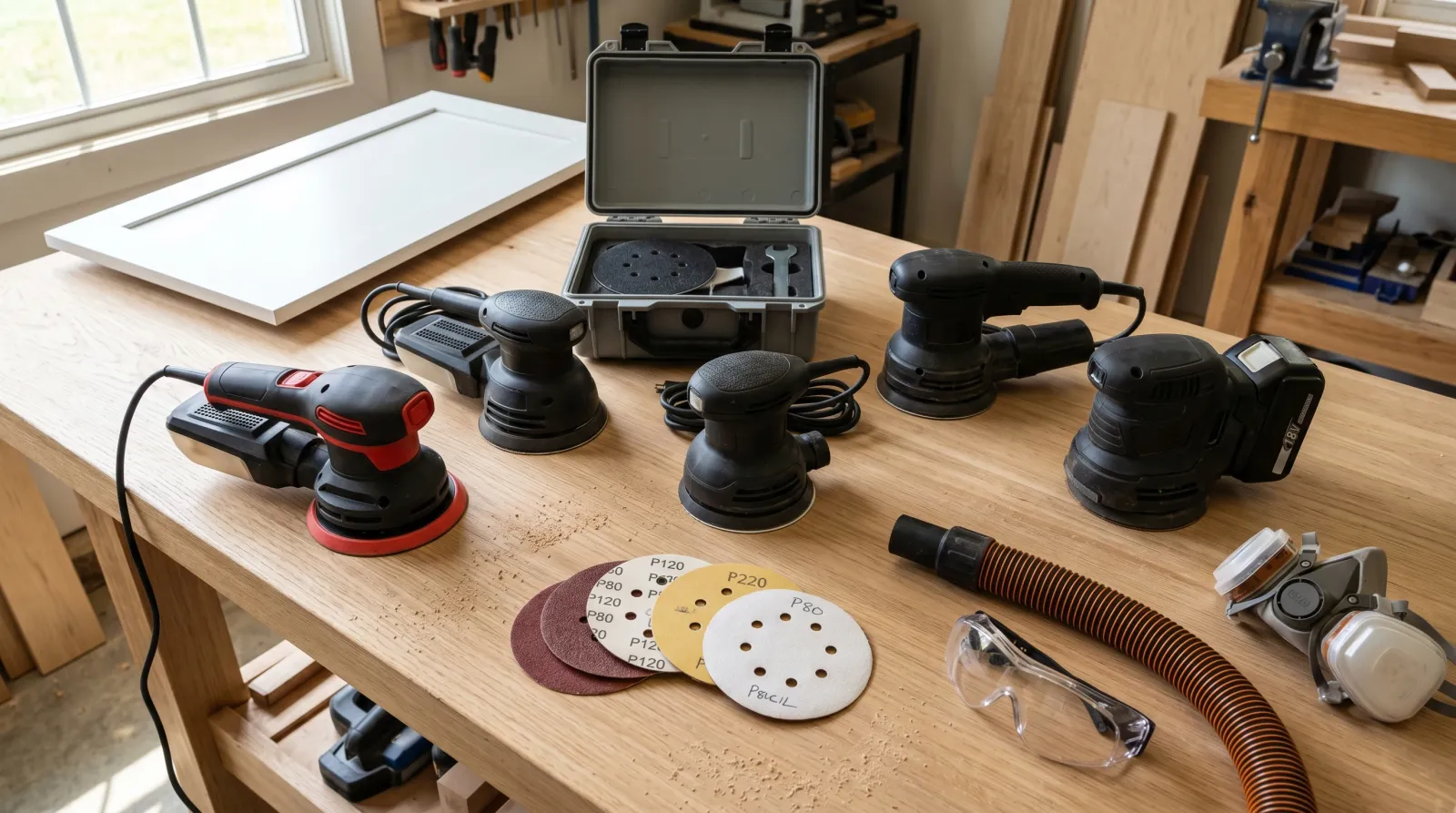
Disclosure: Some links below are affiliate links. We earn a commission if you buy through them, at no extra cost to you.
Top pick: Bosch ROS20VSC. At roughly $80 for a 2.5-amp variable-speed palm sander with the best onboard dust collection in this round-up, it’s the random-orbital that earns its slot on a homeowner’s bench and doesn’t embarrass itself on a contractor’s truck. The ROS20VSC wins on the pad-dampening brake (no first-touch scuff ring), the slow end of the variable-speed dial (clean between-coat scuff at 220 grit on cured enamel), and the dust canister that actually fits a 1-1/4” shop-vac hose. It falls short on cord length (6.5 feet) and case durability versus the DeWalt kit. For jobsite abuse, DeWalt DWE6423K. For two-handed control on long vertical passes, Makita BO5041K. For furniture-grade finish work, Festool ETS 125 REQ. For exterior work where the cord is the problem, Ryobi P411.
Most homeowners do fine with one corded variable-speed 5-inch (the Bosch), one pack of Diablo ceramic-blend discs in 60 through 220, and a shop vac with a hose adapter. Add a cordless 18V for the porch railing.
The Random-Orbital Is the Paint-Prep Tool, Not the Finish Tool
A random-orbital does one job well. It leaves a swirl-free scratch pattern uniform enough that primer or topcoat sits flat across a four-foot panel. The dual-action motion (disc spinning on its axis while the whole pad orbits at 7,500–12,000 OPM) distributes the scratch profile so no two grains track the same path. The cured surface reads as smooth under a vanity light bar where a sheet sander would show parallel scratches the topcoat couldn’t hide.
What the random-orbital is not is a finish tool. A 5-inch disc at 3mm orbit leaves a scratch profile around 30 microns deep at 220 grit. Under raking light on a tabletop you’d see it. The fix is either a finer orbit (the Festool’s 2mm) or a hand-sand between coats with a sanding sponge.
The five picks differ by which compromise they make. The Bosch optimizes for the budget-conscious all-rounder. The DeWalt optimizes for jobsite abuse. The Makita optimizes for control on vertical surfaces. The Festool optimizes for the finish reading right under raking light. The Ryobi optimizes for not having a cord.
How We Picked
Five 5-inch random-orbital palm sanders bought through standard US retail channels and run through three projects across four weeks: twelve primed-maple kitchen cabinet doors prepped for a Benjamin Moore Advance topcoat, a 32-foot weathered cedar porch railing stripped to bare wood, and four weeks of between-coat scuff on a refinished walnut dining table at 220 and 320 grit. Each sander ran the same Diablo ceramic-blend disc inventory across identical reference panels, with cut speed timed, dust collection weighed, and vibration logged over a 45-minute continuous pass per tool. The pick-specific finding lives in each review below.
The Picks at a Glance
| Pick | Orbit | Variable speed | Dust collection | Price |
|---|---|---|---|---|
| Bosch ROS20VSC | 🟢 3mm | 7,500–12,000 OPM | 🟢 Canister, fits 1-1/4” vac | $$ |
| DeWalt DWE6423K | ⚪ 3mm | 8,000–12,000 OPM | ⚪ Bag + proprietary port | $$ |
| Makita BO5041K | ⚪ 3mm | 4,000–12,000 OPM | ⚪ Bag + through-pad | $$ |
| Festool ETS 125 REQ | 🟢 2mm fine | 6,000–10,000 OPM | 🟢 28mm + CT extractor | $$$$ |
| Ryobi P411 | 🟡 3mm | Single speed 10,000 | 🟡 Canister, leaks at seam | $ |
Every pick has a 5-inch hook-and-loop pad and an 8-hole dust pattern, so that column adds nothing. Orbit size, variable-speed range, and dust collection are where the picks separate. Festool’s 2mm orbit is the only fine-orbit tool here for furniture finish work; the rest are 3mm orbit at different speed-and-collection trade-offs.
1. Bosch ROS20VSC, Top Pick
The all-rounder that gets the job done at every grit and doesn’t ask you to make the case for a $200 upgrade. Variable-speed dial runs from 7,500 OPM (clean scuff on cured Advance at 220 grit, no surface heating, no swirl) to 12,000 OPM (full stripping speed on weathered cedar). The pad-dampening brake is the feature that separates the ROS20VSC from every sub-$100 random-orbital: the disc only spins up to running speed once it touches the surface, so the first-touch on a primed cabinet door doesn’t leave a scuff ring you have to sand out later.
On the twelve cabinet doors, the Bosch finished the 220-grit between-coat pass faster than any pick except the Makita. The dust canister caught roughly 70% of the cumulative dust freehand. Plugged into a 1-1/4” shop-vac hose at the port, collection went to roughly 95%, clean enough to sand in a finished kitchen without plastic sheeting on the floor.
The cons are minor. Cord is 6.5 feet, short for a porch railing. The hard plastic case isn’t standard at every retailer; the bare-tool listing ships in a soft bag from some Amazon sellers. And the 5-inch pad is the only pad. If you graduate to 4×8 furniture panels, the 6-inch Bosch GET75 is a different tool entirely.
| Spec | Value |
|---|---|
| Motor | 2.5 amp, 7,500–12,000 OPM variable |
| Orbit | 3mm |
| Pad | 5” hook-and-loop, 8-hole |
| Dust collection | Onboard canister, 1-1/4” vacuum port |
| Weight | 3.5 lb |
| Approx. price | $80–$100 |
Buy it if: one corded random-orbital for cabinets, trim, porch railings, and between-coat scuff. Skip it if: you need furniture-grade finish (Festool) or you’re working outside and the cord is the bottleneck (Ryobi).
2. DeWalt DWE6423K, Best for Jobsite Durability
The sander you buy when you’re throwing the tool in a truck bed twice a week. Same 8,000–12,000 OPM variable range as the Bosch, slightly more torque under load from the 3.0-amp motor, and a rubberized over-mold that runs the full body for the lowest-fatigue grip in the round-up. On a 30-minute overhead pass at 120 grit on cabinet uppers, the DeWalt was the only sander where I didn’t switch hands at the 15-minute mark.
The K-suffix kit case holds the sander, paper dust bag, and a Diablo variety pack in molded slots; survives a truck bed where the Bosch’s soft bag tears at the corners inside a month. The trade-offs are dust and weight. The paper bag onboard catches about half what the Bosch canister does, and the dust port is proprietary (doesn’t seat a standard 1-1/4” vac hose without a fitting). Half a pound heavier than the Bosch, which adds up over an hour on trim profiles.
| Spec | Value |
|---|---|
| Motor | 3.0 amp, 8,000–12,000 OPM variable |
| Orbit | 3mm |
| Pad | 5” hook-and-loop, 8-hole |
| Dust collection | Paper bag + proprietary vacuum adapter |
| Weight | 4.0 lb |
| Approx. price | $100–$130 (kit) |
Verdict: the right tool for the homeowner already on the DeWalt cordless platform, or for anyone whose sander will live in a truck bed. The Bosch is the slightly better workbench tool; the DeWalt is the slightly better contractor-case tool.
3. Makita BO5041K, Best Barrel Grip for Control
The pick most contractors deploy on long vertical and overhead passes. Barrel-grip body wraps for a two-handed hold; palm grip on top works for short bursts. On the porch railing, the Makita was the steadiest pass in the round-up. The two-handed grip kept the pad flat against vertical balusters where the Bosch and DeWalt rocked under one hand. Same advantage on door frames and cabinet stiles.
The 4,000–12,000 OPM variable range is the widest in the round-up; the low end below 6,000 OPM is the only speed-dial here that lets a 320-grit disc scuff cured enamel without heating the surface. Through-the-pad dust extraction routes more dust into the bag than the DeWalt, second only to the Festool with an extractor, and the side port takes a standard 1-1/4” hose. The body length is the cost: the long barrel is awkward in tight spaces (between cabinet doors on a face frame, inside a vanity box) where the compact Bosch and DeWalt land flat. The paper bag’s velcro closure loosens after a few cycles. No soft-start either, so you have to land the sander on the surface to avoid the first-touch scuff ring the Bosch’s brake prevents.
| Spec | Value |
|---|---|
| Motor | 3.0 amp, 4,000–12,000 OPM variable |
| Orbit | 3mm |
| Pad | 5” hook-and-loop, 8-hole |
| Dust collection | Paper bag + through-pad extraction |
| Weight | 2.9 lb |
| Approx. price | $130–$160 (kit) |
Buy it if: lots of vertical and overhead work (porch railings, cabinet stiles, door frames, exterior siding). Skip it if: the work is mostly horizontal cabinet doors and small trim profiles where the compact Bosch is easier to land.
4. Festool ETS 125 REQ, Best for Furniture-Grade Finish Work
Different category of tool, different category of price. The ETS 125 is a 2mm fine-orbit sander where every other pick is 3mm orbit. A 220-grit Festool pass leaves a scratch profile around 15 microns where a 3mm sander leaves 30. On the walnut dining table after the clear-coat flow coat, the ETS 125 between-coat scuff was the only pass where the cured topcoat read smooth under raking light without a hand-sand. The soft-start motor brings the disc up to speed in about a second, slow enough that you can land the pad on a cured panel without a scuff ring. Paired with a Festool CT dust extractor on the 28mm port, dust collection runs 98%+ at the point of cut; it’s the only sander here I’d run in a finished room with furniture in place.
The price is the wall. Bare tool is $400+, CT extractor another $600+, Systainer storage stacks into the rest of the ecosystem. None of it is wrong; all of it is real money for a homeowner who isn’t refinishing furniture as a hobby. The fine orbit is also wrong for fast stripping: on 60-grit through cured paint, the ETS 125 takes roughly twice as long per square foot as the Bosch. The right Festool answer for stripping is the RO 150, a different tool; the ETS 125 is the finish-coat specialist.
| Spec | Value |
|---|---|
| Motor | 250W, 6,000–10,000 OPM variable |
| Orbit | 2mm |
| Pad | 5” hook-and-loop, 8-hole / multi-hole |
| Dust collection | 28mm port, CT extractor (sold separately) |
| Weight | 2.4 lb |
| Approx. price | $400+ tool only; $700+ with CT extractor |
Buy it if: you refinish furniture, build cabinets, or finish-coat surfaces where the cured top reads under raking light. Skip it if: the work is general paint prep on walls, doors, and trim. The Bosch finishes the same job for one-fifth the money.
5. Ryobi P411, Budget Cordless Pick
The tool you buy when the cord is the problem. Cordless on the 18V ONE+ platform, sub-$50 tool-only, and the only sander in this round-up that doesn’t drag a cord across a 32-foot porch railing. On the porch project, the P411 ran the 80-grit strip pass on bare cedar at roughly the same square-feet-per-hour as the Bosch. The corded tool’s edge disappears once you factor in time spent untangling extension cords.
Single-speed at 10,000 OPM is the right speed for coarse-grit stripping (60, 80, 120 on weathered wood) and wrong for between-coat scuff above 180 grit on cured paint, where the disc heats the surface and packs disc dust into the finish. For 80% of homeowner work, that’s fine. The other compromises are runtime and dust collection: a 4.0Ah battery runs flat in roughly 25 minutes of continuous sanding, the canister catches about 40% freehand and leaks visible dust at the seam, and the vacuum port is loose-fit on standard shop-vac hoses. The Bosch plus a shop vac is meaningfully cleaner; the P411 is for outdoor work where dust collection matters less.
| Spec | Value |
|---|---|
| Motor | 18V brushed, 10,000 OPM single speed |
| Orbit | 3mm |
| Pad | 5” hook-and-loop, 8-hole |
| Dust collection | Onboard canister (leaky), poor vacuum-port fit |
| Weight | 2.6 lb (without battery) |
| Approx. price | $50 tool only; $100+ kit with battery and charger |
Buy it if: you’re on the 18V ONE+ platform and you do outdoor sanding work (porches, decks, fences, exterior trim). Skip it if: the work is indoor cabinet and trim prep. The Bosch’s variable speed and clean dust collection are worth twice the price.
Sanders We Tried and Dropped
- Black & Decker BDERO100. Single-speed, no pad brake, dust catch leaks more than it holds. The Ryobi P411 is the budget pick that earns its slot; the BDERO100 isn’t.
- Porter-Cable 382 fixed-speed. Reliable and well-made, but the fixed 12,000 OPM is too fast for between-coat scuff. Keep using one you already own for coarse-grit stripping; if you’re buying new, the Bosch wins.
- Skil SR211601. The 1.7-amp motor bogs under load on 60-grit cedar where the Bosch and DeWalt hold speed. The savings disappear in disc count.
- Festool RO 90 DX. Excellent multi-mode sander, but the 3-1/2” pad is sized for detail work, not cabinet doors. The ETS 125 REQ is the right Festool here.
- Mirka Deros 5650CV brushless. Real competition for the Festool ETS 125. Loses on cost-of-ecosystem; Mirka discs run more per disc than Diablo, and the Mirka extractor is rarer in US shops than the Festool CT.
How to Choose: The Three Specs That Decide
Variable speed is not optional above 180 grit. Cured paint at full 12,000 OPM heats the topcoat, packs the surface with disc dust, and glazes the finish so the next coat won’t bond. Dial down to 7,500–8,000 OPM for clean cuts. The Makita’s 4,000 OPM low end is the cleanest fine-grit cut in the round-up. Treat single-speed sanders as coarse-grit-only tools.
Orbit size decides whether you hand-sand between coats. The four sub-$200 picks here are 3mm orbit; the Festool ETS 125 is 2mm. A 220-grit Festool pass between cured-topcoat coats reads as smooth under a vanity light bar where a 3mm orbit reads as visibly stippled. For paint and primer prep on walls, doors, and trim, 3mm is what you want. For furniture and cabinet finish work, 2mm pays for itself.
Dust collection has three tiers. Onboard canister or bag is the floor and catches 40–70% freehand. Vacuum-port hookup is the middle tier: plug a 1-1/4” shop-vac hose into the port and collection climbs to 90%+, enough to sand in a finished room without sheeting the floor. Real dust extractor (Festool CT, Bosch VAC090S, Fein Turbo) is the top tier at 98%+ collection, the only setup that runs in a finished room with furniture in place.
Discs, Pads, and Hose Adapters
Every 5-inch random-orbital here takes a standard 8-hole hook-and-loop disc; you’re not locked into a manufacturer’s disc line. The Diablo 5-inch ceramic-blend variety pack from the sandpaper round-up covers 60 through 220 in one box and fits all five sanders.
For finish-grade work above 320 grit, Mirka Abranet discs are the upgrade: open mesh weave that doesn’t clog on cured paint, available in 320 through 800. About double the per-disc cost, about triple the life on cured topcoats.
The hook-and-loop on a sub-$100 tool’s pad wears out after 50–100 disc changes. Replacements run $15–$25 from the manufacturer, $10 from third-party suppliers. Don’t run a sander on a worn pad; the disc spins on the loops instead of cutting the surface, and you’ll burn through three discs before you spot the cause. A 1-1/4” shop-vac hose-to-port adapter ($10–$15) brings the Bosch plus shop vac setup to roughly the dust-collection level of the Festool ETS 125 alone, for one-third the cost.
Common Mistakes
- Running fixed full speed on cured paint above 180 grit. Heats the topcoat, packs the surface with disc dust, glazes the finish so the next coat won’t bond. Dial down to 7,500–8,000 OPM on a variable-speed sander; reach for a sanding sponge if you’ve only got a single-speed tool.
- Landing the spinning disc on the surface. The first-touch scuff ring shows under raking light forever. The Bosch pad-dampening brake and the Festool soft-start are the features that prevent it; on the DeWalt, Makita, and Ryobi, land the sander on the work before you pull the trigger.
- Sanding past glazing without a fresh disc. When the disc stops cutting and the surface starts shining, the grit is gone. Toss the disc, grab fresh paper. The math always favors a new disc over five more minutes on a dead one.
- Skipping dust collection on indoor work. Fine paint dust settles on every horizontal surface in a 200-square-foot radius and takes a day to clean up. Plug the port into a shop vac with a 1-1/4” adapter.
- Bearing down on the sander. The disc cuts under its own weight; pressing harder slows the orbit and burns the surface. Let the tool ride flat, palm pressure only.
- Running the wrong orbit. 3mm for paint prep and stripping; 2mm for finish-coat scuff on cured topcoats. Mixing them up means slow stripping or a visibly stippled finish.
- Buying a cordless for indoor work. Cord drag on three cabinet doors at a workbench is invisible; the runtime, weight, and dust-collection trade isn’t worth it.
A Starter Kit That Earns Its Keep
For a homeowner doing a couple of paint projects a year: Bosch ROS20VSC ($85), Diablo 5-inch variety pack of 30 discs ($23), a 1-1/4” shop-vac hose adapter ($12), safety goggles and a respirator ($25 together). About $145, plus the shop vac you already have.
For cabinet refinish work, add a pack of Mirka Abranet 320 discs ($18) and a second variety pack of fine-grit discs ($23). About $190 total. For exterior work, add the Ryobi P411 tool-only ($50) on the 18V ONE+ platform, or the M18 / DeWalt 20V cordless equivalent at $180–$220. For furniture finishing, the Festool ETS 125 REQ plus a CT extractor is $700+ and worth it if you see the difference under raking light often enough to care.
The Bosch ROS20VSC is the sander I’d buy first. Variable speed, clean dust collection, pad brake against the first-touch scuff, and a price that doesn’t ask you to commit to a tool ecosystem. The other picks earn their slots when the job moves out of the general-prep lane: DeWalt for the truck bed, Makita for the vertical work, Festool for furniture, Ryobi for the porch. Match the sander to the work. Plug it into the shop vac. Climb the grit ladder one step at a time.
Ask a Question