What Is Self-Leveling Furniture Paint?
Self-leveling furniture paint flows out brush marks as it dries. How the chemistry works, what flow-and-leveling additives do, and when to reach for it.

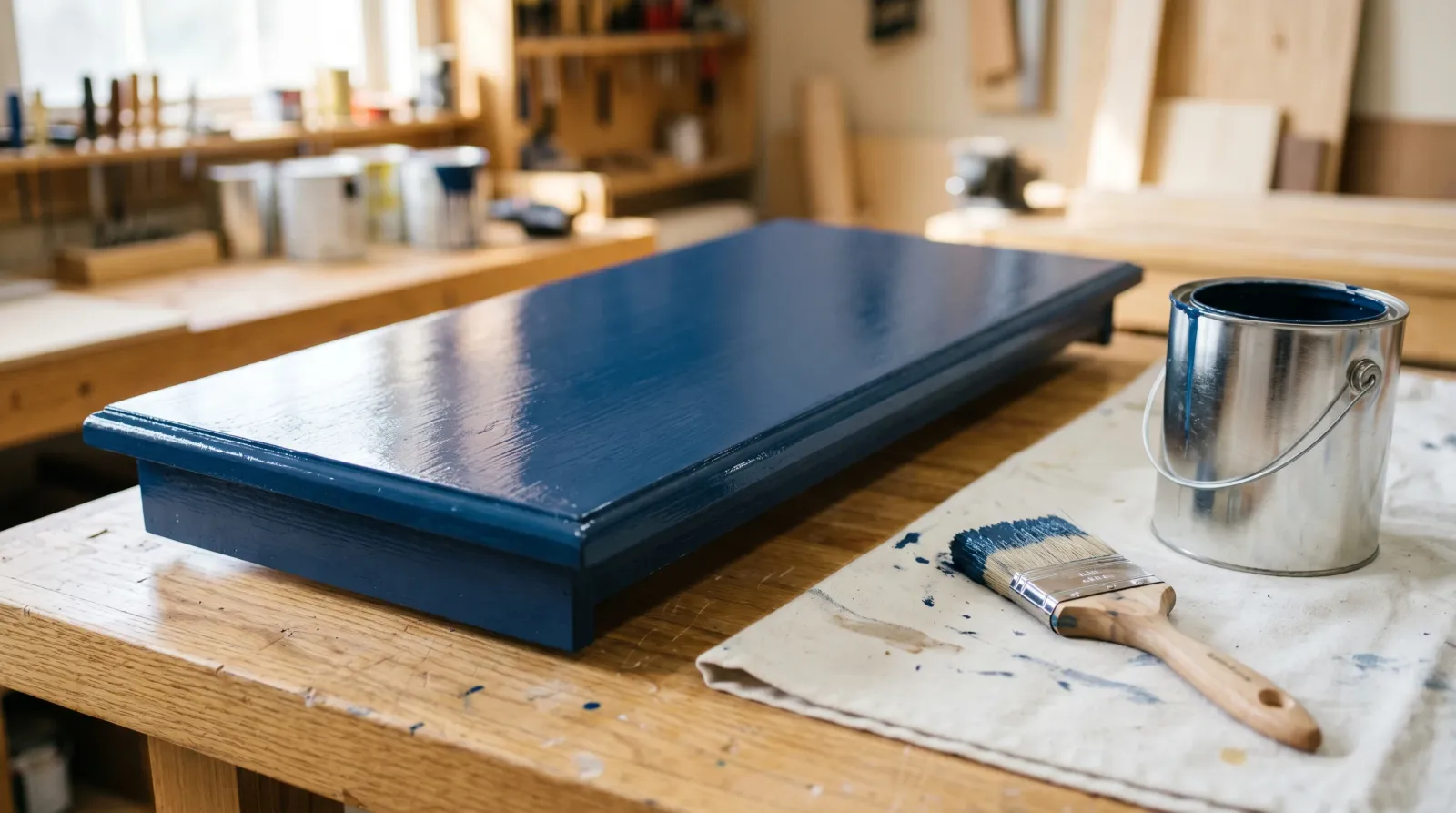
Self-leveling furniture paint is an enamel formulated to relax its own brush and roller marks while it’s still wet, flowing out to a smooth, sprayed-looking film without a sprayer. Most of these paints are waterborne alkyds or alkyd-modified acrylics, applied at a viscosity around 100–130 Krebs units, with an open time of 45 to 90 minutes. That long open time is the whole point. Standard latex skins over in 10 minutes and locks every ridge in place. A self-leveling enamel stays mobile long enough that surface tension can pull the high spots down into the valleys before the film sets, which is why a brushed dresser front can end up looking factory-finished.
The thing people notice is the brush mark that isn’t there. You lay down what feels like a streaky pass, walk away, and come back twenty minutes later to a surface that’s flowed flat. That’s not magic, and it isn’t the brush. It’s the formula doing work after your hand leaves.
How Self-Leveling Actually Works
Two forces fight inside every wet paint film. Surface tension wants to pull the liquid flat, the way water beads into a smooth pool. Viscosity resists that flow and holds the texture your brush left behind. Whether brush marks survive comes down to which force wins before the film stops moving.
A self-leveling enamel is tuned so surface tension wins. Formulators add flow-and-leveling agents (silicones and modified polyacrylates are the common ones) that lower the surface tension and let the film relax evenly instead of pulling into ridges or crawling away from edges. Then they slow the dry. Waterborne alkyds use slower coalescing solvents and a higher-boiling carrier so the film stays open for the better part of an hour. During that window the ridges left by the brush slump downhill under their own surface tension and the surface goes level.
The reason ordinary wall paint can’t do this is that it’s built to dry fast and grab vertical surfaces without sagging. Those are opposite requirements. Fast dry locks brush marks in; sag resistance means high viscosity, which fights leveling. Furniture enamels can take the slow, low-viscosity route because a tabletop is horizontal and you’re not trying to cover a room before lunch. For the chemistry of how the film closes up as the carrier leaves, see how a paint film forms.
When to Use Self-Leveling Furniture Paint
Use it for:
- Cabinet doors, drawer fronts, and dressers where you want a hand-brushed finish to read as smooth and factory-grade.
- Trim, baseboards, doors, and built-ins, especially the flat panels that show every brush stroke under raking light.
- Tabletops, desks, and any surface seen up close in daylight, where roller stipple or brush ridges would be obvious.
- Projects where you don’t own or want to set up a sprayer but still want a sprayed look.
Skip the sprayer math entirely if your piece is small. A quart of self-leveling enamel and a good 2.5-inch synthetic brush will out-finish a cheap sprayer on a single dresser, with no tenting, no overspray, and no cleanup of a paint cup.
When NOT to Use It
Self-leveling enamel is the wrong reach for a few jobs, and using it anyway costs you days.
Don’t use it for:
- Large wall areas. The slow dry that levels a drawer front means a wall stays wet for an hour and shows lap marks where a wet edge dried before you got back to it.
- Vertical surfaces with sharp detail you want to keep crisp. The same flow that smooths a flat panel will soften and round a fine raised bead or carved edge if you load the brush heavy.
- Distressed or matte furniture looks. If you want chalk-style chalkiness or a dead-flat farmhouse finish, you want chalk paint or milk paint, not a leveling enamel that dries to a satin or semi-gloss sheen.
- Fast-turnaround jobs. With a 16-hour recoat window, a two-coat dresser is a two-day project. Standard furniture acrylic recoats in 2–4 hours if you need the piece back in service tonight.
How Self-Leveling Paint Compares
| Self-leveling enamel | Standard latex/acrylic | Chalk paint | |
|---|---|---|---|
| Leveling | Flows brush marks flat | Holds brush marks | Holds marks, often by design |
| Open time | 45–90 min | ~10 min | 10–20 min |
| Recoat | ~16 hr | 2–4 hr | 1–2 hr |
| Sheen | Satin to semi-gloss | Any | Dead matte |
| Best surface | Cabinets, trim, tabletops | Walls, broad areas | Distressed furniture |
| Hardness when cured | High (alkyd film) | Medium | Low without a topcoat |
For the head-to-head on the matte options, see what chalk paint is and what milk paint is.
Common Mistakes
- Back-brushing after the film starts to set. The leveling happens in the first 10–20 minutes. Touch the surface after that and you drag fresh ridges into a film that was about to go smooth. Lay it down in one pass and leave it.
- Painting too thick to “fill” the grain or hide a flaw. A heavy coat sags and skins over before the bottom levels, trapping a wrinkled or orange-peel surface. Two thin coats level better than one thick one, every time.
- Recoating too soon. A waterborne alkyd that says 16-hour recoat means it. Topcoat at hour 4 and the solvent still leaving the first coat lifts and crawls the second one.
- Treating long dry time as a defect. People panic when a furniture enamel is still soft at hour 3 and assume it’s a bad batch. The slow set is the feature that levels the film. Cure is separate from dry; the dry-time-versus-cure-time distinction is where most of the confusion lives.
- Over-thinning to force flow. A splash of water or the maker’s recommended additive (5–10%) helps. Past that you thin the binder out, drop the viscosity too far, and get sags and poor hide instead of a level film.
What It Looks Like
Side by side, the tell is in raking light. Hold a furniture front at a low angle to a window. A standard latex coat throws a fine washboard of parallel ridges where the brush dragged. A leveled enamel coat reflects the window back as a near-continuous sheet, with the brush pattern softened to almost nothing. The sheen also reads more even, because a flat surface reflects uniformly while a ridged one scatters light at every peak.
Where to Buy and What to Look For
Look for the words waterborne alkyd, alkyd-modified acrylic, or enamel on a furniture or cabinet product, paired with a recoat time of 12 hours or longer. That slow recoat is the honest signal that the paint is built to flow rather than to grab fast. The category leaders are Benjamin Moore Advance, Sherwin-Williams ProClassic Waterbased, and INSL-X Cabinet Coat, all of which level well by brush at their out-of-can viscosity. Avoid anything marketed as “fast-dry furniture paint” if a glass-smooth finish is the goal; fast dry and good leveling don’t share a formula.
For the full tested round-up across cabinets, dressers, and tables, see the best furniture paint picks. If you’d rather spray, a fine-finish tip on the right paint sprayer gets you there faster on big batches, though a self-leveling enamel narrows the gap by brush more than most people expect.
One real-world note: if a self-leveling coat goes down fine but stays sticky for days, that’s almost never the leveling chemistry failing. It’s usually a heavy coat, cold air, or high humidity stretching the cure. The tacky-furniture fix walks through why, and what actually rescues a soft film. Buy by the open time, paint thin, and let the formula do the smoothing.