What Is Milk Paint?
Milk paint is a casein-bound powder you mix with water, cures hard in days, and bonds to raw wood. Here's the chemistry and where it works and fails.

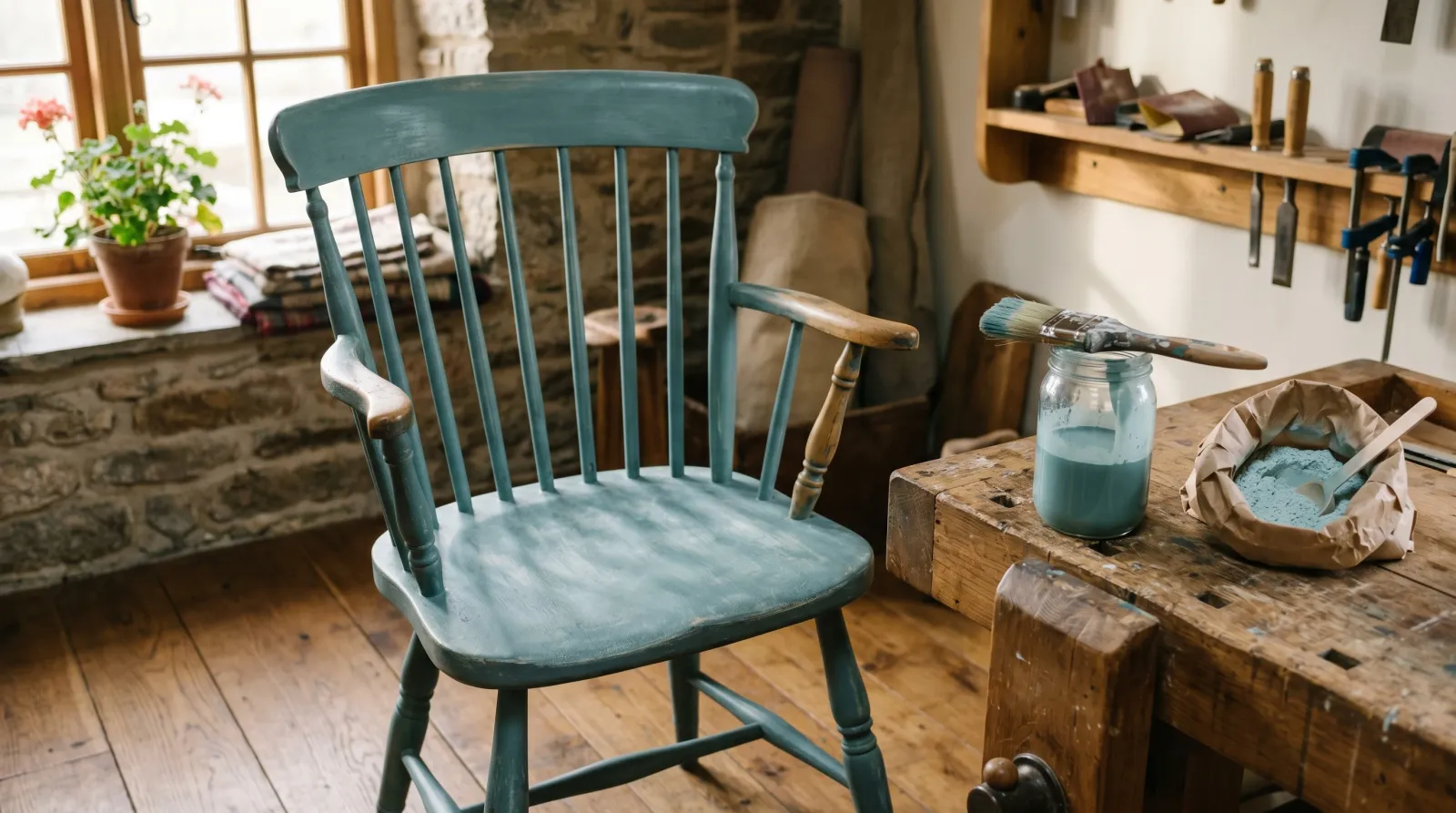
You’ve probably run your hand over a two-hundred-year-old painted chair and felt how the paint had become part of the wood, not a skin sitting on top of it. No gloss, a soft mottled color, edges worn back to bare timber where hands gripped it for generations. That finish is almost certainly milk paint, and the reason it’s still on the wood after two centuries is the same reason it behaves nothing like the paint in a modern can.
Milk paint is a powder you mix with water. Its binder is casein, the main protein in milk, combined with hydrated lime and earth pigments. You blend it on the day you use it, brush on two or three thin coats, and the film cures in 24 to 72 hours into a hard, dead-flat finish with a sheen of 0 to 5 gloss units. It’s one of the oldest paint systems on record, used on Egyptian tombs and colonial American furniture, and it works for the same reason it always did.
TL;DR
- Milk paint is a dry powder (casein protein, lime, and earth pigments) that you mix with water in small batches.
- Casein cross-links with the lime into a genuinely hard film as it cures, unlike chalk paint, which stays soft.
- It bonds to raw, porous wood without primer. On sealed or painted surfaces it flakes off unless you add a bonding agent.
- Mixed paint spoils in 1 to 3 days like the milk it’s made from. Mix only what you’ll use.
- The cured film is hard but porous, so furniture needs a topcoat of oil or water-based polyurethane to be wipeable.
- The look is flat, slightly variegated, and ages by wearing through rather than peeling.
What’s Actually in the Powder
Open a bag of milk paint and you get a fine, slightly clumpy powder that smells faintly of chalk. Three things are in it.
Casein is the binder, and it’s the whole story. It’s a phosphoprotein that makes up about 80% of the protein in cow’s milk. On its own it’s water-soluble, which is no good for a paint. The trick, known since antiquity, is to mix it with an alkali. Add hydrated lime (calcium hydroxide) and the lime reacts with the casein to form calcium caseinate, an insoluble, cross-linked network that hardens as it dries and keeps hardening for weeks. That reaction is why a cured milk paint film resists water it would have dissolved in while wet.
The pigments are earth oxides and minerals: iron oxides for the reds, ochres, and browns, chromium and cobalt compounds for greens and blues, lampblack for the deep grays. These are the same inorganic pigments used in mineral coatings, which is why milk paint colors don’t fade the way some organic dyes do. The muted, slightly grayed palette people associate with milk paint isn’t a style choice. It’s what earth pigments look like.
The third component is the lime itself, doing double duty. Beyond curing the casein, it adds body and contributes to the flat, chalky surface.
Why It Bonds to Bare Wood
Milk paint has almost no film-forming polymer in the modern sense. It grips through absorption, not adhesion to a smooth surface. When you brush thin milk paint onto raw wood, the watery mix carries casein and pigment down into the open grain and the surface pores. As the water leaves and the calcium caseinate cures, that pigment-and-protein network locks into the wood mechanically. The paint isn’t stuck to the wood; it’s anchored inside it.
The reason for that is the same reason the claim breaks on slick surfaces. On a sealed, previously painted, or glossy substrate there are no open pores to soak into. The casein has nothing to grab, and the cured film flakes off in chips the first time something knocks it. Every milk paint brand sells a bonding agent (usually an acrylic emulsion) you stir into the first coat to give it grip on non-porous surfaces. Add it and milk paint will hold on slick wood. Skip it on a varnished tabletop and you’ll be scraping the paint off within the week.
There’s a wrinkle worth knowing. On some sealed surfaces, painters deliberately skip the bonding agent because the paint chips off unevenly as it cures, leaving an authentic worn, crackled look without any sanding. That’s a feature in the antiquing world and a defect everywhere else.
How Milk Paint Compares
| Milk Paint | Chalk Paint | Latex Wall Paint | |
|---|---|---|---|
| Binder | Casein + lime | Acrylic + calcium carbonate | 100% acrylic resin |
| Form | Dry powder, mix with water | Premixed in a can | Premixed in a can |
| Sheen | 0–5 gloss units | 1–3 gloss units | 5–85 depending on grade |
| Cured film | Hard, porous | Soft, porous | Hard, continuous |
| Sticks to raw wood | Yes, soaks in | Yes, thick pigment | Needs primer |
| Needs topcoat | Yes, on furniture | Yes, always | No |
| Shelf life mixed | 1–3 days | Months in the can | Years |
Milk paint and chalk paint get confused constantly because both are dead flat and both go on raw wood without primer. The films behave differently. Chalk paint stays soft and you can scratch it with a fingernail; cured milk paint is genuinely hard. For the soft-film cousin, see what is chalk paint, and if you’re deciding between paint and a penetrating finish on furniture, the paint vs stain breakdown covers that fork.
When to Use Milk Paint
Use it for:
- Raw or freshly stripped wood furniture: chairs, dressers, tables, frames.
- Authentic restoration on antiques and period pieces, where a modern acrylic would look wrong.
- Bare interior wood paneling, beadboard, and trim you want flat and historic.
- Anyone wanting a low-VOC, biodegradable finish. The powder is just protein, lime, and minerals, so it carries essentially no solvent off-gassing. For the broader picture on solvents, see VOCs in paint explained.
- Crackle and chippy antiquing effects on purpose.
Don’t use it for:
- Already-painted or varnished surfaces without a bonding agent. The film flakes.
- Bathrooms, kitchens, and anything wet. The porous film stains and the casein can grow mold in chronic damp.
- Exteriors in most climates. UV and rain wear it fast unless it’s a specialized exterior formula.
- Floors. The film won’t survive foot traffic.
- Large fast jobs. Mixing small batches that spoil in a day makes it slow and wasteful at scale.
Common Mistakes
- Mixing too much. Casein spoils like the milk it is. A gallon mixed Monday is sour by Wednesday. Mix what one session needs and stop.
- Not stirring as you go. The pigment and lime settle to the bottom within minutes. Stir every 15 minutes or your last coat comes out a different shade than your first.
- Skipping the topcoat on furniture. A raw milk paint film drinks up water rings and finger oils. Seal it with hemp oil, tung oil, or a water-based poly on anything that gets touched.
- Painting over a slick surface without a bonder. No open pores, no grip, paint chips off. Add the bonding agent or scuff-sand first.
- Expecting can-paint coverage. Thin coats are the method. Two or three light passes look right; one thick coat cracks and looks muddy.
Where to Buy and What to Look For
Milk paint is a specialty product, sold mostly online and through restoration suppliers rather than big-box stores. The two names that dominate the U.S. market are Old Fashioned Milk Paint Company (the genuine casein-and-lime powder, sold as a dry mix) and Real Milk Paint Co. Both ship powders you reconstitute. General Finishes sells a product called Milk Paint that’s actually a premixed acrylic, durable and convenient but not true casein milk paint, so read the label if authenticity matters to you.
Buy the real powder if you want the historic chemistry and the genuine worn-through aging. Buy the premixed acrylic version if you want the look without the mixing and the one-day shelf life. For prepping older or weathered wood before any of this, the guide to painting weathered wood covers the sanding and cleaning that decides whether the paint holds.
Treat milk paint the way the people who invented it did. Mix it fresh, brush it thin onto bare wood, let the lime and casein cure hard over a few days, and seal it if the piece will be used. Do that and the finish outlasts the furniture. Use it on a sealed cabinet door or a damp bathroom wall and you’ll be scraping it off before the month is out. Match the chemistry to the surface, and a two-hundred-year-old recipe still works exactly as well as it ever did.
Ask a Question