Paint vs Stain: The Chemistry Difference, and Where Each One Wins
Paint forms a film on top of the substrate; stain delivers pigment into wood fiber. Here's the chemistry, the substrate map, and the maintenance trade-off.

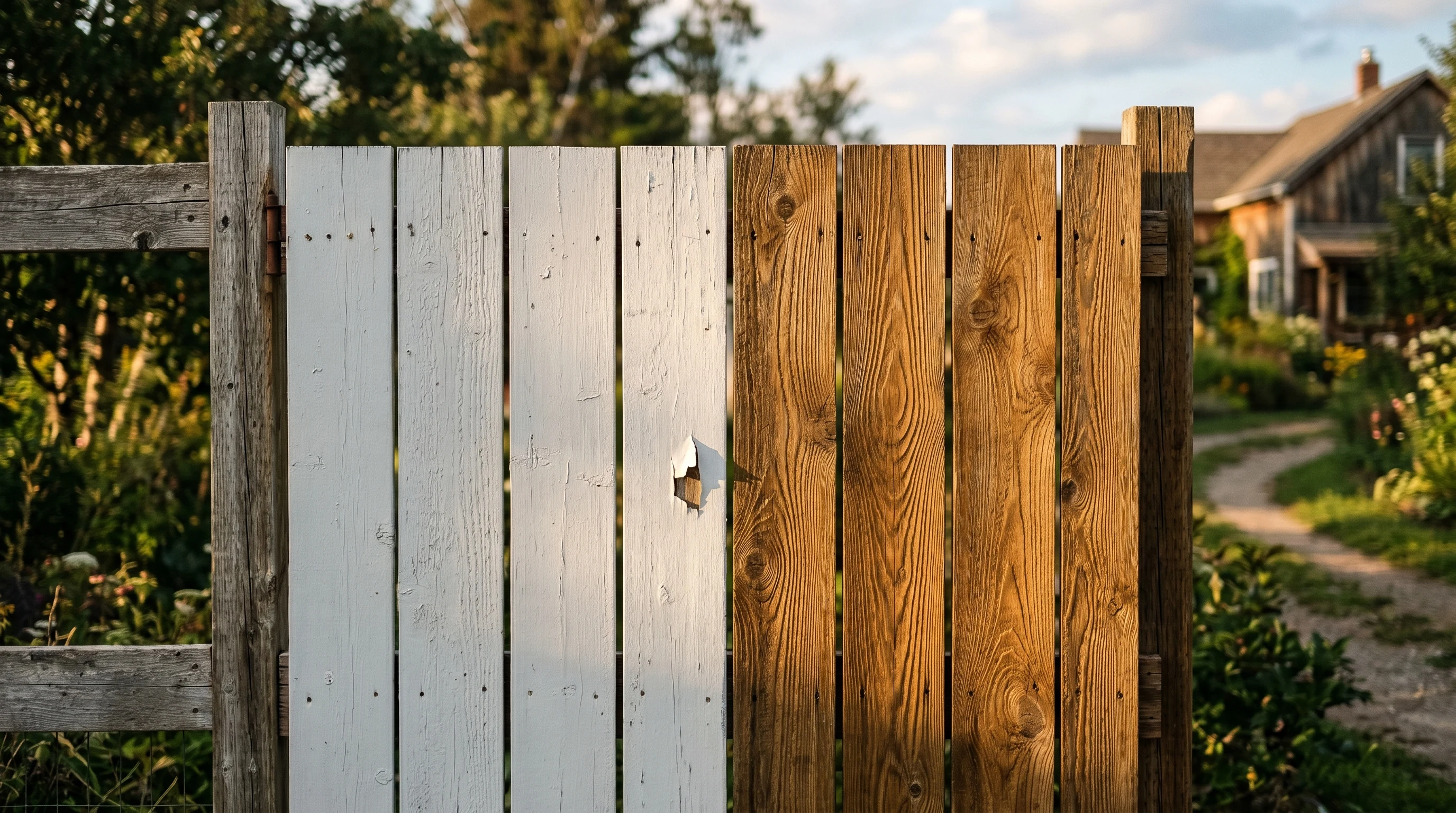
Walk past a five-year-old painted cedar fence and a five-year-old stained cedar fence and the difference tells the whole story. The painted one sheds white flakes at every knot, bare wood showing through where the film let go. The stained one is grayer than it was, but the surface is intact. Same wood, same weather, same five years. They aged through completely different chemistry.
A paint is a film-former. The binder (a 100% acrylic resin in modern exterior latex, an alkyd in oil-based) coalesces during drying into a continuous polymer skin on top of the substrate. The pigment gives the film opacity and color, but the film itself is the finish. Spec dry-film thickness for two coats of quality exterior paint runs 2.5 to 4 mils. Everything you see and touch is that film.
A stain is a penetrant. The carrier (paraffinic oil in classic alkyd stains, water-borne acrylic emulsion in modern formulas) delivers pigment and resin into the top layer of wood fiber rather than building a film on top. Transparent and semi-transparent stains dry to almost no measurable surface film. Semi-solids and solid-colors leave 1–2 mils, but the bond still comes from penetration, not surface adhesion. The wood itself is the finish.
That single distinction — film on top versus pigment inside — drives every other difference between the two products.
The Substrate Question
Stain is a porous-wood product. Cedar, redwood, pine, fir siding, deck boards, fences, shingles, log walls, rough-sawn outbuildings: anything that absorbs a liquid. Dense exotics like ipe and teak resist water-borne stains; oil-based products are the right choice there.
Paint goes on everything else. Drywall, plaster, primed wood trim, metal, masonry, fiber cement, MDF, engineered siding. It also goes on porous wood once you decide hide and color matter more than grain reveal.
Paint on bare cedar isn’t physically wrong. It will adhere for a season or two. But cedar moves with humidity, bleeds tannins through latex, and exudes resin from knots. Two summers in, the film cracks at every grain line and lifts at every knot. Stain on drywall or fiber cement is a category error: no fiber to penetrate, so it dries to a streaky surface coat that wipes off.
Stain Types, Ranked by Pigment Load
The same word on the can means very different chemistry.
| Type | Pigment load | Grain visible | Refresh |
|---|---|---|---|
| Transparent / clear | UV blocker only | Fully | 1–2 years |
| Semi-transparent | Light | Mostly | 2–3 years |
| Semi-solid | Medium | Texture only | 3–4 years |
| Solid-color | Heavy, opaque | No | 5–7 years |
Transparent stain is a UV-protective oil with a trace of pigment. Penofin’s penetrating-oil line for redwood is the canonical example: reveals grain, demands the most frequent attention.
Semi-transparent is the standard for new cedar siding and for fences and decks where the homeowner wants the wood to show. Cabot Australian Timber Oil and Olympic Maximum semi-transparent are the most-stocked SKUs.
Semi-solid sits between. Benjamin Moore Arborcoat semi-solid and Sherwin-Williams SuperDeck semi-solid build enough pigment to mask graying on previously stained wood while still letting texture read through.
Solid-color stain is where the line with paint blurs. Pigment load is comparable to exterior latex, the film build is thinner (1–2 dry mils versus 2.5–4 for paint), and the binder is engineered to weather by erosion rather than peeling. Behr Solid Color Waterproofing Stain & Sealer is the volume product at Home Depot.
The Maintenance Trade-Off
Paint fails by peeling. When the film loses adhesion (usually because moisture got under it or the substrate wasn’t fully dry at application), it lifts in sheets. Repainting then requires scraping every loose section back to sound paint or bare wood, spot-priming, and recoating. On a 2,000 sq ft exterior, scrape-and-prep is two-thirds of the labor.
Stain fails by weathering. Pigment fades, the surface grays as lignin breaks down under UV, and the resin erodes. No film, no peeling. The refresh is a wash (oxalic acid brightener, percarbonate cleaner), a light scuff if needed, and a recoat. Roughly 30% of the labor of a paint refresh, but you’ll do it more often.
Across a decade the totals are closer than they look. A solid stain at 6 years and a paint at 10 years both put one full re-coat into the period. The transparent-stain owner does three light refreshes in that window, but each one is a Saturday, not a weekend.
When to Choose Paint Over Stain
- Already-painted surface. Going back to stain means stripping every fiber of remaining paint. Repaint instead.
- Siding engineered for paint: LP SmartSide, fiber cement, hardboard. Factory-primed, sized for a topcoat film. Stain has no fiber to enter.
- You want a designer color outside the natural-wood palette. Stain hues live in browns, grays, weathered teaks, and a narrow set of barn-reds and sage-greens. A real saturated blue or deep modern green has to come from paint.
- Smooth modern lap siding with crisp factory profiles. Paint reads correctly here; semi-solid stain on a smooth profile looks oddly mottled.
When to Choose Stain Over Paint
- Bare cedar, redwood, fir, or rough-sawn pine where you want the wood to show. Paint here is choosing to fight for a decade.
- Deck boards, dock planks, any horizontal walking surface. Paint on a deck board is the most predictable failure in residential coatings. The film delaminates within two seasons under foot traffic and standing water. Use a deck stain (semi-transparent for new boards, semi-solid for weathered) and accept the 2–3 year refresh.
- Fences, gazebos, outbuildings where the geometry makes future scraping impractical. Stain ages gracefully; paint on a 200-foot fence line is a weekend you don’t want.
- Dense tropical hardwood like ipe, teak, or mahogany. Penetrating oils (Penofin Pro-Tech, Cabot Australian Timber Oil) are the only category that bonds.
The Marketing Trap
“Deck paint” almost never holds up. The category exists because retailers want a product to sell to homeowners who’ve decided their deck should be a solid color, but the chemistry doesn’t change because the label does. Behr DeckOver and Rust-Oleum Restore tried to solve this with a 10-mil-build resurfacer; the line generated enough peeling complaints to spawn a class-action settlement. The shelf still carries it. Don’t.
For an opaque-colored deck board, use a quality solid-color stain (Benjamin Moore Arborcoat Solid, SW SuperDeck Solid, or Cabot Solid Color Acrylic) applied at the spec 1–2 dry mils, not the 8–10 mils of a resurfacer. Even then, plan for a 4-year refresh, not the 7-year cycle a vertical surface gets.
Decision rule. Horizontal wood walking surface, choose stain. Bare cedar siding or fence, choose stain. Already-painted exterior, primed trim, fiber cement, or a designer color, choose paint. The chemistry decides; the marketing only confuses.
Ask a Question