Best Dehumidifiers for Paint Drying
Five dehumidifiers run against fresh latex, drywall mud, and a damp basement. Top pick: hOmeLabs 50 Pint Wi-Fi for the continuous-drain unit that holds a room at 45 percent while you paint it.

Disclosure: Some links below are affiliate links. We earn a commission if you buy through them, at no extra cost to you.
Top pick: the hOmeLabs 50 Pint Wi-Fi Dehumidifier, around $250. It drains continuously through a garden hose, holds a closed room near 45 percent relative humidity, and puts a stalled latex job back on the recoat schedule printed on the can. It wins on price per pint and on the drain fitting. It falls short below 60 degrees, where the coil frosts and the compressor burns cycles defrosting instead of pulling water. For a jobsite with wet drywall mud, the AlorAir Storm LGR Extreme is the machine. For a basement you want dry forever, the AlorAir Sentinel HD55S hangs from the joists. For the fewest trips to the sink, the Midea Cube 50 Pint holds about 4.75 gallons. For one bedroom under $200, the hOmeLabs 32 Pint is enough.
Paint doesn’t dry. Water leaves it.
Why a Humid Room Stalls a Coat
Waterborne paint sets by letting water evaporate out of the film so the acrylic particles can pack together and fuse. Evaporation is driven by the difference between the water vapor pressure at the surface of the wet film and the vapor pressure of the air above it. Fill the air with water and you flatten that difference. The film stops giving up water at any useful rate, and the paint sits there open, soft, and vulnerable.
The label numbers assume 77 degrees and 50 percent relative humidity. That’s the industry test condition, and it’s why “recoat in 4 hours” is a promise about a lab, not about your July basement. At 70 percent RH, that same four-hour recoat window stretches to six or eight. At 85 percent with a cool wall, it can go past 24 hours, and people discover it the hard way by rolling a second coat into a first coat that never set.
The failures that follow are specific and recognizable.
Surfactant leaching. Tan or brown glossy streaks and drips that show up on a cured wall, usually a day or two later, usually on a bathroom or basement wall. The surfactants in the paint stay mobile in a slow-drying film, migrate to the surface, and get pulled into runs by condensing moisture. It looks like the wall is weeping, and it is. This is the single most common humidity failure in interior latex, and the full diagnosis lives in the humid-weather drying guide.
Blocking. A door or a window sash that sticks to its stop, or a cabinet door that peels a chip off its neighbor when you separate the stack. The film hardened at the surface and stayed soft underneath. Enamels on horizontal surfaces are the worst case.
Sagging and runs on trim. A coating that stays open too long keeps flowing. Gravity gets a longer window to work in than the paint chemist planned for.
A second coat that lifts the first. Roll into a coat that hasn’t fused and you drag it. On a dark color you will see it forever under raking light.
None of these are paint defects. They’re condition defects, and a $250 machine in the middle of the room removes the condition.
Reading a Dehumidifier Box Honestly
Pint ratings are the least standardized number in the appliance aisle, and manufacturers know it.
AHAM and DOE ratings. Since the 2019 DOE rule, portable dehumidifiers sold in the US are tested at 65 degrees and 60 percent RH. That’s why a machine that used to be called a 70-pint became a 50-pint overnight without changing a screw. It’s a more honest test than what came before, and it’s cooler than most rooms you’ll actually paint in.
80/60 ratings. Plenty of brands, including hOmeLabs, quote capacity at 80 degrees and 60 percent RH instead. That number is bigger and it is not wrong, it’s just measured somewhere warmer. When you compare two machines, check that both numbers come from the same condition or you’re comparing nothing.
Saturation ratings. The 180 PPD on the AlorAir Storm LGR Extreme is a saturation figure, measured around 90 degrees and 90 percent RH. Commercial and restoration units are quoted this way because that’s the condition they get bought for. It’s a legitimate number for a flooded house. It is not what the machine will pull out of a 68-degree bedroom.
Then the technology, which matters more than the pint number in a cold space.
Compressor (refrigerant). The standard consumer machine. Warm wet air crosses a cold coil, water condenses, dry air comes out slightly warmer than it went in. That extra two to five degrees of heat is a small bonus for paint. The limitation is temperature: below roughly 60 degrees the coil starts icing, and the unit spends more and more of each cycle in defrost. Manufacturers quote a low-temp limit around 41 degrees; treat that as the point where the machine is barely working, not the point where it works.
Low-grain refrigerant (LGR). Pre-cools the incoming air through a heat exchanger before it hits the evaporator coil, so the coil can pull moisture out of air that’s already fairly dry. In practice this is what gets a room from 55 percent RH down to 40 percent instead of parking at 55 and calling it done. It’s also why LGR machines are the standard in water restoration. You pay two to four times a consumer unit for it.
Desiccant. No compressor. A rotating wheel of moisture-absorbing material with a small heater to drive the water back off. Desiccant units keep working at 35 degrees where compressors are useless, which makes them the answer for an unheated garage in November. They’re less efficient in warm humid air, which is the exact condition most paint jobs face, so they’re a specialty buy rather than a first buy. If you’re painting a cold space, the cold-weather painting guide matters more than any machine you can plug in.
Sizing Without the Marketing Math
Every box prints a square footage that assumes an ordinary, already-dry room. A room you’re painting is not that room.
- One closed bedroom, bathroom, or hallway: 30 to 35 pint class. The hOmeLabs 32 Pint.
- A finished basement, a whole floor, or any job where doors stay open: 50 pint class. The hOmeLabs 50 Pint or the Midea Cube.
- New drywall: size up hard, or rent. Joint compound and taping release gallons of water into a closed house over several days, on top of whatever the weather is doing. Our new-construction floor test had roughly 40 sheets of mud drying at once and the consumer 50-pint could not hold the number. See the new drywall prep guide for the sequence.
- A basement that’s damp every summer regardless of paint: buy the fixed unit and stop moving a portable up and down the stairs.
Comparison at a Glance
| Brand / Model | Type | Rated capacity | Drain | Best for | Price tier |
|---|---|---|---|---|---|
| hOmeLabs 50 Pint Wi-Fi | Compressor | 50 pints/day at 80 degrees, 60 percent RH | Hose (gravity) | Whole-floor repaints, basements | $$ |
| AlorAir Storm LGR Extreme | Low-grain refrigerant | Up to 180 PPD at saturation | Built-in pump | New drywall, jobsites, restoration | $$$$ |
| AlorAir Sentinel HD55S | Compressor, low-temp | 120 PPD saturation / 55 PPD AHAM | Plumbed or pump | Fixed basement and crawl space | $$$ |
| Midea Cube 50 Pint | Compressor | 50 pints/day class | Built-in pump or 4.75-gal tank | Rooms with no floor drain | $$$ |
| hOmeLabs 32 Pint Wi-Fi | Compressor | 32 pints/day at 80 degrees, 60 percent RH | Hose (gravity) | One room, tight budget | $ |
1. hOmeLabs 50 Pint Wi-Fi, Top Pick
This is the machine I’d hand a homeowner who called and said their basement walls were still tacky the next morning.
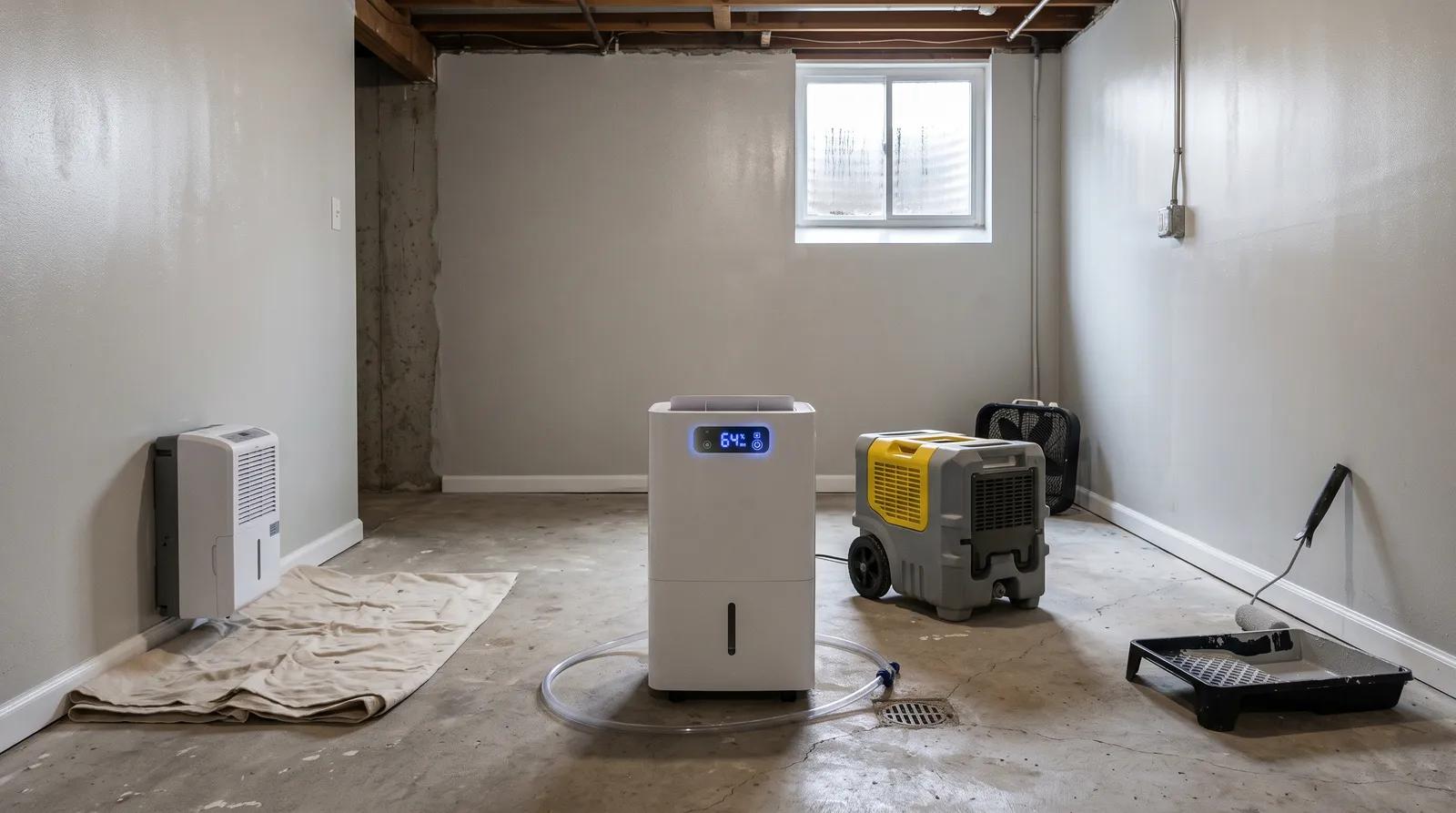
It’s a conventional compressor dehumidifier and it doesn’t pretend otherwise. What it gets right is the boring stuff. The garden hose fitting for continuous gravity drain works without an adapter kit, which sounds trivial until you’ve watched a bucket fill and shut a machine off at 2 a.m. on the one night it needed to run. The Wi-Fi humidistat means you set 45 percent and check the number from your phone in the next room instead of opening the door and walking into wet paint to read a panel.
In the basement repaint, the room started above 70 percent RH with block walls in the mid-60s. Doors closed, hose to the floor drain, one small fan aimed along the wall rather than at it. The room came down into the mid-40s and held there through both coats of Regal Select. Recoat landed close to the label window. Under raking light 48 hours later, no leaching streaks on the block wall, which is where they always show up first.
Where it stops working is cold. It’s a compressor. Below about 60 degrees the coil frosts and the defrost cycle eats the duty cycle, and in an unheated garage in shoulder season you’re better off adding heat first and dehumidifying second. It’s also loud enough that you’ll notice it through a closed door, and the bucket, if you use it, is small for the capacity.
| Spec | Value |
|---|---|
| Type | Compressor, Energy Star |
| Rated capacity | 50 pints/day at 80 degrees, 60 percent RH; 120 pints max at 95 degrees, 90 percent RH |
| Drain | Continuous gravity via garden hose, or internal bucket |
| Control | Digital humidistat, Wi-Fi app |
| Approx. price | $230–$280 |
Buy it if: you paint your own house, you have a basement or a humid summer, and you want one machine that covers a floor. Skip it if: the space is unheated and under 60 degrees, or the job is new drywall across a whole level.
2. AlorAir Storm LGR Extreme, Best for Jobsites
Different class of problem, different class of machine.
New drywall is the job that breaks consumer dehumidifiers. Forty sheets of taped and skim-coated compound put an enormous amount of water into a closed house, and it keeps coming for days. On our new-construction second floor, the 50-pint units pulled the number down and then plateaued in the mid-50s, which is not a paintable condition for primer on fresh mud.
The Storm LGR Extreme is a low-grain refrigerant unit, and the pre-cooling stage is what lets it keep condensing water out of air that’s already partly dried. AlorAir rates it up to 180 pints per day at saturation. The built-in condensate pump pushes water up and out a window, so it runs overnight with nobody in the building. Rotomolded housing, stackable, 6-year limited warranty. This is a machine built to be thrown in a truck by people who don’t own it.
The cost is the con and it’s a big one. At roughly $1,100 to $1,300, nobody painting one bedroom should own this. It also draws enough current that on a tired 15-amp circuit shared with work lights and a sander, you’ll be resetting the breaker. And it’s loud in a way that makes an occupied house unpleasant.
Buy it if: you’re a contractor, a landlord with turnover, or you’re finishing a whole house and the schedule has money attached to it. Rent it if: this is a one-time new-build or a post-flood dry-down. Local rental yards run commercial LGR units in the $60 to $90 a day range, and a three-day rental beats a purchase every time.
3. AlorAir Sentinel HD55S, Best for Basements and Crawl Spaces
The Sentinel solves a different problem than everything else here: it stops being a tool and becomes part of the house.
Rated at 120 PPD at saturation and 55 PPD at AHAM conditions for spaces up to 1,300 square feet, it hangs from the floor joists on a bracket kit or sits on a riser in a crawl space, with a plumbed drain or an add-on pump. Set a target humidity, walk away, and the basement holds that number in June and in February. Low ambient temperature is its normal operating condition rather than its failure mode, which is the whole reason to choose it over a portable for an unheated basement.
For painting specifically, the value shows up on the second job rather than the first. A basement that sits at 45 percent year-round doesn’t grow the mildew that comes back through a fresh coat, and it doesn’t put you back at square one the next time you repaint. If your walls are showing the symptoms in the damp wall repair guide, a portable is a bandage and this is the fix.
Cons are honest and short. It’s $700 to $800. There’s no bucket, so installation is a small plumbing project rather than an unboxing. And you can’t carry it upstairs to dry out a bedroom, because it isn’t that kind of machine.
| Spec | Value |
|---|---|
| Type | Compressor, low ambient temperature operation |
| Rated capacity | 120 PPD at saturation, 55 PPD at AHAM |
| Coverage | Up to 1,300 sq ft |
| Drain | Plumbed gravity drain or optional condensate pump |
| Filter | MERV-8, washable access |
| Approx. price | $700–$800 |
4. Midea Cube 50 Pint with Pump, Best Big Tank
Every dehumidifier review skips the part that actually annoys people, which is emptying the thing.
A standard 50-pint holds about 1.6 gallons. On a saturated basement wall job, that’s three trips to the laundry sink in a day, and every trip is one where the machine sat idle waiting for you. The Cube’s expandable base holds roughly 4.75 gallons. Same capacity, one-third the interruptions. It also has a built-in pump, so if there’s no floor drain you can run a line up and out a window instead of hunting for a downhill path.
The collapsing design is the other half of the pitch. It nests down into a cube for storage, which reads like a gimmick until you remember the machine lives in a garage corner eleven months a year.
The trade-off is price and mechanism. You pay a premium over a plain 50-pint that removes exactly the same amount of water, and the collapsing base is a moving joint on a machine full of water. It’s also a compressor, with the same fall-off below 60 degrees as everything else in its class. Widely stocked at Home Depot and Lowe’s, which makes a warranty claim a drive rather than a shipping label.
Buy it if: the room you’re painting has no floor drain and no easy gravity path, and you’re tired of the bucket.
5. hOmeLabs 32 Pint Wi-Fi, Best Budget
One room, one door, under $200.
hOmeLabs rates it at 32 pints a day at 80 degrees and 60 percent RH, with a stated 80-pint maximum in hot saturated air. For a closed 12 by 14 bedroom that’s enough, and it takes the same continuous drain hose as its bigger sibling, so you’re not stuck with bucket duty just because you saved fifty dollars.
The limit is obvious the moment the door opens. It cannot hold two rooms, and it’s slow to pull the first 10 points of RH out of a genuinely wet basement. Start it a day before you plan to paint rather than turning it on with the roller in your hand.
Verdict: right machine for a single-room repaint on a budget, wrong machine for a floor.
What We Left Off
- Dri-Eaz Revolution LGR. Excellent restoration-grade unit and a rental-yard staple. It’s well past $2,000 to buy, and if you need this much capacity you need it for three days, not for ten years. Rent it.
- Peltier and thermoelectric mini dehumidifiers. The small quiet cubes sold for closets pull a few ounces a day. That’s a closet product. It will do nothing measurable for a room of wet paint.
- Renewable desiccant packs. Same category, same answer. Fine for a gun safe or a boat locker. Not a paint tool.
- Whole-house ducted dehumidifiers. The right long-term answer for a humid house, and a licensed-installer purchase rather than something you buy for a repaint weekend.
- No-name 30-pint units without a continuous drain port. The port is the feature. A machine that can only fill a bucket is a machine that stops working the moment you go to bed.
Running One in a Room You’re Painting
Placement and setup change results more than the choice between two similar machines.
Close the room. A dehumidifier fighting an open window is a space heater with a water bill. Shut the doors, shut the windows, turn off the bath fan. This runs against the instinct to ventilate, and it’s correct: you dry the air by treating it, not by trading it for outdoor air that’s wetter than what you have. If lingering odor is the concern, ventilate after the coating has set, not during. The paint smell guide covers the timing.
Center of the room, off the floor if you can. Twelve inches of clearance around the intake and discharge. On a bare concrete slab, a scrap of plywood under it stops the machine from re-absorbing slab moisture into its own footprint.
Hose it, don’t bucket it. Route condensate to a floor drain, a sump, or out a window with the pump. Every bucket-fill shutoff is dead time in the middle of your dry window.
Add air movement, but aim it across the wall. One box fan set low, pointed along the wall surface rather than at it. Moving air strips the saturated boundary layer sitting against the wet film, which is where most of the drying gain comes from. Aiming a fan directly at fresh enamel skins the surface while the body is still soft, and that’s how a wall that rolled beautifully ends up with lap marks.
Target 45 to 50 percent, not 30. Over-drying is a real failure mode. Below 30 percent RH the paint skins so fast that you lose open time, wet edge, and any hope of a clean lap on a big wall.
Verify with a meter, not a feeling. A cheap hygrometer tells you about the air. A pinless moisture meter tells you about the wall, which is the number that decides whether the second coat goes on. The moisture meter round-up covers what’s worth owning.
Keep it out of the spray booth. If you’re spraying, shut the dehumidifier off or move it out of the room. Overspray on an evaporator coil is permanent, and a coil coated in dried enamel loses capacity and never gets it back. Same reasoning as running a dust extractor during sanding: protect the coil, clean the filter between prep and paint.
Mistakes That Cost People a Coat
- Starting the machine at the same time as the first coat. The room needs to be at target before paint goes on, not while it’s going on. Run it 12 to 24 hours ahead.
- Trusting the label recoat time in an 80 percent room. The can assumes 77 degrees and 50 percent RH. Check the drying time chart for what those numbers do under real conditions, and thumbprint the wall before the second coat regardless.
- Opening windows “to help it dry.” In July, outdoor air at a 72-degree dew point is wetter than the room. You’re adding water.
- Buying on square footage alone. A 4,500 sq ft rating assumes a dry space. A room with fresh joint compound in it is a wet load, not a dry one.
- Running a compressor unit in a 50-degree garage. It will ice, defrost, ice again, and remove almost nothing. Heat the space first, or use desiccant.
- Skipping the filter clean after prep. Sanding dust blinds the coil, capacity drops, and people blame the machine.
- Painting over a wall that’s still wet inside. Air at 45 percent doesn’t mean the block or the patch is dry. Meter the substrate. Especially on masonry and on anything that was previously pressure-washed.
What I’d Actually Buy
For a homeowner with a basement, a garage, and a humid summer: the hOmeLabs 50 Pint, a 25-foot garden hose, and a $15 hygrometer. Around $270 total, and it earns its keep every August whether you’re painting or not.
For a contractor or anyone finishing new construction: rent an LGR for the mud-drying week, and buy the Storm LGR Extreme once you’ve rented one three times.
For a basement that’s damp every single year: stop buying portables. Hang the Sentinel HD55S, plumb the drain, and paint a room that’s already dry.
Ask a Question