Why Your Paint Isn't Drying (Humidity and Temperature)
Paint won't dry in humid weather because water can't leave the film. The humidity and temperature limits for latex, why above 85 percent stalls cure, and how to fix it.

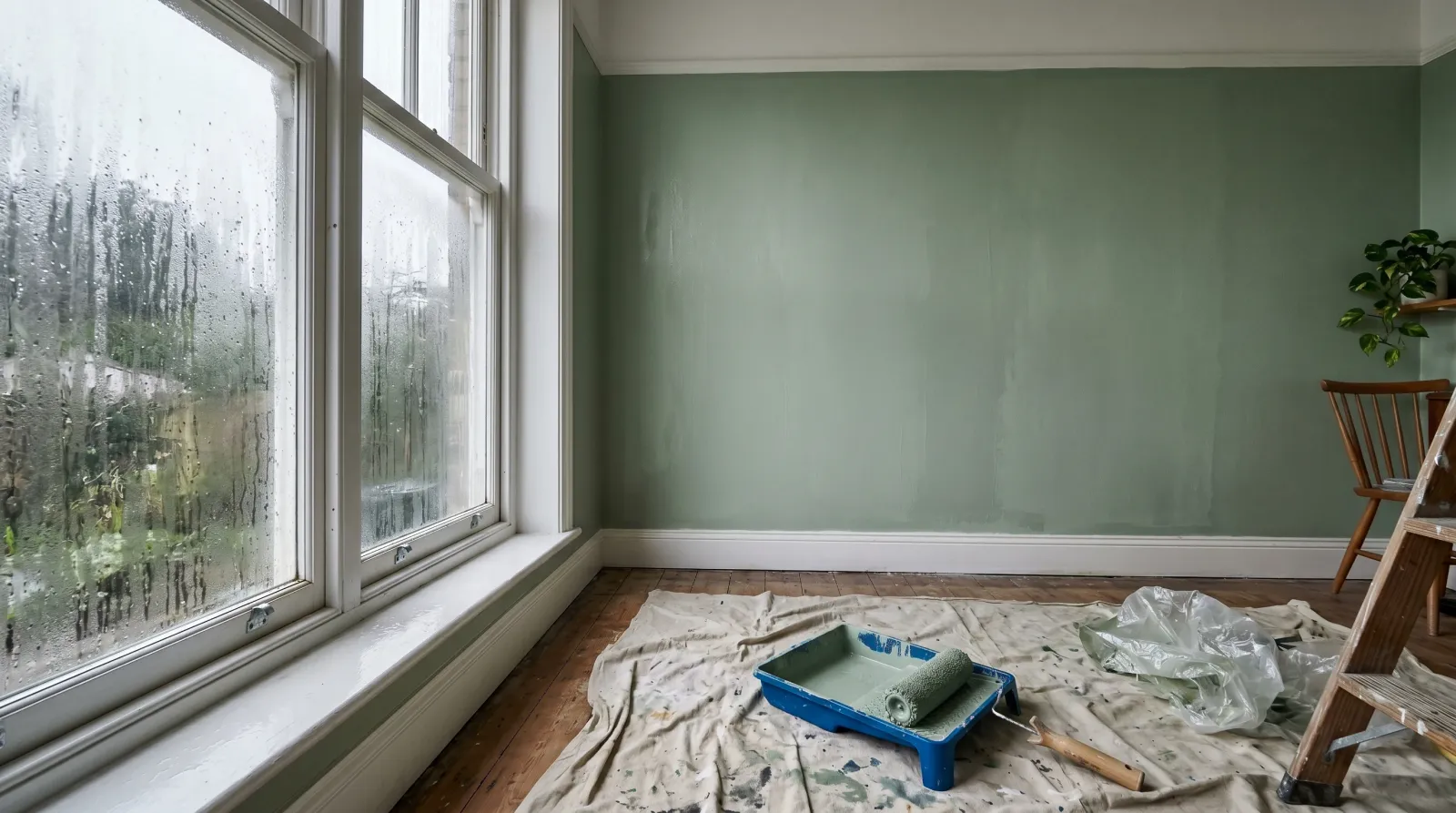
Paint that won’t dry in humid weather is stuck for one reason: the water in the film has nowhere to go. Latex paint dries by evaporation, and evaporation depends on the air being dry enough to accept the moisture leaving the wall. Once relative humidity climbs past about 85 percent, the air is already near its saturation point and pulls water out of the film slowly or not at all. The coat stays soft, tacky, and uncured for hours or days past the can’s stated dry time. The fix is to lower the humidity below 70 percent and move air across the surface.
That’s the whole mechanism. The rest of this explains the chemistry, the temperature side that usually rides along with it, and how to get a stalled film moving again.
Why Humidity Stops a Latex Film From Drying
Most people picture paint drying as the liquid simply vanishing. What actually happens is a two-stage handoff. First the water evaporates out of the wet film. Then the binder particles left behind soften and fuse into a continuous layer, the step chemists call coalescence. Both stages depend on the water getting out, and both stall when the air is saturated.
Evaporation is a balance. Water leaves the wet film, but humid air pushes water vapor back toward it at nearly the same rate. At 50 percent relative humidity the net flow is strongly outward and the surface dries on schedule. At 90 percent the two rates nearly cancel, and the film can sit wet for most of a day. The binder particles are still suspended in trapped water, unable to draw together, so the coat never reaches full strength even though it looks finished from across the room.
The reason oil-based and alkyd paints behave differently is that they don’t cure by evaporation at all. They cure by oxidation, pulling oxygen out of the air to cross-link the binder. High humidity still slows them, because a film of moisture on the surface interferes with that oxygen uptake, and damp air can leave a hazy bloom called blushing on a glossy alkyd. Either chemistry, the lesson is the same: wet air, slow cure.
When Humidity and Temperature Become a Problem
Watch for a stall when:
- Relative humidity is above 85 percent indoors or out. This is the hard line where evaporation nearly stops.
- The room is below 50°F. Cold air holds less moisture and slows coalescence at the same time, a double penalty.
- You’re painting a bathroom, basement, laundry room, or any space with weak ventilation and standing humidity.
- Rain, fog, or heavy dew is in the forecast within the cure window, usually the first 24 to 48 hours.
- The surface itself is cold, like a basement masonry wall or a north-facing exterior in shade. A cold surface sits closer to the dew point and condenses moisture you can’t see.
When NOT to Paint Because of Humidity
Don’t start the coat when:
- Relative humidity is above 85 percent and you have no way to lower it. Indoors that means a dehumidifier or heat; outdoors it means waiting for the weather.
- The exterior surface is within 5°F of the dew point, or there’s visible dew, fog, or condensation on it. Paint applied over that hidden water film won’t bond and will peel within a season or two.
- Rain is likely within the cure window. A latex coat that hasn’t released its water can wash or blush if it gets wet too soon.
- You’re painting an unheated basement or garage in summer, where warm humid air hits cool masonry and condenses. See what to do about condensation on cold walls before you load a brush.
- The overnight low will drop the room below the can’s minimum while the film is still soft.
How Humidity Compares to the Other Cure-Stalling Conditions
| Condition | What goes wrong | The number to watch |
|---|---|---|
| Too humid | Water can’t leave the film; coat stays tacky | Relative humidity above 85% |
| Too cold | Binder won’t coalesce; weak, powdery film | Surface below the can minimum (often 50°F) |
| At/below dew point | Water condenses under the paint; no adhesion | Surface within 5°F of dew point |
| Coat too thick | Outer skin seals in wet underlayers | Applied past the wet-mil rating |
Humidity and cold usually arrive together, which is why a damp 48°F basement is the worst case: the air can’t take the water and the binder can’t fuse. For the full cold-weather rulebook, see the guide to painting in cold weather. For why “dry to the touch” doesn’t mean the paint is finished underneath, the difference between dry time and cure time is the one to read.
Common Mistakes
- Recoating on the can’s schedule in humid weather. The label assumes 70°F and 50 percent humidity. At 85 percent your real recoat window is two to three times longer. Slap the second coat onto a first coat still holding water and you seal the moisture in, which gives you a soft, slow, gummy film that can stay tacky for days.
- Going on too thick to “cover in one coat.” A heavy film skins over on the surface while the layers underneath stay wet. The skin then blocks the trapped water from escaping. Two thin coats dry faster in humid air than one thick one, every time.
- Closing the room up to keep it clean. Still, saturated air is the enemy. A sealed bathroom holds its humidity all night. Open it up and run a fan; moving air across the wall is what carries the evaporated water away.
- Ignoring the surface temperature outdoors. A shaded wall can sit 10 to 15°F below the air and slide right to the dew point by evening. Point an infrared thermometer at the actual surface, not the air.
- Blaming the paint. A tacky film in a humid room is almost never a bad can. It’s the conditions. The same gallon dries fine at 50 percent humidity.
What It Looks Like
A humidity-stalled latex coat looks finished but fails the touch test. Press a fingertip into an inconspicuous spot after the stated dry time. If it feels cool, slightly soft, or leaves a faint print, the water is still in there. On a glossy oil or alkyd, watch for blushing, a milky haze across the sheen that signals moisture interfered with the cure. On furniture and trim, the tell is tackiness that lingers for days, which is the same failure mode covered in fixing tacky painted furniture.
How to Get a Stalled Coat Moving
The fix is to change the air, not the paint. Indoors, run a dehumidifier to pull the room below 70 percent, ideally to 50 percent, and put a box fan blowing across the wall to keep dry air moving over the surface. Add gentle heat if the room is also cold; warmer air holds more moisture and speeds coalescence. Run all of it for the first several hours after each coat, the window when most of the water needs to leave.
Outdoors you’re at the mercy of the weather. Paint in the late morning after the dew has burned off and the surface has warmed, stop well before evening when the surface cools back toward the dew point, and check the forecast for rain across the next two days.
What to Look For When You Buy
There’s no paint that beats the humidity ceiling, but the back label tells you the conditions a given product was tested for. Look for the application range: most latex lists 50°F to 90°F and below 85 percent relative humidity. A quality 100 percent acrylic releases its water and coalesces more reliably at the edges of that range than a budget vinyl-acrylic or PVA. For damp-prone rooms, the better move is often a dehumidifier and a fan rather than a different gallon. The tool, not the paint, is what changes the air.
The chemistry doesn’t negotiate. Water leaves the film only when the air will take it. Lower the humidity, move the air, and the coat that’s been sitting wet all morning will finally dry.
Ask a Question