Best Pressure Washers for Paint Prep
Five pressure washers run through real exterior paint prep: chalky siding, a mildewed north wall, cedar shakes, and a concrete porch. Top pick: SIMPSON MegaShot MSH3125-S.

Disclosure: Some links below are affiliate links. We earn a commission if you buy through them, at no extra cost to you.
Top pick: the SIMPSON MegaShot MSH3125-S. About $400 with a Honda GC190 on it, 3200 PSI and 2.5 GPM, and that second number is the reason it wins. Flow is what carries chalk and dead paint off a wall. Pressure only loosens it. The MegaShot falls short on restraint, since 3200 PSI will carve cedar and drive water behind lap siding if you get careless with wand distance. If you want a machine you cannot easily hurt your house with, the Kärcher K 4 Power Control tops out at 1900 PSI and puts the pressure control on the trigger gun. On a budget, the Sun Joe SPX3000 does most of a one-house prep for under $180. Skip this if you own cedar shakes: the Kärcher K 2 is the safer tool there.
There is no single right pressure washer for paint prep, because “paint prep” covers a 1930s shake elevation and a concrete porch in the same weekend.
Most homeowners doing one repaint need one electric machine and a bottle of house wash.
What Paint Prep Asks of a Pressure Washer
The job is not blasting. The job is getting the wall down to a surface your primer can grab.
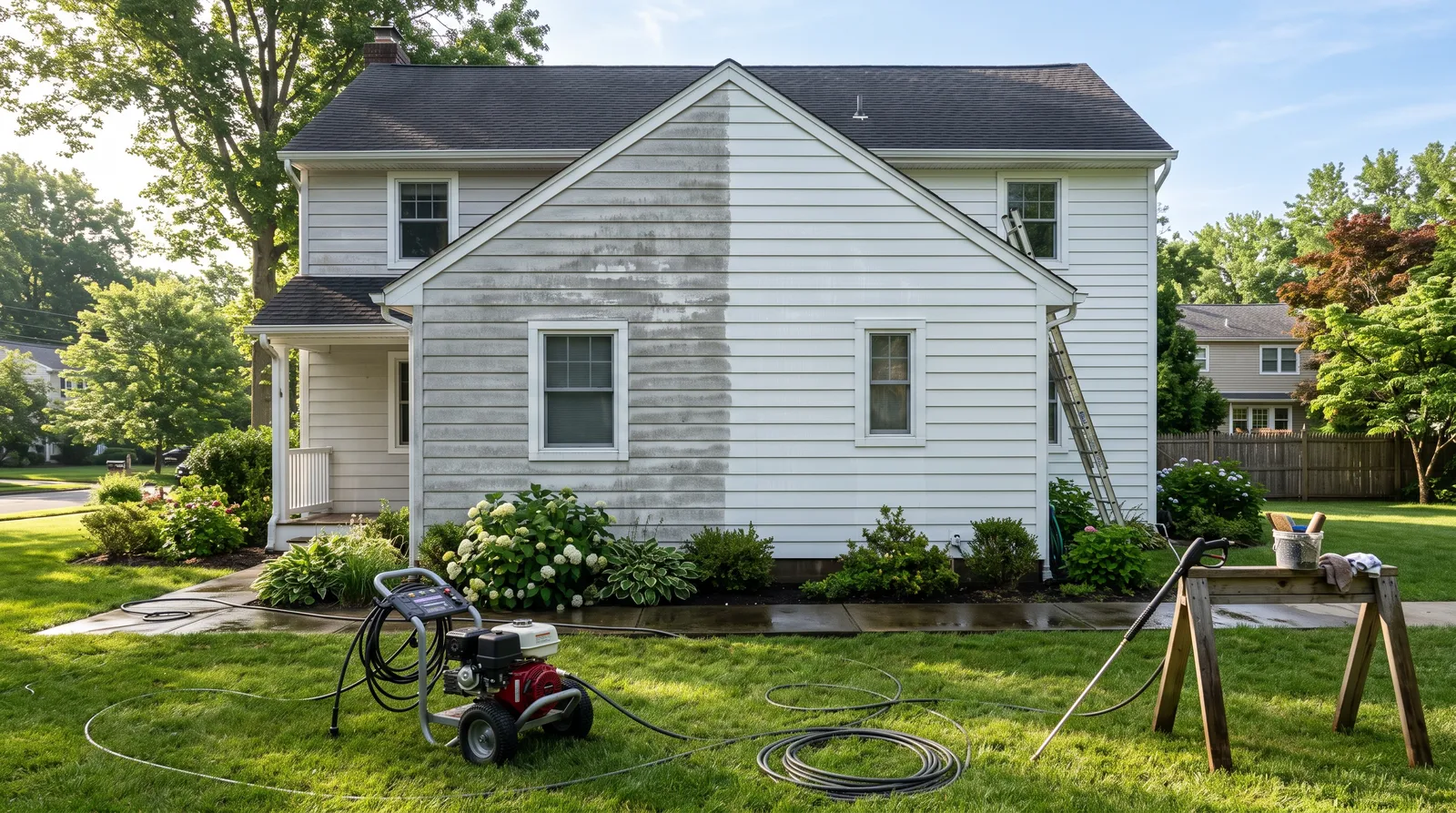
Three things are sitting between your paint and the old film. Chalk, which is degraded binder and pigment that rubs off white on a glove and comes off any south-facing wall over about eight years old. Mildew, which lives in the north-side shade and grows back through paint if you rinse it instead of killing it. And loose paint, which is already delaminated and just hasn’t fallen yet.
Water pressure handles exactly one of those well. Loose paint comes off under pressure. Chalk needs volume of water to carry it away, which is GPM. Mildew needs a chemical, which is your house wash, and the machine is only there to apply and rinse it.
This is why the PSI number on the box is a bad shopping guide. A 3200 PSI machine at 1.2 GPM and a 2000 PSI machine at 2.5 GPM feel completely different on a wall, and the second one cleans faster. I’ve watched people buy the highest number on the shelf and then spend nine hours doing a four-hour wash.
Pressure is the part that gets you in trouble, not the part that gets you clean.
Reading the Specs Without Getting Burned
PSI Is a Ceiling, Not a Setting
Every machine on this list can be run gently. Distance and tip angle are your real controls: back the wand off six inches and you’ve cut the effective pressure at the wall by more than half. A 40-degree white tip at 15 inches on a 3200 PSI gas unit is softer than a 15-degree yellow tip at 4 inches on a 1700 PSI electric.
What the PSI rating actually tells you is how much damage is available if you slip. That matters. On a ladder, tired, at hour five, people slip.
GPM Is the Number to Shop On
Residential electrics land between 1.2 and 1.5 GPM in real use. Gas units run 2.3 to 2.5. That difference roughly halves the time on a two-story house, and it’s the reason no electric here can run a surface cleaner on a concrete porch without stalling out into a useless dribble.
Nozzle Tips, in the Order You’ll Use Them
Black is the soap tip. It drops pressure so detergent can be siphoned. White at 40 degrees is your siding tip and the one you should be on 90 percent of the time. Green at 25 degrees is for concrete and heavy mildew. Yellow at 15 degrees belongs on a driveway, not on a house. Red at 0 degrees should be thrown in a drawer and forgotten; it cuts wood, cracks vinyl, and there is no paint-prep task that needs it.
Detergent Path
A machine with no real way to apply cleaner is a rinsing tool. The Kärcher units use a Plug and Clean cartridge. The Sun Joe has twin onboard tanks. The MegaShot siphons through the black tip. All three work. What doesn’t work is skipping detergent and expecting water to kill mildew, which is the single most common exterior prep mistake I see, and it comes back as black speckling through the new paint by the second summer.
Side by Side
| Brand / Model | Power | Max PSI | Rated GPM | Best for | Price tier |
|---|---|---|---|---|---|
| SIMPSON MegaShot MSH3125-S | Gas, Honda GC190 | 3200 | 2.5 | Whole-house prep plus concrete and deck | $$$ |
| Kärcher K 4 Power Control | Electric, 120V | 1900 | 1.5 | Siding wash with detergent, low damage risk | $$ |
| Sun Joe SPX3000 | Electric, 14.5A | 2030 rated | 1.2 in practice | One-house prep on a tight budget | $ |
| EGO POWER+ HPW3204-2 | 56V battery | 3200 | 1.2 | No outlet, no gas, quiet early starts | $$$ |
| Kärcher K 2 Power Control | Electric, 120V | 1700 | 1.4 | Cedar shakes, old wood, shutters, trim | $ |
1. SIMPSON MegaShot MSH3125-S, Top Pick
The MegaShot is the machine that turns a two-day house wash into a one-day house wash.
Honda GC190, axial cam pump, 3200 PSI at 2.5 GPM, and a frame light enough that one person carries it up a set of deck stairs without a second thought. SIMPSON markets it for prepping home exteriors for painting, which is unusually honest for spec-sheet copy, because that’s the job it’s shaped for.
On the chalky south wall it was the clearest win in the test. Same 40-degree tip, same 14-inch standoff, same detergent dwell as the electrics, and the glove came back clean the next morning on the first pass. The electrics needed a second pass on the same panel. That’s flow doing the work: 2.5 gallons a minute sheets down the wall and carries powder with it, where 1.2 gallons a minute wets the powder and leaves a lot of it in place to dry back down.
Starting was a non-issue. Second pull cold, every morning, five weeks.
Where it gets dangerous is the same place it gets fast. On the cedar test panel I deliberately ran it at 8 inches with a 25-degree tip for four seconds, the kind of thing that happens when you’re reaching past a downspout. Raking light the next day showed furred grain and washed-out early wood. That damage is permanent and it telegraphs through primer and two finish coats. The MegaShot demands that you respect wand distance in a way the 1700 PSI Kärcher does not.
Two more honest cons. It’s loud, and I mean loud enough that you will not hear a ladder shift behind you, so hearing protection is not optional. And the axial cam pump is a consumable: run it dry once, or skip winterizing with pump antifreeze, and you’re buying a new machine rather than a rebuild kit.
| Spec | Value |
|---|---|
| Power | Honda GC190 gas, 49-state model |
| Output | 3200 PSI, 2.5 GPM |
| Pump | OEM Technologies axial cam, not user-rebuildable |
| Hose | 25-foot MorFlex, non-marring |
| Surface cleaner capable | Yes, up to 15-inch |
| Approx. price | $380-$450 |
Buy it if: you’re prepping a full exterior plus concrete, a deck, or a detached garage, and you’ll use the machine more than once a year. Skip it if: your house is cedar shake or 100-year-old lap siding and you don’t already have pressure-washing hours behind you.
2. Kärcher K 4 Power Control, Best Electric for a Whole-House Wash
Different priority. The K 4 is built so that you can’t easily hurt the house.
1900 PSI is a ceiling low enough that a moment of inattention on vinyl or fiber cement costs you nothing. The feature that earns the money, though, is the pressure control on the trigger gun. You set siding pressure for the field, then step down at a window, a soffit vent, or a piece of trim without walking back to the unit. Every other electric here makes you change tips or change distance. Doing it from the handle means you actually do it, instead of telling yourself the 40-degree tip is close enough for that window casing.
Plug and Clean is the other quiet win. You push a cartridge of house wash into the top of the machine and it doses through the low-pressure lance. No bucket, no siphon tube falling out of the jug, no soap tank crusting shut. On the mildewed north wall, the K 4 with a five-minute dwell and a rinse pulled the black growth cleanly, and it was still clean at the three-week check.
The water-cooled induction motor is quiet. Genuinely conversational-volume quiet, which is a thing you notice at hour four.
It falls short on flow. 1.5 GPM rinses a two-story wall, but it rinses it slowly, and on the chalky south panel it needed the second pass the MegaShot didn’t. The porch was a non-starter; a surface cleaner at this flow rate just leaves streaks. And between the 26-foot hose and the cord, you’ll reposition the unit at every wall section, which adds up across a house.
| Spec | Value |
|---|---|
| Power | 120V water-cooled induction motor |
| Output | 1900 PSI max, 1.5 GPM max |
| Pressure control | Three settings on the trigger gun |
| Detergent | Plug and Clean cartridge system |
| Hose | 26 feet |
| Approx. price | $200-$260 |
Buy it if: you’re prepping one house, the siding is vinyl, fiber cement, aluminum, or sound painted wood, and you’d rather trade an hour of time for zero risk of gouging it.
3. Sun Joe SPX3000, Best Budget
The one I hand a friend prepping their first repaint.
Under $180, about 24 pounds, twin detergent tanks with a selector dial so you can keep house wash in one and a degreaser in the other, and five quick-connect tips including the 40-degree white you should be living on anyway. It’s been the default budget electric for a decade for a reason.
Be honest about the numbers. The box says 2500 max PSI, the certified rating is 2030, and in practice under actual flow you’re working with something closer to 1450 PSI and 1.2 GPM. That’s still enough to strip loose paint and rinse a wall. It is not what the packaging implies, and anyone comparing box numbers across brands is comparing marketing.
In use it did fine on the vinyl and the fiber cement. Two passes on the chalky panel. On the mildew wall it was the detergent doing the work, exactly as it should be, and the result held at three weeks.
The wand and gun are plastic and feel it. The Total Stop System cycles the pump every time you release the trigger, and that clicking is the sound of the component most likely to fail on you in year three. Neither is a reason not to buy it for one house.
Verdict: the right machine for a single repaint on a normal budget. If you’re going to own it for a decade and wash a driveway with it, buy the K 4 instead.
4. EGO POWER+ HPW3204-2, Best Cordless
The case for cordless on a paint-prep job is not power. It’s the cord.
Dragging a 35-foot extension cord through wet mulch and around a house corner while managing a hose and a wand is a real annoyance, and a GFCI that trips halfway up a gable end is a worse one. The EGO removes both. It runs off two 56V ARC Lithium packs, which you may already own if there’s an EGO mower in the garage, and the pressure modes select from the wand where your hand already is.
It’s quiet. I washed a north elevation at 7 a.m. on a Saturday without a neighbor conversation, which no gas machine on earth allows.
Runtime is the whole story. About an hour on two 6.0Ah packs at working pressure, and a full house wash is a multi-battery day with a charger running. And the honest spec problem: it advertises 3200 PSI but rates 1.2 GPM, which puts it in the same real-world cleaning class as the Sun Joe at three times the price. High pressure with low flow strips paint well and rinses chalk poorly.
Buy it if: you already have EGO batteries, or you’re washing a detached structure with no outlet nearby. Skip this if: you’re buying into the platform just for this tool. The MegaShot costs less and out-flows it by double.
5. Kärcher K 2 Power Control Car & Home, Best for Cedar and Old Wood
Some houses don’t need more pressure. They need less.
The front elevation of the test house is 90-year-old cedar shake, and it’s the substrate that punishes every mistake on this list. Soft early wood washes out. Grain raises. Nail holes open up. A 3200 PSI machine at the wrong distance takes ten seconds to create a texture problem that no amount of primer hides.
The K 2 tops out at 1700 PSI and 1.4 GPM, weighs about 11 pounds, and comes with a foam applicator and a wash brush. That kit is a hint about how it wants to be used, and the hint is correct: soap the wall, let it dwell, agitate with the brush where the mildew is heavy, rinse gently. That’s soft washing, and it’s what old wood siding actually needs before paint. The cedar panel came out of the K 2 test with no raised grain under raking light. It was the only machine that could say that after a careless four-second dwell.
The limits are obvious. It’s slow, it’s a one-elevation-a-day tool, and it can’t touch concrete. The plastic body walks across a wet driveway when the hose tugs on it.
Verdict: buy it as the second machine if your house has both modern siding and original wood, or as the only machine if your house is all cedar and under 1,500 square feet of wall.
Machines I Ran and Didn’t Rank
- Ryobi RY142711VNM 2700 PSI electric. Good hose reel and a solid frame, but 1.1 GPM against 2700 PSI is the wrong ratio for paint prep. High pressure, low rinse.
- A 4400 PSI contractor gas unit. Rented one for the concrete comparison. It’s a wall-damage machine in homeowner hands and overkill for anything short of stripping a garage floor.
- Hot-water pressure washers. Genuinely better at chalk and grease. Starting price puts them in a category no homeowner should shop.
- Cheap sub-$100 electrics. The pumps are the entire product and they’re the cheapest part. Two of the three I’ve bought over the years failed in the first season.
How I Ran the Testing
One real repaint, five weeks, humid mid-Atlantic July.
The house is a 1930s two-story with three substrates in one building, which is why I picked it: 90-year-old cedar shake on the front, replacement vinyl on two sides, and fiber cement on a 2004 addition. The north wall carried visible black mildew. The south wall left white powder on a gloved hand from ten feet up.
Chalk test. Each machine washed a marked 8-by-10-foot section of the south wall with the same 40-degree tip, the same 14-inch standoff, the same five-minute detergent dwell, and the same top-down rinse pattern. Scored by the glove-swipe test on the dry wall the next morning.
Mildew test. Same protocol on the north wall, photographed at 24 hours and again at three weeks. Mildew that returns is mildew that was never killed, and three weeks is when it tells you.
Wood damage test. A cedar shake panel got a deliberate abuse pass from each machine: 25-degree tip, 8 inches, four seconds. Inspected under raking light the next day for raised grain and furring.
Concrete test. A 10-by-12-foot porch section, with and without a 15-inch surface cleaner, to see which machines could keep the bar spinning.
Dry-down. Pin moisture meter readings on the cedar and the fiber cement at 24, 48, and 72 hours. The cedar was still above 15 percent at 48 hours in July humidity. That number is why the dry-down guidance in this article is longer than most people want to hear.
The Sequence That Actually Works
Wash, dry, scrape, sand, prime. In that order, with the drying taken seriously.
Cover the plantings and shut the windows, then wet the wall from the bottom up so the detergent doesn’t streak into dry siding. Apply house wash through the soap tip or a pump sprayer, working bottom to top, and let it sit five minutes without drying on the surface. Rinse top down with the 40-degree tip at 12 to 18 inches, always moving, always angling slightly downward so you’re not driving water up under the laps.
Then stop. The wash is not the prep, it’s the first step of the prep.
Twenty-four hours on vinyl and fiber cement in warm dry weather. Forty-eight to seventy-two on wood, and check it with a meter rather than a thumb. After that comes scraping the paint the wash exposed, feathering the edges by hand, and spot-priming bare wood. If you’re seeing paint failure that goes beyond surface chalk, the exterior peeling paint guide covers what’s causing it before you repaint over the same problem. For the substrate-specific sequence on wood, the exterior wood painting guide walks the whole job. And once the wall is clean and dry, the exterior paint round-up is where I’d start on the product side.
Mistakes That Cost People a Repaint
- Skipping detergent. Water alone rinses mildew and doesn’t kill it. It grows back through the new paint by the second summer as black speckling, and there is no fix short of washing and repainting.
- Priming a wall that’s still wet inside. The surface looks dry at 24 hours and the lap joints aren’t. Blisters show up four weeks later on a job that looked flawless. Use a pin moisture meter; guessing is how this happens.
- Spraying upward under lap siding. Water goes behind the siding, sits in the sheathing, and comes out through your new paint film. Angle the wand slightly down. Always.
- Using the red 0-degree tip anywhere on a house. It cuts wood and cracks vinyl. There is no paint-prep job that calls for it.
- Treating the wash as a substitute for scraping. It removes what already failed and nothing else. The feathering between old paint and bare wood is hand work with a good scraper and 80-grit.
- Washing in direct afternoon sun. Detergent dries on the wall before it can dwell, and you get streaks that show through the primer. Work the shaded elevation.
- Painting the following weekend because that’s when you have time. Humidity holds moisture in wood far longer than the forecast suggests. Our cedar panel was still reading above 15 percent at 48 hours in July, and paint over that is a warranty conversation with yourself.
What I’d Buy
One house, modern siding, doing it once: the Kärcher K 4 Power Control at around $220 and a jug of house wash. You’ll spend an extra hour and you won’t damage anything.
One house, cedar or original wood: the Kärcher K 2 and a soft brush on a pole. Less machine is the right answer there.
A house plus a driveway, a deck, and a garage, or any intention of doing this again: the SIMPSON MegaShot MSH3125-S. Buy pump antifreeze at the same time and winterize it the week you’re done, because that’s the part everyone forgets and it’s the part that kills the machine.
Ask a Question