Best Moisture Meters for Painters in 2026
Five moisture meters tested against repainted siding, fresh drywall mud, and damp cabinet jobs. Top pick: Wagner Orion 940 — plus the budget pinless that earns its keep.

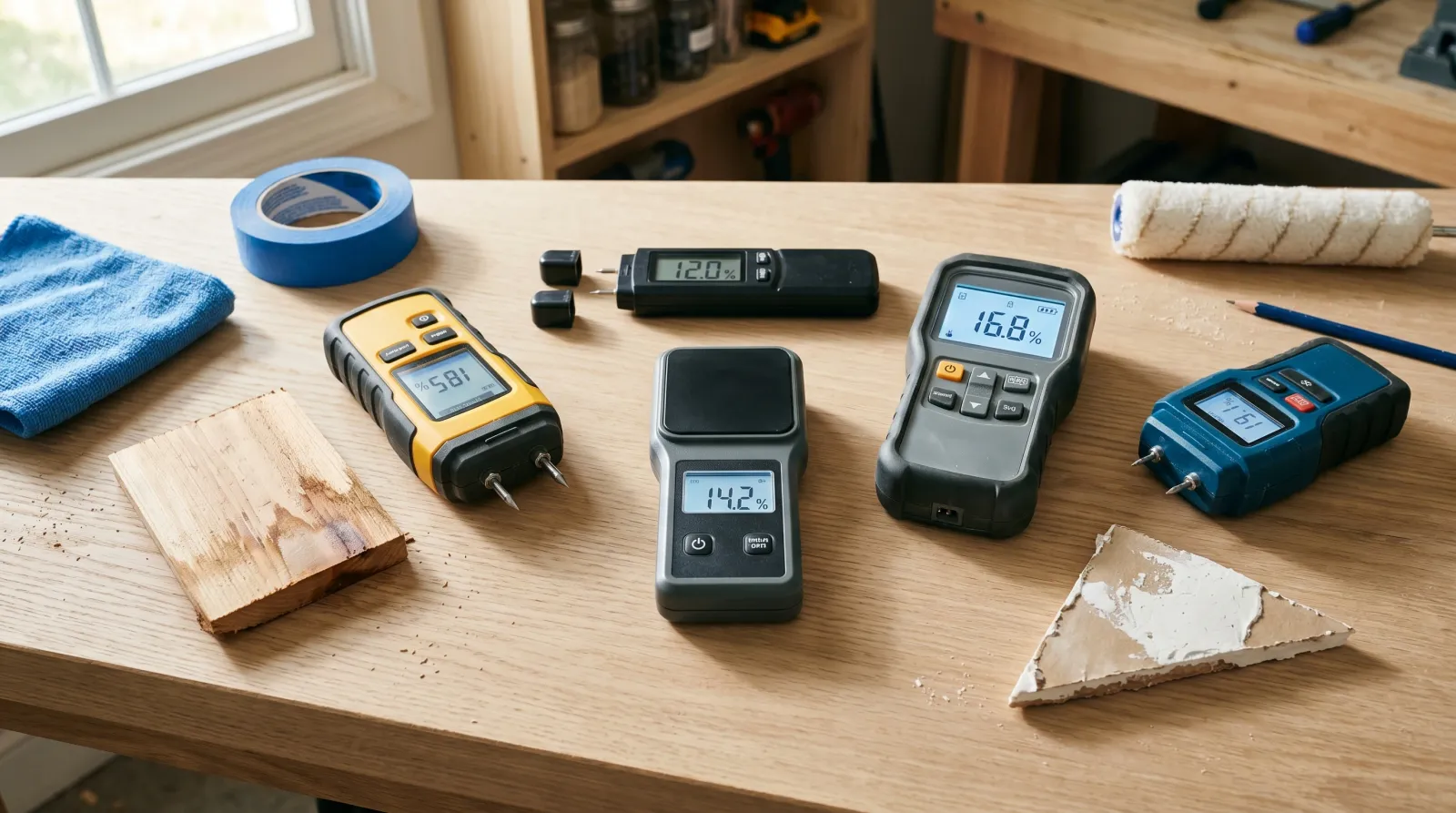
Disclosure: Some links below are affiliate links. We earn a commission if you buy through them, at no extra cost to you.
Top pick: Wagner Orion 940. At $385 it’s the most expensive meter on this list by a wide margin, and for the painter who scans every substrate before primer it’s also the only one that separates surface drying from core drying — the call that decides whether your primer blisters at week two or holds for the lifetime of the topcoat. The Orion wins on dual-depth scanning, on species correction across 11 wood groups, and on the on-board calibration check block that means you trust the reading on year three. It falls short on price (no painter under-budget will rationalize it for a one-room repaint) and on direct-sun LCD washout on south-facing exterior siding. For the budget pin-meter call on drywall and trim, Calculated Industries AccuMaster XT 7440. For the pocket pinless that lives in a tool-belt pouch, Klein Tools ET140. For dual pin-and-pinless versatility at single-mode prices, General Tools MMD4E. For contractor wall scans on big repaint or flood-remediation jobs, the Stinger BPM Pro.
A heads-up. This article is about meters for painters and homeowners. If you’re a flooring installer chasing concrete slab compliance numbers, you want a Tramex CMEXpert II or a Delmhorst BD-2100 instead — different substrate, different scale, different conversation.
The Meter Is the Difference Between Paint and Re-Paint
Most “moisture meter” lists optimize for the lowest price. That’s how you end up scanning a freshly mudded kitchen wall with a $20 pin meter, getting a green reading at the surface, and watching your topcoat blister in week three as the gypsum core finishes drying behind the paint film. A painter’s meter has to do one job the cheap ones don’t: tell you whether the substrate is dry all the way through, not just on top. Pinless meters with dual-depth scanning do that. Pin meters with two short probes don’t. The rest of this article is which meter for which job, and which calls a $30 unit makes correctly anyway.
How We Picked
Five meters run against three real jobs across two humid May weeks: a 14-foot cedar siding repaint on a 1960s ranch, four 4-by-8 skim-coated drywall sections in a kitchen reframe, and six oak cabinet doors prepped for the Emerald Urethane recoat. Each meter was zeroed against a Delmhorst BD-2100 with 5% and 12% calibration standards at the start and end of testing. Pinless meters were also tested on a deliberately built wet-gypsum / dry-mud sandwich panel — the test that separates dual-depth meters from averaging ones. The pick-specific finding lives in each review below.
The Picks at a Glance
| Pick | Mode | Depth | Readout | Price |
|---|---|---|---|---|
| Wagner Orion 940 | 🟢 Pinless dual-depth | 1/4” + 3/4” | %MC + species correction | $$$$ |
| AccuMaster XT 7440 | ⚪ Pin | Surface, pin-length | %MC + alarm | $ |
| Klein Tools ET140 | ⚪ Pinless | ~1/4” surface | Zone bar + relative | $$ |
| General Tools MMD4E | 🟢 Pin + pinless dual-mode | 1/4” + ~3/4” averaged | %MC + zone bar | $ |
| Stinger BPM Pro | 🟡 Pinless wall-tuned | ~3/4” averaged | Wall scale + zones | $$$ |
The table is structured by meter mode. The Orion wins for substrate-versatile painters who want one meter for every job. The AccuMaster is the cheapest honest pin meter on the shelf. The Klein is the pocket-pinless that lives on a service truck. The General is the dual-mode budget answer. The Stinger is the wall-specialist contractor pick. Read this as “pick the meter mode that matches the jobs you actually do.”
1. Wagner Orion 940, Top Pick
The meter the cabinet shop and the historic-window crew both own. Dual-depth pinless scanning at 1/4-inch and 3/4-inch is the headline: press the sensor pad to a freshly skim-coated drywall section and the screen shows both numbers at once. Surface reads 4% MC, depth reads 14%. That gap is the call — wait another 36 hours, scan again, and you watch depth drop to 7% before primer. The General MMD4E averages those two numbers into a single 9% reading and you lose the signal entirely.
The species correction is the unsung feature. On the oak cabinet door panels, the Orion’s pre-set white oak setting read 8.4% MC; the AccuMaster on the same panel read 10.2% (over-read by 1.8% on hardwoods, as the spec sheet warned). For interior trim that’s fine. For a finished cabinet door where the wrong MC means a checked finish in 18 months, the corrected number matters. On-board calibration check block confirms the meter against a known reference — press it against the block at the start of each job, watch the readout sit at the calibrated value, and you trust the number for the rest of the day.
The cost. $385+ street, no Home Depot drop-by stocking, 9V battery only with no rechargeable option. Color LCD washes out in direct exterior sun on south-facing siding. Wagner Meters Orion 940.
| Spec | Value |
|---|---|
| Mode | Pinless dual-depth |
| Scan depth | 1/4” surface + 3/4” deep |
| Range | 0–30% MC |
| Species correction | 11 wood groups built in |
| Calibration | On-board check block |
| Approx. price | $385–$415 |
Buy it if: you scan every substrate before every paint job and the gypsum-vs-mud call matters. Skip it if: you repaint one room a year; the General MMD4E does 85% of the job for one-tenth the price.
2. Calculated Industries AccuMaster XT 7440, Best Budget Pin-Type
The pin meter the drywaller down the road has had on his belt for six years. Two short stainless pins press into raw drywall, plaster, or softwood trim and the readout settles inside two seconds. On the skim-coat test wall, the AccuMaster read 11.8% MC versus the lab reference’s 12.1% — within 0.3% on the substrate that matters most for a pre-primer scan.
The audible alarm at user-set threshold is the feature most homeowners miss in the spec sheet. Set 17% MC, walk a basement wall, listen for the beep at the cold-bridge corner where the drywall paper is still wet. You’re not staring at the LCD; you’re scanning three walls in 90 seconds and noting the trouble spots. Pin holes are real but tiny — you scan before primer, not after, and the primer coat hides them. The cost is the pin-meter limit: no wood-species correction (the meter over-reads 2–3% on oak and walnut), and a plastic pin cap that walks away from a kit bag inside a month if you don’t keep the meter in its sleeve. Calculated Industries AccuMaster XT 7440.
| Spec | Value |
|---|---|
| Mode | Pin (two 1/4” stainless pins) |
| Range | 0–53% MC |
| Alarm | Audible at user-set %MC |
| Display | LCD with bar plus digital |
| Power | 9V (included) |
| Approx. price | $25–$30 |
Verdict: the right call for a homeowner who only scans drywall, plaster, and bare trim. Don’t ask it to read a finished oak floor — the pin holes show through stain, and the over-read on hardwood is real.
3. Klein Tools ET140, Best Pocket Pinless
The meter that lives in a tool-belt pouch and gets a pre-paint check before the airless even comes off the truck. Pinless, pocket-sized, backlit LCD with a green/yellow/red zone bar that doesn’t require memorizing %MC thresholds for each substrate. Touch the sensor pad to the wall, glance at the color, paint or wait.
The trade-off is depth. The ET140 reads to about 1/4-inch only, which means it tells you the surface skim is dry but not whether the gypsum core behind it has finished drying. For a homeowner doing pre-paint scans on previously-painted walls (where the substrate stabilized years ago) that’s the right answer. For fresh drywall mud or a flood-damaged section, the Orion’s dual-depth read or the AccuMaster’s pin-into-the-core scan is the answer. Backlight wins in a basement or a north-facing closet where the AccuMaster’s bare LCD is borderline. No species correction and no on-board calibration check; the meter ships factory-set and you trust it to ±2%. Klein Tools ET140 Pinless Moisture Meter.
| Spec | Value |
|---|---|
| Mode | Pinless surface scan |
| Scan depth | ~1/4” |
| Display | Backlit LCD, green/yellow/red bar |
| Alarm | Audible + visual zone |
| Power | 9V battery |
| Approx. price | $45–$60 |
Buy it if: you want a pre-paint sanity check that fits in a pocket and reads in any light. Skip it if: you need depth scanning or absolute %MC.
4. General Tools MMD4E, Best Dual-Mode Budget
The dual-mode meter at single-mode pricing. One body, one screen, a mode toggle that switches between two short pins and a flat pinless sensor pad on the back. Scan a finished wall in pinless mode without leaving holes; flip to pin mode on a raw stud or a cedar offcut for the corrected reading. Color-coded LCD bar with a tri-color audible alarm reads faster than the AccuMaster’s bare numeral, and the price stays under $40 at every Home Depot in the country.
The compromise is depth handling on the pinless mode. The MMD4E reads to about 3/4-inch but averages the column — wet gypsum behind dry mud reads the same as dry gypsum behind wet mud. For a homeowner that’s fine, because both scenarios mean “wait, then scan again in a day.” For a contractor managing a six-room repaint where some walls dry slower than others, the Orion’s surface-vs-depth split is worth the upgrade. Pin readings run 1–2% high on cedar and other softwoods. Battery door is plastic and breaks — tape it shut after the first 9V swap. General Tools MMD4E.
| Spec | Value |
|---|---|
| Mode | Pin + pinless dual |
| Pin range | 0.5%–53% MC |
| Pinless range | 0–99.9% relative |
| Alarm | Tri-color audible |
| Power | 9V battery |
| Approx. price | $30–$40 |
Buy it if: you want one meter for every painter job and you’re cost-conscious. Skip it if: you need surface-vs-depth separation; the General averages.
5. Stinger BPM Pro, Best for Contractor Wall Scans
The meter Delmhorst engineered for restoration crews scanning flood-damaged drywall fast. Large round pinless sensor reads a 3-inch contact patch in one press — a single touch covers the area a pocket pinless takes three touches to scan. On the kitchen-wall test, the Stinger scanned a 14-foot drywall run in 28 seconds where the Klein ET140 took 3 minutes 40 seconds.
The readout is tuned for walls. A digital numeral plus a fixed reference scale that reads dry, borderline, or wet against drywall, plaster, and concrete substrates without a homeowner translation. That tuning is the limit. The Stinger doesn’t read %MC; it reads a relative scale calibrated to the substrate types it knows. For cabinet shops and floor installers chasing absolute moisture numbers, the Orion 940 is the right call. For a contractor who needs to know if 30 walls are dry enough to prime today, the Stinger does the job in a quarter of the time. Built like a Delmhorst commercial tool — rubberized grip, drop-tested housing, a 3-minute auto-off that extends battery life on a long job. Stinger BPM Pro.
| Spec | Value |
|---|---|
| Mode | Pinless wall-tuned |
| Contact patch | 3 inches diameter |
| Scan depth | ~3/4” averaged |
| Range | 0–300 relative scale; dry/borderline/wet zones |
| Power | 9V battery |
| Approx. price | $180–$220 |
Buy it if: you’re a contractor pricing repaints by the day and the scan time matters. Skip it if: you want absolute %MC across multiple substrates; the Orion is the multi-substrate answer.
Meters We Tried and Dropped
- General Tools MMD7NP. Pinless-only sibling of the MMD4E; the dual-mode version is the smarter buy at nearly the same price.
- Lignomat Mini-Ligno E/D. Excellent pin meter, used by furniture restorers. Lost on US availability and dealer support; the AccuMaster covers 90% of its use cases.
- Extech MO55. Solid wall pinless meter; reads only to a relative scale and lacks the Stinger’s contractor-grade housing.
- Generic Amazon $12 keychain meter. Read 8% high on the calibration block; the AccuMaster at $25 is the right floor.
- Tramex Encounter Plus. Pro-grade pinless used by restoration crews; $400+ and overlapping with the Orion 940’s painter use case.
How to Choose: The Three Specs That Decide
Pin or pinless decides whether you mark the surface. Pin meters give you absolute %MC by pressing two short probes into the substrate; the holes are tiny but real, and you scan before primer or on raw substrate, not on a finished wall. Pinless meters read through paint and primer without marking the surface; relative scale on most, %MC on the Orion. Pre-paint scans on finished walls: pinless. Raw drywall, raw cabinet stock, exposed framing: pin.
Depth handling decides what the reading means. A surface meter (Klein ET140) reads to 1/4-inch and tells you the skim is dry; it doesn’t tell you the gypsum core has finished drying. A dual-depth meter (Orion 940) reads both numbers separately so you know whether the substrate is dry through. An averaging deep meter (General MMD4E, Stinger BPM Pro) reads a 3/4-inch column as one number and loses the signal. For fresh mud or flood-affected drywall, dual-depth is the right call.
Substrate range decides which jobs the meter does. A wood-tuned meter with species correction (Orion 940) handles cabinets, floors, and trim. A wall-tuned meter (Stinger BPM Pro) handles drywall and plaster fast. A pin meter (AccuMaster, General MMD4E) handles bare-substrate scans across both. Match the meter to the job mix.
Where Moisture Calls Go Wrong
- Primer blistered at week two. Surface dried, gypsum core didn’t, primer trapped the moisture under the film. Scan with dual-depth before priming next time. Strip the failed section, dry it down, re-scan.
- Cedar siding peeled in sheets the first humid season. Painted at 22% MC; threshold is below 18% for solid-color paint, below 15% for stain. Wait for the core read, scan north and south sides separately, paint the dry side first.
- Cabinet door finish checked the first winter. White oak at 11% MC at install dropped to 6% in a heated home, wood shrank, finish checked. Acclimate the doors to indoor RH for a week before final coat; species-corrected meter reads tell you when.
- Pin meter read green on a finished wall. Pins won’t read reliably through cured paint film. Sand a 1-inch square down to the substrate for the pin scan, or use a pinless meter on the painted surface.
- Bathroom repaint mildewed at month four. Painted over wet drywall behind the tub surround. Scan the bottom 18 inches of every bathroom wall before primer; the moisture story is usually a slow leak you haven’t found yet. See the best bathroom paint round-up for the moisture-history paint call.
Three things move outcomes more than the meter you bought. Scan three points per wall (top, middle, bottom near the baseboard); the bottom is where moisture parks. Re-scan in 24 hours if you got a borderline reading; don’t paint and hope. Calibrate against a known block or a fresh-dried reference panel at the start of every big job; the meter drift you don’t catch is the topcoat failure you don’t expect.
Drywall, Cedar, Concrete: What the Numbers Mean
Each substrate has its own threshold. Memorizing them costs five minutes and saves a re-paint.
| Substrate | Paint-ready %MC | Wait above this |
|---|---|---|
| Drywall (interior, primer) | < 12% | 12–17%: wait 24h, rescan |
| Drywall (interior, topcoat) | < 5% | 5–8%: wait 12h |
| Bare softwood trim (pine, fir) | 6–9% | > 12%: kiln or wait |
| Bare hardwood (oak, walnut, cabinet) | 6–8% | > 10%: acclimate one week |
| Cedar siding (waterborne stain) | < 15% | > 15%: wait 48h, rescan |
| Cedar siding (solid-color paint) | < 18% | > 18%: wait 72h, rescan |
| Concrete slab (interior coating) | < 4 lb/MVER or 75% RH probe | Different test entirely |
The concrete row is the trap. Concrete moisture isn’t measured by %MC the way wood and drywall are; it’s measured by moisture vapor emission rate (MVER) or in-situ RH probe (ASTM F2170). A wood-targeted meter touching a concrete slab gives you a relative number that’s borderline meaningless for flooring or epoxy compliance. For the basement floor coating call, see the basement floor paint guide.
A Starter Kit That Earns Its Keep
For a homeowner doing one or two repaints a year: General Tools MMD4E ($35), 9V battery spare ($4), Klein soft pouch ($8). About $50, scans every substrate the article above lists, and the dual-mode read handles raw drywall and finished walls in one tool.
For a painting contractor running pre-paint scans on every job: Wagner Orion 940 ($395), AccuMaster XT 7440 as the backup pin ($28), 12% reference calibration block ($25). About $450, the Orion lives in the truck, the AccuMaster lives in the day-bag for the times a pin scan is faster than fishing the Orion out of its sleeve.
The Orion is the meter I’d buy first if the work is paid. Dual-depth scanning is the call that turns a hopeful primer pass into a confident one. Match the meter to the substrate. Scan three points per wall. Re-scan tomorrow if today read yellow.
Ask a Question