Room Colors · White Basement
8 Best White Basement Paint Colors for 2026
ideas, combinations, and real rooms
8 curated picks from real white basements — with the exact colors, honest reasons why, and the combinations that hold the room together.

Former interior stylist who can spot a green undertone from across a room. Jessica writes the color and mood pieces — what to choose, what pairs, and why your "white" looks pink.
The Fast Answer
Don't want to read 8 picks? These four are the safe answers.

Top Picks for the White Basement
Tap a shade to see the white basement in it, then try it on your own room.
White Basement Color Trends 2026 — What's In, What's Out


- Flat Builder-Gray Basements — The cool flat gray that basement finishers defaulted to for years now reads dated and makes a windowless room feel colder.
- Harsh Cool-Toned Lighting Look — Stark blue-white walls under bare basement lighting are giving way to warmer whites that soften the underground feel.
- White Paired With Warm Wood Beams — Soft white basement walls set against exposed warm wood ceiling beams is a 2026 pairing that keeps a below-grade room from feeling sterile.
The 8 Best White Basement Paint Colors
Every pick below is a real rendered white basement, not a chip. The lead color first; the swatches are the full scheme in the photo — walls, furniture, textiles, accent.

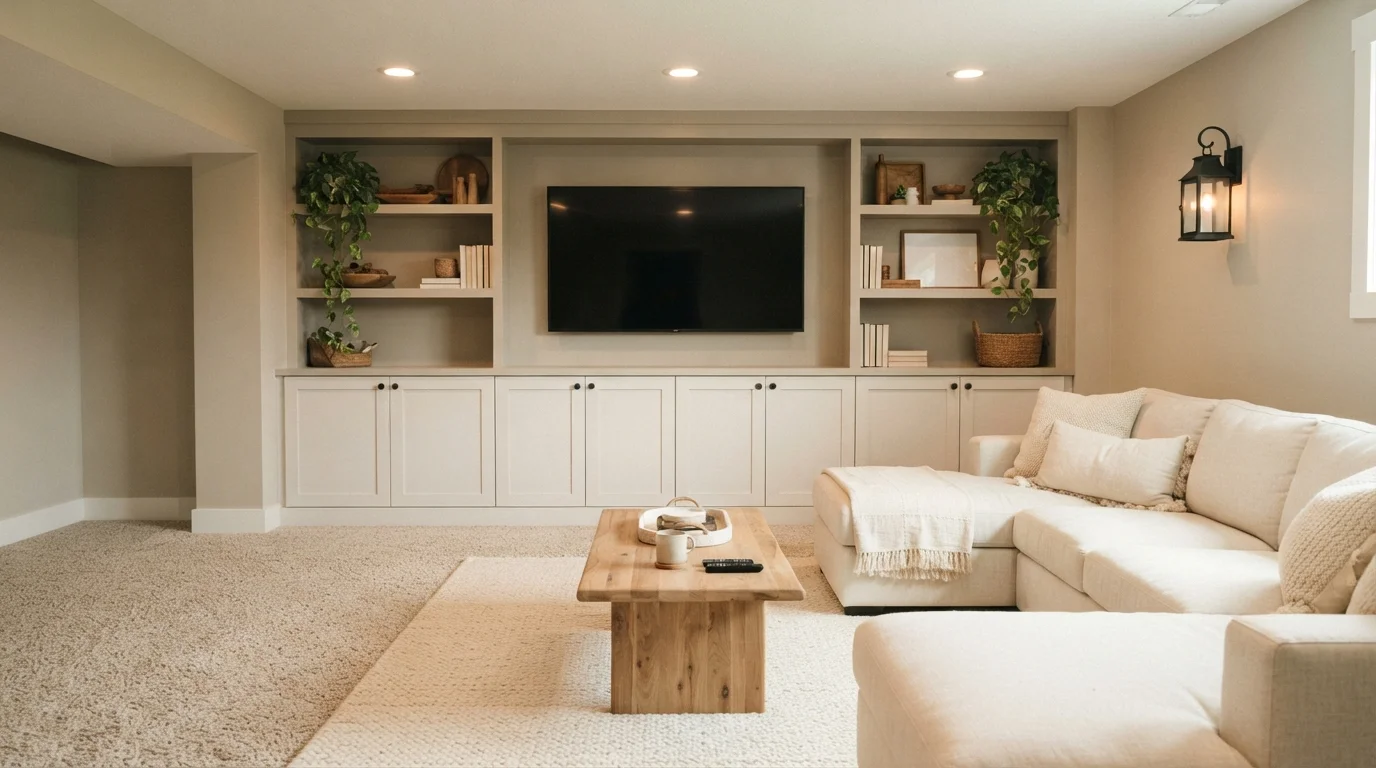
Sink into soft cream cushions and gentle neutrals for an effortlessly peaceful, movie-night atmosphere.
Soft off-white is a gentle, comforting cream that feels inviting without looking stark. In this room, that warm shade coats the built-in media cabinets and shelving, while soft taupe-beige sits on the walls alongside a plush linen sofa, textured woven rug, and raw wood table. The whole setup feels snug, calm, and uncluttered. Light monochromatic layers keep a lower-level space bright while rustic wood accents add grounding texture. It is an ideal style for anyone who loves relaxed, cozy family movie nights.
SEE SLUMBER SLOTH ON YOUR WALLS →
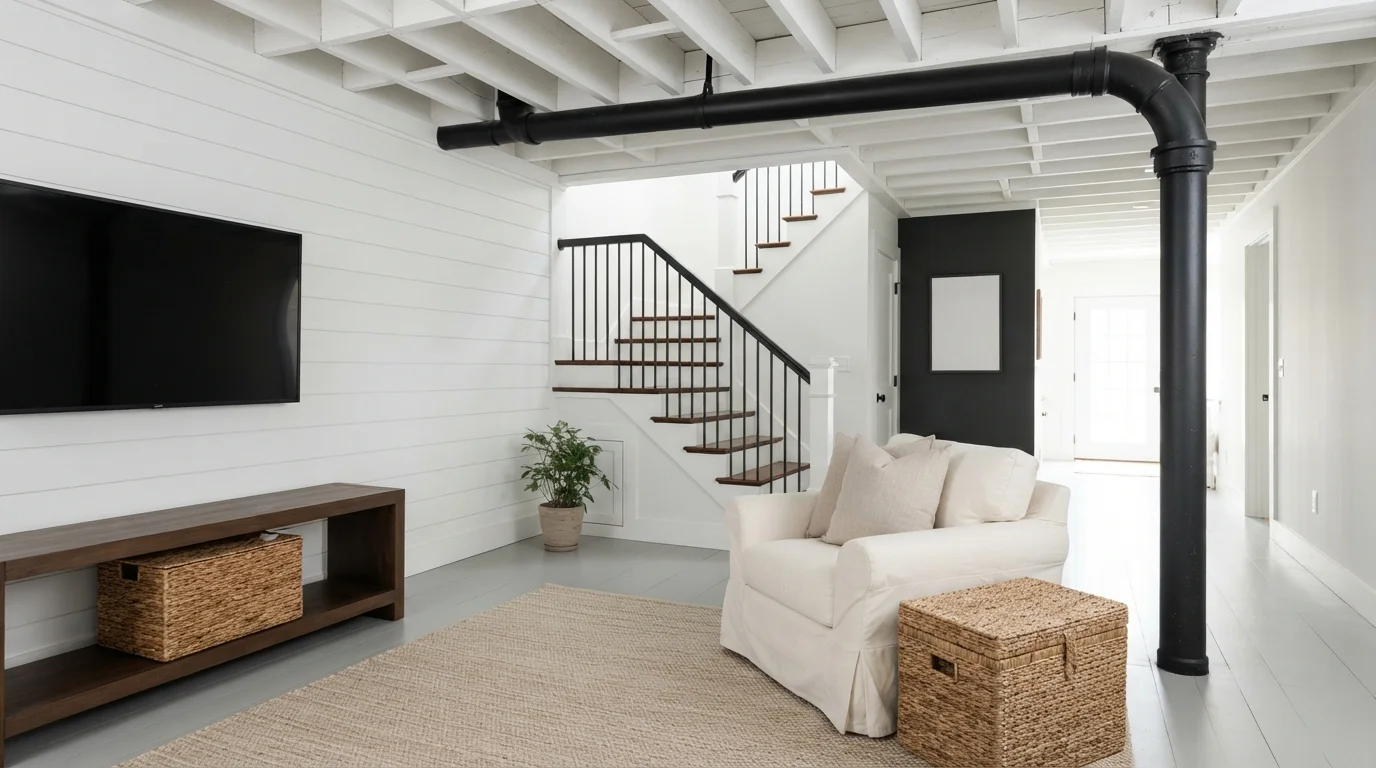
Clean white shiplap paired with bold black metal accents and warm woven baskets creates a fresh, open coastal vibe.
Soft white is a bright, clean neutral with a light and breezy feel. Here, crisp white covers the shiplap walls and exposed wood ceiling, while an oversized black industrial pipe and matching stair rail add sharp contrast. A cozy cream slipcovered armchair, woven wicker storage trunk, and beige area rug soften the entire scene. The room feels calm, spacious, and wonderfully uncluttered. This pairing works because the rich texture of natural wicker balances out the cool, sleek white architecture. It is perfect for modern coastal cottage lovers.
SEE LIGHTHOUSE ON YOUR WALLS →
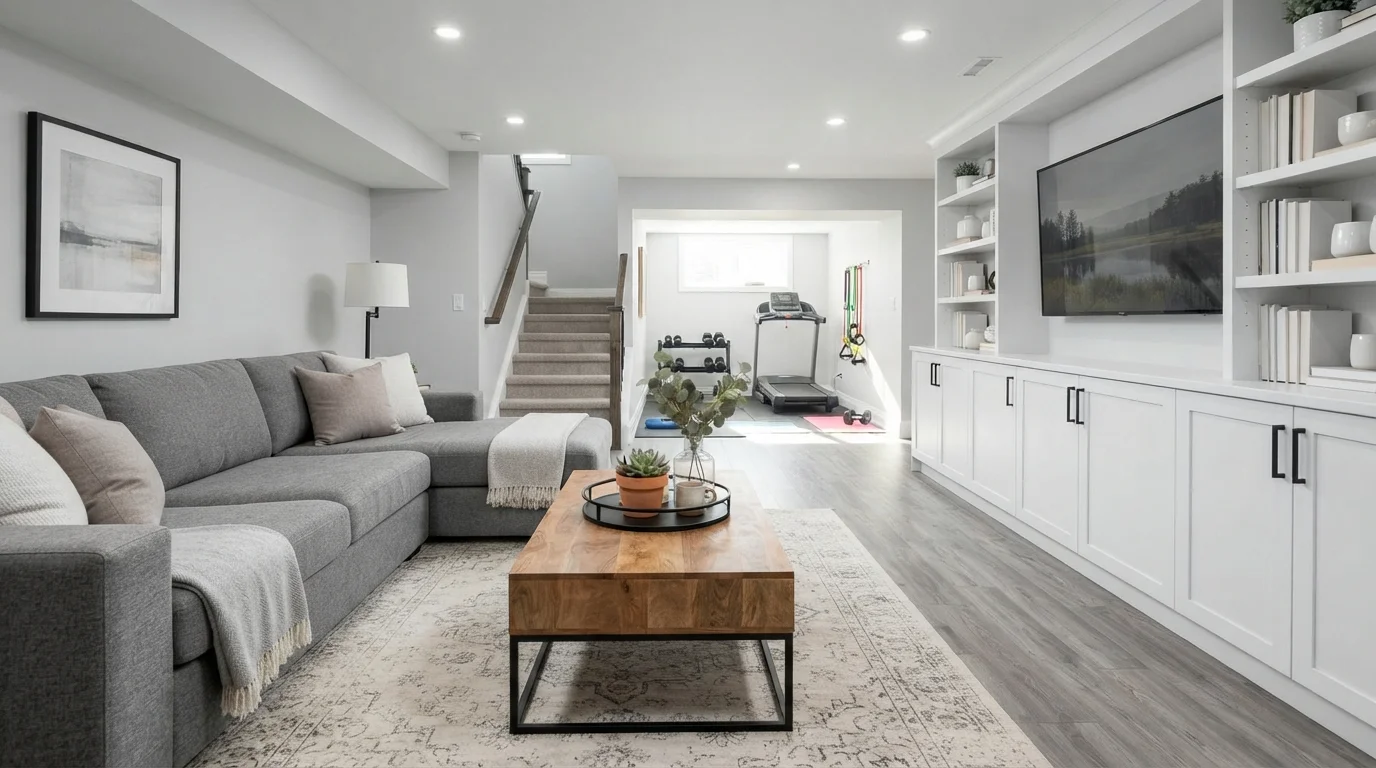
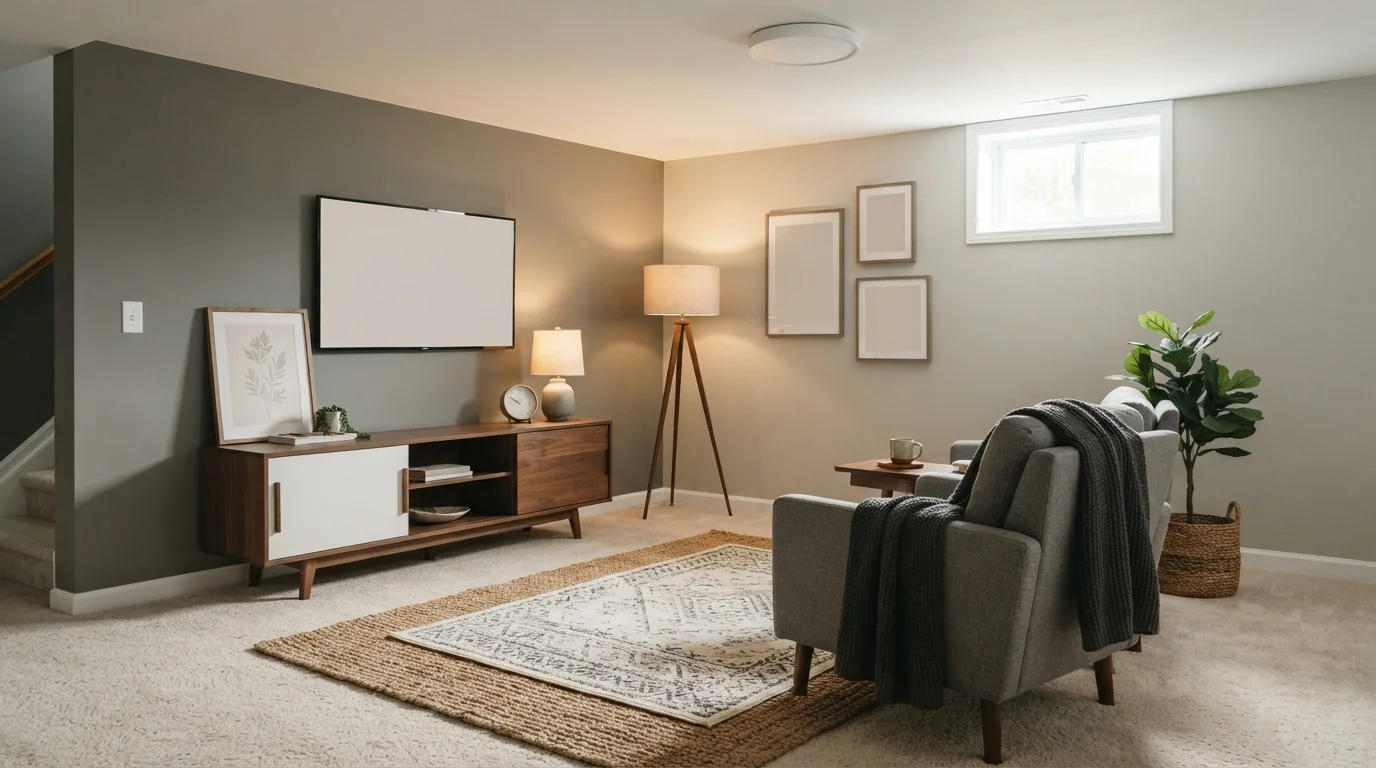
Clean soft white walls paired with a plush gray sectional create an airy, ultra-functional family lounge.
Soft off-white is a fresh, luminous neutral that bounces light effortlessly. In this finished basement, it coats the walls and custom built-in cabinetry, paired with a plush charcoal gray sectional and a light patterned rug. The room feels remarkably open, clean, and calming rather than dark or enclosed. Crisp white built-ins keep the space looking expansive while letting the dark TV and hardware stand out cleanly. It is the perfect setup for families wanting a welcoming, modern hangout space for movie nights.
SEE ARCTIC DAWN ON YOUR WALLS →
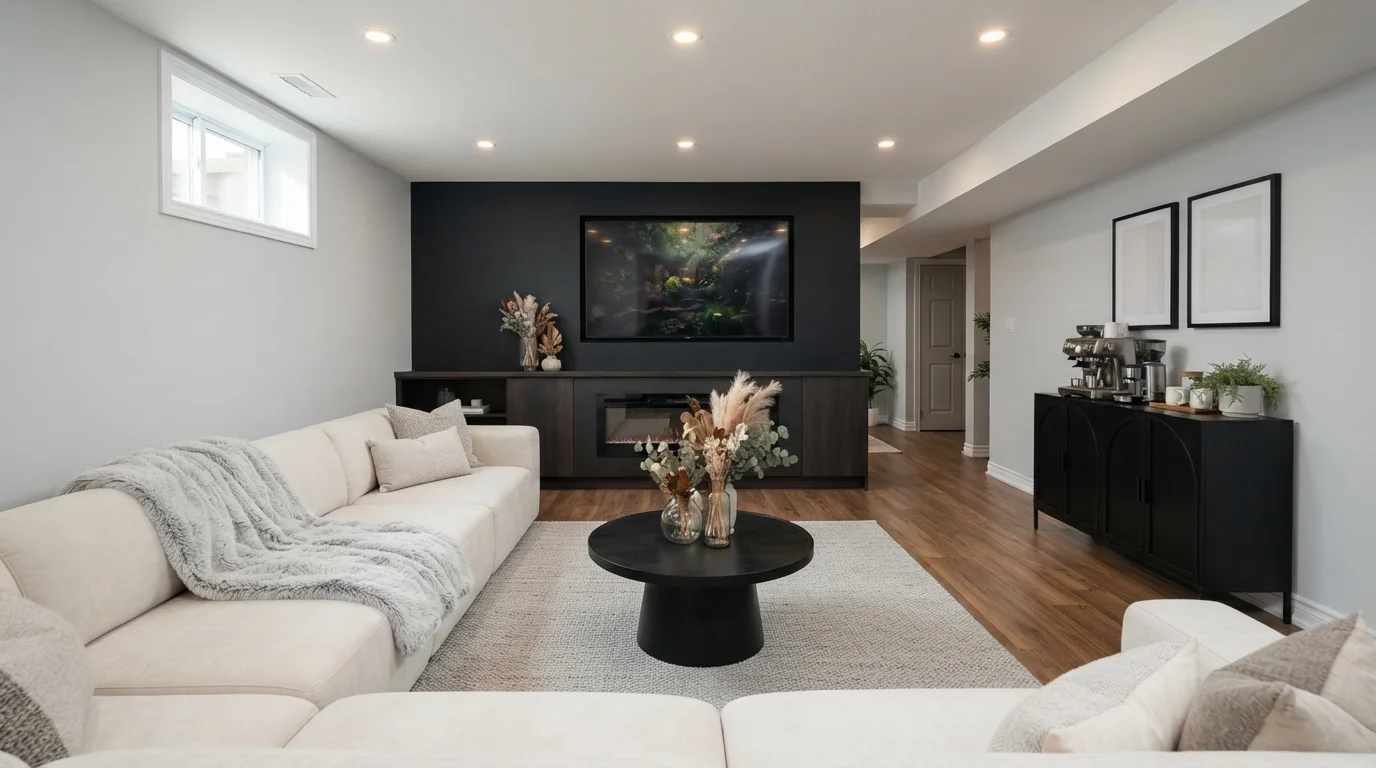
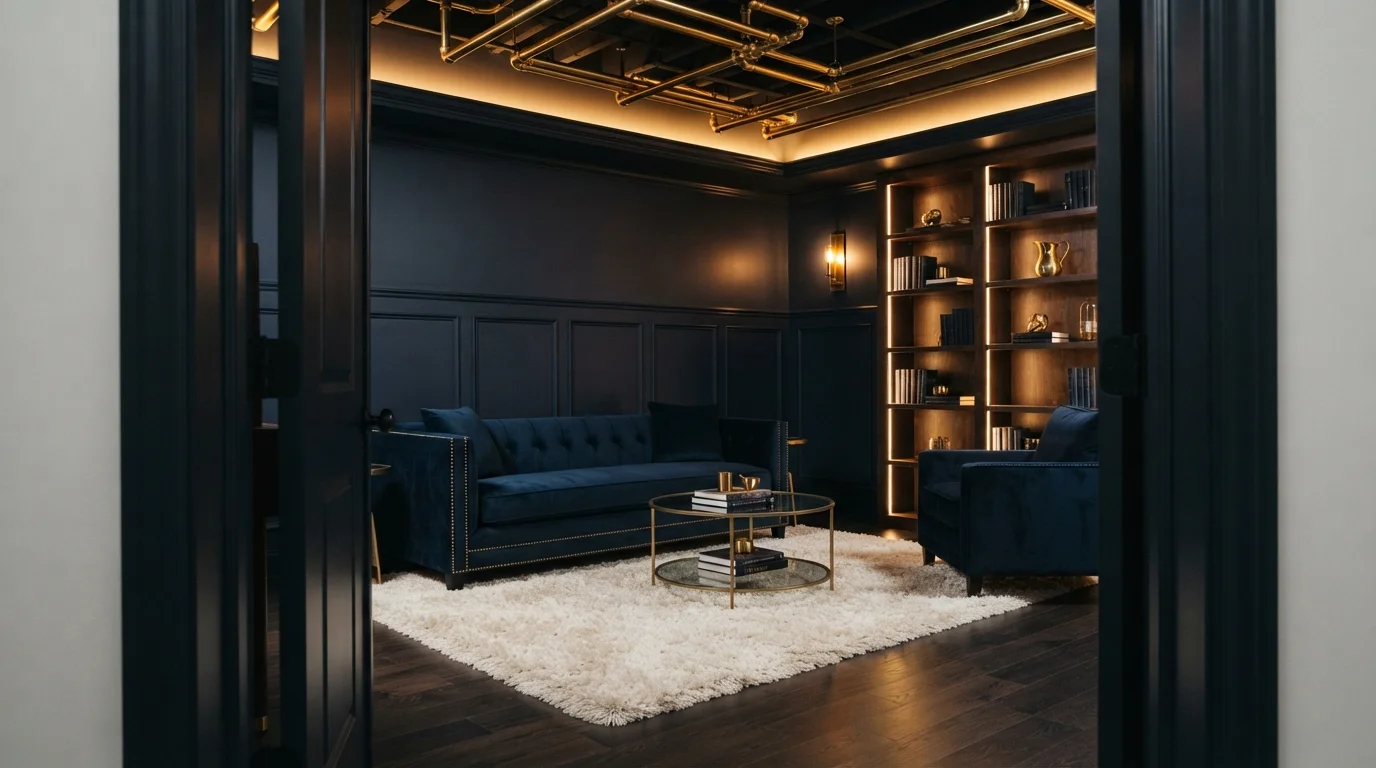
Crisp pale walls balance a striking matte black feature wall, creating a clean, movie-ready lounge space.
Crisp off-white is a clean, bright neutral that gives rooms an airy finish. In this space, pale walls and ceilings surround a bold, matte black media wall with a built-in fireplace and TV. A plush cream sectional wraps around a sleek black coffee table on a soft grey rug. The room feels grounded, cozy, and ready for relaxing evenings. The look works because the sharp contrast anchors the TV area without making the windowless corners feel dark. It is perfect for modern entertainment spaces.
SEE SILVER STREAK ON YOUR WALLS →
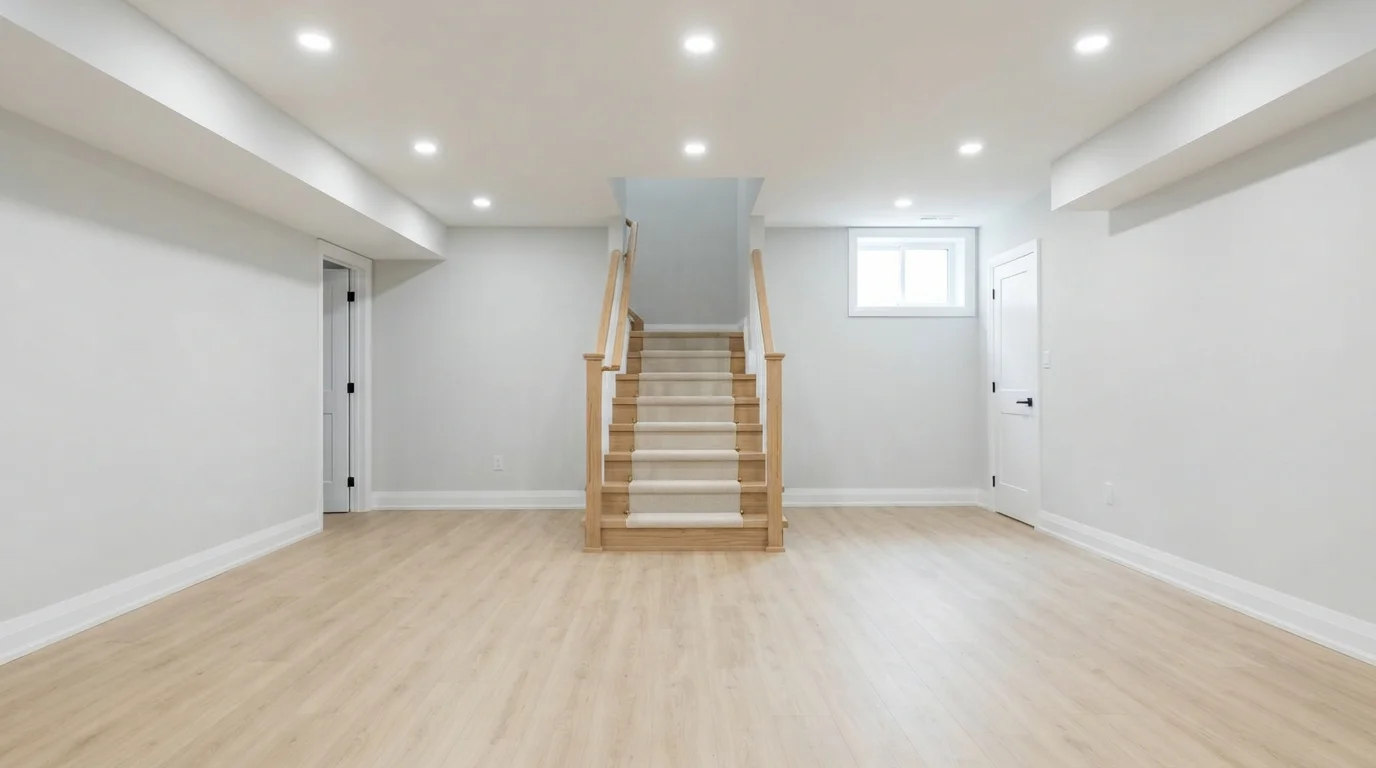
Bright white walls and light blonde floors turn a lower-level space into an airy, inviting retreat.
Crisp white is a clean, luminous shade that reflects every bit of available light. In this open room, pure white covers the drywall and ceiling, accented only by soft honey-blonde wood floors and a matching stair rail. The room feels completely spacious, calm, and unexpectedly cheerful for a lower level. Light walls naturally make window-limited spaces feel open and tall. It is ideal for anyone looking to turn an empty basement into a bright family room, play area, or modern home gym.
SEE MISTY GRAY ON YOUR WALLS →
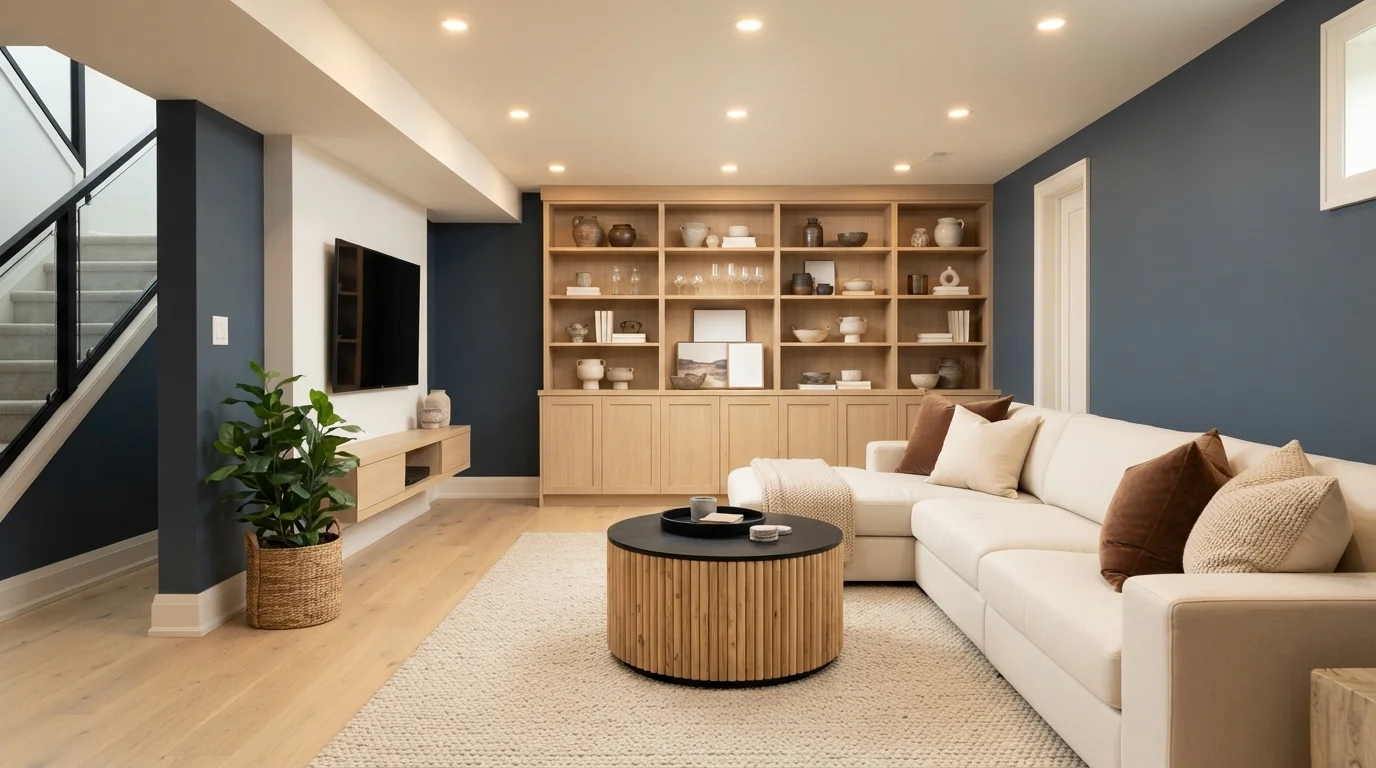
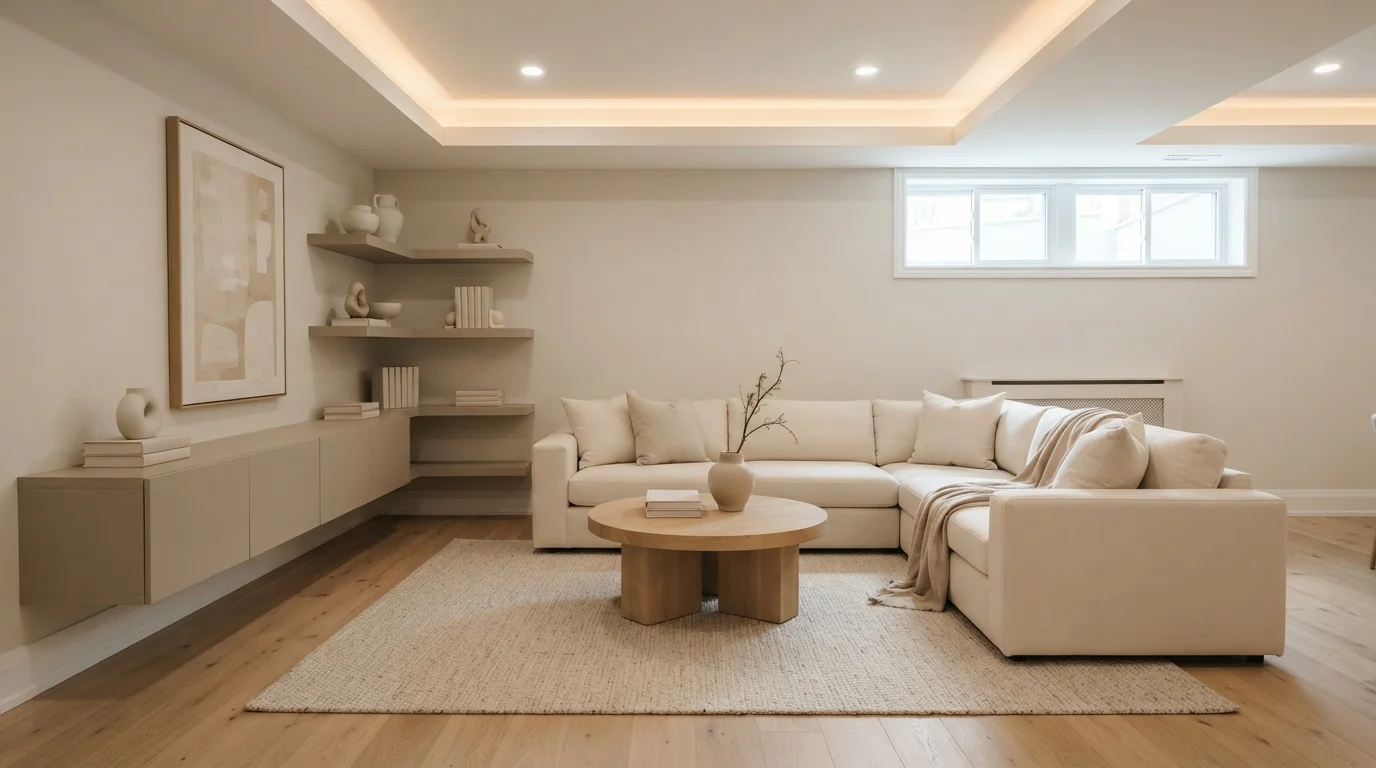
Soft glowing recessed lights and creamy tones wrap this living area in a deeply peaceful, inviting warmth.
Soft ivory is a warm, gentle off-white that keeps any room bright without feeling clinical. In this space, the walls and ceiling wear a smooth cream finish that pairs effortlessly with a light oatmeal sectional, textured wool rug, and honey-toned oak built-ins. The whole room feels grounded, peaceful, and wonderfully snug. It works so well because the creamy wall shade reflects the warm wood tones and soft textiles naturally. It is the perfect choice for anyone wanting a modern, serene space to relax in.
SEE NAVY BEAN ON YOUR WALLS →
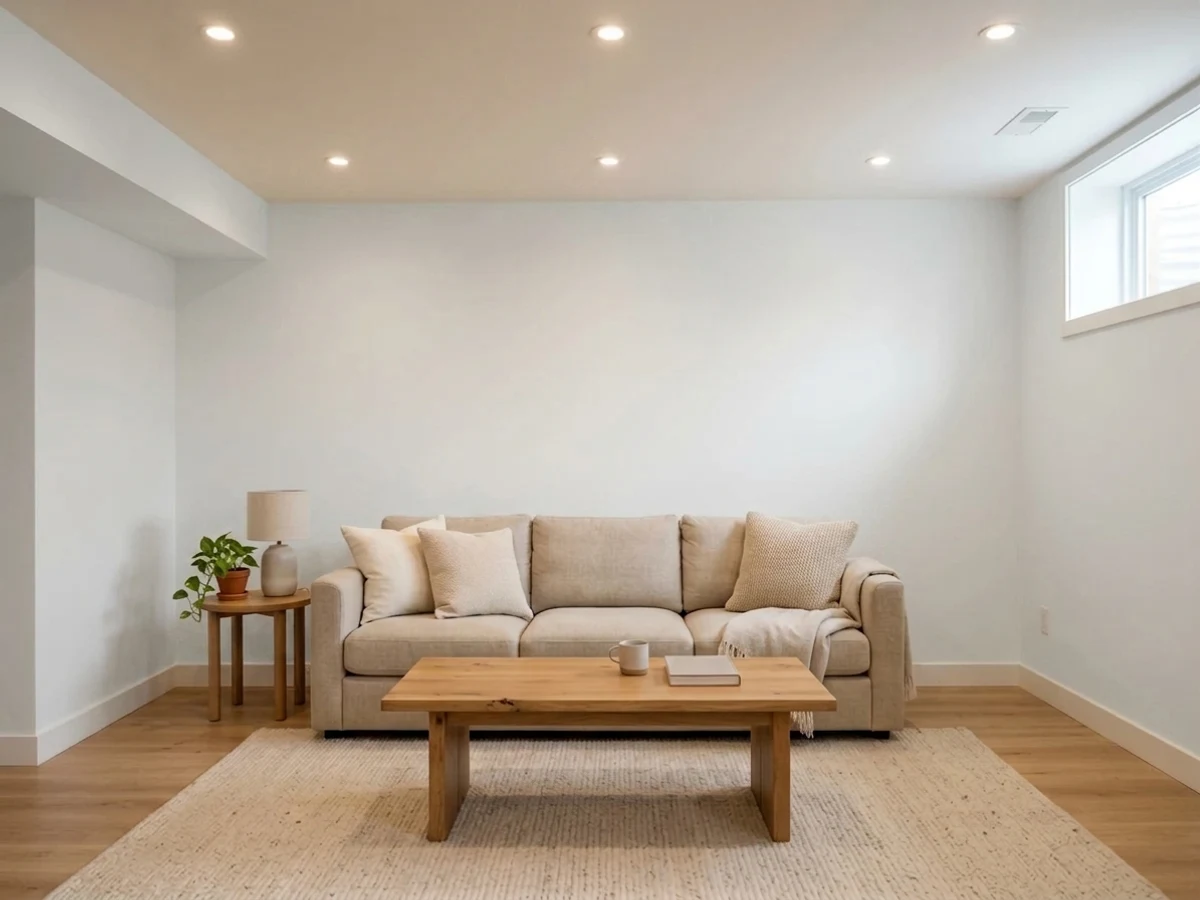
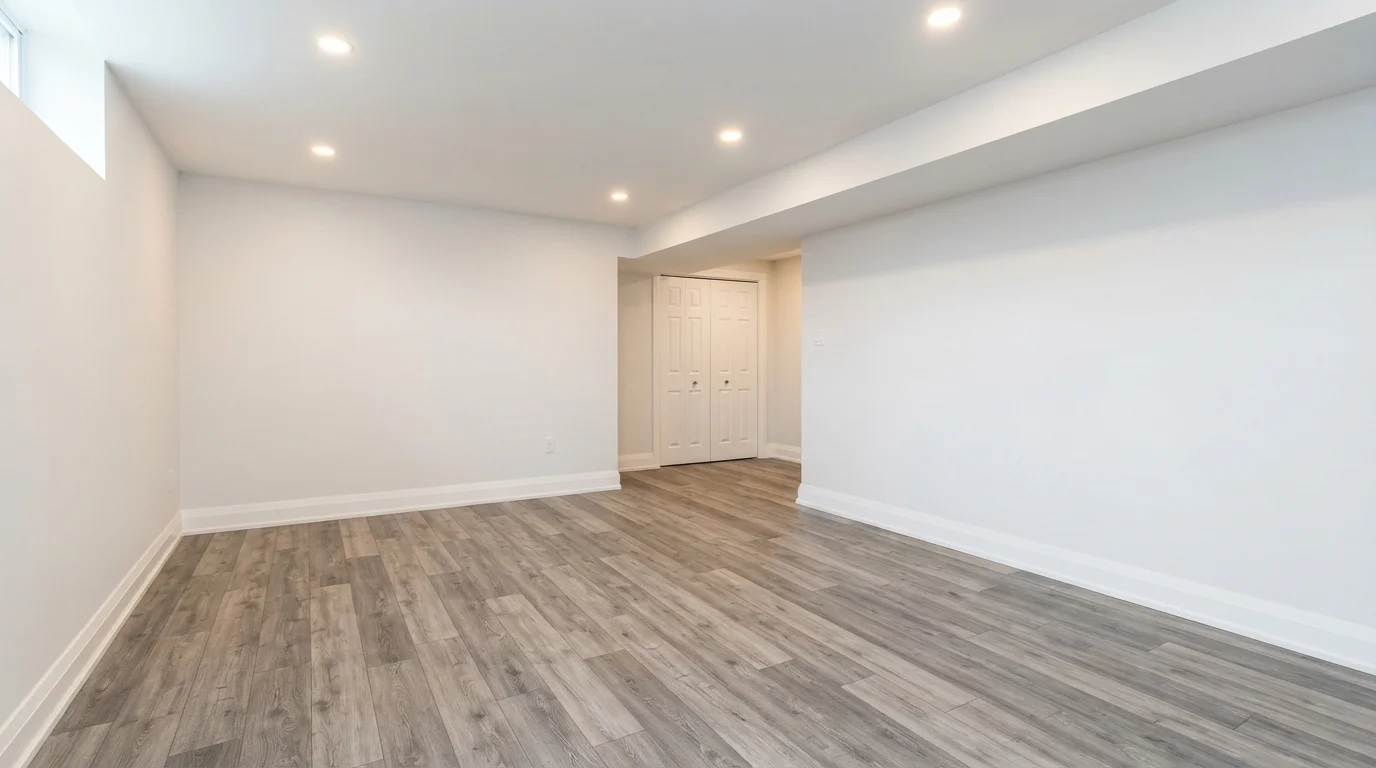
Bright crisp white walls pair seamlessly with cool weathered gray plank floors for an airy, open foundation.
Crisp white is a bright, clean, and refreshing neutral. In this space, pure white wraps the walls and ceiling drop, contrasting against rich gray wood-look plank flooring. The room feels fresh, airy, and full of open potential. White walls easily bounce light from the ceiling fixtures to balance the deeper grain in the floorboards. It is the perfect choice for anyone wanting a completely fresh and versatile modern backdrop.
SEE PALE BUD ON YOUR WALLS →
Soft warm walls and glowing ceiling lights create a peaceful, inviting modern sanctuary for relaxing.
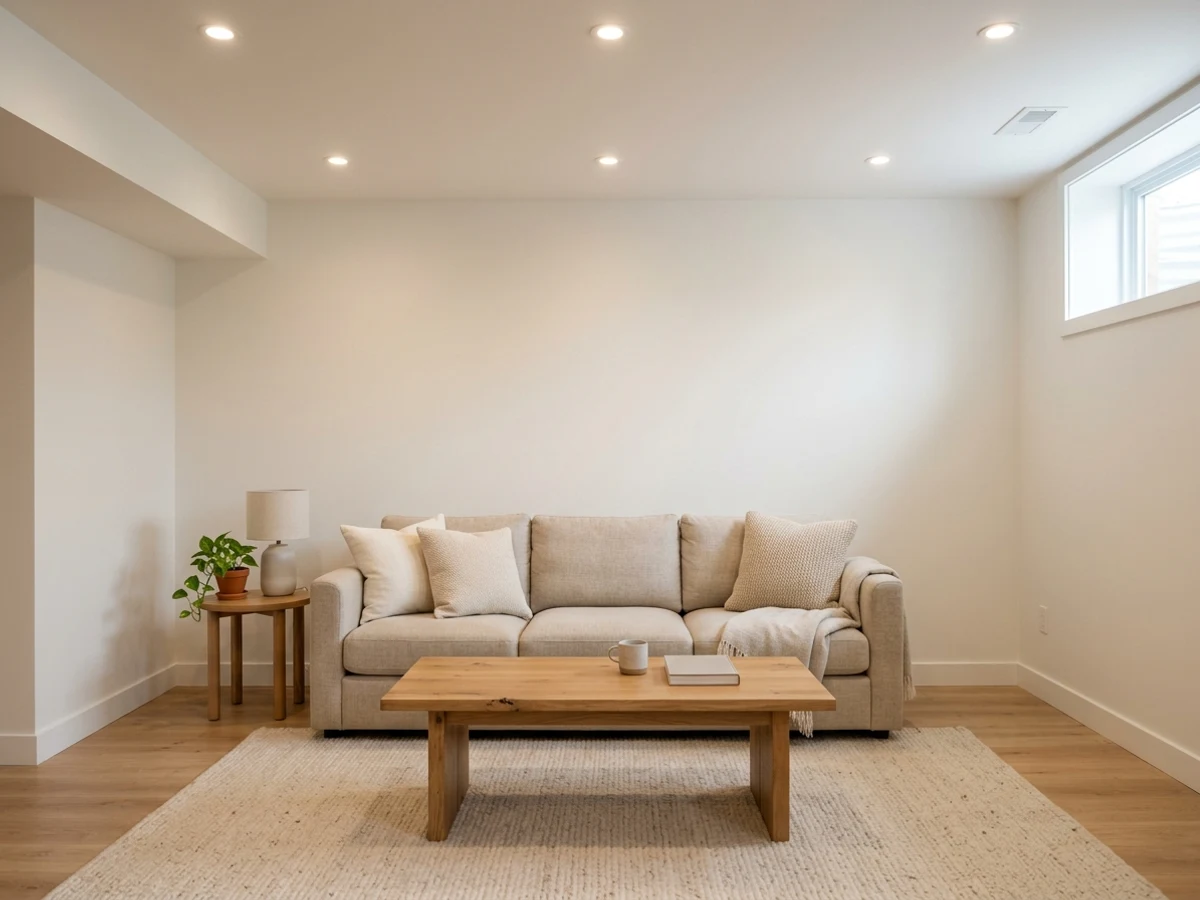
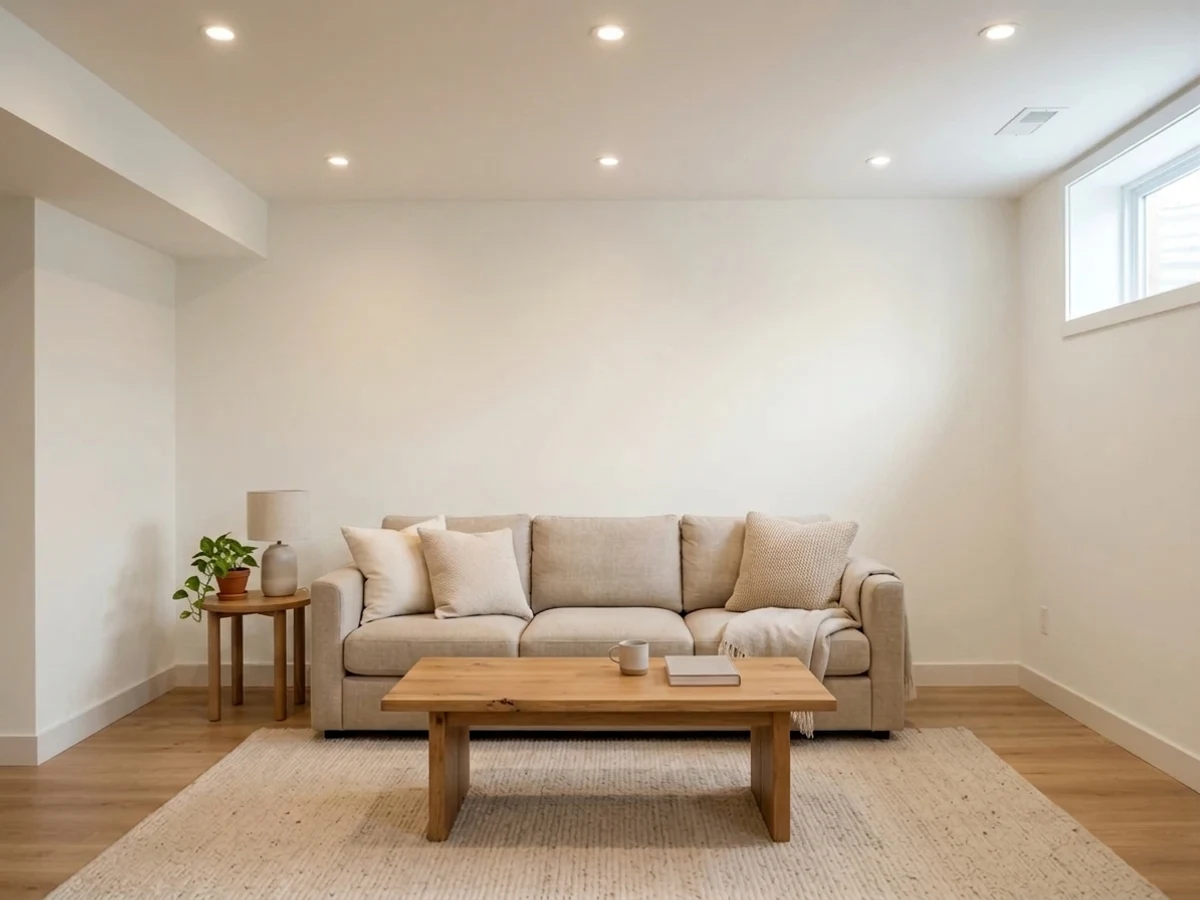
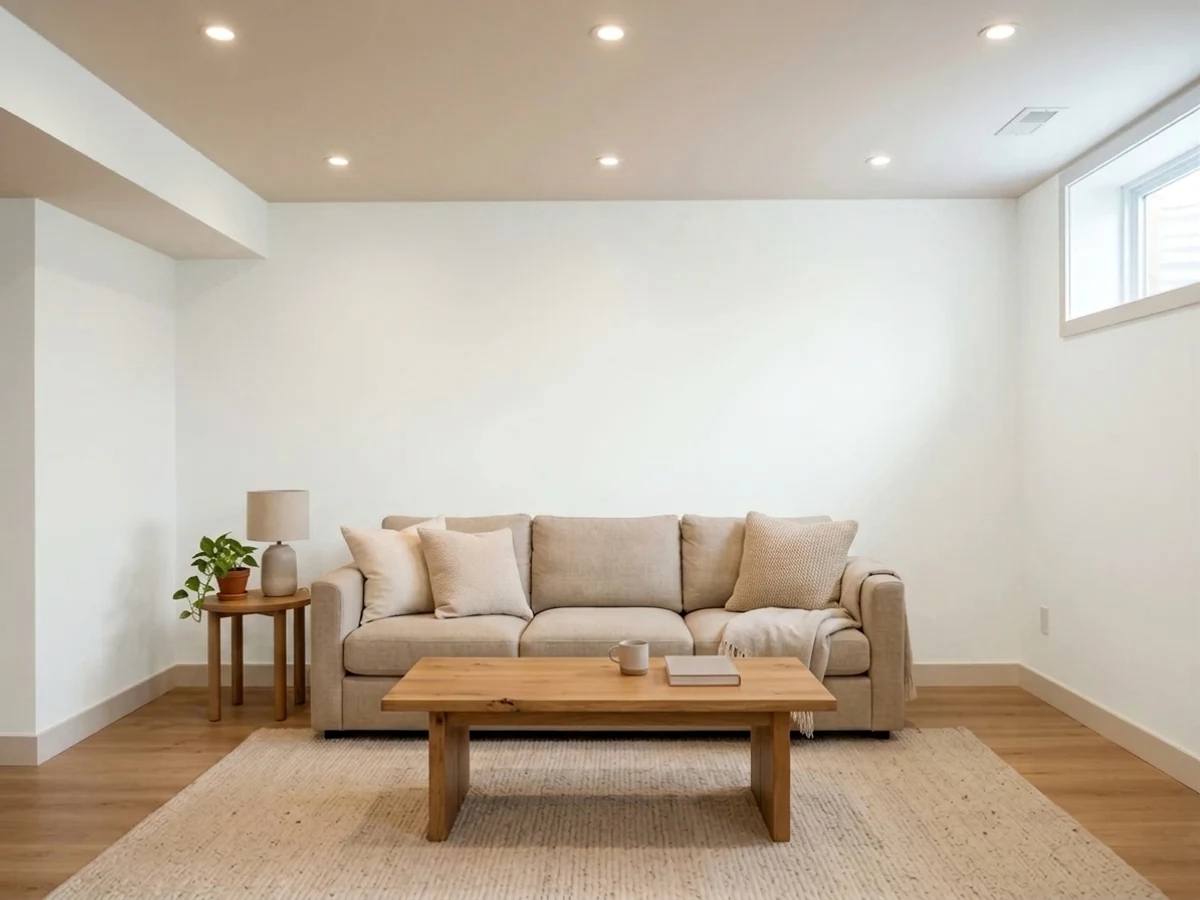
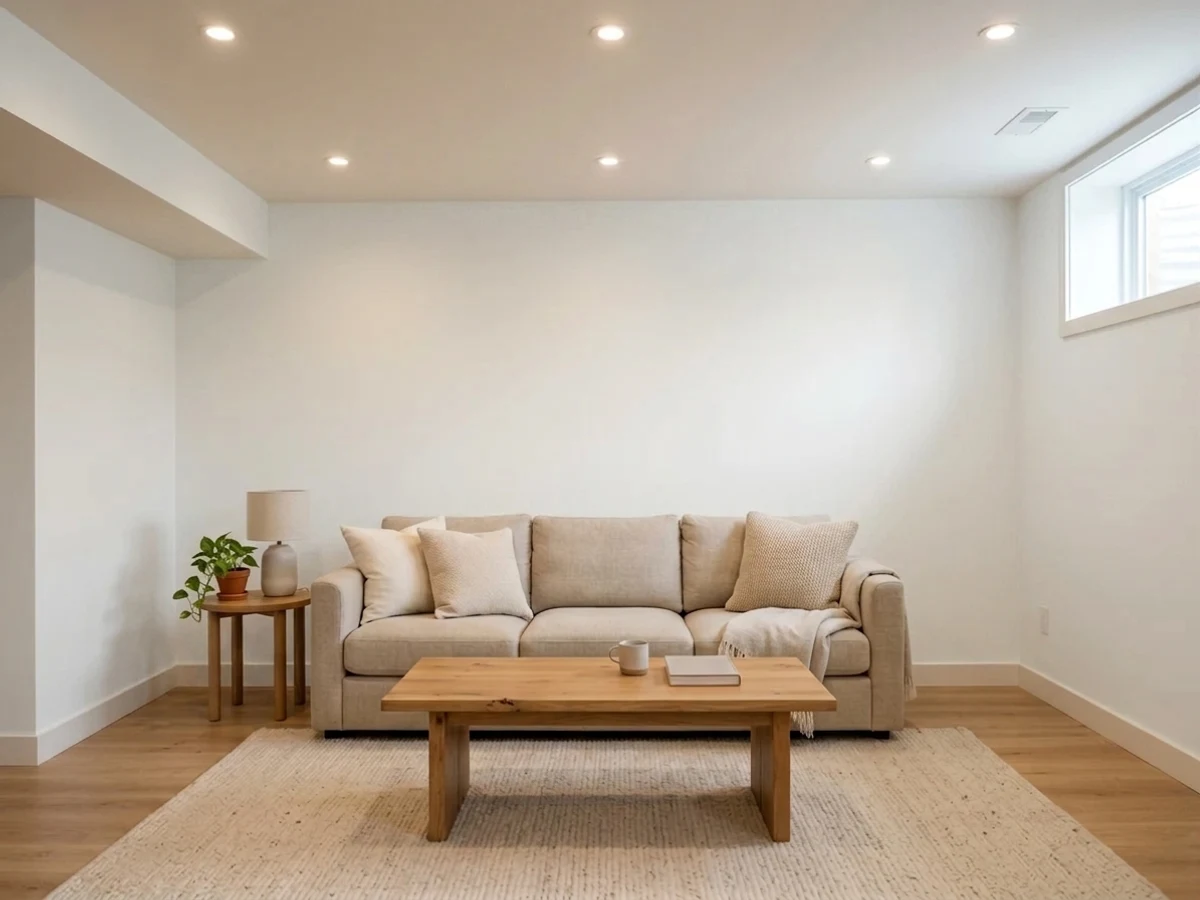
Warm cream is a soft, soothing off-white with a gentle beige touch. Here, warm cream coats the smooth walls and ceiling, perfectly paired with a pale linen sectional, a light oak coffee table, and an oatmeal rug. The entire space feels serene, snug, and totally clutter-free. This combination works because layering soft tone-on-tone neutrals makes a lower-level room feel airy, open, and bright. It is an ideal look for anyone wanting a modern, restful hideaway that always feels inviting.
SEE TENDER CLOUD ON YOUR WALLS →White Basement Wall Color Combinations
A wall color never works alone. These are the full schemes from the rooms above — the lead color first, then the supporting colors that make the photo work.
Sink into soft cream cushions and gentle neutrals for an effortlessly peaceful, movie-night atmosphere.
TRY THIS PALETTE →Clean white shiplap paired with bold black metal accents and warm woven baskets creates a fresh, open coastal vibe.
TRY THIS PALETTE →Clean soft white walls paired with a plush gray sectional create an airy, ultra-functional family lounge.
TRY THIS PALETTE →Crisp pale walls balance a striking matte black feature wall, creating a clean, movie-ready lounge space.
TRY THIS PALETTE →For a finished basement with wood stair treads, paneling, or LVP flooring in a warm tone, pair the walls in Benjamin Moore White Dove with the wood left natural and trim in a matching warm white — the undertones agree instead of competing, which is the most common mismatch in basements with wood accents. Sherwin-Williams Alabaster works the same way one shade cooler, and pairs well with a mid-gray concrete or polished floor since its warmth keeps the gray from feeling flat.
For a utility or laundry basement, keep it simple: Behr Swiss Coffee or Behr White on the walls with a gray or tinted-concrete floor coating, and skip elaborate trim contrast — the goal is a clean, bright box, not a design statement. If the basement has an exposed or painted ceiling you want to disappear rather than announce, run Sherwin-Williams Superwhite or PPG/Glidden Delicate White across walls and ceiling in the same sheen family so the seam between them stops being visible, which reads taller than stopping the white at the wall line and switching to a darker ceiling color.
More Basement Color Ideas
Set on a color family already? Each page has its own real rooms and picks.
Light or Dark White Basement Colors?
Go Light (LRV 60+) If…
The room is small, faces north, or has to work at every hour. Light warm colors make it feel bigger and stay calm in evening light — the light you actually live in.
Go Dark (LRV Under 20) If…
You want the cocoon effect and the room has real daylight. Dark works best on one feature wall — or fully color-drenched in a large room with good windows.
In almost every basement, the answer is to go as light as the picks here allow — LRV 86–88 (White Diamond, White, Delicate White) is close to the ceiling of what paint can do, and a below-grade room rarely has light to spare. The exception is a corner or stairwell run that gets no fixture at all: no white, however high its LRV, will look bright in true darkness. In that situation the fix is a light source, not a darker or lighter color choice — add a fixture first, then let the white do its job once there's something for it to reflect.
Where the light/dark decision actually matters is undertone, not value. A cooler white like Behr White or Superwhite reads crisp and slightly clinical under bright, cool-temperature lighting — good for a utility room or a home gym. A warmer white like White Dove or Alabaster reads cozier under the warm LED bulbs most finished basements already have installed, and it won't drift toward gray the way a stark white can in a room's dimmer stretches. Satin or eggshell sheen also does real work here: it catches and holds whatever light is available better than a flat finish, which just absorbs it.
See It. Love It.
Paint It.
Upload one photo of your white basement and try every color on this page on your own walls — in your own light, before you buy a drop of paint.

AlabasterBeforeSolve Moisture Before You Pick a Sheen
None of these whites will hold up on bare basement masonry that's still taking on moisture. Below-grade concrete pushes water vapor through the wall via hydrostatic pressure, and ordinary wall paint applied straight over it can bubble, peel, or grow mildew within a year or two. If the basement has any history of dampness, a dedicated masonry waterproofing product goes on first, and the finish white — Behr White, White Diamond, whichever pick fits the room — goes on top of that, not directly on raw concrete.
This is a sequencing issue, not a color issue. No white on this list, however high its LRV, will look clean over an active moisture problem — the paint film fails before the color has a chance to matter.
Match Sheen To The Room's Job
A basement that doubles as a rec room or home office benefits from eggshell or satin on the walls — both hold up to the wipe-downs a below-grade room eventually needs, and both bounce more of the room's scarce light than a flat finish does. That's part of why Superwhite and Delicate White read as bright as their LRV numbers suggest: sheen is doing some of the reflecting, not just pigment.
Ceilings are the one place flat still wins. Basement ceilings are often exposed joists, ductwork, or a patched drywall job, and a flat finish hides those imperfections the way a satin or semi-gloss won't — gloss highlights every seam and screw head it catches light on.
The Mistake: Picking The Coldest White You Can Find
The instinct in a dark basement is to reach for the starkest, whitest white available, assuming maximum contrast means maximum brightness. It backfires in the corners a fixture doesn't fully reach — a cool, blue-leaning white with nothing to bounce off looks gray and flat exactly where you needed it to look clean. Warmer high-LRV whites like White Dove and Alabaster hold their color better in a basement's uneven, mostly-artificial light.
The fix isn't switching to beige — it's staying white but picking the warmer end of the white family, and pairing it with warm-temperature bulbs so the undertone and the light source agree instead of canceling each other out.
About White Basement Paint Colors
A basement usually has one or two small windows, a low ceiling, and concrete somewhere in the mix — walls, floor, or both. That combination eats light, so the whites that work here are the ones with the highest reflectance you can buy. Behr White (52, LRV 88) and PPG/Glidden Delicate White (PPG1001-1, LRV 88) sit at the top of the scale; almost nothing bounces more of a room's available light back into it. Benjamin Moore White Diamond (2121-60, LRV 86) is a half-step behind but still well past the point where a basement stops reading as a cave.
The risk with a basement isn't picking a white that's too bright — it's picking one that goes gray in the corners a lamp doesn't reach. A stark, blue-leaning white loses its warmth the moment the light drops, and in an unlit basement corner that reads as dingy, not clean. That's why the warmer options on this page earn their spot: Sherwin-Williams Alabaster is a high-LRV white with just enough warmth to survive weak light without looking cold, and Benjamin Moore White Dove goes a step warmer still, which matters because most basements are lit with warm-temperature LED bulbs (2700K–3000K) rather than daylight — a cool white under warm bulbs can look slightly green or gray, while White Dove's warmth matches the bulb instead of fighting it.
For basements that are more utility space than living space — laundry, storage, a workshop — bounce matters more than mood, so a pure, undertone-light white does the job without the cost of full waterproofing and trim work a finished rec room gets. Behr Swiss Coffee is built for that: a clean, low-drama white for a space you walk through, not lounge in. Sherwin-Williams Superwhite is the crispest pick on the list and works well when the basement has decent overhead lighting already and you just want maximum bounce without any warmth added.

The Questions Everyone Asks
What color should I paint my white basement?
If you want one answer, start with the safe picks above — Lighthouse, Slumber Sloth, Arctic Dawn, Silver Streak. They read well in any light and survive furniture changes. Then check the light: strong afternoon sun wants a step cooler, a north-facing room wants a step warmer.
what color should i paint a basement with no windows?
Go with the highest-LRV white you can find — Behr White (52) and PPG/Glidden Delicate White (PPG1001-1) both sit at LRV 88, close to the practical ceiling for reflectance. With no daylight at all, the paint is only ever bouncing artificial light, so every point of LRV counts, and a warmer white like Benjamin Moore White Dove will read cleaner than a stark cool white once the room's lamps and LEDs are the only light source.
is white a good color for a basement?
Yes, for the reason most basements need help with in the first place: low light. A basement below grade almost always benefits from a color that reflects rather than absorbs, and white does that better than any other family. The only failure mode is picking a cold, stark white that goes gray in the room's dim corners — warmer options like Sherwin-Williams Alabaster or Benjamin Moore White Dove avoid that.
should the basement ceiling match the wall color?
In a basement, usually yes. Running the same white — Sherwin-Williams Superwhite or PPG/Glidden Delicate White, for example — across both walls and ceiling removes the visual stop where they meet, which reads taller in a room that's already working with a lower-than-usual ceiling height. A contrasting darker ceiling can work to hide ductwork, but it also visually lowers the room.
what sheen should i use on basement walls?
Eggshell or satin. Both wipe clean, which matters in a room that tends to collect dust and the occasional damp spell, and both reflect more of the basement's limited light than a flat finish. Save flat for the ceiling, where it's better at hiding joists, patches, and duct seams than a sheen that catches light on every flaw.
does painting a basement white make it look bigger?
Yes, more reliably than almost any other change short of adding windows. A high-LRV white like Behr White or Benjamin Moore White Diamond blurs the edges where wall meets ceiling meets floor, which is most of what makes a low-ceilinged basement feel boxed in. It won't fix a genuinely dark corner on its own, but paired with decent lighting it's the single biggest low-cost move for making a basement read larger.
What two-color combination works best in a white basement?
The reliable pattern is a quiet main color plus one deep accent on a single wall. Keep trim and ceiling in one warm white so the two colors are the only event in the room — the combination cards above show complete schemes from real rooms.
What colors make a white basement look bigger?
High-LRV, slightly warm colors — LRV 60–75 is the sweet spot. Paint the walls and trim close to the same light color so the corners blur, and keep the ceiling white. Stark cool white actually works against you; it creates hard shadows that show the room's edges.


Ask a Question