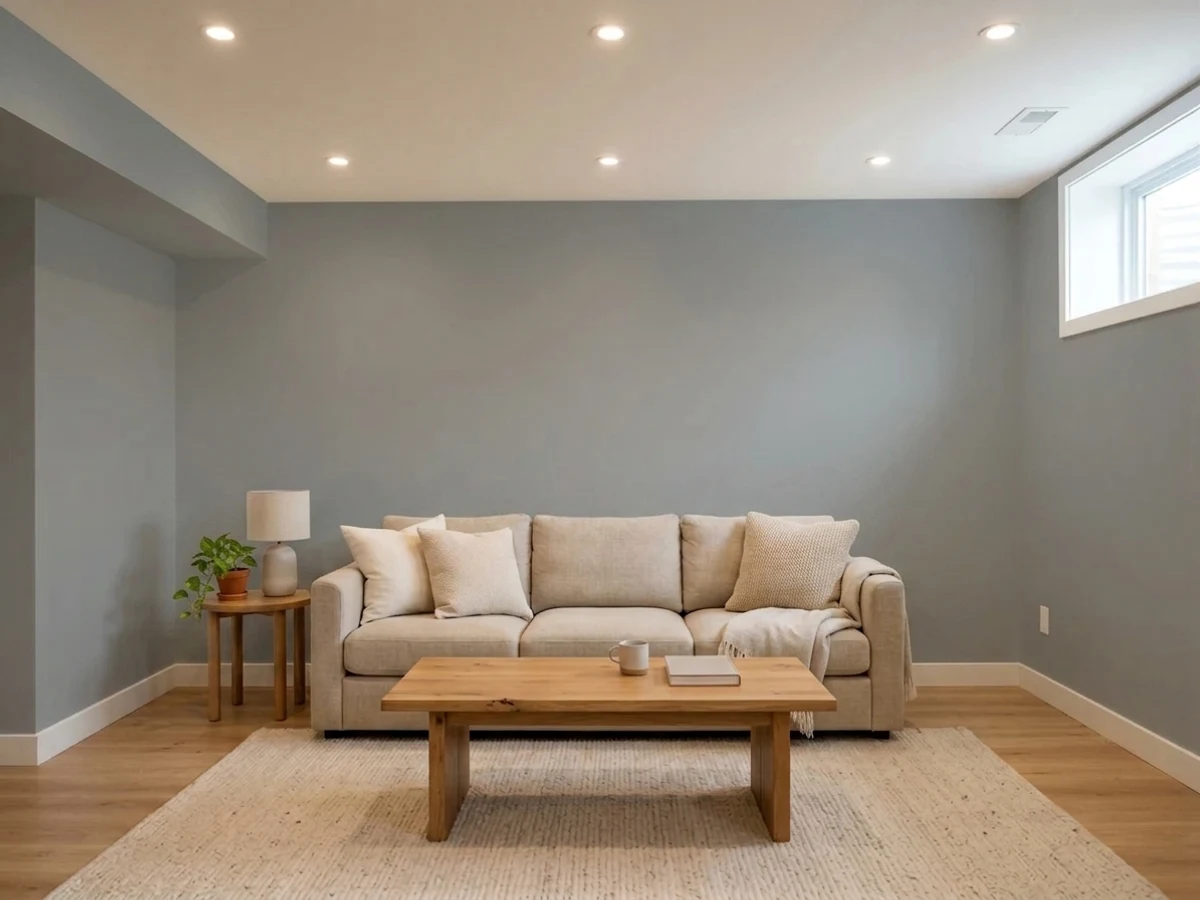
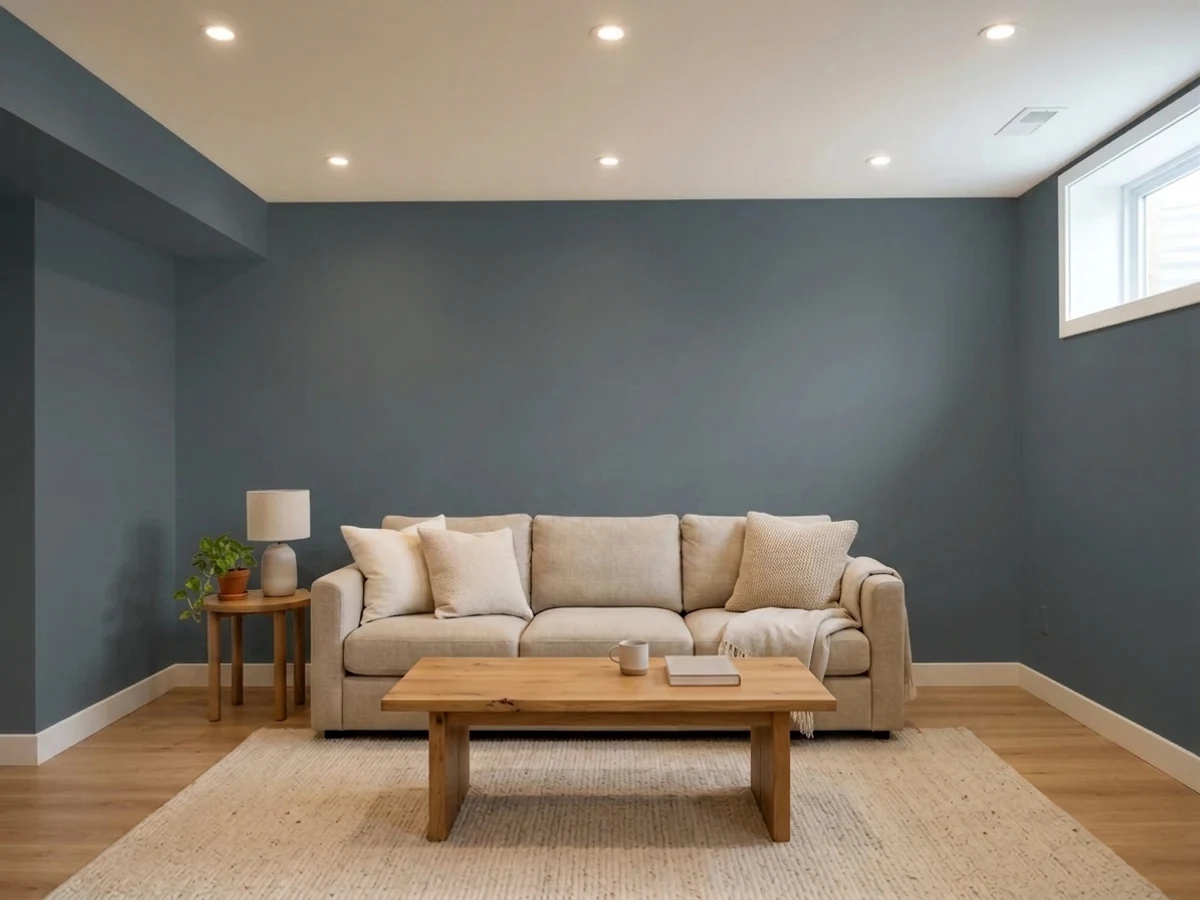
Room Colors · Gray Basement
8 Best Gray Basement Paint Colors for 2026
ideas, combinations, and real rooms
8 curated picks from real gray basements — with the exact colors, honest reasons why, and the combinations that hold the room together.

Former interior stylist who can spot a green undertone from across a room. Jessica writes the color and mood pieces — what to choose, what pairs, and why your "white" looks pink.
The Fast Answer
Don't want to read 8 picks? These four are the safe answers.

Top Picks for the Gray Basement
Tap a shade to see the gray basement in it, then try it on your own room.
Gray Basement Color Trends 2026 — What's In, What's Out


- Flat Cool Builder-Gray — The single flat cool gray that used to cover every basement surface is losing ground to darker, warmer, more deliberate grays.
- Cold Powder-Blue Undertones — Grays with a blue-leaning undertone are reading dated and clinical compared to 2026's warmer, moodier basement gray choices.
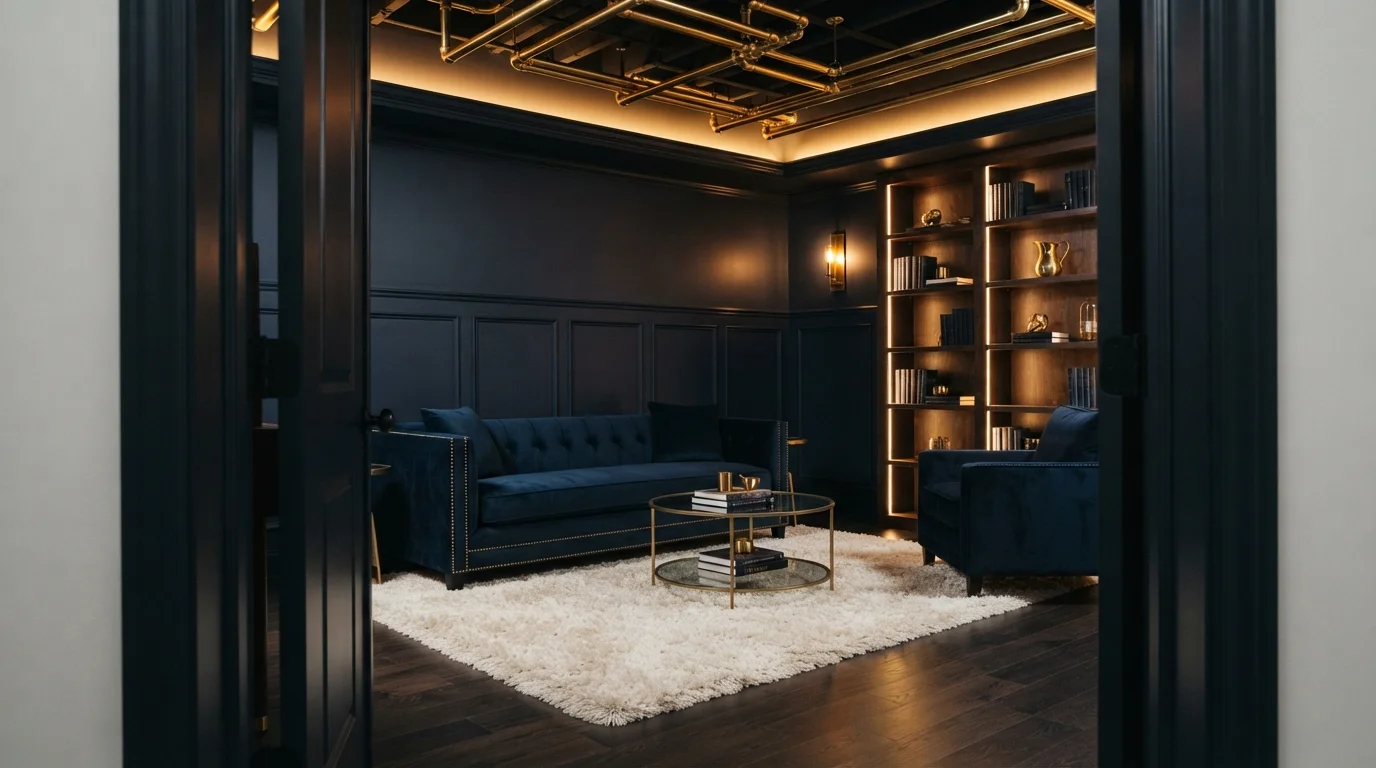
- Gray Paired With Brass Bar Fixtures — Deep warm gray basement walls set against brass bar and lighting fixtures is a 2026 pairing replacing chrome-and-cool-gray combinations from past renovations.
The 8 Best Gray Basement Paint Colors
Every pick below is a real rendered gray basement, not a chip. The lead color first; the swatches are the full scheme in the photo — walls, furniture, textiles, accent.

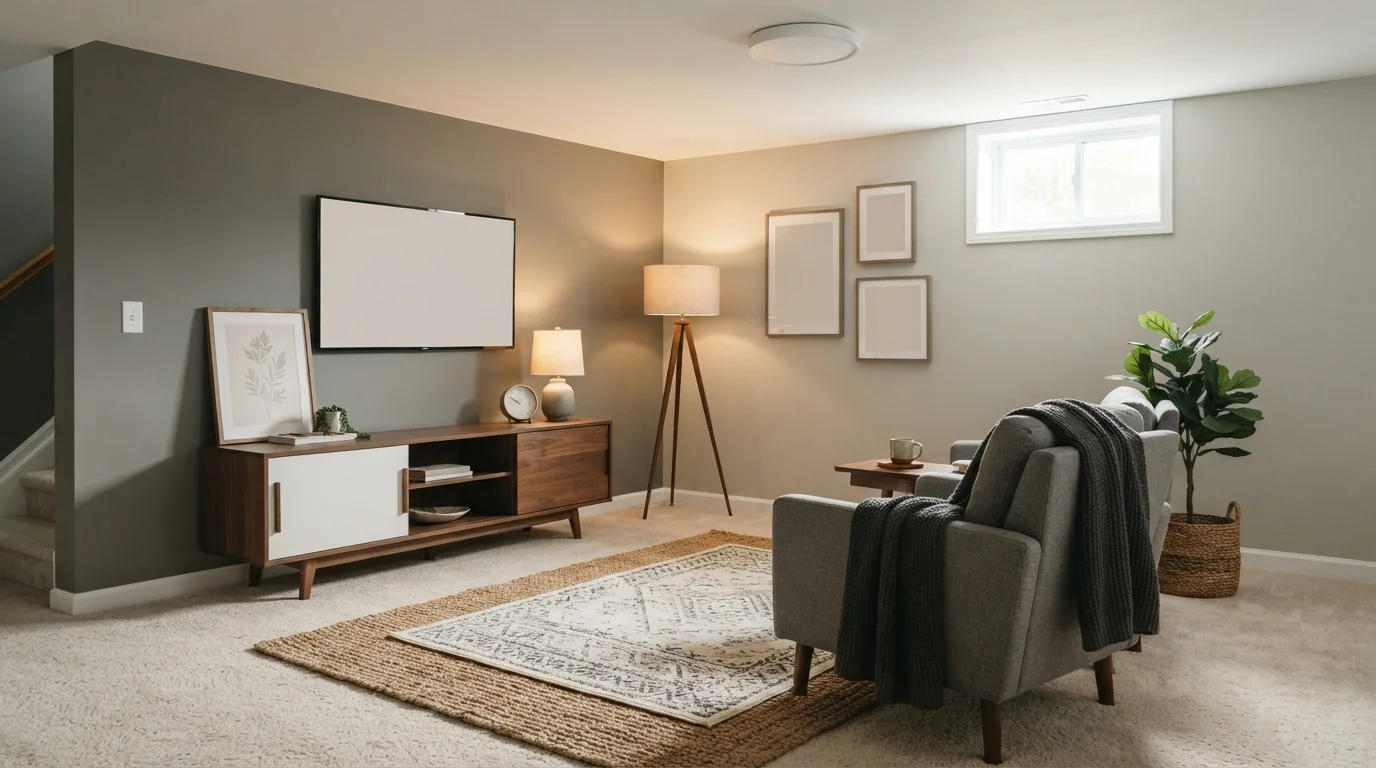
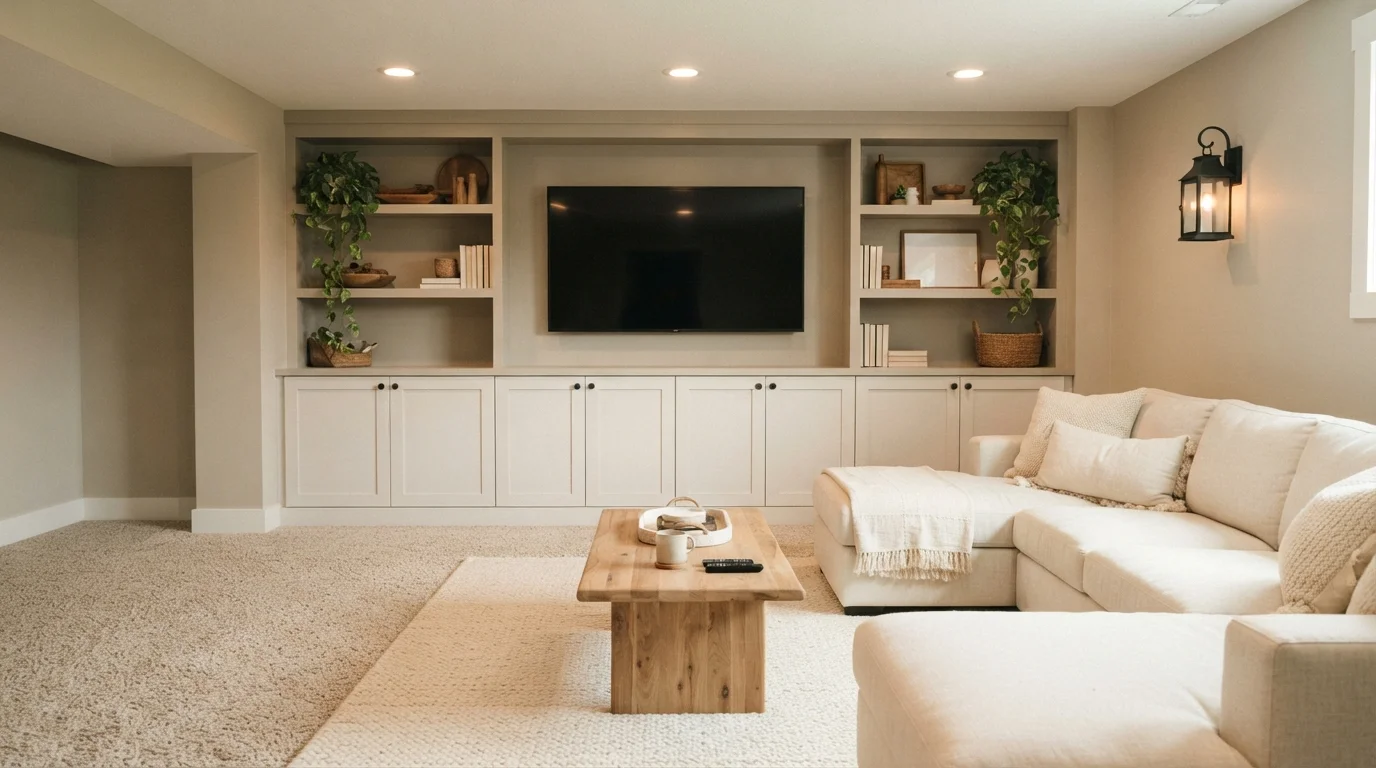
Soft gray walls and layered patterned rugs create a relaxed, cozy retreat perfect for winding down downstairs.
Warm gray is a soft, earthy neutral that sits comfortably between gray and beige. In this room, warm gray covers the walls and soffits, pairing effortlessly with light carpet, a wood media console, and cream patterned rugs. The entire space feels calm, grounded, and snug. The combination works so well because the muted wall tone keeps a lower level feeling warm rather than cold or sterile. It is a wonderful look for anyone building an inviting media room or finished basement retreat.
SEE FIELDSTONE ON YOUR WALLS →
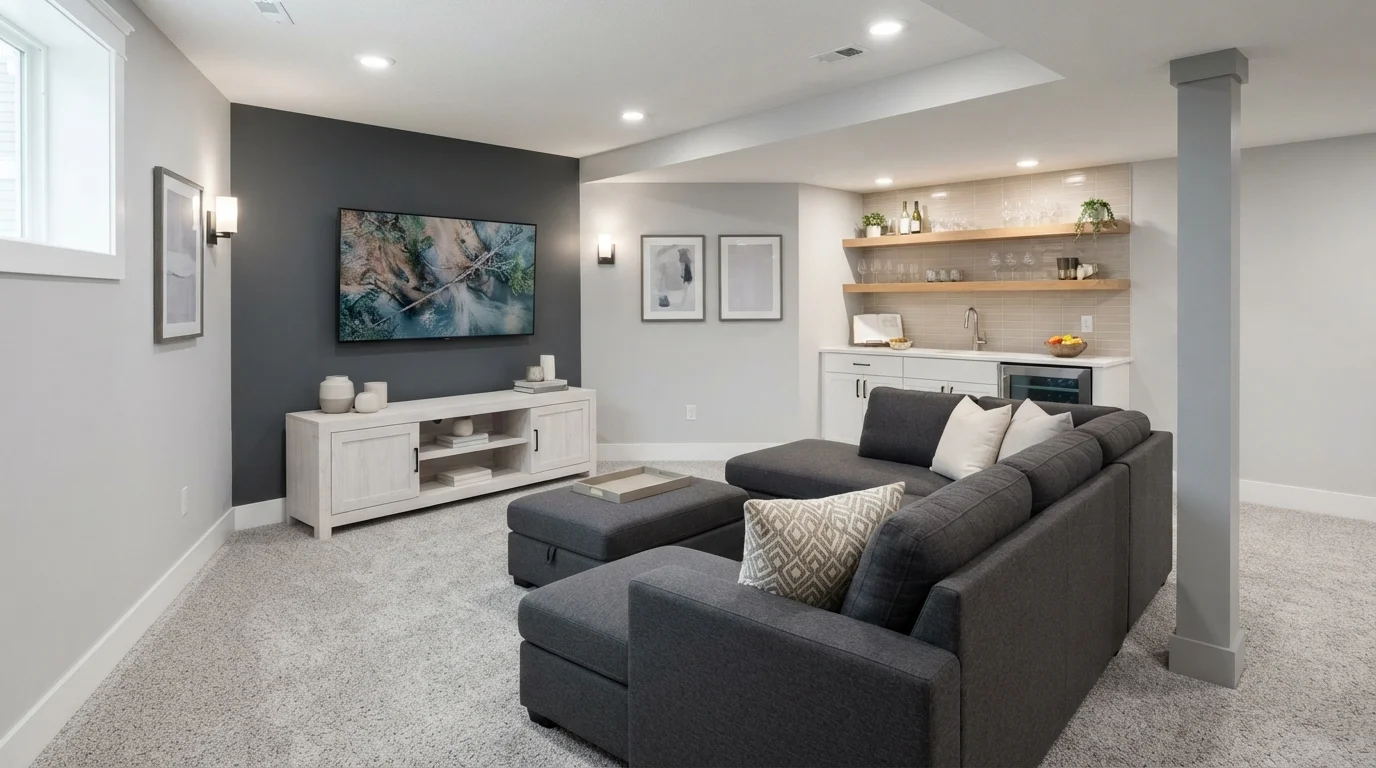
Crisp cool grays and deep charcoal create a serene, modern lounge ready for cozy movie nights and easy entertaining.
Light gray is a crisp, cool neutral that brightens any enclosed space. Here, pale gray covers the primary walls, complemented by a deep charcoal accent wall behind the mounted TV and clean white trim on the column and baseboards. The room feels sleek, relaxed, and surprisingly open for a lower level. This combination works because the deep accent wall adds rich depth while the light walls keep the room feeling airy. It is ideal for anyone designing a modern home theater or entertainment hub.
SEE PIGEON GRAY ON YOUR WALLS →
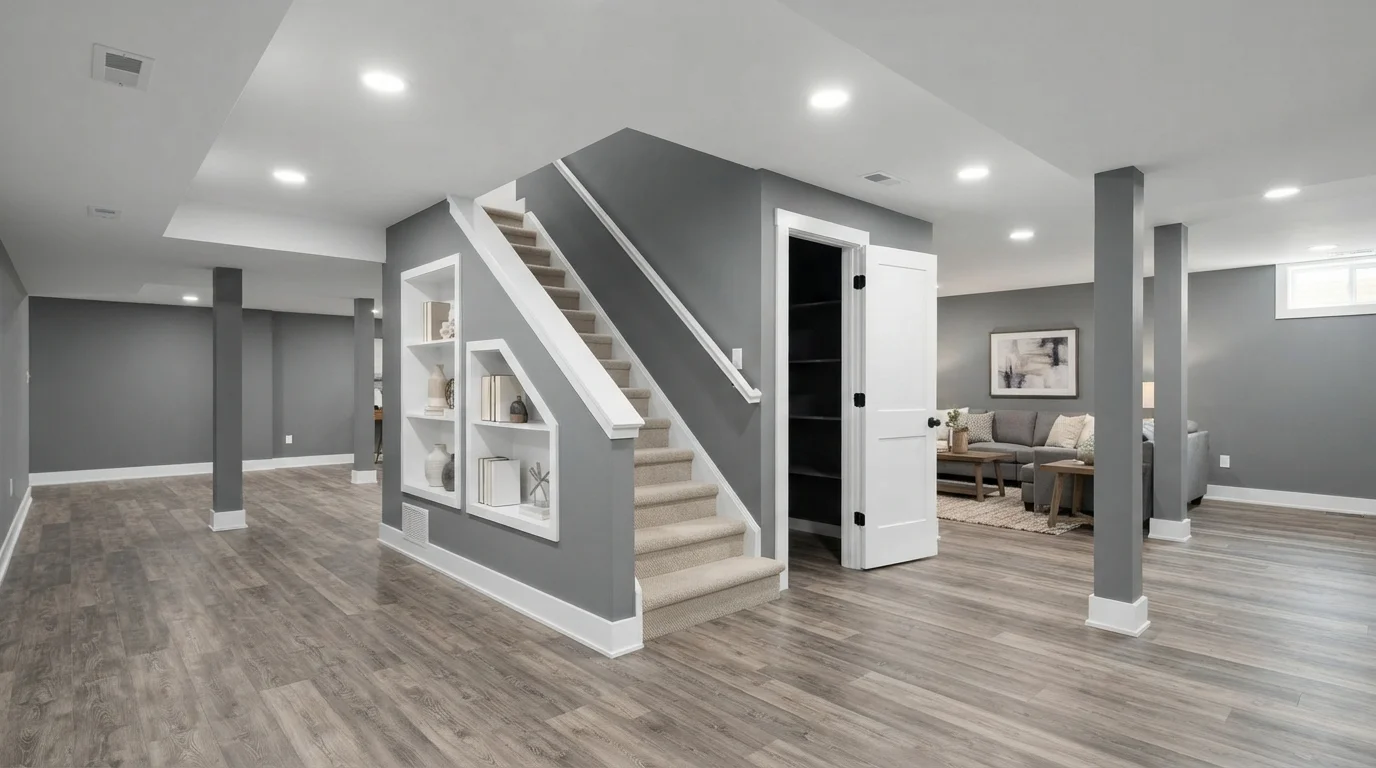
Cool slate walls pair with brilliant white architectural trim to turn a lower level into a polished retreat.
Slate gray is a balanced, cool-toned neutral that feels grounded without feeling heavy. In this finished space, smooth medium gray wraps around the walls and support pillars, while pure white sharpens up the baseboards, stair railing, and built-in geometric niches. The room feels fresh, orderly, and modern. High-contrast white trim keeps the gray looking crisp and bright under ceiling lights. It is a fantastic choice for anyone finishing a lower level who wants clean lines and a polished look.
SEE GRAY SHOWER ON YOUR WALLS →
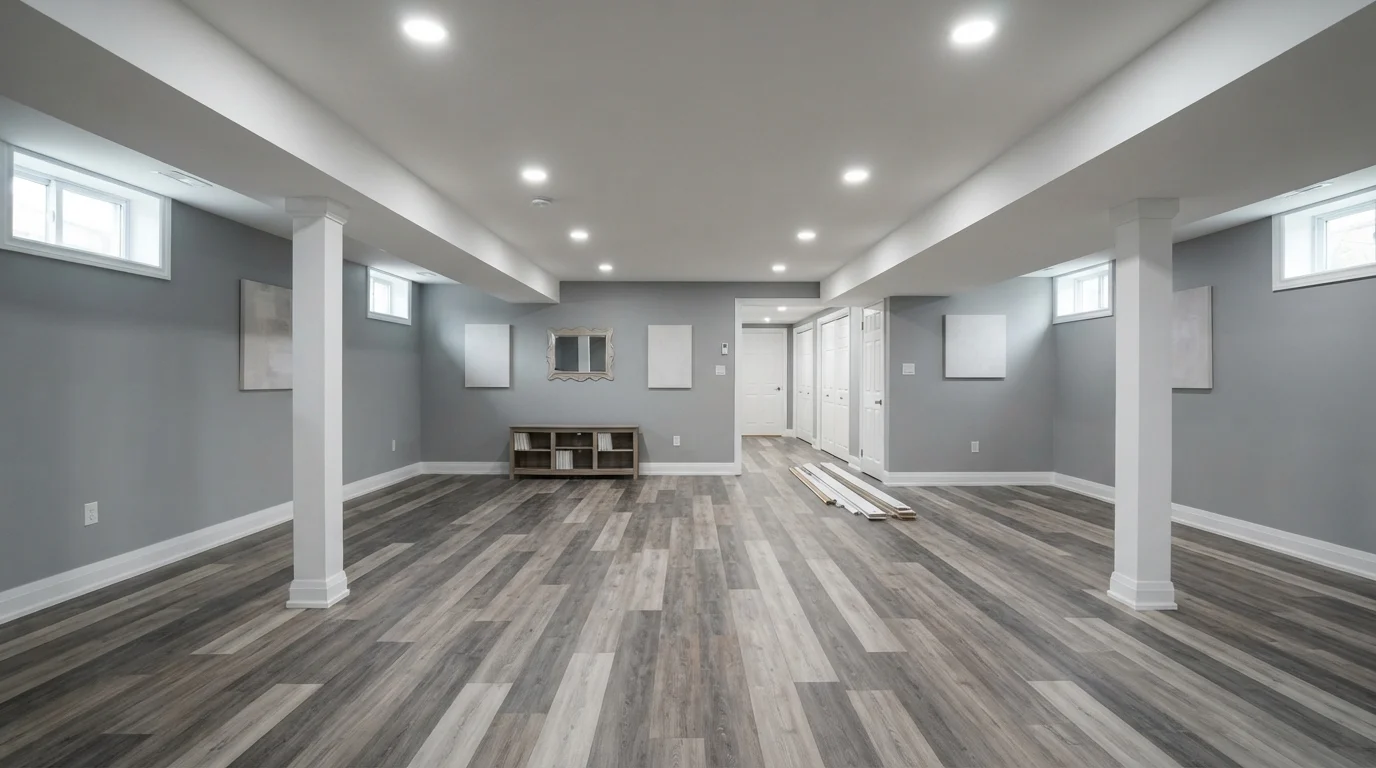
Bright recessed lighting and cool gray walls turn a subterranean basement into a fresh, expansive living space.
Cool gray is a balanced neutral that brings a crisp, modern edge to any room. Here, smooth gray walls contrast sharply with bright white support columns, ceiling beams, and baseboards, all tied together by weathered gray plank flooring. The space feels open, fresh, and surprisingly bright for a lower level. This combo works because the pure white trim bounces light around the room, keeping the neutral walls from feeling heavy. It is a fantastic choice for anyone finishing a basement rec room or home gym.
SEE SILENT FILM ON YOUR WALLS →
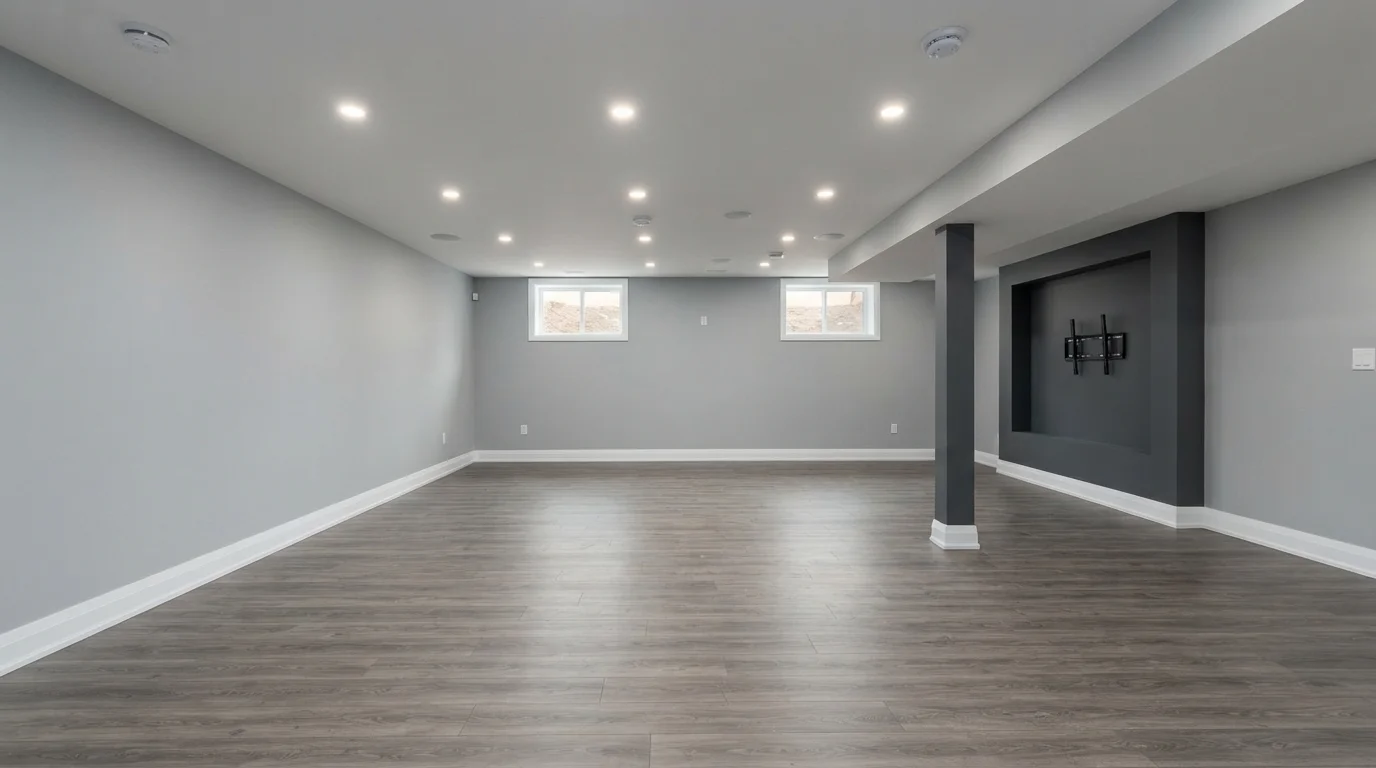
Cool gray walls pair with deep charcoal accents and bright white trim for a fresh, open living space.
Light grey is a crisp, cool neutral that feels sleek and tidy. In this room, soft grey covers the main walls, accented by a deep charcoal support pillar, matching media wall, and clean white baseboards. The space feels open, calm, and contemporary. Using darker charcoal on structural features gives the room dimension while the lighter grey keeps the subterranean space feeling bright and airy. It is ideal for homeowners building a clean, modern home theater or multi-purpose entertainment zone.
SEE SILENT NIGHT ON YOUR WALLS →
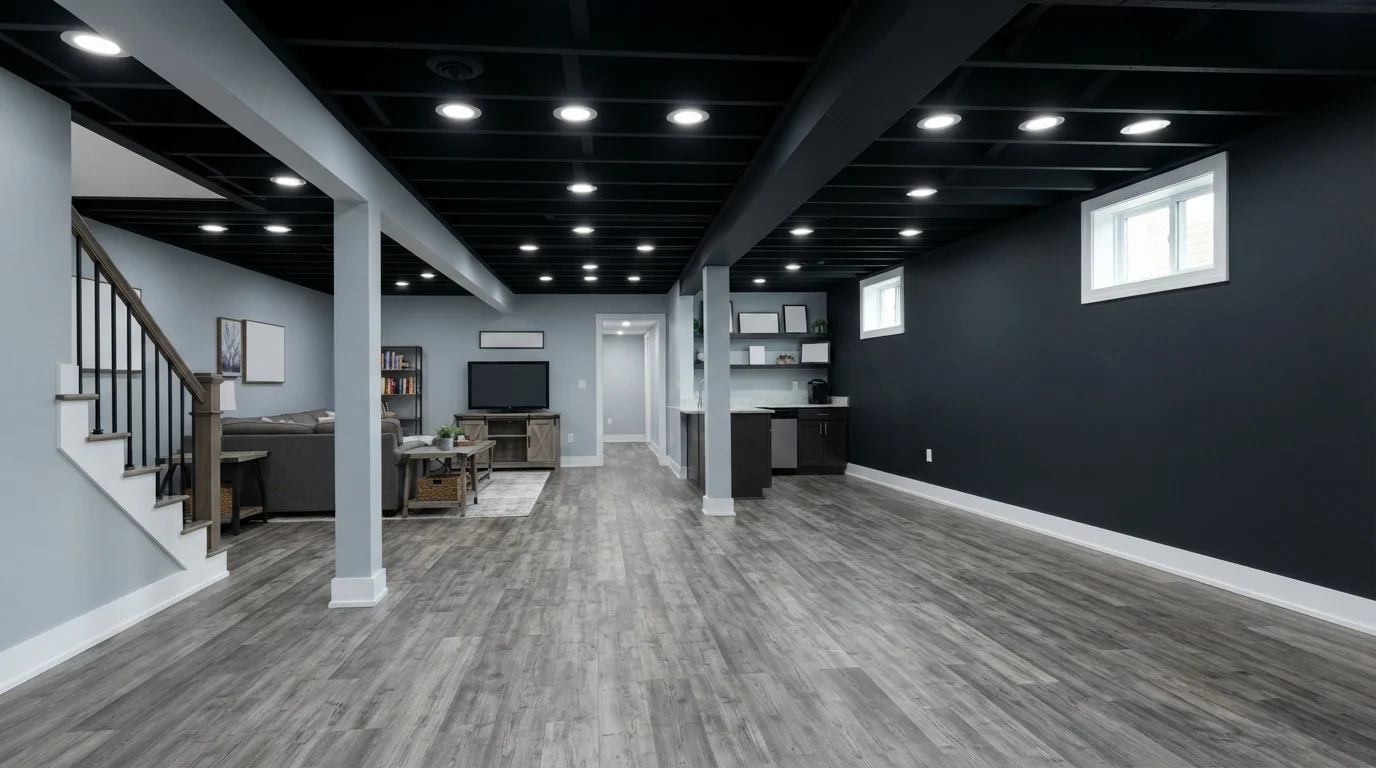
Cool slate walls and a dramatic black ceiling create a clean, contemporary lower-level retreat.
Slate grey is a cool, calming mid-tone neutral with subtle blue notes. In this open basement, smooth grey covers the walls and support pillars, contrasting against the matte black open-beam ceiling above. The finished space feels crisp, modern, and surprisingly open. Crisp white baseboards frame the grey wood-look floor, keeping the room bright despite the dark industrial ceiling. This look is perfect for anyone wanting a sleek, contemporary multipurpose basement for entertaining or relaxing.
SEE BLUE CASHMERE ON YOUR WALLS →
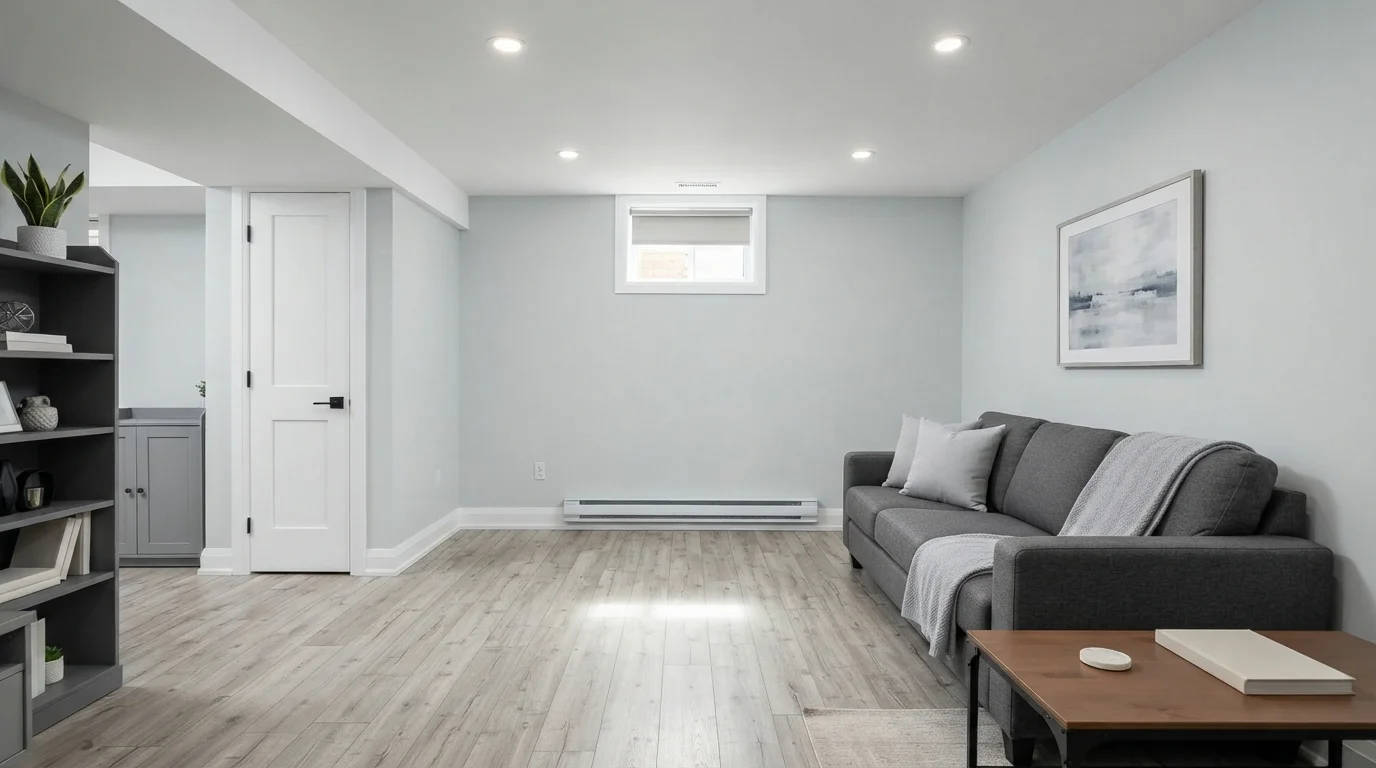
Soft misty grey walls and a dark charcoal sofa create a bright, calm, and effortlessly modern living area.
Pale misty grey is a quiet, airy neutral with a cool edge. In this room, the light grey walls wrap around a deep charcoal fabric sofa and bright white trim over weathered grey plank flooring. The space feels open, peaceful, and clean. This combo works because the light walls reflect the overhead lights to keep the room bright while the dark couch anchors the space. It is ideal for anyone seeking a fresh, unfussy basement lounge.
SEE PELICAN ON YOUR WALLS →
This classic stone shade gives your lower level a cozy, grounded feel.
SEE SLATE GRAY ON YOUR WALLS →Gray Basement Wall Color Combinations
A wall color never works alone. These are the full schemes from the rooms above — the lead color first, then the supporting colors that make the photo work.
Soft gray walls and layered patterned rugs create a relaxed, cozy retreat perfect for winding down downstairs.
TRY THIS PALETTE →Crisp cool grays and deep charcoal create a serene, modern lounge ready for cozy movie nights and easy entertaining.
TRY THIS PALETTE →Cool slate walls pair with brilliant white architectural trim to turn a lower level into a polished retreat.
TRY THIS PALETTE →Bright recessed lighting and cool gray walls turn a subterranean basement into a fresh, expansive living space.
TRY THIS PALETTE →Slate Gray pairs cleanly with crisp white trim and baseboards — it keeps a finished basement feeling like a real living space rather than a converted storage room, and it's easygoing enough to sit behind whatever furniture gets moved down there. If the basement has any warm wood tones — a stair rail, laminate flooring, a reclaimed-wood accent wall — Slate Gray's slight warmth keeps the room from feeling split between two temperatures.
For a home theater or media room, run Grays Harbor or Cracked Pepper on the walls and take the trim dark too — matte black or a deep charcoal trim disappears the wall-to-ceiling line and makes the space feel more like an actual theater and less like a painted basement. Dark Shadows works the same way but leans a touch cooler, so it pairs well with black hardware and brushed-nickel fixtures rather than brass. Fired Bronze, being the warmest of the deep picks, is the one to reach for if there's a leather sectional or warm wood built-ins already in the room — it'll pull those tones together instead of fighting them. Misty is the outlier of the group: keep its trim white and its accents cool (glass, chrome, cool-toned tile) rather than mixing it into the theater-room palette.
More Basement Color Ideas
Set on a color family already? Each page has its own real rooms and picks.
Light or Dark Gray Basement Colors?
Go Light (LRV 60+) If…
The room is small, faces north, or has to work at every hour. Light warm colors make it feel bigger and stay calm in evening light — the light you actually live in.
Go Dark (LRV Under 20) If…
You want the cocoon effect and the room has real daylight. Dark works best on one feature wall — or fully color-drenched in a large room with good windows.
Basement light and basement dark aren't about personal taste as much as they're about how much daylight actually reaches the room. If there's at least one decent window or a walkout, a mid-tone like Slate Gray (LRV 24) has enough reflectance to still look like a color and not a shadow once the sun hits it, and it won't wash out under warm bulbs the way a pale gray can.
In a fully below-grade basement with no windows, very light grays are usually a mistake — under artificial light alone they tend to read dingy rather than bright, since there's no daylight balancing out the yellow or blue cast of the bulbs. That's exactly where Grays Harbor (LRV 12), Cracked Pepper, and Dark Shadows earn their keep: going darker on purpose reads as a designed media room or den instead of a room that's just dim. Save Misty for basement zones that do get real light — a walkout laundry room or a basement bath with a window — where its pale blue-gray can actually brighten instead of just looking washed out.
See It. Love It.
Paint It.
Upload one photo of your gray basement and try every color on this page on your own walls — in your own light, before you buy a drop of paint.

MistyBeforeSheen And Finish For Basement Walls
Basements deal with more moisture than any other room besides the bathroom and kitchen, even when there's no visible leak — concrete slabs and below-grade walls give off humidity that regular flat paint can't handle over time. A mildew-resistant acrylic latex in satin or eggshell is the standard recommendation for basement drywall, and satin is the safer of the two if the space is a laundry room, a bar area, or anywhere near a bathroom, since its slicker surface wipes clean of moisture and mildew more easily than eggshell.
On Slate Gray or Grays Harbor, satin also has the side benefit of bouncing a little more light around a dim basement than a flat finish would, which helps in a room that's already fighting for brightness. Save flat or matte sheens for a strictly dry, finished theater room where wall imperfections under Cracked Pepper or Dark Shadows matter more than moisture resistance — dark colors show roller marks and sheen inconsistencies more than light ones, so a flat or matte finish actually hides more than a satin does on those deeper shades.
Common Basement Gray Mistakes
The biggest mistake is picking a pale, barely-there gray for a windowless basement because it worked upstairs in a sunny bedroom. Without daylight to activate it, that same color can look gray-brown or just dirty under basement lighting. If the room has little to no natural light, go with something closer to Grays Harbor or Cracked Pepper on purpose rather than defaulting to a light gray and hoping it reads clean.
The second mistake is painting the ceiling a different, brighter white than the walls in a low-ceilinged basement. That contrast draws the eye straight to how low the ceiling actually is. Carrying the wall color — or a close, lighter version of it — up onto the ceiling tends to blur that line and make the room feel taller than it is, especially with Slate Gray or Dark Shadows.
The third is skipping a stain-blocking, moisture-tolerant primer before any of these colors go up, especially over unpainted concrete or drywall that's ever seen dampness. Gray in particular will show blotching from an unprimed or unsealed surface faster than a warmer neutral would, since any undertone shift is more visible against a true gray.
About Gray Basement Paint Colors
A basement is the one room in the house where the usual paint advice gets reversed. There's rarely a window putting real daylight on the wall, the ceiling is often lower than upstairs, and the light that does exist comes from bulbs that render color differently than the sun does. Gray still works down there, but it has to be the right depth of gray — a pale, chalky gray with no daylight to react to just goes flat and gloomy instead of calm.
Slate Gray from Behr (LRV 24) is the safest starting point for a basement that gets some light, whether that's a few egress windows or good overhead fixtures. It reads as a grounded, stone-like neutral rather than a cold gray, which matters in a room that can otherwise feel like an unfinished box no matter how much drywall is up.
For basements with little or no natural light — the classic windowless rec room or media space — the better move is to stop fighting the darkness and lean into it. Grays Harbor from Sherwin-Williams (SW 6236, LRV 12) is deep enough to look intentional under lamp light instead of murky, and Cracked Pepper, Dark Shadows, and Fired Bronze from Dunn-Edwards push that same idea further for a genuine home-theater feel. Misty, a pale cool-blue gray, goes the opposite direction and is the pick when the goal is a brighter, spa-like basement bathroom or laundry area instead of a moody lounge.
The Questions Everyone Asks
What color should I paint my gray basement?
If you want one answer, start with the safe picks above — Slate Gray, Fieldstone, Pigeon Gray, Gray Shower. They read well in any light and survive furniture changes. Then check the light: strong afternoon sun wants a step cooler, a north-facing room wants a step warmer.
what color should i paint a basement with no windows
Go deeper than instinct suggests. A pale gray with no daylight to react to tends to look dingy under artificial light alone, while a committed mid-to-deep gray like Grays Harbor (SW 6236, LRV 12) or Cracked Pepper reads as an intentional, designed space instead of a dim one. Add layered lamp lighting rather than a single overhead fixture, since the color's job is easier when the light source is warm and close to eye level.
does gray make a basement look smaller
A dark gray can make a basement feel smaller if the ceiling stays bright white, because the contrast highlights low ceiling height. Carrying a color like Dark Shadows or Grays Harbor up onto the ceiling, or close to it, removes that hard line and the room reads bigger, not smaller. A lighter, higher-LRV gray like Slate Gray (LRV 24) is the more straightforward choice if the room already feels tight.
what sheen of paint is best for basement walls
Satin is generally the better call for basement walls, since it resists moisture and wipes clean more easily than flat or eggshell, and basements deal with humidity even without a visible leak. Use a mildew-resistant acrylic latex in satin on drywall or masonry. Eggshell is fine for a strictly dry, finished theater or living space where hiding wall imperfections under a deep color like Cracked Pepper matters more than moisture resistance.
should the basement ceiling be painted the same color as the walls
In a low-ceilinged basement, yes — painting the ceiling the same color as the walls, or a slightly lighter version of it, removes the visual stopping point that a bright white ceiling creates and the room feels taller. This works especially well with Slate Gray or Grays Harbor, where the ceiling can go a step lighter than the wall color without breaking the scheme.
is it ok to paint a basement dark
Yes, and for a windowless basement it often works better than going light. A deep, saturated color like Grays Harbor, Cracked Pepper, or Fired Bronze looks purposeful under lamp light and hides the scuffs and shadows that plague below-grade rooms, while a pale color in the same space can look washed out and unfinished instead of bright.
What two-color combination works best in a gray basement?
The reliable pattern is a quiet main color plus one deep accent on a single wall. Keep trim and ceiling in one warm white so the two colors are the only event in the room — the combination cards above show complete schemes from real rooms.
What colors make a gray basement look bigger?
High-LRV, slightly warm colors — LRV 60–75 is the sweet spot. Paint the walls and trim close to the same light color so the corners blur, and keep the ceiling white. Stark cool white actually works against you; it creates hard shadows that show the room's edges.

Ask a Question