Gauntlet Gray
SW 7019 · #78736E · LRV 17 — neutral with no strong undertone, dark — high drama, needs strong daylight or warm bulbs.
- 1Black Fox7
- 2Pewter Green12
- 3Gauntlet Gray17
- 4Storm Cloud23
- 5Stardew43
What Color Is Gauntlet Gray, Really?
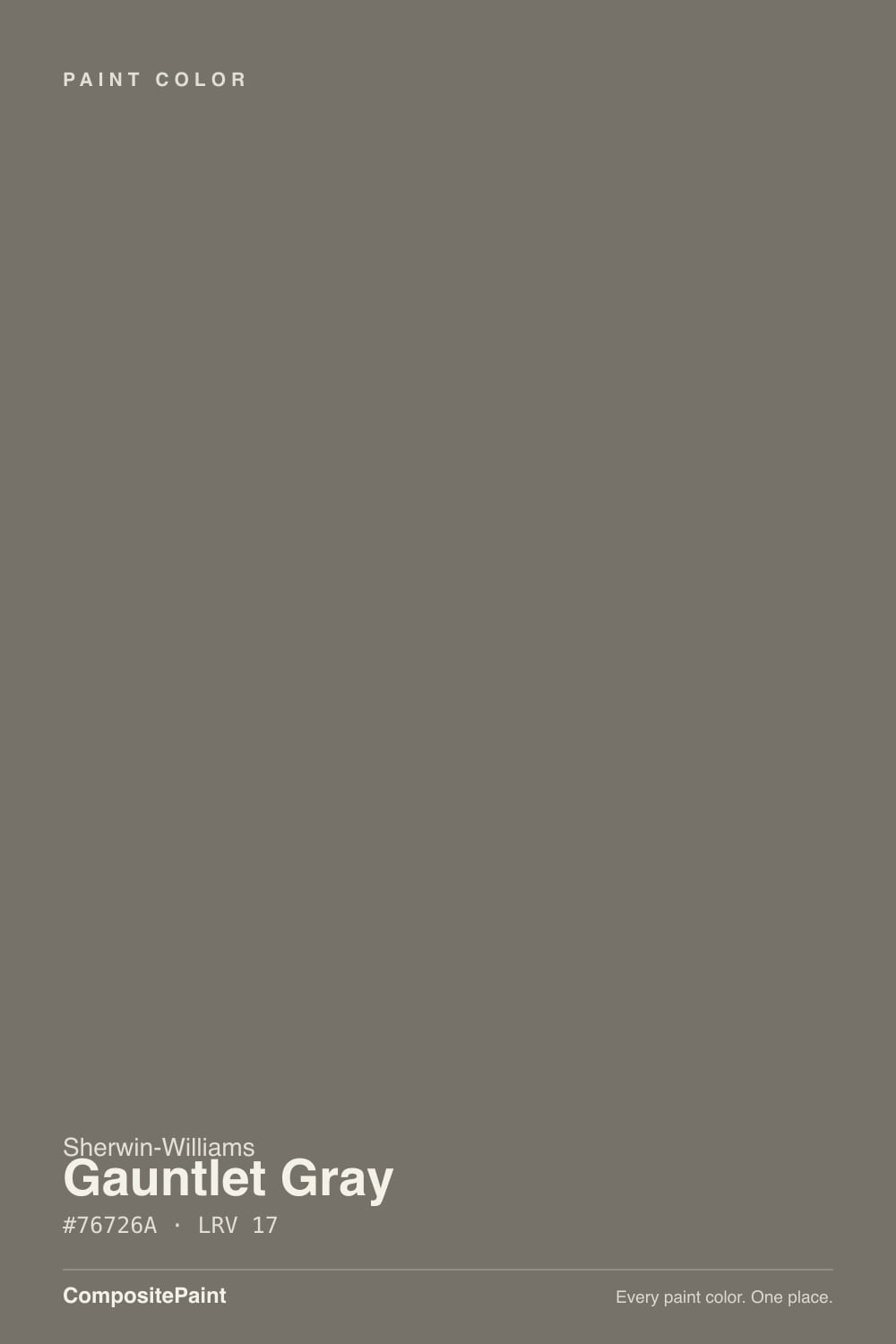
Gauntlet Gray (SW 7019) is a dark warm gray. The hex value #76726A is nearly balanced across red, green, and blue, and the saturation reading is only about 5 percent, so this is a genuine gray rather than a brown pretending to be one. What tilts it is the hue at 40 degrees, which adds a quiet warm cast and keeps it from going cold or blue. An LRV of 17 puts it firmly in the dark band, deep enough to change the mood of a room the moment it goes up.
People reach for it when they want charcoal without the chill. Cool grays at this depth can feel severe, while Gauntlet Gray stays grounded and a little earthy. That makes it a common pick for exterior siding, front doors, kitchen islands, and cabinetry where the goal is weight rather than color.
The catch is light. At an LRV of 17 it absorbs far more light than it gives back, so a room with one small window will read almost black at the corners. It also shows sheen and surface flaws more than a mid-tone would, so surface prep and a flatter finish matter. Look at a large sample at night as well as at noon.
Gauntlet Gray is a warm gray with a very small amount of color in it. Saturation sits near 5 percent, which is low enough that most people register it as a straight charcoal. The hue reading of 40 degrees is what supplies the warmth, giving it a faint brown or greige lean rather than the blue or violet cast that many deep grays carry.
That lean becomes visible by comparison. Next to a cool blue-gray it looks distinctly brown and soft. Next to a beige or a tan it flips and reads as a clean, almost neutral gray. Against white trim the warmth is subtle but present, which is part of why it looks calm rather than harsh.
Check it against anything gray you already own, especially flooring, stone, and roof shingles. If those materials run cool, Gauntlet Gray can look muddy beside them. If they run warm, it settles in and disappears into the scheme in a good way.
Best Rooms and Uses for Gauntlet Gray
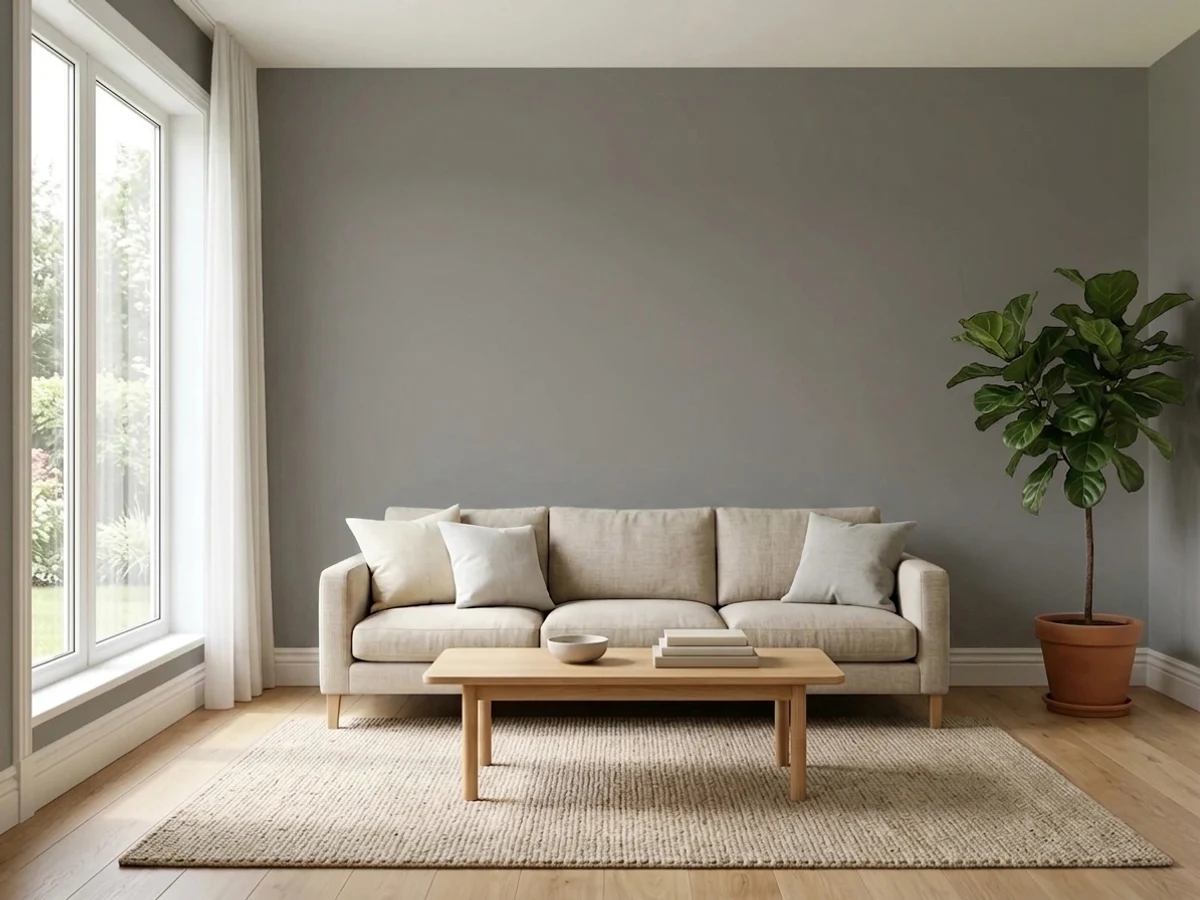
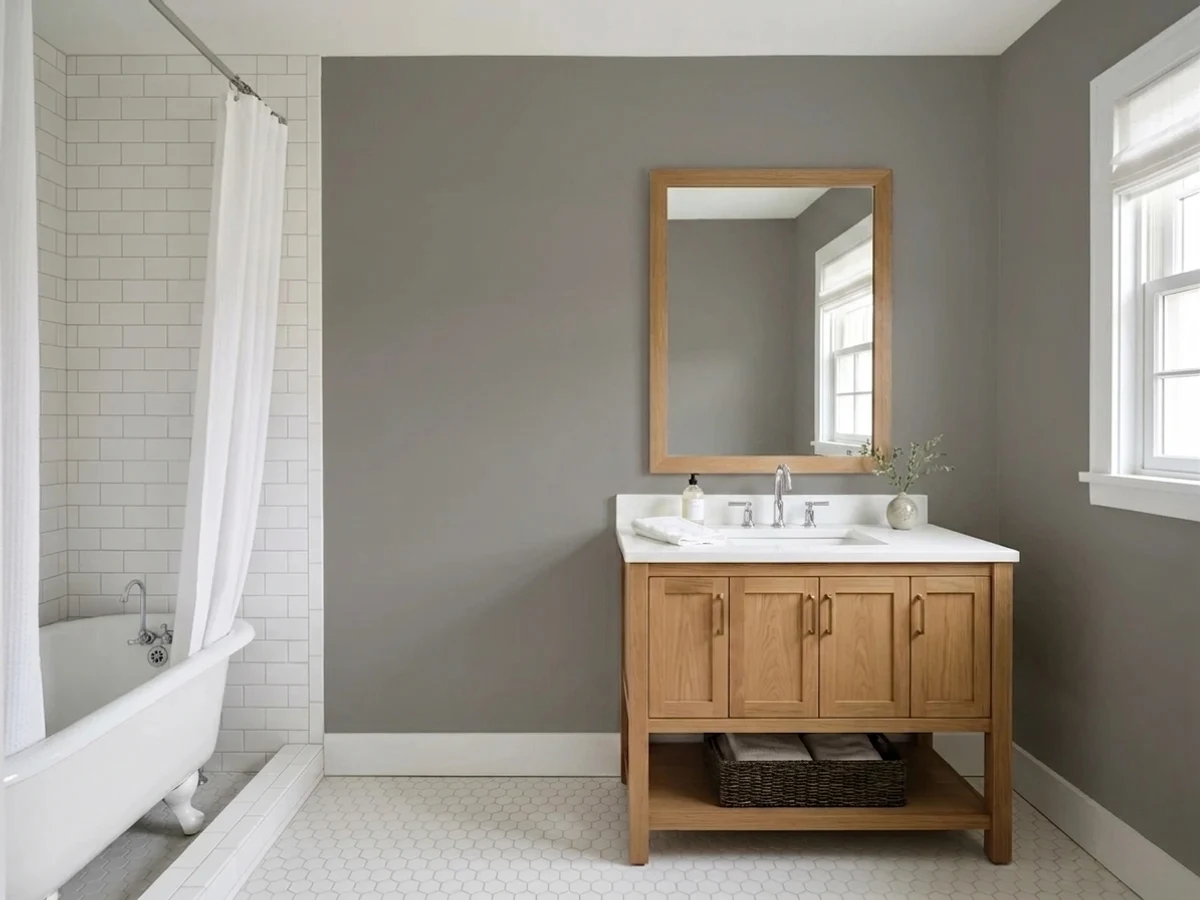
Gauntlet Gray is a color for rooms that already have light to spare or for rooms you want to make deliberately moody. Home offices, dens, dining rooms, and powder rooms take it well, and an accent wall behind a bed or a fireplace gives it presence without darkening everything.
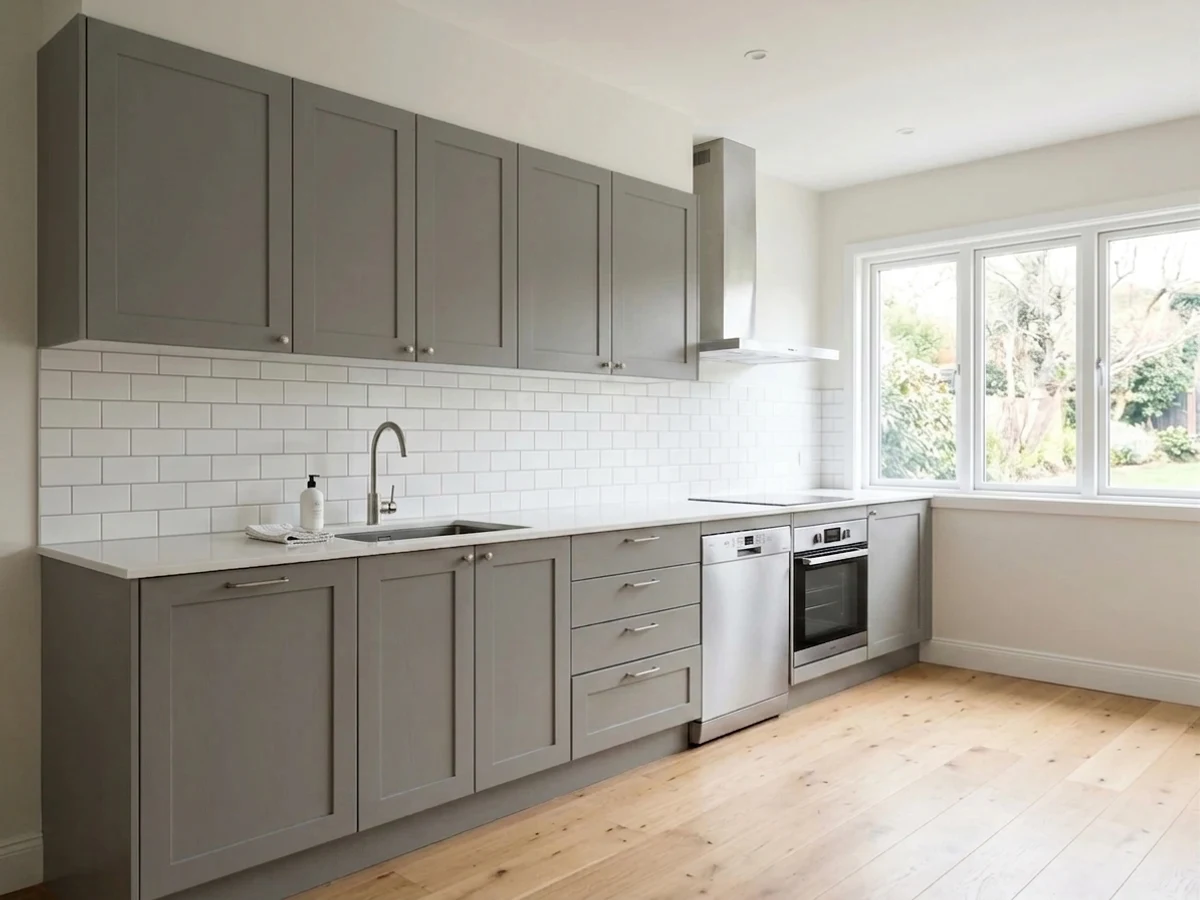
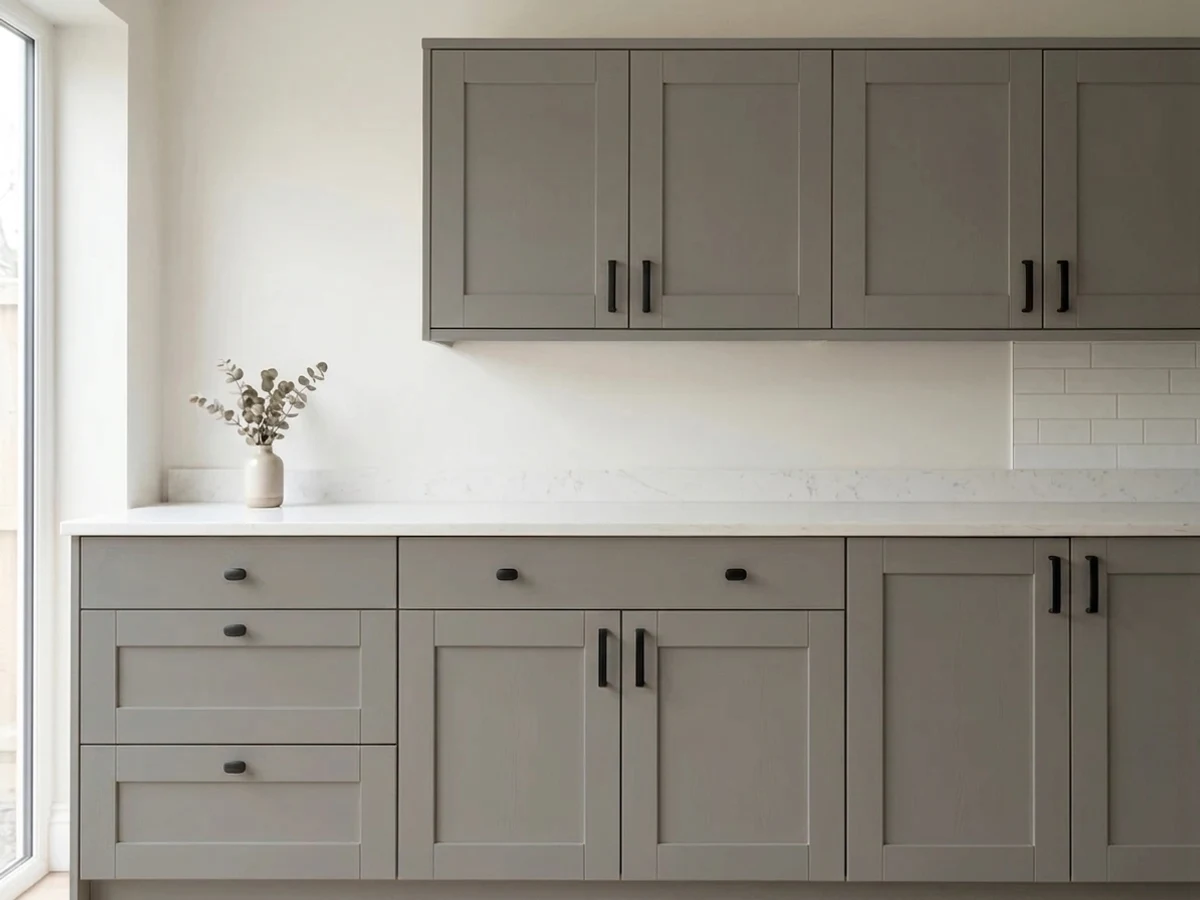
Cabinetry is one of its strongest uses. On an island, a lower run, or a full set of built-ins it reads as weight and structure rather than as a color statement, and the warm lean keeps it friendly next to wood and brass.
Outside it is a well-used siding and front door color. At an LRV of 17 it stands up to bright sun without fading into blue, and it pairs naturally with white trim, black windows, and stone. Avoid it on ceilings in rooms with low daylight, and think twice about it on all four walls of a small north-facing space unless the enclosed feeling is the point.
How Lighting Changes Gauntlet Gray
With an LRV of 17, Gauntlet Gray reflects little light, so every source in the room counts. In north-facing rooms it goes deeper and quieter and the warmth mostly disappears, leaving a sober charcoal. Corners and walls away from the window will read close to black.
South-facing rooms bring the warmth back. Steady sun lifts the 40 degree hue and the color looks softer and more brown-gray, closer to weathered stone than to charcoal. East rooms look flat and cool in the morning and warm as the day moves on, and west rooms hold their depth until late-day light warms them noticeably.
Artificial light does the same work. Warm 2700K bulbs strengthen the brown side and make it cozy, while 3500K to 4000K bulbs push it toward a colder, harder gray. Because dark colors show every uneven patch of light, place samples on more than one wall and look at them after sunset.
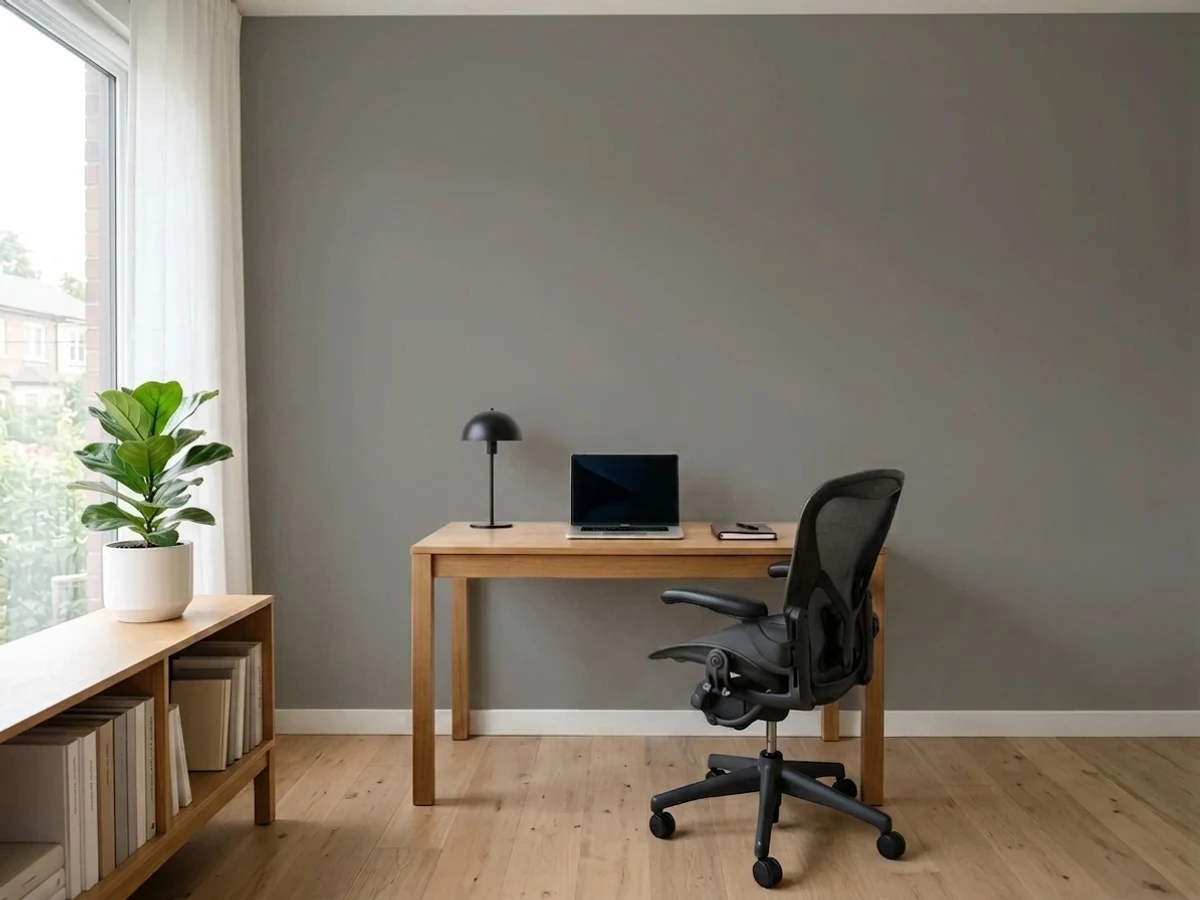
Most complaints about Gauntlet Gray are a light mismatch. Upload a photo of your actual room and see it on your walls — then ask for the same wall in north light or evening lamps before you buy a single sample.
Need It From Another Brand?
Any paint counter can custom-tint Sherwin-Williams SW 7019 directly. If you would rather stay in one brand's own deck, these are the closest stock matches, measured as ΔE2000. Under 2 is a difference you will not see on the wall.
| Brand | Closest color | ΔE | LRV | |
|---|---|---|---|---|
| Behr | Unpredictable HueMQ2-58 · Behr | 0.9 | 17 | Color page → |
| Benjamin Moore | Gray Mountain1462 · Benjamin Moore | 2.9 | 19 | Color page → |
| Valspar | Nature Walk8006-12E · Valspar | 3.0 | 18 | Color page → |
| PPG / Glidden | DeconstructionPPG1006-6 · PPG / Glidden | 2.1 | 18 | Color page → |
| Glidden | DeconstructionPPG1006-6 · Glidden | 1.9 | 18 | Color page → |
| Dutch Boy | Cliffside Gray437-5DB · Dutch Boy | 2.4 | 17 | Color page → |
Similar Sherwin-Williams Colors
The nearest shades to Gauntlet Gray within Sherwin-Williams's own range, ranked by perceptual color distance — useful when you want the same look a touch lighter, darker, or warmer.
WCAG 2.1: AA is 4.5 : 1 for normal text, 3 : 1 for large text, AAA is 7 : 1.
Gauntlet Gray vs Similar Colors
Dovetail (SW 7018) is the comparison that comes up most. At LRV 26 with the hex #807A6E it is clearly lighter than Gauntlet Gray at 17, and it carries a little more visible warmth. Dovetail is the safer choice for full walls in an average room; Gauntlet Gray is the one to use when you want real depth or a contrasting element.
Among close SW neighbors, Hulett Ore (SW 9574) at LRV 16 is more neutral and slightly cooler, Carriage Stone (SW 9614) at LRV 18 leans more olive, and Library Pewter (SW 38) at LRV 17 is the warmest of the group at hex #7F7263.
Across brands, PPG or Glidden Artillery (PPG1008-6) has a deltaE of 0.79, which makes it effectively the same color. Behr Unpredictable Hue (MQ2-58) at 1.17 and Dunn-Edwards Winter Branches (DESS47) at 1.38 are visually identical in normal room light. Benjamin Moore Amherst Gray (HC-167) at 3.03 is close but visibly different side by side, sitting slightly lighter at LRV 19.
Colors That Go With Gauntlet Gray
The simplest partner is a clean white on trim, doors, and ceiling. At an LRV of 17 the contrast is strong enough to look crisp and architectural, and it is the standard exterior pairing for a reason. A warmer white softens the effect if you want less of a hard line.
Inside the Sherwin-Williams deck, Dovetail (SW 7018) at LRV 26 is the natural step up. It is the same warm gray family, nine points lighter, so it can carry the walls while Gauntlet Gray takes the island, the doors, or the trim. That kind of light-to-dark pairing works far better than pairing Gauntlet Gray with a neighbor like Hulett Ore (SW 9574) at LRV 16 or Carriage Stone (SW 9614) at LRV 18, which are too close to read as separate colors.
Materials do the rest. Oak, walnut, brass, and aged bronze all warm it up, while black hardware and natural stone keep it sharp.
Coordinated palette
Generated by hue-rotating #78736E in HSL space. Pair Gauntlet Gray with one accent and one neutral — the swatches below are starting points, not final picks.
Gauntlet Gray FAQ
Is Gauntlet Gray warm or cool?
It is a warm gray. The hue reading sits at 40 degrees, which adds a soft brown cast, but saturation is only around 5 percent so the warmth stays quiet. Compared with a blue-based charcoal it looks noticeably softer and earthier. In cool north light most of that warmth drops away and it reads as a straight dark gray.
What LRV is Gauntlet Gray?
Gauntlet Gray has an LRV of 17. On the scale from 0 for black to 100 for pure white, that is firmly in the dark range. It absorbs far more light than it reflects, so it adds weight and drama to a room rather than brightness. Expect it to look deeper in person than it does on a small chip.
Does Gauntlet Gray work in a dark room?
Only if you want the room to feel enclosed. At an LRV of 17 it gives back very little light, so a small north-facing space with one window will read close to black in the corners. In a room like that it works better on cabinetry, a fireplace wall, or built-ins than on all four walls.
What white trim goes with Gauntlet Gray?
A clean, bright white gives the sharpest result and is the usual pairing on exteriors, where the contrast between dark siding and white trim is the whole effect. Indoors, a softer warm white blends better with the color's 40 degree warm cast and takes the hard edge off. Both are valid, so choose by how much contrast you want.
Is Gauntlet Gray good for exteriors and cabinets?
Yes to both. On siding and front doors an LRV of 17 holds its depth in bright sun instead of fading toward blue, and it sits well with white trim, black windows, and stone. On cabinets and islands it reads as structure rather than as a color statement, and the warm lean keeps it comfortable next to wood floors and brass hardware.
How is Gauntlet Gray different from Dovetail?
They belong to the same warm gray family, but Dovetail (SW 7018) has an LRV of 26 against Gauntlet Gray's 17. That nine-point gap is easy to see: Dovetail looks like a medium gray you can live with on every wall, while Gauntlet Gray reads as a charcoal. Many people use Dovetail on walls and Gauntlet Gray on an island, door, or accent.
Have you painted with Gauntlet Gray?
Rate it — one tap helps the next reader decide.
Ask a Question