Zinsser Gardz vs BIN: Weak Surface or Stained Surface?
Zinsser Gardz vs BIN, sorted by the problem on your wall. Gardz binds torn drywall paper and wallpaper paste; BIN blocks stains and odor. Prices, a problem-to-primer table, the overlap jobs that need both, and when neither can is right.

The 30-Second Answer
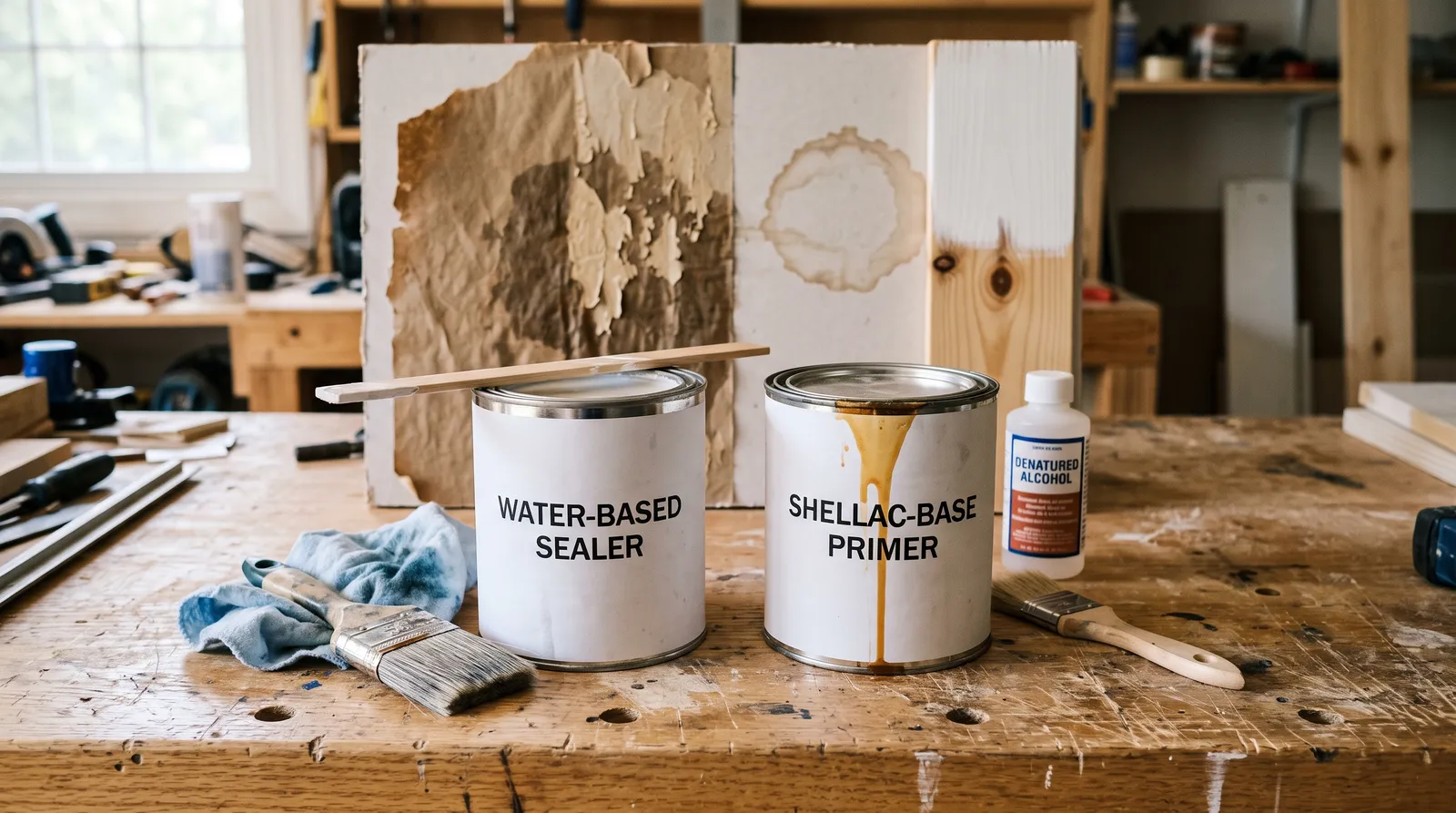
Gardz fixes a wall that is falling apart. BIN fixes a wall that is stained or smells. If the surface is weak — torn drywall paper, wallpaper paste, chalky plaster — buy Gardz. If something is bleeding through your paint, buy BIN.
That is the whole decision, and almost every argument about these two cans comes from people trying to make one of them do the other’s job. Gardz is a clear, water-thin acrylic sealer. It soaks in, glues loose fibers to the sound material underneath, and dries rigid. It has no pigment, so it hides nothing and blocks nothing. BIN is shellac dissolved in denatured alcohol. It builds a hard white film on top of the surface and traps water rings, smoke, nicotine, tannin, marker, and odor under it forever. It binds nothing loose.
Put BIN on torn facing paper and the paper still bubbles under your topcoat, with shellac riding along on top of it. Put Gardz over a ceiling water ring and the ring shows through your finish in a week. Neither can is at fault. Read the wall first.
At a Glance
| Zinsser Gardz | Zinsser BIN | |
|---|---|---|
| Chemistry | Water-based penetrating acrylic | Shellac resin in denatured alcohol |
| What it does | Soaks in and hardens weak material | Builds a barrier film over a stain |
| Color | Clear (goes on milky, dries clear) | Flat white, opaque |
| Torn drywall paper | 🟢 Its signature job | 🔴 Bubbles under the film |
| Wallpaper paste residue | 🟢 Seals it so it can’t re-wet | 🔴 Not what it’s for |
| Chalky plaster, dusty skim coat | 🟢 Binds it rigid | 🔴 Sits on the dust |
| Water rings | 🔴 Ghosts straight through | 🟢 Locks them down |
| Smoke and nicotine | 🔴 No | 🟢 Best in class |
| Knot bleed and tannin | 🔴 No | 🟢 Best in class |
| Pet and fire odor | 🔴 No | 🟢 Seals the surface |
| Glossy oil trim, no sanding | 🔴 No | 🟢 The only can that does it |
| Touch dry | About 30 min | About 20 min |
| Topcoat / recoat | 3 hours | 45 minutes |
| Smell | Low, under 30 g/L VOC | Sharp alcohol, about 540 g/L |
| Cleanup | Soap and water | Ammonia water or denatured alcohol |
| Coverage | About 400–450 sq ft/gal on a sound surface | Up to 500 sq ft/gal on the label; less in practice |
| Price (qt) | ~$22–32 | ~$25 |
| Price (gal) | ~$40–55 | ~$75 |
Match the Primer to the Problem
Walk the room before you walk to the store. Name the defect, then buy the can.
| What’s on the wall | Right can | Why |
|---|---|---|
| Torn drywall facing paper after stripping wallpaper | Gardz | Soaks into the fuzz and locks it rigid so it can’t swell |
| Wallpaper paste you couldn’t fully wash off | Gardz | Seals the residue so latex can’t re-wet it and tent |
| Powdery plaster, calcimine, dusty skim coat | Gardz | Binds the loose layer to the sound material below |
| New drywall about to get wallpaper | Gardz | The next person to strip it won’t tear the wall’s face off |
| Brown water ring on a ceiling | BIN | Non-porous shellac traps the dissolved residue for good |
| Smoke, soot, nicotine haze | BIN | Nothing on a consumer shelf blocks it in one coat |
| Knot bleed on pine, tannin on cedar | BIN | Alcohol carrier caps the knot; water-based primers reactivate it |
| Marker, crayon, lipstick, food splatter | BIN | Water-soluble stains can’t migrate through cured shellac |
| Pet urine or fire odor in a porous floor | BIN | Seals the surface the smell escapes from |
| Glossy oil trim the homeowner won’t let you sand | BIN | Shellac keys into the gloss as the alcohol leaves |
| Torn paper and a stain in the same wall | Both | Gardz first, 3 hours, then BIN, then topcoat |
| Clean, sound drywall or a clean repaint | Neither | 1-2-3 or a PVA primer, at a third of the price |
| Flaking paint on wood or anything outdoors | Neither | Peel Stop stays flexible; Gardz cures rigid and cracks |
Two rules of thumb hold up on the job. If the defect shows up under your hand — dust on your palm, a flap you can lift, a slick spot that goes tacky when it gets wet — that’s Gardz. If the defect shows up in your eyes or your nose, that’s BIN.
What Gardz Actually Does
Gardz is not a primer in the normal sense. It’s a binder that goes looking for something to glue.
Most primers are formulated to sit on top of a surface and build a film. Gardz does the opposite on purpose. It’s a low-viscosity acrylic dispersion with very small particle size, thin as skim milk, so it can wick down into torn paper, friable plaster, or chalky compound and then cure into a rigid network that ties the loose stuff to the solid stuff. You aren’t coating the wall. You’re saturating it.
The milky-to-clear color change is your gauge. Wet, the binder particles scatter light and read blue-white. As the water leaves and the particles fuse, the film goes optically clear. When it’s clear, the surface is locked.
Where it earns its keep, per our Gardz review:
- Torn facing paper after wallpaper removal. Roll latex over raw torn paper and the fibers swell and blister. Gardz stops that.
- Paste residue you couldn’t scrub off. Old wheat or clay paste re-wets under waterborne paint and tents the topcoat. Gardz seals it shut.
- Friable plaster and powdery skim coats. That dust is a bond breaker. Anything you paint over it delaminates.
- Wallpaper prep, in both directions. Hang new paper over cured Gardz with ready-mixed paste, and seal bare drywall with it before the first paper goes up.
Where it doesn’t: stains, odor, hide, and anything outdoors. It also runs, because thin is the whole point. Roll it out lean, work upward, keep a rag close. For the full stripped-wall sequence, our guide on leftover wallpaper paste covers the scrape-and-seal order.
What BIN Actually Does
BIN is the opposite chemistry doing the opposite job. Shellac resin in denatured alcohol. The alcohol flashes off in about twenty minutes and leaves a hard, non-porous film behind.
That non-porous part is the trick. Most stains move by dissolving into your wet paint and wicking up: tannins in cedar and redwood, the brown residue in a water ring, the tar in cigarette smoke. They’re all water-soluble, which is why a water-based primer is exactly the wrong defense — the stain dissolves right into it. Cured shellac gives them nothing to move through.
Same chemistry explains the rest of the résumé, per our BIN review: it seals odor rather than covering it, which is why restoration crews use it on smoke-soaked framing and pet-urine subfloors, and it grips glass, tile, and glossy oil trim that latex slides straight off. Recoat is 45 minutes, so a spot prime and a topcoat are the same afternoon.
Two honest cautions the label skips. The can separates in storage — heavy titanium dioxide drops out and leaves clear amber shellac floating on top — so scoop and stir from the bottom before every use or you’ll brush on pigment-free resin that hides nothing. And hide is the weak link, not blocking. On dark wood or a discolored ceiling, budget a second BIN coat and extra topcoats up front instead of being surprised.
Winner on stains: BIN, and it isn’t close. Winner on weak surfaces: Gardz, and that isn’t close either.
The Overlap Cases: When You Need Both
There are real jobs where both cans go on the wall. They’re common enough that they cause half the confusion.
A ceiling that leaked is the classic one. Water comes through, the drywall paper blows and goes soft, and it dries with a brown ring. That surface is weak and stained. Fix the leak, let it dry all the way through, cut out anything spongy, then:
- Gardz over the damaged zone. One pass, wet but not flooded. A 3/8-inch nap synthetic cover carries it well; cut torn edges with a brush.
- Wait the full 3 hours. Touch dry is 30 minutes. Don’t gamble the whole job on 30 minutes.
- Skim, sand, and re-seal the bare compound if you had to fill anything. Fresh joint compound drinks paint and flashes through a finish.
- BIN over the stain. One coat, 45 minutes, check it under raking light before you commit to a second.
- Topcoat. Two coats of finish, because BIN’s warm cast can read through a single thin white.
Same order for a smoke-damaged room where old plaster is chalking, or a stripped bathroom wall with torn paper and a mildew shadow. Bind first, block second, paint third. Reverse it and you get a brittle stain-blocking film sitting on material that’s still crumbling underneath, and the sandwich fails as a unit.
One more overlap worth naming: if the surface is chalky bare wood with tannin bleed, skip the two-can dance. Cover Stain is oil, it penetrates grain, and it blocks tannin in one product. Gardz has no business on exterior wood anyway.
When Neither One Is Right
Half the people standing in the aisle with these two cans should be holding a third one.
Sound drywall, patches, a normal repaint. Nothing is loose and nothing is bleeding. That’s a Bulls Eye 1-2-3 job at roughly $28 to $32 a gallon, or a plain PVA primer on fresh board. Gardz binds nothing that needs binding, and BIN at $75 a gallon is a waste of good shellac. The BIN vs 1-2-3 breakdown has that call in detail.
Flaking paint on siding, a peeling window frame, anything outside. Gardz cures rigid and moisture-resistant, which is right for drywall paper and wrong for wood that moves every season. Peel Stop stays flexible and breathable. BIN is interior-only with spot exterior use — the film is brittle and water-sensitive and won’t survive a freeze-thaw cycle.
Bare or weathered exterior wood, cedar, redwood. Cover Stain, about $35 to $42 a gallon, exterior rated.
Glossy laminate, melamine, a slick factory finish headed for cabinet paint. BIN grips it, but a dedicated bonding primer — Zinsser BONDZ or INSL-X Stix — stays flexible on a surface that gets handled every day. Our bonding primer vs stain blocker explainer draws that line.
Live mold on the wall. Neither. Kill it first, then Zinsser Mold Killing Primer, which is the only can in the lineup rated to kill rather than resist.
If you’re comparing brands rather than cans, the KILZ vs Zinsser rundown maps the whole shelf — and worth knowing, KILZ has no real Gardz equivalent. Kilz Klear is the closest thing and it doesn’t penetrate torn paper the same way.
Price and How Far the Can Goes
| Primer | Street price | Coverage | Buy this size |
|---|---|---|---|
| Zinsser Gardz | ~$22–32/qt, ~$40–55/gal | 400–450 sq ft/gal on a sound surface, well under on raw substrate | Quart for one stripped room; gallon for whole rooms of torn paper |
| Zinsser BIN | ~$25/qt, ~$75/gal, $415 for 5 gal | Label says up to 500 sq ft/gal; plan on less | Quart, unless the whole room is smoke damaged |
Buy by the job, not by the shelf price. Gardz gets bought in gallons because you’re sealing whole walls of damage. BIN gets bought in quarts because stain and odor work is almost always spot work, and an opened gallon of shellac thickens on the shelf as the alcohol escapes — that’s money you spend twice.
Two notes from the field. Gardz coverage falls off a cliff on genuinely thirsty substrate; raw torn paper and bare plaster will drink well under 400 sq ft. And shellac primer is a category, not a brand — if you need gallons, call a paint store counter before you pay the big-box price, because store-brand shellac primer runs the same chemistry and goes on sale.
Verdict by Use Case
- Pick Gardz if: you just stripped wallpaper, the drywall face is torn, paste residue is still on the wall, or the plaster powders under your hand. Also for sealing new drywall before the first wallpaper goes up.
- Pick BIN if: a stain keeps coming back through paint, something smells, a knot is bleeding, or the trim is glossy oil and sanding is off the table.
- Buy both if: the wall is weak and stained. Gardz, 3 hours, BIN, topcoat. That order, no shortcuts.
- Buy neither if: the wall is sound and clean (1-2-3 or PVA), the job is outside (Cover Stain or Peel Stop), or there’s live mold (kill it first, then Mold Killing Primer).
- If Gardz is out of stock: Roman PRO-999 Rx-35 from Home Depot. Slower, tackier, better drip control, not quite the same penetration on bad damage.
- If BIN’s smell is the dealbreaker: B-I-N Advanced, under 100 g/L VOC, at the cost of some blocking power and a 2-hour wait before topcoating a stain.
What’ll Bite You in Two Years
Two failures, and I’ve been called back for both.
The first is Gardz used as a stain blocker. It looks like a win on day one, because clear sealer over a faint ring reads clean while it’s wet. Six months of seasonal humidity later the ring is back through two coats of finish, and now it’s under a hard sealed film that fights you when you finally do it right. Clear means clear. It hides nothing.
The second is BIN used as a binder. Shellac over torn facing paper or chalky plaster gives you a hard shell over loose material, and it holds — until the wall takes a knock, a door slams a hundred times, or a humid summer swells what’s underneath. Then the whole assembly sheets off in a palm-sized flake with the topcoat still attached to it, and the tear takes gypsum with it. That’s a skim-coat repair you paid for twice.
Neither can is the tough one. The right can is the one that matches the defect. Read the wall, then buy.
Related
- Zinsser Gardz review: what it binds, what it won’t touch, and the substitutes
- Zinsser BIN review: shellac blocking, the real coverage number, and why it costs $75
- Zinsser brand hub: the whole primer ladder, sorted by substrate problem
- Zinsser BIN vs 1-2-3: the other Zinsser head-to-head
- KILZ vs Zinsser: the full shelf, brand against brand
- Blocking water stains on a ceiling: the sequence that stops the ring coming back
- What shellac primer actually is: the chemistry under the BIN decision
- Best primer round-up: every primer class and where it belongs
Ask a Question