KILZ vs Zinsser: Primer Brand Showdown
KILZ vs Zinsser, sorted by stain. KILZ Original, KILZ 2, Restoration vs Zinsser BIN, 1-2-3, Cover Stain — chemistry, stain-blocking, odor sealing, gallon prices, and a decision tree from a working contractor.

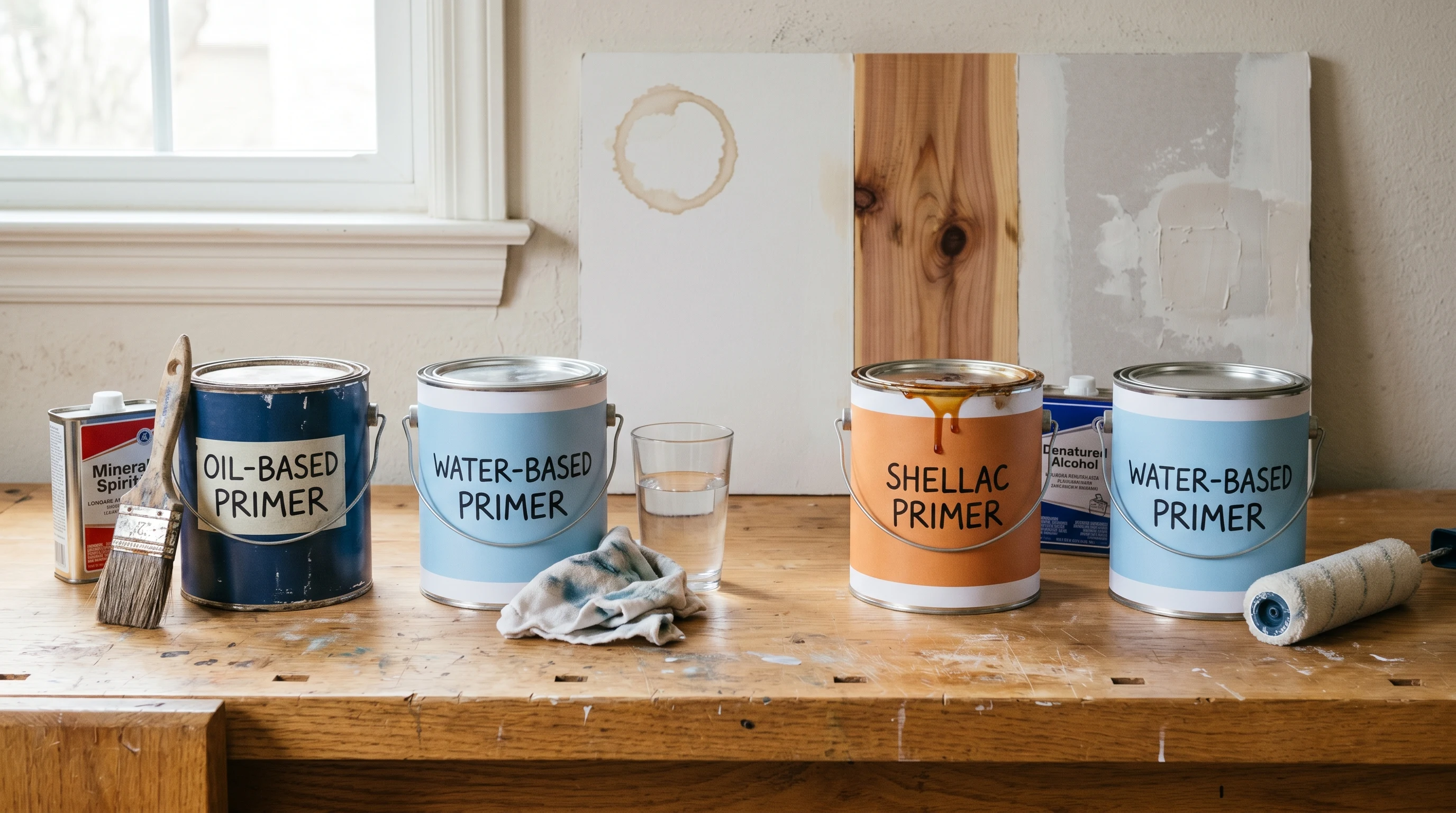
The 30-Second Answer
Two different companies. Different jobs. Don’t pick by the label.
Zinsser owns the stain-block end of the shelf. BIN is shellac, and it locks down smoke, nicotine, knot bleed, water rings, pet odor, and glossy oil trim like nothing else on the consumer market. 1-2-3 is the water-based generalist with a real exterior rating. KILZ Original is a solid alkyd at a fair gallon price for big oil-priming jobs. KILZ 2 is the budget water-based primer for fresh drywall and patches where the substrate is the only issue — about $23 a gallon against $30 to $35 for 1-2-3. Stain trouble: Zinsser. Whole-room priming with no drama: KILZ 2 or 1-2-3, whichever is on the shelf cheaper.
Are KILZ and Zinsser the Same Company?
No. They are rivals, and they always have been.
KILZ is made by Masterchem Industries LLC out of Imperial, Missouri. Masco Corporation bought Masterchem in 2000, which puts KILZ in the same corporate family as Behr. Zinsser belongs to Rust-Oleum, which sits under RPM International. Separate parents, separate factories, separate chemistries, and no shared formula between them.
The history explains the shelves. William Zinsser & Co. opened in 1849 as a shellac house — shellac was the business from day one, and BIN is the direct descendant of that. KILZ arrived in 1974 as a stain-blocking primer brand and never had the shellac heritage. The Masco connection is also why you find a wall of KILZ at Home Depot and Walmart, while Zinsser turns up nearly everywhere — Home Depot, Lowe’s, Menards, Ace, and the independent paint stores. If one brand is missing from your store, that’s distribution, not a discontinued product.
Anyone telling you the two lines come out of the same plant is repeating an old internet mistake. Price them as competitors, because that’s what they are.
At a Glance
| KILZ Original | KILZ 2 | Zinsser BIN | Zinsser 1-2-3 | |
|---|---|---|---|---|
| Resin | Alkyd (oil) | Acrylic | Dewaxed shellac | Acrylic |
| Solvent | Mineral spirits | Water | Denatured alcohol | Water |
| Recoat | 1 hr label / overnight safe | 1 hour | 45 minutes | 1 hour |
| Smoke / nicotine | 🟡 Two coats | 🔴 Bleeds through | 🟢 Best in class | 🔴 Bleeds through |
| Knot bleed | 🟡 Two coats | 🔴 No | 🟢 Best in class | 🟡 Mild only |
| Water rings | 🟡 Holds most | 🟡 Light only | 🟢 Locks down | 🟡 Light only |
| Bare drywall | ⚪ Overkill | 🟢 Built for it | ⚪ Overkill | 🟢 Built for it |
| Glossy oil trim | 🟡 Scuff-sand | 🟡 Scuff-sand | 🟢 No sanding | 🟡 Scuff-sand |
| Exterior use | 🟢 Yes | 🟡 Limited | 🔴 Indoors only | 🟢 Rated |
| Odor sealing | 🟡 Needs 3–4 coats | 🔴 No | 🟢 Seals it | 🔴 No |
| Mildew-resistant film | ⚪ Not rated | 🟡 Yes, prevention only | ⚪ Not rated | 🟡 Yes, prevention only |
| Takes tint | 🔴 Poorly | 🟢 Yes | 🟡 Limited | 🟢 Yes |
| Smell | Strong, lingers | Mild | Sharp, flashes fast | Mild |
| Coverage | 300–400 sq ft/gal | 300–400 sq ft/gal | 300–400 sq ft/gal | 350–450 sq ft/gal |
| Price (qt) | ~$15 | ~$10 | ~$22 | ~$11 |
| Price (gal) | ~$40 | ~$23 | ~$56–80 | ~$30–35 |
What a Gallon Costs and How Far It Goes
Quart pricing hides the real gap. At gallon scale it’s a 3x spread.
| Primer | Street price per gallon | Coverage per gallon | Cost per sq ft, one coat |
|---|---|---|---|
| KILZ 2 | ~$23 ($18–25) | 300–400 sq ft | ~$0.07 |
| Zinsser Bulls Eye 1-2-3 | ~$30–35 | 350–450 sq ft | ~$0.08 |
| Zinsser Cover Stain | ~$35 | ~400 sq ft | ~$0.09 |
| KILZ Premium | ~$35 | 300–400 sq ft | ~$0.10 |
| KILZ Original | ~$40 | 300–400 sq ft | ~$0.11 |
| KILZ Restoration | ~$32–47 | 300–400 sq ft | ~$0.12 |
| Zinsser BIN | ~$56–80 | 300–400 sq ft (call it 300 on porous) | ~$0.23 |
Do the room math before you judge the price. A 12x12 bedroom with 8-foot walls is roughly 384 sq ft of wall — one gallon per coat, near enough. So the primer bill for that room is $23 in KILZ 2 or about $70 in BIN, and that’s the whole argument in one line: never buy shellac for a surface that doesn’t need shellac.
For a 3-bed, 2-bath house going through a full repaint, budget $80 to $110 total on primer: three gallons of water-based for the walls and ceilings, plus a quart of shellac on the truck for the stains you find once the furniture moves. That quart handles the water ring in the hall ceiling and the two knots in the closet shelving without spending BIN money on 1,200 sq ft of clean drywall.
One caution on BIN’s coverage number. The label says 300 to 400 sq ft, but on porous substrate — bare joint compound, raw wood, an old plaster ceiling — you’ll land at the bottom of that range or below. Buy for 300.
Winner: KILZ tier for tier on shelf price. Zinsser if you count coats instead of gallons, because one BIN coat often replaces two KILZ Original coats and a day of waiting.
How to Tell Which Primer the Job Actually Wants
Walk the room before you walk to the store.
If you can see a stain that isn’t dirt — yellow rings on a ceiling, brown shadows around a vent, gold haze on a kitchen wall, a dark knot on raw pine — that’s a stain-block decision and Zinsser BIN is the answer. If the substrate is the problem and the wall is otherwise clean — fresh drywall, taped joints, a skim coat over old plaster, a wall full of nail-pop patches — that’s a general primer decision and either KILZ 2 or 1-2-3 will do. If the trim is original 1950s oil enamel and the homeowner won’t let you sand, that’s a BIN job and there’s no second answer. Cotton ball, denatured alcohol, ten seconds: if the surface goes tacky and color lifts, you’re on old shellac or uncured acrylic. If it doesn’t move, it’s a cured alkyd that needs deglossing before any water-based primer will hold.
Stain-Blocking by Stain Type
The whole reason these two brands exist as separate lines.
BIN is the king on water-soluble stains. Smoke, nicotine, marker, crayon, mildew shadow, food splatter, knot bleed, water rings after the leak is fixed. Shellac is polar, and the water-soluble pigments in those stains can’t dissolve through it or migrate into the topcoat. One coat on a light stain, two on heavy. Ghost gone.
KILZ Original is a half-step down for the same stain set. The alkyd resin holds most stains in two coats, dries overnight, and costs less per gallon. For a big oil-priming job where you’ve got the time and the ventilation, it earns its keep. The catch is recoat speed and odor — a full day off the job between coats, and the room is unlivable while it cures.
1-2-3 and KILZ 2 are not stain-block primers, they’re general primers that handle mild stains as a bonus. A light water ring, a faded marker, a clean patch over old drywall mud. Push either of them onto smoke or knot bleed and the water in the primer reactivates the stain and pulls it into the film. You’ll see the ghost back inside two weeks.
Winner: Zinsser BIN on stains. KILZ Original on big oil-priming budget.
The Rest of the Lineup, Matched Up
Four cans is the shorthand. Both brands are deeper than that, and half the people standing in the aisle are holding a can neither of us named yet.
Oil Tier: Cover Stain vs KILZ Original
Zinsser Cover Stain is about $35 a gallon, dries in 35 minutes, recoats in 2 hours, covers around 400 sq ft, and carries an exterior rating. That last part decides it. On cedar, redwood, or knotty pine siding where tannin is going to bleed, Cover Stain is the strongest can in either lineup that belongs outdoors. KILZ Original is about $40 a gallon and built for interior work — there is a separate KILZ Original Exterior SKU, so read the can, because the two look almost identical on the shelf. Inside, they’re close. Outside, Cover Stain wins on price, dry time, and rating all at once.
Heavy Water-Based Tier: KILZ Restoration vs BIN
KILZ Restoration — the can that used to be KILZ Max — is water-based chemistry aimed squarely at shellac’s job. $32 to $47 a gallon, soap-and-water cleanup, low odor while you roll it, dry in 30 minutes, and it claims smoke, nicotine, water, and pet-urine blocking. On medium stains it delivers, at roughly half of BIN’s price. On the severe end — a fire-damage ceiling, a subfloor a cat used for two years — shellac still wins and it isn’t close. Restoration is the can for an occupied house you can’t gas out. BIN is the can for when you only want to do the job once.
The Specialty Cans Worth Knowing
- Zinsser Gardz: torn drywall paper after wallpaper removal. It soaks in and hardens the fuzz so you can skim and paint.
- Zinsser Peel Stop: flaking, chalky edges on old exterior paint. It binds the loose edge instead of covering it.
- Zinsser Mold Killing Primer: EPA-registered to kill the mold and mildew on the surface it covers.
- Zinsser Bulls Eye 1-2-3 Plus: 1-2-3 with bonding added, for slick surfaces you’d rather not sand hard.
- KILZ 3 Premier: the step up from KILZ 2 on stain-blocking and hide, still water-based.
- KILZ Adhesion: the KILZ answer to gloss. It’s the closest thing in the lineup to BIN’s no-sand trick on tile, laminate, and glossy trim, and it’s water-based.
- KILZ PVA: the cheapest way to prime new drywall. Nothing else, but nothing else is needed there.
- KILZ Premium: around $35 a gallon, mildew-resistant film, the one for bathrooms and laundry rooms.
Sealing Odor: Smoke, Nicotine, and Pet Urine
Blocking a stain and sealing a smell are two different jobs, and only one chemistry does the second one.
Shellac is the only primer on the consumer shelf that seals odor rather than just covering what you can see. That’s why BIN shows up in every fire restoration and every rental turnover where the last tenant had cats. Over a cleaned, fully dried, urine-soaked subfloor, one to two coats of BIN and the smell is gone. KILZ Original on the same soak takes three to four coats and may still let odor through on a humid day, because an alkyd film blocks pigment better than it blocks vapor. Water-based KILZ 2 and 1-2-3 don’t seal odor at all — don’t ask them to.
The sequence matters more than the can:
- Fix the source first. A leak, a litter box, a smoker still in the house — prime over an active source and you’re painting a problem, not solving it.
- Let the substrate dry all the way through. Subfloor takes days, not hours. Seal wet wood and you trap moisture under a film that won’t let it out.
- Prime the whole surface, not the spot. Spot-priming odor leaves halos — the sealed patch is quiet and everything around it still breathes. Do the full floor, the full wall, edge to edge.
- Topcoat after 45 minutes. BIN is ready that fast, so a same-day floor is realistic.
If the house is occupied and you can’t run the alcohol fumes, KILZ Restoration at about $42 a gallon handles moderate pet odor with almost no smell going on. For fire smoke and soaked urine, spend the $70 on a gallon of BIN and do it once.
Worth saying plainly: BIN’s own application smell is intense. Industrial alcohol, sharp enough that you want windows open and a fan in the doorway. It flashes off within hours and leaves nothing behind. KILZ water-based cans go on nearly odorless and stay that way. That’s a comfort trade, not a performance one.
Winner: Zinsser BIN. Nothing in either lineup seals smell the way shellac does.
Mold and Mildew
Everything here says mildew-resistant. Only one can says it kills mildew.
Zinsser Mold Killing Primer is EPA-registered to kill the existing mold and mildew on the surface it covers, and the film keeps growth from coming back through. It’s the only can in either brand’s lineup that makes that claim.
KILZ 2, KILZ Premium, and Bulls Eye 1-2-3 all have mildew-resistant films. Read that as prevention. The film discourages new growth; it does nothing to the colony already on the wall. Kill that first with a proper cleaner, rinse, dry the surface completely, then prime.
For a bathroom ceiling that’s blotchy rather than actively growing, the working answer is a mildew-resistant water-based primer — KILZ Premium or 1-2-3 — under a bath-rated topcoat, and a vent fan that actually runs. For live mold you can see spreading, Zinsser Mold Killing Primer is the one can that’s rated for the job.
Winner: Zinsser on the one can that kills. Tie on everyday mildew resistance.
Dry and Recoat Speed
Every can on the shelf says one-hour recoat, but not all of them mean it.
BIN is the fastest can on the shelf: touch-dry in 15 to 20 minutes, recoat at 45 minutes, every time. That’s not a marketing number, it’s the reason a quart lives on most painters’ trucks. KILZ 2 and 1-2-3 dry in 30 and recoat at the hour under decent conditions. Cover Stain is the middle case — dry in 35 minutes, recoat at 2 hours.
KILZ Original is the outlier. The label says recoat in 1 hour and it is touch-dry about then, but an alkyd cures by oxidation, not evaporation, and rolling latex over a half-cured coat traps solvent and shows up as lifting. Take the label at its word on a small spot repair; give it overnight before a full topcoat on a whole room. Plan the job around it or pick a different can.
Winner: Zinsser, on the whole lineup. The shellac and water-based options both recoat the same morning. KILZ Original is a day behind.
Smell and Cleanup
BIN smells like industrial alcohol and the smell flashes off with the solvent. Sharp for an hour, gone by lunch. Cleanup in denatured alcohol — a splash in a jar, work the bristles, rinse, hang.
KILZ Original is the worst on this front. Strong solvent odor that hangs in the room for a day, mineral spirits cleanup, and the brush is a project to clean. If the homeowner is in the house, you’ll get a phone call.
KILZ 2 and 1-2-3 are both mild, low-VOC, soap-and-water cleanup. You can prime a kid’s bedroom with the door open and a fan running. Brushes wash out in two minutes.
Winner: 1-2-3 and KILZ 2 for comfort. BIN if you need stain-block and want the smell gone fast. KILZ Original loses on this one outright.
Adhesion to Glossy Substrate
Shellac is the only primer on the consumer shelf that bonds to glossy oil trim without sanding.
BIN does it because the alcohol carrier wets the cured alkyd and the shellac keys in as the alcohol leaves. KILZ Original needs a scuff-sand on any glossy surface or it’ll release at the bond line. KILZ 2 and 1-2-3 both need 220-grit prep first. If the trim is original oil and the homeowner says no sanding, BIN is your only move.
Winner: Zinsser BIN. Nothing in the KILZ lineup does this without help — KILZ Adhesion is the closest, and it still wants a clean, deglossed surface to be sure.
Tinting for a Big Color Change
This is the one round where the two brands genuinely tie, and most people never ask about it.
Both KILZ 2 and Bulls Eye 1-2-3 accept tint, and both big-box paint desks will do it free — usually up to about 2 oz of colorant per gallon, which is enough for a gray or a mid-tone, not enough for a saturated color. The move is to tint the primer roughly halfway to your finish color. Going navy over builder beige, or deep red over white, a tinted primer coat plus two finish coats gets you there. Untinted, that same wall usually takes three or four finish coats, and finish paint costs two to three times what primer does.
The exceptions: BIN takes only limited tint, and KILZ Original tints poorly — both are stain-blockers first, and neither is the can to build a color under. If you need shellac and a deep color, prime with BIN and then put a tinted coat of KILZ 2 or 1-2-3 over it before the finish.
Winner: tie. Both budget water-based cans do this equally well. Ask at the paint desk when they mix your topcoat — you’ll want the primer tint recorded on the same ticket.
Topcoat Compatibility
All four take latex topcoats cleanly when you respect the dry time.
BIN takes anything — latex, oil, alkyd, even another coat of shellac. KILZ Original takes oil and latex but you want it fully cured before the latex goes on. KILZ 2 and 1-2-3 take latex and waterborne enamels with no fuss; oil topcoats work too but the bond is mechanical.
One color note worth flagging — BIN dries dead-white but cures with a faint warm cast under thin topcoats. Two coats of bright-white ceiling paint and you don’t see it. KILZ 2 and 1-2-3 stay neutral.
Winner: BIN on flexibility. 1-2-3 if you’re going all-waterborne and the substrate is straightforward.
Verdict by Use Case
- Pick Zinsser BIN if: the stain is smoke, nicotine, knot bleed, water-damage ring, or marker; the trim is glossy oil you can’t sand; the job is small and the recoat is the same morning; the ceiling is popcorn (use the aerosol).
- Pick KILZ Original if: you want classic alkyd stain block on a budget, the room is well-ventilated, and you can leave overnight between coats.
- Pick Zinsser 1-2-3 if: the substrate is bare or patched drywall, the topcoat is latex, the job is exterior, or the surface is questionable and you want the best general-purpose water-based primer.
- Pick KILZ 2 if: the substrate is clean fresh drywall or patches, the topcoat is latex, and you want the cheapest water-based primer that does the job — about $23 a gallon against $30 to $35 for 1-2-3.
- Pick Zinsser Cover Stain if: the job is exterior wood with tannin bleed — cedar, redwood, knotty pine — and you want an oil primer that recoats in 2 hours.
- Pick KILZ Restoration if: the stains are medium-heavy or the smell is moderate pet odor, and the house is occupied so alcohol fumes are off the table.
- Pick Zinsser Mold Killing Primer if: there’s live mold on the surface and you need a primer that’s rated to kill it, not just resist it.
- Pick KILZ Premium if: it’s a bathroom or laundry room, the walls are sound, and you want a mildew-resistant film under a bath-rated topcoat.
- It’s basically a tie when: the substrate is interior drywall in good shape with no stains. Both KILZ 2 and 1-2-3 cover it. Pick whichever gallon is on sale.
Top Picks by Side
Going with KILZ? See the KILZ brand hub for the full lineup — KILZ Original for oil priming at about $40 a gallon, KILZ 2 for budget water-based at about $23, KILZ Restoration for the heavier stain-block tier that competes with BIN at roughly half the price. KILZ is stocked deepest at Home Depot and Walmart, which is the Masco connection showing up in the aisle. Whole-room interior repaints with no stain trouble are where KILZ 2 earns its place on the truck.
Going with Zinsser? See the Zinsser brand hub — BIN at $56 to $80 a gallon for stains, odor, and glossy trim; Bulls Eye 1-2-3 at $30 to $35 for general water-based priming; Cover Stain at about $35 for exterior tannin bleed. Zinsser is the easier line to find — Home Depot, Lowe’s, Menards, Ace, and the independents all carry it. For the side-by-side on the two best-selling Zinsser cans, the BIN vs 1-2-3 breakdown is the next read.
For the broader primer landscape — bonding primers, masonry primers, exterior wood primers — see the best primer round-up.
Related
- Best primer round-up: every primer class and where it belongs
- KILZ brand hub: the full KILZ product map
- Zinsser brand hub: every Zinsser can and what it’s for
- Zinsser BIN vs 1-2-3: shellac vs water-based, by substrate
- Oil primer vs shellac primer: the chemistry decision under the brand decision
Frequently asked questions
Is Zinsser the same company as KILZ?+
Which primer seals pet urine odor, KILZ or Zinsser BIN?+
What is the difference between KILZ Restoration and Zinsser BIN?+
Which is cheaper per gallon, KILZ or Zinsser?+
Which one should I use outside, KILZ or Zinsser?+
Is KILZ 2 the same thing as Zinsser 1-2-3?+
Can I use KILZ Original over smoke damage instead of BIN?+
Which one blocks knot bleed on cedar and pine?+
Do either of these work on glossy oil trim without sanding?+
- Best primer round-up: every primer class and where it belongs
- KILZ brand hub: every product line, where it wins, where it loses
- Zinsser brand hub: BIN, 1-2-3, Cover Stain, and the rest of the lineup
- Zinsser BIN vs 1-2-3: shellac vs water-based, by substrate
- Oil primer vs shellac primer: Cover Stain vs BIN, by stain class