Oil Primer vs Shellac Primer: Cover Stain vs BIN, by Substrate and Stain
A chemist's read on the two industry-standard heavy-duty stain blockers. Where Zinsser BIN's shellac chemistry wins, where Cover Stain's alkyd film wins, and how to pick by substrate, stain type, and job size.

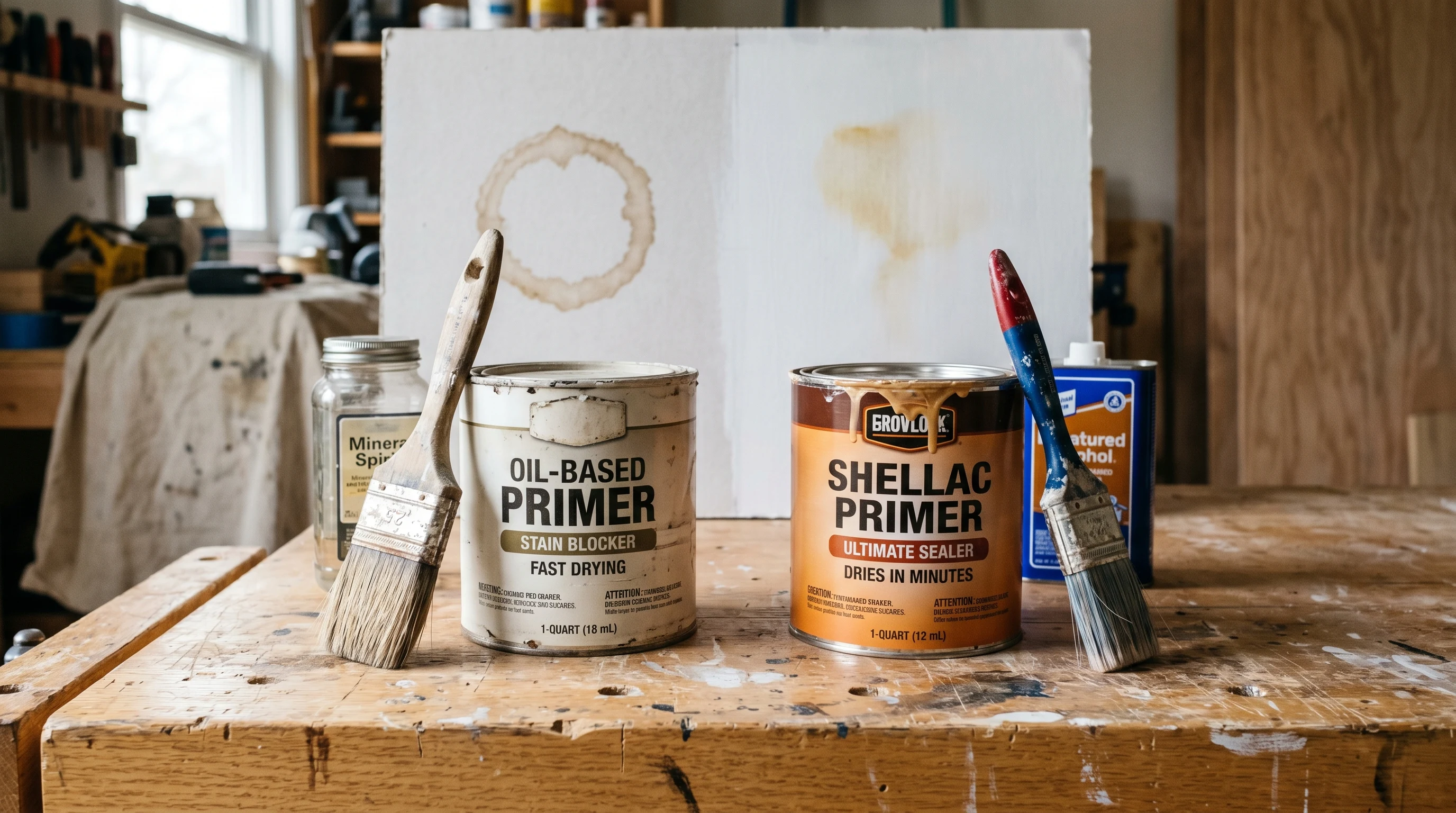
The 30-Second Answer
Both cans live on the same hardware-store shelf and both block stains nothing else can touch. The chemistries are completely different. BIN is shellac dissolved in denatured alcohol; it recoats in 45 minutes by alcohol flash-off, locks down smoke, nicotine, and the odors that come with them, bonds to glossy oil trim without sanding, and goes on in temperatures down to 0°F. Cover Stain is a styrenated alkyd in petroleum solvent; it cures by oxidation over 7 days, lays a film about 60 percent thicker for severe water damage and exterior wood, and asks you to wait overnight before a waterborne topcoat.
Then there is the number nobody puts on the shelf tag. Cover Stain runs about $31-39 a gallon and covers 400-450 square feet. BIN runs about $94-107 a gallon and covers about 500. That is roughly $0.09 a square foot against $0.20, so BIN costs about 2.5 times as much to put on a wall. Smoke ceiling, glossy trim, knot bleed, odor, freezing garage, fast turn: BIN. Heavy water rings, exterior siding, foundation walls, anything measured in whole rooms: Cover Stain. And on exterior knotty wood you are not choosing at all, because the manufacturer tells you to use both.
At a Glance
| Zinsser Cover Stain | Zinsser BIN | |
|---|---|---|
| Resin class | VT styrenated modified alkyd | Dewaxed shellac (lac-bug secretion) |
| Solvent | Aromatic hydrocarbons (petroleum) | Denatured alcohol |
| Drying mechanism | Oxidative cure (binds with O₂) | Solvent flash-off (no chemical cure) |
| Price per gallon | ~$31-39 | ~$94-107 |
| Coverage per gallon | 400-450 sq ft | ~500 sq ft |
| Cost per square foot | ~$0.08-0.10 | ~$0.19-0.21 |
| Touch-dry | 30 minutes | 20 minutes |
| Recoat (label) | 1 hour (see FAQ on waterborne topcoats) | 45 minutes |
| Full adhesion | 7 days | 1-3 days |
| Application temperature | 40-80°F | 0-90°F |
| Max relative humidity | 85% | 70% |
| Smoke / nicotine stains | Good | Best in class |
| Odor sealing (smoke, urine) | Not rated for it | Best in class |
| Heavy water rings | Best in class | Good |
| Knot bleed (cedar / pine) | Good | Best in class |
| Glossy oil trim adhesion | Needs scuff-sand | Bonds without sanding |
| Exterior use | Yes, whole surface | Spot priming knots and sap only |
| Cleanup | Mineral spirits | 1:3 ammonia-water, or denatured alcohol |
| Topcoat compatibility | Any (after full dry) | Latex, oil, alkyd, shellac same day |
| Aerosol option | Exists, impractical at scale | Genuinely useful (popcorn, spots, knots) |
| Can sizes | Quart, gallon, 3-gal, 5-gal | Pint, quart, gallon, 5-gal |
How the Chemistries Actually Differ
Two different worlds.
Shellac is a natural resin secreted by the lac bug, harvested in India and Thailand, processed into flakes, and dissolved in denatured alcohol. BIN is dewaxed shellac with titanium dioxide loaded into the alcohol carrier: 51% solids by weight, 29% by volume, 9.8 pounds per gallon. There is no chemical cure. The alcohol evaporates, the shellac reverts to its solid state, and a thin, hard, polar film stays behind at 0.75 to 0.9 mil per coat. Touch-dry lands at 20 minutes and recoat at 45, because alcohol flashes fast and shellac solidification is a phase change, not a polymerization. Full adhesion and hardness keep building for another 1 to 3 days, but nothing about the topcoat has to wait on that.
Cover Stain is the opposite chemistry, and the data sheet is more specific than the shelf label suggests. The binder is a VT styrenated modified alkyd: an oil-modified polyester backbone with styrene grafted into it. The styrene is the point. It stiffens the resin and pulls the dry time down sharply, which is why this primer is nothing like a classic slow long-oil house primer. The solvent is aromatic hydrocarbons, not plain odorless mineral spirits. Solids run much higher than BIN at 68.6% by weight and 45.6% by volume, 11.1 pounds per gallon, and the film comes out 1.0 to 1.5 mil per coat.
That last pair of numbers is worth sitting with. Cover Stain lays down roughly 60% more dry film per coat than BIN does. When the film has to bridge a saturated, mineral-laden water stain or stand up to weather on siding, thickness is doing real work. When the job is locking nicotine under a ceiling, it is not, and you are paying for solids you do not need.
When the solvent flashes off Cover Stain, the alkyd is still soft; it then cures by reacting with atmospheric oxygen to cross-link the unsaturated fatty-acid bonds into a continuous polymer film. Touch-dry in 30 minutes, recoatable in an hour, full adhesion at 7 days. Polar shellac in fast-flash alcohol against a styrenated alkyd in slow-cure petroleum solvent. Every other difference in this article flows from there.
Stain-Blocking Strength
The right primer depends on what the stain is actually made of.
BIN handles water-soluble stains and bleed-through pigments better than anything else on the shelf. Smoke residue on a kitchen ceiling. Nicotine on the walls of a former smoker’s house. Marker, crayon, food splatter, mildew shadow, pet urine, tannin from oak and cedar and redwood. The shellac resin is polar and forms a continuous, impermeable surface; soluble tannins and nicotine compounds don’t dissolve in shellac and can’t migrate through it.
Cover Stain handles oil-soluble stains and persistent organic stains better than BIN. Heavy water-ring damage where the substrate has been saturated and is now mineral-laden. Old grease shadows behind a stove. Asphalt or roof-cement bleed-through. Mineral stains on basement walls. The alkyd film is thicker per coat than shellac, and the cured polymer holds out oily compounds the way an oil topcoat does.
The rule: if the stain dissolved in water, BIN. If it dissolved in oil, Cover Stain. Smoke and nicotine sit at the top of the BIN curve and the bottom of the Cover Stain curve. Don’t put Cover Stain on a fire-damage ceiling.
Winner: BIN on smoke, nicotine, knot bleed, and water-soluble organic stains. Cover Stain on severe water damage, mineral stains, and grease.
Sealing Odors, Not Just Stains
This is a separate job from hiding a mark, and only one of these two cans is rated for it.
BIN’s headline claim from the manufacturer is odor sealing: the data sheet says it permanently seals odors from fire and smoke damage, nicotine and tobacco, and urine and other animal odors. That is not a stain-hiding claim restated. A smoke-damaged ceiling can be visually clean after a wash and still push the smell back into the room every time the heat kicks on, because the odor compounds have soaked into the drywall paper and the framing. Encapsulating them takes a continuous, impermeable film that the compounds cannot diffuse through, and the dried shellac film is exactly that.
Cover Stain blocks fire, smoke, and water stains. Rust-Oleum does not market it as an odor sealer, and in practice a cured alkyd film is more permeable to small odor molecules than shellac is. Prime a cat-urine subfloor with Cover Stain and you will likely still smell it in August.
So the decision tree for a remediation job is short. If the complaint includes a smell, the answer is BIN, whatever the stains look like. Two coats over the affected area, edge to edge, no gaps, and do not leave the framing or the subfloor bare if that is where the source soaked in. If the complaint is purely visual, cost comes back into play.
Winner: BIN. Not close, and not a dimension Cover Stain competes in.
Cost and Coverage
Every other section of this article is chemistry. This one is arithmetic, and it explains most of what pros actually do.
| Zinsser Cover Stain | Zinsser BIN | |
|---|---|---|
| Gallon, typical retail | $31-39 (Menards $31.13, True Value $35.99, Home Depot $37.98, Ace $38.99) | $94-107 (Home Depot $94.48, McCormick $107.12) |
| Quart | ~$19 | ~$19-30 |
| Coverage (per data sheet) | 400-450 sq ft/gal | ~500 sq ft/gal |
| Cost per square foot | ~$0.08-0.10 | ~$0.19-0.21 |
BIN actually covers more ground per gallon, because its film is thinner. It still lands at roughly 2.5 times the cost per square foot, because the gallon costs nearly three times as much.
Put that on a real job. A 1,200-square-foot interior, one coat, is about $110 in Cover Stain and about $250 in BIN. On a whole-house repaint with two coats, the gap is a few hundred dollars of pure material, which is why contractors who love BIN still do not prime houses with it. They prime with oil or water-based, and they keep a quart of BIN on the truck for the eight square feet that need it.
The size lineup follows the same logic. BIN comes in pint, quart, gallon, and 5-gallon, and the pint exists because spot priming is the normal use. Cover Stain comes in quart, gallon, 3-gallon, and 5-gallon, sized for surfaces rather than spots.
Winner: Cover Stain. Decisively, and it is the reason the large-area verdict goes the way it does.
Dry and Recoat Windows
BIN is the fastest stain-blocking primer made. Touch-dry in 20 minutes, recoat at 45, ready for topcoat inside the hour. No oxidative chemistry to wait on. Prime a smoke-damaged ceiling at 9am and have it under finish paint by 10:30.
Cover Stain is faster than its reputation. The data sheet says touch-dry in 30 minutes and recoat in 1 hour, with full adhesion at 7 days. Those numbers are technically correct and operationally misleading if you read them as a topcoat clearance. One hour gets you a surface skin and enough film strength for a second coat of the same primer. What it does not get you is a film that has finished releasing solvent, which continues for 12 to 24 hours. Waterborne latex inside that window risks solvent trapping: the latex tries to coalesce while solvent is still escaping from below, and the bond suffers in a way that shows up months later as sheet peeling. Stack oil over oil the same day. Wait overnight for waterborne.
Winner: BIN. Decisively on real time-to-topcoat, even though the label gap looks narrow.
Application Temperature and Humidity
The most underrated line on either data sheet, and the one that settles a whole category of jobs before chemistry gets a vote.
BIN applies from 0°F to 90°F. Zero. Rust-Oleum lists application in freezing temperatures as a feature, and the reason is structural: BIN dries by alcohol evaporation, and alcohol evaporates below freezing. There is no cross-linking reaction that needs warmth to proceed. The constraints are relative humidity under 70%, substrate moisture under 12%, and a surface at least 15°F above the dew point.
Cover Stain needs 40°F to 80°F, because oxidative cure slows and eventually stalls in the cold. Below 40°F you are not getting a slow cure, you are getting an uncured film that stays soft, stays soft under the topcoat, and fails later. Cover Stain tolerates more moisture in the air, though, up to 85% relative humidity.
That splits the awkward jobs cleanly:
- Unheated garage, vacant house, porch ceiling, exterior trim in February: BIN is the only one of the two that will dry. This is the case pros know and homeowners never hear about.
- Muggy bathroom or basement in August, no dehumidifier: the sides flip. Above 70% relative humidity, BIN is out of spec and Cover Stain is still inside its 85% window. If you are priming a steamy bathroom for a mildew or water stain, run the fan or a dehumidifier first and check the number, or use Cover Stain and give it the overnight.
Winner: BIN on cold. Cover Stain on humidity. This is the one dimension where the usual answer reverses.
Smell and Cleanup
BIN smells like industrial alcohol: acrid, sharp, fast-flashing. The smell flashes off with the solvent, and an hour after the last brush stroke the room is breathable.
Cleanup is the part most people get wrong, and it costs them money. Everyone reaches for denatured alcohol, which has gotten expensive and is restricted at retail in several states. The data sheet gives a cheaper standard method: wash tools immediately in 1 part household ammonia to 3 parts water. For a brush that already dried hard, soak it overnight in a 1:1 ammonia-water mix and it will come back. Spills and drips lift with acetone, denatured alcohol, or an ammoniated detergent. A gallon of ammonia from the grocery store cleans a lot of BIN brushes for the price of a small can of alcohol.
Cover Stain smells like oil paint. Heavier, sweeter, longer-lingering. The solvent doesn’t flash; it works its way out as the film cures. Open the can in a small bathroom and the room is unpleasant for the rest of the day and faintly noticeable into the next morning. Cleanup is mineral spirits, and it takes longer.
Two storage and prep notes that apply to both cans and are easy to trip over. BIN has a 54°F flash point, so it has to be stored indoors between 40 and 80°F, never in a freezing shed or a hot truck bed in July. And do not wash the surface with TSP before either primer: both data sheets prohibit it, because TSP residue interferes with adhesion. Shelf life is 3 years for BIN, 5 for Cover Stain.
For a small ventilation-limited room, BIN’s brutal-but-fast smell is preferable to Cover Stain’s steady fade. For an unfinished basement or open exterior with airflow, Cover Stain’s longer fade is unobjectionable. Neither primer should be used without ventilation.
Winner: BIN in tight spaces, and on cleanup cost once you know about the ammonia. Cover Stain is fine in ventilated work.
Adhesion to Glossy Substrate
This is where BIN does something nothing else does.
Shellac bonds to cured oil paint, glossy alkyd trim, varnish, and old shellac without scuff-sanding. The polar alcohol carrier wets the glossy surface, and the shellac keys into the substrate as the alcohol flashes. BIN is the only primer in mass-market production that bonds to high-gloss oil trim without surface prep. For a turn-of-the-century house with original oil-trim casing the homeowner doesn’t want to sand, BIN is the answer.
Cover Stain doesn’t have this property. Glossy oil trim under fresh Cover Stain peels at the bond line within months. The standard procedure is scuff-sand with 220-grit, dust off, then prime. The alkyd then bonds mechanically to the abraded film.
Winner: BIN. The “no sanding” claim is real and chemistry-based.
Film Toughness Against Food, Water, and Grease
The two primers cure to different end states.
Shellac is hard, polar, and water-resistant from the moment the alcohol flashes. Wipe-down with a damp cloth: fine, immediately. Soap and water: fine after the topcoat. Shellac is softened by alcohol, so don’t clean a BIN-primed surface with anything containing alcohol or ammonia until the topcoat is on.
Cover Stain is the tougher of the two at full cure, but the cure is slow. Wipe down a Cover Stain-primed wall with anything wet inside the first week and the partially-cured film softens locally. This bites homeowners who prime kitchen cabinets on Saturday and try to wipe spilled coffee off the boxes on Tuesday. Wait the full week before any moisture exposure.
In practice, both films are usually under a topcoat within 24-48 hours, which makes the cure-rate gap moot for most jobs.
Winner: Cover Stain at full cure. BIN at every point before that.
Topcoat Compatibility
BIN takes any topcoat. Latex, oil, alkyd, shellac, even epoxy. The cured shellac surface is chemically inert to common waterborne and solventborne topcoats. No wait, no scuff, just paint over it.
Cover Stain takes any topcoat too, but the timing matters. Once the alkyd film is fully cured, latex and oil both bond cleanly. Inside the cure window, waterborne topcoats risk solvent trapping and the bond can fail months later when the trapped mineral spirits finish migrating out. Same-day oil-over-oil if stacking coats; next-day waterborne over Cover Stain.
There is also a pigment consideration. BIN’s white is bright and crisp; Cover Stain’s white runs slightly warmer because of the alkyd resin’s natural amber tint. Under a thin coat of bright-white finish paint, the warm tint of Cover Stain ghosts through unless you topcoat at full build.
Winner: BIN. On compatibility, speed-to-topcoat, and color neutrality under whites.
Prep Exceptions That Override the Label Times
The 45-minute recoat is a headline, not a rule. The fine print on the data sheets has exceptions that will burn you if you work off the headline, and they cluster around exactly the substrates people buy these primers for.
- New cedar and redwood under BIN: wait 24 hours before topcoating, not 45 minutes. The extractives in fresh cedar and redwood keep migrating, and a shellac film that has been rushed under a topcoat can let a stain through it that a fully dried one would have held.
- New plaster has to cure 30 days before BIN goes on. Priming green plaster traps moisture and alkalinity under an impermeable film, and both come back out through your finish coat.
- Bare wood that has been exposed to weather for more than about 4 weeks needs a scuff with 80 to 100 grit before priming. The surface fibers have degraded, and primer bonds to the degraded layer rather than to sound wood.
- Tinting prolongs the dry time. BIN accepts up to 2 ounces of universal colorant per gallon, which is worth doing under a deep topcoat color, but budget more time before recoating.
- Do not thin either primer. Both are formulated to spray as supplied, and thinning BIN in particular breaks the film build the stain-blocking depends on.
- Neither is a floor or deck primer, and neither survives immersion. Cover Stain additionally excludes roof surfaces.
The Exterior Question: It’s Usually Both Cans
The common answer, including the one this article used to give, is that BIN is an interior product and Cover Stain is the exterior one. That is half right and it misses the workflow the manufacturer actually specifies.
BIN is not rated for whole-surface exterior use. Shellac is sensitive to UV and to repeated wet-dry cycling, and a shellac film left as the only primer on exposed siding softens and loses adhesion. That part is true.
But the Cover Stain data sheet contains a direct instruction: spot prime knots and sap streaks with BIN Primer-Sealer before priming the whole surface with Cover Stain. The BIN data sheet says the same thing from the other direction, limiting exterior use to spot priming knots and sap bleed before a full-surface water- or oil-based primer goes over it. The two products are designed to be used together on exterior wood, and the manufacturer of both says so.
So the correct sequence on knotty exterior siding, trim, or a cedar door is three steps:
- Two coats of BIN on the knots and sap streaks only, feathered slightly past each one.
- Cover Stain (or a quality exterior acrylic primer) over the entire surface, knots included.
- Your exterior topcoat.
Skip step one on cedar or knotty pine and the knots will telegraph amber through the finish inside a year, no matter how good the exterior primer is. Skip step two and the shellac takes the weather it was never meant to take. Neither can does this job alone, and a pint of BIN covers a whole house worth of knots.
BIN vs BIN Advanced: The Two White Cans
There is a third can on the shelf that causes more confusion than any other primer in the store, and it looks nearly identical to the one you want.
Original BIN is real shellac in denatured alcohol. Everything above describes this can.
BIN Advanced Synthetic Shellac is a water-based primer built on a synthetic resin engineered to behave like shellac. Much lower VOC, far less odor, soap-and-water cleanup, a slightly slower dry, and a more flexible film that is less prone to cracking on substrates that move. Rust-Oleum positions the two as performance equals.
Working painters, in the trade forums where these things get argued for years, do not agree. The consistent field reports on Advanced are weaker adhesion than original shellac, less complete tannin blocking, and sandpaper that gums up instead of cutting. Nobody claims it is a bad primer. The claim is that it is not the same primer, and that the difference shows up on exactly the severe jobs you would buy a shellac primer for.
The rule worth writing on the can:
- Severe smoke, nicotine, fire odor, pet odor, active knot bleed, glossy oil trim with no sanding: original alcohol-based BIN. These are the jobs where nothing else works and the compromise costs you the job.
- Milder stains where the odor or the VOC rules are the binding constraint (occupied house, sensitive household, a state with tight VOC limits, an interior job you cannot ventilate): BIN Advanced is the reasonable compromise, and cleanup at the sink is a genuine convenience.
Price runs the way you would expect from the chemistry: Home Depot lists Advanced at $241 for 5 gallons against $415 for 5 gallons of the original. If you are pricing a large low-odor job, Advanced is doing you two favors at once. Just do not let the price talk you into it for a fire-restoration ceiling.
Where the Water-Based Option Fits
Most people arriving at this comparison are actually still holding a three-way question, so it’s worth placing the third option before you spend $95 on a gallon you may not need.
A standard water-based stain-blocking primer, the Zinsser Bulls Eye 1-2-3 class, runs about $15-25 a gallon. Low odor, water cleanup, a wide 35-90°F application window, and completely adequate for the two most common priming jobs there are: bare drywall and previously painted walls in sound condition. If there is no stain, no knot, no odor, and no gloss to defeat, this is the can, and buying either of the specialists instead is spending money on performance the job cannot use.
Where it loses is specific and predictable. Water raises the grain on raw wood and MDF, so you sand a fuzz back down before the topcoat lays smooth. And on knots, tannin, smoke, nicotine, and heavy water stains it finishes behind both of the primers in this article. In published scrape-adhesion testing, the ranking came out shellac first, oil second, water-based third, which matches what the chemistry predicts.
The practical hierarchy, then: water-based by default, oil when the surface is fighting you or the area is large, shellac when the stain or the odor is one nothing else seals. For the full head-to-head on the water-based side, see BIN vs Bulls Eye 1-2-3 and latex vs oil primer.
The Full Spec Sheet
The numbers behind everything above, pulled from the two manufacturer data sheets. Useful if you’re specifying, spraying, or arguing with a supplier.
| Zinsser Cover Stain | Zinsser BIN | |
|---|---|---|
| Resin | VT styrenated modified alkyd | Dewaxed shellac |
| Solvent | Aromatic hydrocarbons | Denatured alcohol |
| Solids by weight | 68.6% | 51% |
| Solids by volume | 45.6% | 29% |
| Weight per gallon | 11.1 lb | 9.8 lb |
| VOC | 450 g/l | 550 g/l max |
| Dry film per coat | 1.0-1.5 mil | 0.75-0.9 mil |
| Flash point | 83°F | 54°F |
| Shelf life | 5 years | 3 years |
| Flame spread | — | 0, Class 1 |
| Tinting | Accepts colorant | Up to 2 oz universal colorant per gallon |
| Airless tip | 0.015-0.017 inch | 0.011-0.013 inch |
| Airless pressure | 1500-2000 psi | 800-1200 psi |
| Thinning | Do not thin | Do not thin |
Two things to pull out of that table. First, the dry film numbers are the honest version of the “thicker film” claim: 1.0-1.5 mil against 0.75-0.9 is roughly 60% more build per coat, and that is the whole argument for Cover Stain on heavy water damage and exterior wood. Second, the spray settings are not interchangeable. BIN is thin and wants a small tip at low pressure; run it through a 0.017 at 2000 psi and you will get runs and an atomized fog of alcohol. Cover Stain at BIN’s settings will tail and finger. Change the tip when you change the can.
One more BIN spec that matters in specification work: the dried film is rated non-toxic and hypo-allergenic, with a flame spread of 0 and a Class 1 rating. That is why it turns up in schools, hospitals, and food-service remodels where the coating stack has to be justified on paper.
A Note on the Aerosol Cans
BIN aerosol is the right answer for popcorn ceilings. Brushing rips the texture off; rolling pulls strands. The aerosol lays a continuous shellac film without disturbing the texture. Reserve it for popcorn, knots, and spot priming on stains. Cover Stain aerosol exists and works, but cost-per-square-foot makes it impractical at scale. For a whole ceiling, a gallon and a roller is the right call.
Verdict by Use Case
- Pick BIN if: the stain is smoke, nicotine, marker, knot bleed, or water-soluble; there is an odor to seal, not just a mark to hide; the substrate is glossy oil trim you don’t want to sand; the surface is popcorn texture; the room is small and ventilation-limited; the space is unheated and it’s winter; you need the topcoat going on within the hour.
- Pick Cover Stain if: the stain is severe water damage with mineral content, grease shadow, or asphalt bleed; the substrate is exterior wood or masonry; the air is humid enough to put BIN out of spec; the room has good ventilation and you can give the cure 24-plus hours before a waterborne topcoat; the area is large enough that a 2.5x cost per square foot is real money.
- Use both if: the job is exterior knotty wood. BIN on the knots and sap streaks, Cover Stain or an exterior acrylic over the whole surface, then the topcoat. This is the manufacturer’s own sequence, not a workaround.
- Step down to a water-based primer if: there is no stain, knot, odor, or gloss to defeat. Bare drywall and sound painted walls do not need either of these cans.
- It’s a tie when: the stain is moderate (a single old water ring, a few knots in interior pine), the substrate is interior drywall or flat trim, and either primer will solve the problem cleanly. Pick on whichever is on the truck and on the topcoat schedule.
Top Picks by Side
Going with shellac? Zinsser BIN is the only mass-market dewaxed-shellac primer worth specifying. Buy the size that matches the job, not the wall: a pint or quart ($19-30) for knots, stains, and odor spots, a gallon ($94-107) only when you are genuinely priming a whole smoke-damaged room. Aerosol for popcorn ceilings, knots, and tight spots. Verify: Zinsser BIN Shellac-Base Primer product page. Find a can: Zinsser BIN on Amazon.
Need the low-odor version? Zinsser BIN Advanced is the water-based synthetic-shellac alternative for occupied houses and VOC-restricted work, at a real discount on the large sizes ($241 vs $415 per 5 gallons). Accept the trade-offs described above and keep it off severe smoke, nicotine, and active knot bleed. Verify: Zinsser BIN Advanced product page. Find a can: Zinsser BIN Advanced on Amazon.
Going with oil? Zinsser Cover Stain is the styrenated-alkyd standard and the cheapest way to cover real square footage with a heavy-duty stain blocker at roughly $0.09 a square foot. Brush and roller at gallon scale, or spray it with a 0.015-0.017 inch tip; skip the aerosol unless you’re spot-priming a single mark. Verify: Zinsser Cover Stain Oil-Base Primer product page. Find a gallon: Zinsser Cover Stain on Amazon.
Priming exterior knotty wood? Buy both. A pint of BIN for the knots and a gallon of Cover Stain for the surface is about $115 and is what the manufacturer’s own instructions call for.
For the broader primer landscape (water-based stain blockers, bonding primers, masonry primers), see the primer round-up.
Related
- Best primer round-up: every primer class and where it belongs
- BIN vs Bulls Eye 1-2-3: shellac against the water-based option
- Latex vs oil-based primer: the three-way question, simplified
- Water stains on ceiling: diagnosis and the right primer to seal them
- Yellowing trim: what’s bleeding through and how to lock it down
- Primer vs paint-and-primer-in-one: when the marketing claim doesn’t hold
- Bare wood interior: primer choice for trim, doors, and casework
Ask a Question