Bonding Primer vs Stain-Blocking Primer
A chemist's head-to-head on bonding primer vs stain blocker: which one grips glossy surfaces, which one seals tannins and water rings, and how to pick.

The 30-Second Answer
Bonding primer fixes an adhesion problem: the surface is too slick for paint to grip. Stain-blocking primer fixes a bleed-through problem: something underneath keeps migrating up into your topcoat. They solve different failures, so the right pick is set by what’s wrong, not by preference. Glossy laminate, tile, or oil enamel that paint slides off? Bonding primer. Water rings, smoke, tannins, or marker that ghost through? Stain blocker. When you have both at once, seal the stain first, then bond over it.
At a Glance
| Bonding primer | Stain-blocking primer | |
|---|---|---|
| What it fixes | Adhesion to slick surfaces | Bleed-through of stains |
| Grips glossy / non-porous | ✓✓ | ~ (shellac only) |
| Seals water / tannin / smoke | ✗ (water-based bleeds) | ✓✓ |
| Cleanup | ✓✓ (soap and water) | ✗ (alcohol or solvent) |
| Odor | Low | High (shellac/oil) |
| Cost per gallon | $$ | $$–$$$ |
How to Tell Which Problem You Actually Have
Run two quick tests on the surface before you buy anything.
For the adhesion question: press a strip of painter’s tape down hard on a scrap of existing finish, then rip it off fast. If old paint lifts, or if the surface is so slick the tape barely sticks, you have a grip problem. A fingernail scratch helps too. Hard, glassy, no mark left behind means the substrate is non-porous and a topcoat won’t key into it.
For the bleed-through question: look at what’s there. A brown ring on a ceiling, yellow nicotine film, a dark knot in pine, a kid’s marker line. Those are soluble compounds that will dissolve up into a fresh coat. Dab a little water on a suspected stain. If it reactivates or darkens, a water-based primer will carry it straight through.
What Each One Fixes
Here’s the chemistry, because the two primers are built around opposite goals.
A bonding primer is engineered for mechanical and chemical grip on surfaces with no tooth. The binder is usually a modified acrylic or a urethane-acrylic with a high-tack resin and additives that wet out and cling to low-energy surfaces: melamine, PVC, fiberglass, glass, glazed tile, glossy alkyd enamel. The reason for that is surface energy. Paint adheres by getting into microscopic pores and by chemically wetting the substrate. A slick surface offers neither, so a standard primer beads and lets go. Bonding primer carries resins that grab anyway. Zinsser Stix and Glidden Gripper are the common water-based options.
A stain-blocking primer is built to be a one-way door. Its job is to seal soluble contaminants under a film they can’t dissolve back through. The two formats that work are shellac (Zinsser BIN) and oil/alkyd (Zinsser Cover Stain, KILZ Original). Shellac is dissolved in denatured alcohol, so once the alcohol flashes off, water-soluble stains underneath have no solvent to climb back up into. Same logic for oil: water stains and tannins aren’t soluble in the alkyd film, so they stay put. A water-based “stain blocker” exists, but it relies on opacity and a tight film rather than solvent chemistry, and it loses to shellac on the stains that matter most.
Adhesion to Slick Surfaces
This is the category bonding primer was invented for, and nothing else competes cleanly.
On melamine cabinets, glazed tile, glass, fiberglass doors, or PVC trim, a water-based bonding primer like Stix or Gripper wets the surface and cures into a film with measurable pull-off strength. Topcoat then bonds to the primer, which is now a porous, paint-friendly layer. Skip it and the topcoat peels at the first stress point, usually a cabinet door edge or a corner that gets handled.
Shellac (BIN) also bonds to glossy oil trim, which is why pros reach for it on pre-1990 enamel. But BIN is brittle. On a flexible substrate (vinyl, fiberglass, anything that moves with temperature) it can crack and lose its grip over a season. For raw plastic and melamine specifically, a dedicated acrylic bonder holds better and stays flexible.
Winner: Bonding primer.
Stain Sealing
Now flip it. Take a brown water ring on a ceiling and roll a water-based bonding primer over it. The water in the primer reactivates the stain, and within an hour the ring ghosts back through the wet film. Two coats won’t fix it. Three won’t either.
Stain blockers seal because the carrier doesn’t dissolve the contaminant. For water rings, smoke, and nicotine, shellac (BIN) is the gold standard, dries in 45 minutes, and seals in one coat. For heavy tannin bleed (cedar, redwood, knotty pine) and exterior work, an oil stain blocker like Cover Stain holds up better because it stays flexible outdoors. Knots specifically need shellac or oil; the resin in a live knot keeps weeping for years and a water-based primer can’t cap it. See the fix for knots bleeding through paint for the full sequence.
Winner: Stain-blocking primer (and it’s not close).
Cleanup & Odor
Water-based bonding primers clean up with soap and water and run low on odor. Stix and Gripper are pleasant to use indoors, no respirator needed beyond basic ventilation.
Stain blockers cost you here. Shellac needs ammonia or denatured alcohol for cleanup and fills a room with a sharp alcohol smell that lingers. Oil stain blockers need mineral spirits and off-gas solvent for hours. Both want real ventilation and a respirator on a big job. If you’re sealing a single water ring, you’ll live with the smell for an afternoon. If you’re priming a whole smoke-damaged room in BIN, it’s a hard day.
Winner: Bonding primer.
Cost
Per gallon, the two land close, with stain blockers running a little higher. A water-based bonding primer like Stix runs roughly $40–55 a gallon. Shellac (BIN) runs $45–60. Oil stain blockers (Cover Stain) sit around $35–50. Spray cans of BIN cost more per square foot but make sense for spot-sealing a few knots or a single ceiling ring without cleaning a brush.
Coverage is similar across the board, roughly 300–400 square feet per gallon. Cost isn’t the deciding factor here. The job decides.
Winner: Tie. Pick on the problem, not the price.
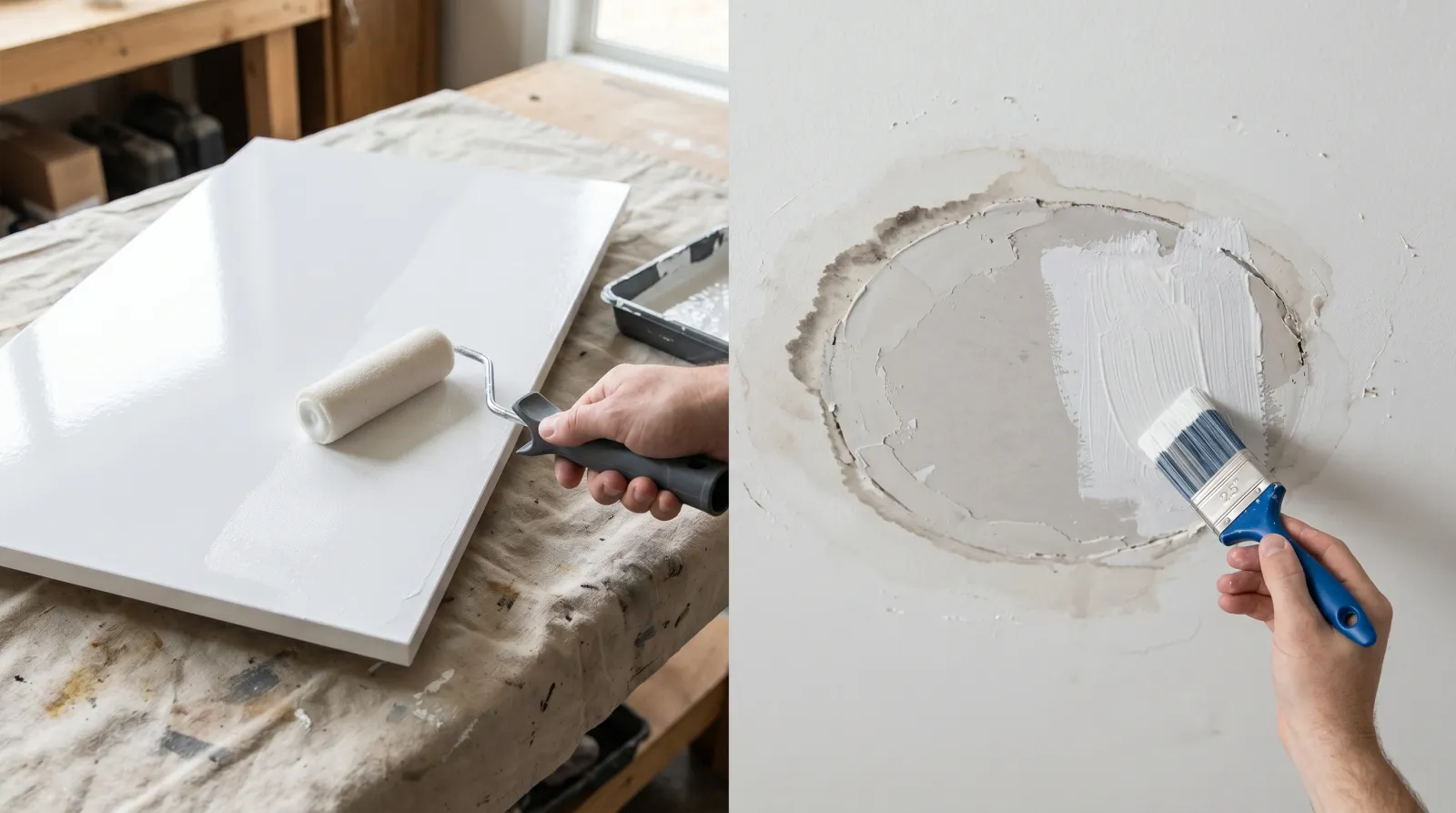 Two different failures, two different primers: grip on the left, seal on the right.
Verdict by Use Case
- Pick bonding primer if: you’re painting melamine or laminate cabinets, glazed tile, glass, fiberglass doors, PVC trim, or any glossy oil enamel where the topcoat would otherwise peel. The surface is clean and sound, it just won’t grip.
- Pick stain-blocking primer if: you’re covering water rings, smoke or nicotine film, tannin bleed from cedar or pine, knots, or marker and crayon. The surface holds paint fine, but something keeps migrating up through it.
- Use both when: a slick surface also has a stain. Spot-seal the stain with shellac or oil first, let it cure, then bond-prime the whole surface so the topcoat grips evenly.
For glossy laminate furniture and melamine, the bonding step is non-negotiable. See the stained or varnished wood paint-over guide for the prep that goes with it.
Top Picks by Side
Going with a bonding primer? Zinsser Stix is the default for cabinets and slick trim; Glidden Gripper is the budget alternative. See the full primer round-up for the head-to-head.
Going with a stain blocker? Zinsser BIN (shellac) for interior water and smoke stains, Cover Stain (oil) for knots and exterior tannin. The primer round-up covers both, and the primer vs sealer breakdown explains where a dedicated sealer fits instead.
Common Mistakes
Rolling a water-based primer over a fresh water stain. The single most common failure. The water in the primer reactivates the stain and it ghosts straight back. Always seal with shellac or oil first.
Assuming self-priming paint handles slick surfaces. It doesn’t. Self-priming wall paint has no adhesion package for low-energy substrates. On melamine it lifts off in sheets the first time you stress an edge.
Skipping the scuff before bonding primer. Even a bonding primer grips better on a lightly abraded surface. A quick 220-grit scuff on glossy enamel or laminate gives the resin something to bite, and it costs five minutes.
Using BIN on a flexible substrate and expecting it to last. Shellac is brittle. On vinyl, fiberglass, or anything that flexes with temperature, it cracks and releases over a season. For those, a flexible acrylic bonder is the right call.
FAQ
Can I use bonding primer on bare drywall? You can, but you’re wasting money. Bare drywall is porous and a standard drywall primer-sealer is cheaper and seals the paper face better. Save the bonding primer for surfaces paint can’t grip on its own.
Does stain-blocking primer help paint stick? Indirectly. Shellac and oil stain blockers bond well to glossy oil surfaces, so on pre-1990 enamel trim they double as a grip layer. But they don’t grip raw plastic or melamine, and shellac is too brittle for flexible substrates. For a pure adhesion problem on plastic, use a dedicated bonding primer. For more on the primer-versus-sealer distinction, see the primer vs sealer comparison.
How many coats of each do I need? One coat of stain blocker seals most stains; heavy nicotine or deep knots sometimes want two. One coat of bonding primer is standard before topcoat. More coats of bonding primer don’t improve adhesion. The first coat does the work.