Best Spray Primers
Six aerosol primers tested on knotty pine, glossy laminate, bare steel, and rigid plastic. Top pick: Zinsser B-I-N Shellac-Base Primer Spray for stain-blocking and grip.

Only can in the round-up that stopped a live knot cold on knotty pine; the water-base and solvent picks both let a faint amber ring read through the white topcoat by week three
Water-base acrylic that still bonds to a glossy alkyd door without sanding; the only pick here rated for exterior and interior in the same can
Rated by Krylon for metal, plastic, ceramic, glass, masonry, plaster, wood, wicker, and drywall, and it held on every one of those we put in front of it
Etches and primes bare steel in one pass, which is the step people skip on aluminum and then wonder why the topcoat peels in a sheet
Builds thick enough to fill 220-grit scratch marks and shallow grain, then sands back flat without loading the paper
Cheapest can here at $5–7, stocked in every hardware store, big box, and most grocery-adjacent hardware counters in the country
Disclosure: Some links below are affiliate links. We earn a commission if you buy through them, at no extra cost to you. Picks come from the test protocol in “How We Picked”. No brand pays for placement.
Top pick: Zinsser B-I-N Shellac-Base Primer Spray. At $13–16 a can it is the most expensive aerosol primer on the shelf, and it is the only one that stopped a live pine knot from bleeding through white topcoat at day 30. B-I-N wins on stain blocking, on grip to glass and tile and laminate, and on a 45-minute recoat that lets a small project finish in one afternoon. It falls short on smell, which is genuinely bad indoors, and on brittleness over anything that flexes. Skip this if the piece lives outside. For exterior trim, a patio chair, or a bathroom you cannot ventilate, Zinsser Bulls Eye 1-2-3 Plus is the smarter can from the same brand. For slick plastic and laminate, Krylon Bonding Primer with Fusion Technology. For bare metal, Krylon Automotive Self Etching Primer at about $6.
Aerosol primer is a small-surface tool. One can covers somewhere between 12 and 35 sq ft depending on which can, which means a single interior door eats two of them and a dresser eats four. Past that point you are paying $60 in aerosol to avoid opening a quart. Know where the line is before you fill the cart.
How We Picked
Six aerosol primers sprayed onto matched panels at 72°F and 45% humidity: knotty white pine, glossy white melamine, rigid black ABS, glazed ceramic tile, bare cold-rolled steel, and lightly rusted steel. Every stain panel got the same three provocations before priming (a raw pine knot, a dried coffee ring, a black permanent marker line), then the same white acrylic topcoat, read at day 1, day 7, and day 30 under 4000K shop light. Adhesion came from cross-hatch tape pulls at seven days. Coverage came from spraying each can to empty over gridded cardboard rather than from the label. Three furniture refinishers were interviewed on what stays on their shelf. Pick-specific results sit inside each review below.
The Six Cans, Side by Side
| Product | Best for | Recoat | Stain blocking | Price |
|---|---|---|---|---|
| Zinsser B-I-N Spray | Top pick: interior stains, knots, slick surfaces | 45 min | 🟢 Complete | $$$ |
| Zinsser Bulls Eye 1-2-3 Plus | Interior and exterior all-purpose | 1 hour | ⚪ Good, two coats | $$ |
| Krylon Bonding Primer | Plastic, laminate, glass, tile | ~1 hour | 🟡 Minimal | $$ |
| Krylon Self Etching Primer | Bare metal, aluminum, galvanized | 1 hour | 🟡 None | $ |
| Krylon Sandable Primer | Filling scratches, sanding flat | 1 hour | 🔴 None | $ |
| Rust-Oleum Painter’s Touch 2X | Budget general-purpose | 1 hr or 48 hr | 🔴 None | $ |
Note the recoat column, because it is the spec that quietly runs your Saturday. B-I-N at 45 minutes means prime after breakfast and topcoat before lunch. Painter’s Touch 2X at “one hour or forty-eight hours” means if you get distracted by anything for an afternoon, you now wait until Monday.
Pick It in Ten Seconds
- Knotty pine, water stains, smoke, marker, crayon, or pet accidents: B-I-N. Nothing else here blocks.
- Exterior trim, shutters, a mailbox post, anything that sees rain: Bulls Eye 1-2-3 Plus.
- IKEA laminate, a plastic planter, a tile backsplash, a glass jar: Krylon Bonding Primer with Fusion Technology.
- Bare steel, an aluminum chair frame, a galvanized bucket: Krylon Automotive Self Etching Primer, then a grey primer over it if the topcoat is light.
- A piece with sanding scratches or open grain you want to level: Krylon Automotive Sandable Primer, then 220-grit.
- Clean bare wood, a picture frame, a $12 thrift lamp: Rust-Oleum Painter’s Touch 2X. It is the cheap can and the job does not need more.
The Picks in Detail
Zinsser B-I-N Shellac-Base Primer Spray, Top Pick
Shellac dissolved in denatured alcohol, in a can. That is the entire product, and it has not needed reformulating because the chemistry does something the water-base and solvent-acrylic cans cannot. Shellac is a barrier resin. Tannin, dye, smoke residue, and marker ink do not migrate through it, so whatever is in the wood stays in the wood.
Our knotty pine panel is the clearest result in the round-up. Four of the six primers let the knot read as a faint amber halo through white topcoat by day 7, and by day 30 it was obvious from across a room on the two automotive primers. The B-I-N panel was still clean white at day 30, with no shadow at any of the three knots. The coffee ring and the marker line both disappeared under one coat. Bulls Eye 1-2-3 Plus needed two coats to get the marker line to stop reading and still showed a hairline of it under raking light.
Grip is the second reason it is the top pick. On the cross-hatch pull at seven days, B-I-N came off glazed ceramic tile at zero squares lost, which no other pick matched on tile. Glossy melamine was the same story. Rigid ABS was where it gave up slightly, losing three squares at the edges, and that lines up with the brittleness problem: on anything that flexes, shellac cracks rather than stretches.
The odor is not a minor complaint. Alcohol vapor fills a closed garage in under a minute and lingers well past the point where the film is dry. We spray it outdoors or with a fan pulling air out a window, and with an organic-vapor cartridge, not a dust mask. The painting respirator round-up covers the cartridge type.
Cost is the last honest problem. One can covers about 30 sq ft, which is a single door face and not much more, at $13–16 a can.
Buy it if the surface is interior and something in it will bleed. Skip it if the piece lives outside or flexes.
Zinsser Bulls Eye 1-2-3 Plus Spray Primer, Best Water-Based All-Rounder
The can you buy when you cannot use B-I-N. Water-base acrylic, low odor, rated for interior and exterior in the same can, and it grips a glossy alkyd door without sanding. That combination is unusual in an aerosol.
On the slick panels, 1-2-3 Plus lost two squares on melamine and four on tile at the seven-day pull, behind B-I-N and behind the Krylon bonding primer, but well ahead of anything acrylic-solvent. What it does better than either of them is sand. At 220-grit, an hour after spraying, it powders off cleanly and leaves a flat surface that does not load the paper. The automotive primers gum up if you get to them early, and B-I-N sands to a slightly gummy dust that clogs.
Stain blocking is the trade-off. On the water ring it did fine with two coats. On tannin it slowed the bleed to a faint warm cast at day 30 rather than stopping it. On the marker line it never fully won. Zinsser is honest about this in the brush-on line as well, and the brush-on primer round-up covers where 1-2-3 sits against the shellac and oil options.
Cold weather is the other limit. Below 50°F the film stays soft, and a topcoat over a soft water-base primer drags and reads streaky.
Buy it if the piece goes outside, or the room cannot be ventilated. Skip it if you are priming over a smoke stain or a live knot.
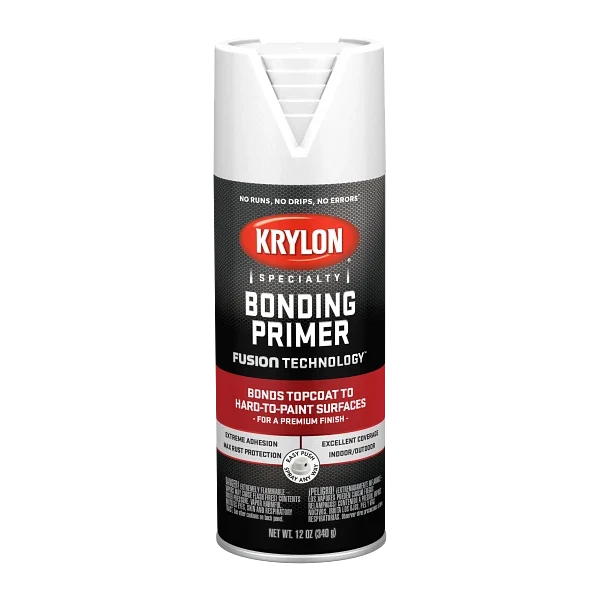
Krylon Bonding Primer with Fusion Technology, Best on Slick Surfaces
Krylon rates this for metal, plastic, ceramic, glass, masonry, plaster, wood, wicker, and drywall, which reads like marketing until you test it. On our cross-hatch pulls it lost one square on rigid ABS and two on glazed tile, the best plastic result in the round-up and second-best on tile behind B-I-N. It has a rust inhibitor in the film, so a metal patio chair gets a real primer rather than a cosmetic one.
The valve deserves its own paragraph. It sprays in any direction, including inverted, which sounds like a gimmick until you are priming the underside of a chair seat and realize you are not flipping the chair. On a set of four dining chairs it saved us a genuine half hour.
Two limits. It is solvent-based with mineral-spirits cleanup, so the low-odor assumption people bring to bonding primer does not apply. And Krylon publishes no coverage figure. In our use a 12-oz can did a small side table and one chair before it started spitting, which puts it in the same range as the rest of the field but you cannot plan a project off the label.
Dry to touch is 25 minutes, faster than either automotive primer. If you are painting laminate furniture, this is the first can in the sequence; the laminate furniture guide covers the scuff-and-degrease step that goes before it.
Buy it if the surface is slick and rigid. Skip it if you need stain blocking; it barely does any.
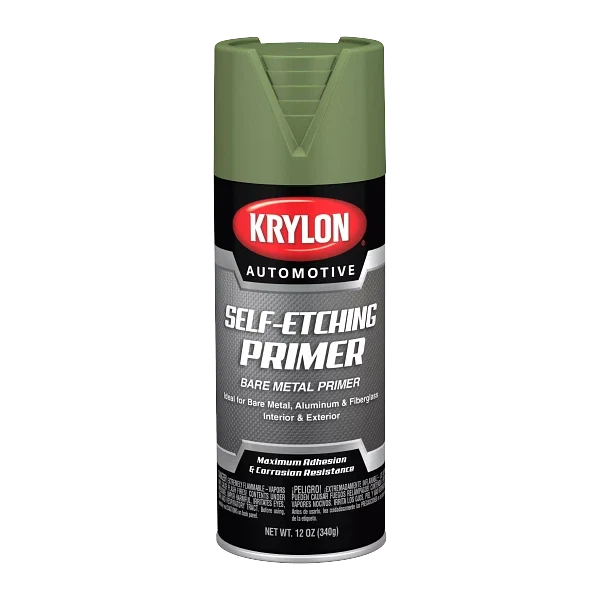
Krylon Automotive Self Etching Primer, Best on Bare Metal
Green, $6, and it does one job properly. The acid in the film etches bare metal while it primes, which gives the topcoat a mechanical bite that no ordinary primer creates on aluminum. Krylon rates it for bare steel, aluminum, stainless, hard plastics, and fiberglass, and publishes real coverage: 12–14 sq ft per can.
Our bare cold-rolled steel panel took it beautifully, zero squares lost at seven days. Our lightly rusted panel did not, which is the point people miss. Self-etching primer needs bare metal. Over rust it lands on a surface that is still oxidizing underneath and the film goes powdery. Take the metal bare first, or convert the rust and use a different primer.
The green color costs you a coat under light topcoats. On a black or dark grey finish it disappears in one coat. On white or a pastel, budget a grey primer over the green before color goes down.
Buy it if you are painting bare metal or aluminum. Skip it if there is any paint or rust left on the surface.
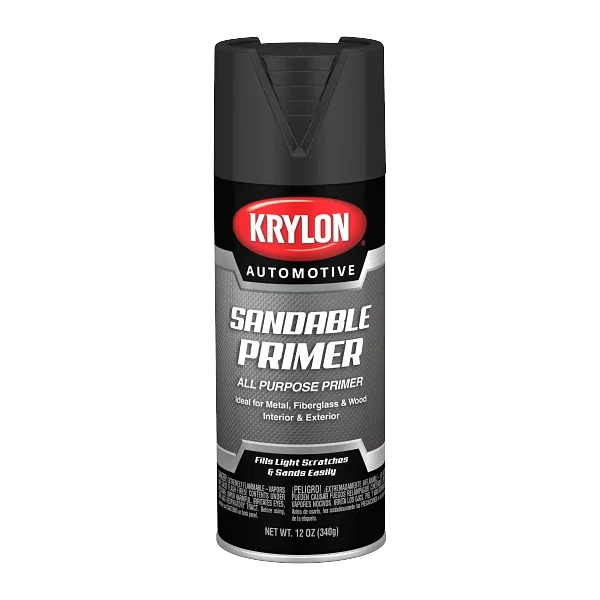
Krylon Automotive Sandable Primer, Best for Filling and Leveling
The high-build can. It lays down thicker than the rest of the field and fills 220-grit scratch marks and shallow open grain, then sands back flat without loading the paper. On a pine drawer front that had been stripped and coarse-sanded, two coats plus a 220-grit pass gave the flattest surface of any pick here. White and grey versions both exist, so you match the primer to the topcoat instead of covering the primer.
It blocks nothing. Our coffee ring came back at day 12 and the pine knot at day 20. Treat it as a leveling product used after a stain-blocking coat, not as a substitute for one.
The other thing to know is that sprayed and left alone it dries slightly textured, like very fine sandpaper. That is by design. Skip the sanding step and the topcoat reads rough.
Buy it if the surface has scratches or grain you want to level. Skip it if anything might bleed.
Rust-Oleum Painter’s Touch 2X Ultra Cover Primer, Budget Pick
Five to seven dollars a can, sold in every hardware store in America, and honest about what it is. Flat grey or flat white, wide fan tip, 20-minute dry to touch. On clean bare wood and scuffed metal it does exactly what a general-purpose primer should. On glossy laminate it lost eleven squares on the cross-hatch pull, which settles that use case.
The recoat rule is the thing that catches people. Rust-Oleum wants the topcoat within an hour or after 48 hours. We deliberately topcoated a panel at hour six and got visible wrinkling within ten minutes. Nobody reads the side of the can until after this happens once.
Where it earns its place is the small job with a matching topcoat. Grey primer under a dark Painter’s Touch 2X color saves you a color coat, and the two products are engineered to go together. For a thrift-store picture frame or a lamp base, buying anything more expensive is a waste.
Buy it if the surface is clean, bare, dull wood or metal and the budget matters. Skip it if the surface is glossy, plastic, or stained.
Which Primer for Which Surface
| Surface | Use | Why |
|---|---|---|
| Knotty pine, cedar, oak | Zinsser B-I-N | Only shellac stops tannin permanently |
| Water-stained ceiling patch | Zinsser B-I-N | Blocks in one coat; water-base needs two and still ghosts |
| Exterior trim, shutters, post | Bulls Eye 1-2-3 Plus | The only interior-exterior can here that also blocks |
| Melamine or laminate furniture | Krylon Bonding Primer | Best plastic and slick-surface tape-pull result |
| Ceramic tile, glass | Zinsser B-I-N | Zero squares lost on glazed tile at 7 days |
| Bare steel, aluminum, galvanized | Krylon Self Etching | Acid etch gives mechanical bite no other primer creates |
| Rusted steel | Convert first, then prime | Self-etch needs bare metal; converter then any primer |
| Sanding scratches, open grain | Krylon Sandable | Builds thick, sands flat, does not load paper |
| Clean bare wood, small pieces | Painter’s Touch 2X | Cheapest can that does the job on an easy surface |
For the full prep sequence on metal, see the rusted metal guide.
Where Spray Primer Goes Wrong
- One heavy coat instead of two light ones. The heavy coat runs on vertical surfaces and stays soft underneath for days. Two passes at 10–12 inches, 50% overlap, is the whole technique.
- Spraying below 50°F or above 85% humidity. Water-base primers stay soft, solvent primers blush white. Garage in February is the single most common cause of a project that never hardens.
- Priming over a glossy surface without scuffing. Bonding primers are rated to skip this step. They still perform better with a 60-second pass of a grey scuff pad.
- Topcoating in the dead zone. Every solvent aerosol here has a recoat window with a gap in the middle. Hour six is inside the gap.
- Using sandable primer as a stain blocker. It is a leveling product. The stain comes back at week two or three, after you have already finished.
- Skipping degreaser on kitchen furniture. Cooking oil film is invisible and no primer bonds through it. Wipe with a TSP substitute and rinse before anything else.
- Priming trim that is yellowing from an old oil topcoat. The primer is not the problem there; the old alkyd is. See the yellowing trim fix.
Technique That Changes the Result
- Warm the can in a bucket of tap water for five minutes. Pressure drops as the can cools while spraying, and a warm can atomizes finer. Never use hot water.
- Start the spray off the piece and end it off the piece. The heaviest deposit happens at the moment you press and release the tip.
- Keep the can moving at a walking pace and hold it 10–12 inches out. Closer gives runs, further gives dry overspray that feels like sand.
- Scuff between primer and topcoat with 220-grit on furniture. Two minutes per door, and the finish reads twice as smooth. The sandpaper guide covers grit choice.
- Invert the can and spray until it runs clear before you set it down. A clogged tip on a half-full can is a wasted can.
- Mask more than you think. Aerosol overspray drifts eight to ten feet indoors. The drop cloth round-up is the boring purchase that saves a floor.
For a full furniture repaint from stripping to topcoat, the furniture repaint project guide has the sequence.
What a Real Project Costs in Cans
| Project | Surface area | Cans needed | Primer cost |
|---|---|---|---|
| Thrift lamp base | ~3 sq ft | 1 Painter’s Touch 2X | ~$6 |
| Two dining chairs | ~20 sq ft | 2 Krylon Bonding | ~$18 |
| One interior door, both faces | ~36 sq ft | 2 B-I-N | ~$29 |
| 5-drawer dresser | ~55 sq ft | 3–4 B-I-N | ~$45–60 |
| 10 cabinet doors | ~110 sq ft | 6–8 B-I-N | ~$90–125 |
The dresser row is where aerosol stops making sense. A quart of brush-on B-I-N runs about $30 and covers three times what four cans do. Ten cabinet doors is firmly sprayer territory; see the paint sprayer round-up for the entry-level options.
Also Considered, Not Picked
- Rust-Oleum Automotive Filler Primer. A close analogue to the Krylon sandable pick, with similar build and similar sanding behavior. Retail stocking is less consistent outside auto parts stores, so the Krylon takes the slot.
- Krylon COLORmaxx Primer. Fine general-purpose aerosol primer, functionally overlapping with Painter’s Touch 2X. The Rust-Oleum is cheaper and stocked more widely.
- Rust-Oleum Universal Bonding Primer. Real product, real performance on slick surfaces, but on our tile and melamine pulls the Krylon bonding primer edged it and the Krylon costs a dollar less. If Krylon is out of stock, this is the swap.
- Automotive 2K aerosol primers. Two-component cans with an activator button in the base. Genuinely better film than anything here, and genuinely wrong for a homeowner: 24-hour pot life after activation, $30 a can, and you commit the whole can the moment you press the button.
- Sanding sealers sold as primer. They seal, they do not block, and they do not bond to anything slick. Different product, different job.
- Cheap unbranded primers in multi-packs. The tips clog, the fan is uneven, and we have yet to see one publish a coverage figure. Aerosol quality lives in the valve as much as the chemistry.
If the surface is interior and something in it might bleed, buy B-I-N and stop shopping. Everything else on this list is a specialist.
Full comparison
| Product | Best for | Yellowing | Price |
|---|---|---|---|
| 🥇B-I-N Shellac-Base Primer | Top pick — best stain-blocking and best grip overall | Ambers under direct UV; stays white under a topcoat indoors | $$$ |
| Bulls Eye 1-2-3 Plus Primer | Best water-based all-rounder, interior and exterior | Very low; stays white on exterior trim | $$ |
| Bonding Primer with Fusion Technology | Best on slick plastic, laminate, glass, and tile | Low under a topcoat; interior and exterior rated | $$ |
| Automotive Self Etching Primer | Best on bare metal, aluminum, and galvanized | N/A (green film, always topcoated) | $ |
| Automotive Sandable Primer | Best for filling scratches and sanding flat | Low under a topcoat | $ |
| Painter's Touch 2X Ultra Cover Spray Primer | Budget pick — general-purpose priming on wood and clean metal | Low under a topcoat | $ |
Reviews
Pros, cons, and specs for each pick.
1. B-I-N Shellac-Base Primer

| Coverage | About 30–35 sq ft per 13-oz can, one coat |
|---|---|
| Sheens | Flat white |
| Dry / Recoat | Touch 20 min · recoat 45 min |
| Full cure | Handles at 1 hour; full hardness about 7 days |
| VOC | High (denatured alcohol carrier); use a respirator indoors |
| Yellowing risk | Ambers under direct UV; stays white under a topcoat indoors |
| Primer | Topcoats with latex, alkyd, or lacquer |
| Price tier | $$$ |
- Only can in the round-up that stopped a live knot cold on knotty pine; the water-base and solvent picks both let a faint amber ring read through the white topcoat by week three
- Recoat at 45 minutes means prime and topcoat in the same afternoon, which no other pick here matched on a cool day
- Grips glass, ceramic tile, glossy laminate, and bare metal without sanding, so it doubles as a bonding primer when the surface is rigid
- Denatured alcohol carrier. The smell fills a room in seconds and it stays unpleasant for an hour after you stop spraying
- Brittle once cured. On anything that flexes (thin sheet metal, vinyl, a plastic bin lid) it can crack at the bend
- Roughly $13–16 a can and one can covers about 30 sq ft, so a full dresser is three to four cans and the math stops being cheap fast
- Not an exterior product. Shellac re-emulsifies with prolonged moisture and ambers under direct UV
2. Bulls Eye 1-2-3 Plus Primer

| Coverage | About 25–30 sq ft per 13-oz can, one coat |
|---|---|
| Sheens | Flat white |
| Dry / Recoat | Touch 30 min · recoat 1 hour |
| Full cure | Handles at 1 hour; full hardness about 7 days |
| VOC | Water-base carrier; low odor for an aerosol |
| Yellowing risk | Very low; stays white on exterior trim |
| Primer | Topcoats with latex or alkyd |
| Price tier | $$ |
- Water-base acrylic that still bonds to a glossy alkyd door without sanding; the only pick here rated for exterior and interior in the same can
- Low odor next to B-I-N. We primed a bathroom vanity with the window cracked and the room was usable in twenty minutes
- Sands to a genuinely smooth surface at 220-grit without gumming the paper, which the automotive primers do when you rush them
- Water stains and tannin need two coats, and a heavy nicotine or smoke stain needs shellac instead. It slows the bleed, it doesn't stop it
- Wants 50°F and up. Below that the film stays soft and the topcoat drags
- Coverage is thin per can, and the fan is narrower than the Rust-Oleum tip, so wide flat panels take longer
3. Bonding Primer with Fusion Technology
| Coverage | Not published; roughly one small side table per 12-oz can |
|---|---|
| Sheens | Flat white |
| Dry / Recoat | Touch 25 min |
| Full cure | Handles in about 1 hour; topcoat per topcoat instructions |
| VOC | Solvent-based; mineral spirits cleanup |
| Yellowing risk | Low under a topcoat; interior and exterior rated |
| Primer | Topcoats with most aerosol and brush finishes |
| Price tier | $$ |
- Rated by Krylon for metal, plastic, ceramic, glass, masonry, plaster, wood, wicker, and drywall, and it held on every one of those we put in front of it
- The any-direction valve sprays upside-down, which is the difference between finishing a chair underside in one pass and flipping the chair four times
- Rust inhibitor in the film, so it works as a light-duty metal primer on patio furniture without a second product
- Solvent-based with mineral-spirit cleanup, so it is not the low-odor option people expect from a bonding primer
- Flat white only. On a dark topcoat you will spend an extra color coat covering the white
- No published coverage figure from Krylon, and in our use a 12-oz can went about as far as a small side table plus one chair
4. Automotive Self Etching Primer
| Coverage | 12–14 sq ft per can |
|---|---|
| Sheens | Flat, green |
| Dry / Recoat | Touch 30 min · handle 1 hour |
| Full cure | Topcoat after handling dry; full hardness about 7 days |
| VOC | Solvent-based; lacquer thinner cleanup |
| Yellowing risk | N/A (green film, always topcoated) |
| Primer | Follow with a grey or white primer under light colors |
| Price tier | $ |
- Etches and primes bare steel in one pass, which is the step people skip on aluminum and then wonder why the topcoat peels in a sheet
- Rated for aluminum, stainless, hard plastics, and fiberglass, not only mild steel
- Coverage is published (12–14 sq ft per can), which almost nobody in the aerosol primer aisle does
- Green film. On a light topcoat you need an extra coat of grey or white primer over it before color
- Bare metal only. Over old paint the acid has nothing to bite and you get a weak, dusty film
- Wants 55–75°F and under 60% humidity, a narrow window in a July garage
5. Automotive Sandable Primer
| Coverage | 12–14 sq ft per can |
|---|---|
| Sheens | Flat, white or grey |
| Dry / Recoat | Touch 30 min · handle 1 hour |
| Full cure | Sand after 1 hour; topcoat same day |
| VOC | Solvent-based; lacquer thinner cleanup |
| Yellowing risk | Low under a topcoat |
| Primer | Topcoats with lacquer, enamel, or acrylic aerosol |
| Price tier | $ |
- Builds thick enough to fill 220-grit scratch marks and shallow grain, then sands back flat without loading the paper
- Comes in white and grey, so you can pick the shade that suits the topcoat instead of fighting it
- Works on metal, wood, and fiberglass, which covers most furniture-refinishing jobs where the surface is not perfectly flat
- No stain blocking at all. Over a water ring or a live knot it disappears under the topcoat within a month
- Needs sanding to look right. Sprayed and left alone it dries slightly textured
- Adhesion on slick laminate is weaker than the bonding primer. Scuff first or use a different can
6. Painter's Touch 2X Ultra Cover Spray Primer

| Coverage | About 12 sq ft per 12-oz can |
|---|---|
| Sheens | Flat grey, flat white |
| Dry / Recoat | Touch 20 min · handle 1 hour |
| Full cure | Recoat within 1 hour or after 48 hours |
| VOC | Solvent-based; mineral spirits cleanup |
| Yellowing risk | Low under a topcoat |
| Primer | Topcoats best with Painter's Touch 2X or similar acrylic aerosol |
| Price tier | $ |
- Cheapest can here at $5–7, stocked in every hardware store, big box, and most grocery-adjacent hardware counters in the country
- Wide fan tip lays down a flat panel faster than any other pick in the round-up
- Color-matched to the Painter's Touch 2X topcoat range, so grey under dark colors and white under light ones actually saves a color coat
- Blocks nothing. Tannin, water stains, and marker all read through
- Bonds to clean wood and scuffed metal, not to glossy laminate or plastic
- The 1-hour-or-48-hour recoat rule is real; topcoat at hour six and the primer wrinkles