How to Paint Over Rusted Metal — Wire Wheel to Topcoat
Painting over rust the right way: wire-wheel to bare metal, convert what's left with phosphoric acid, prime with Stops Rust, finish with a DTM acrylic that lasts.

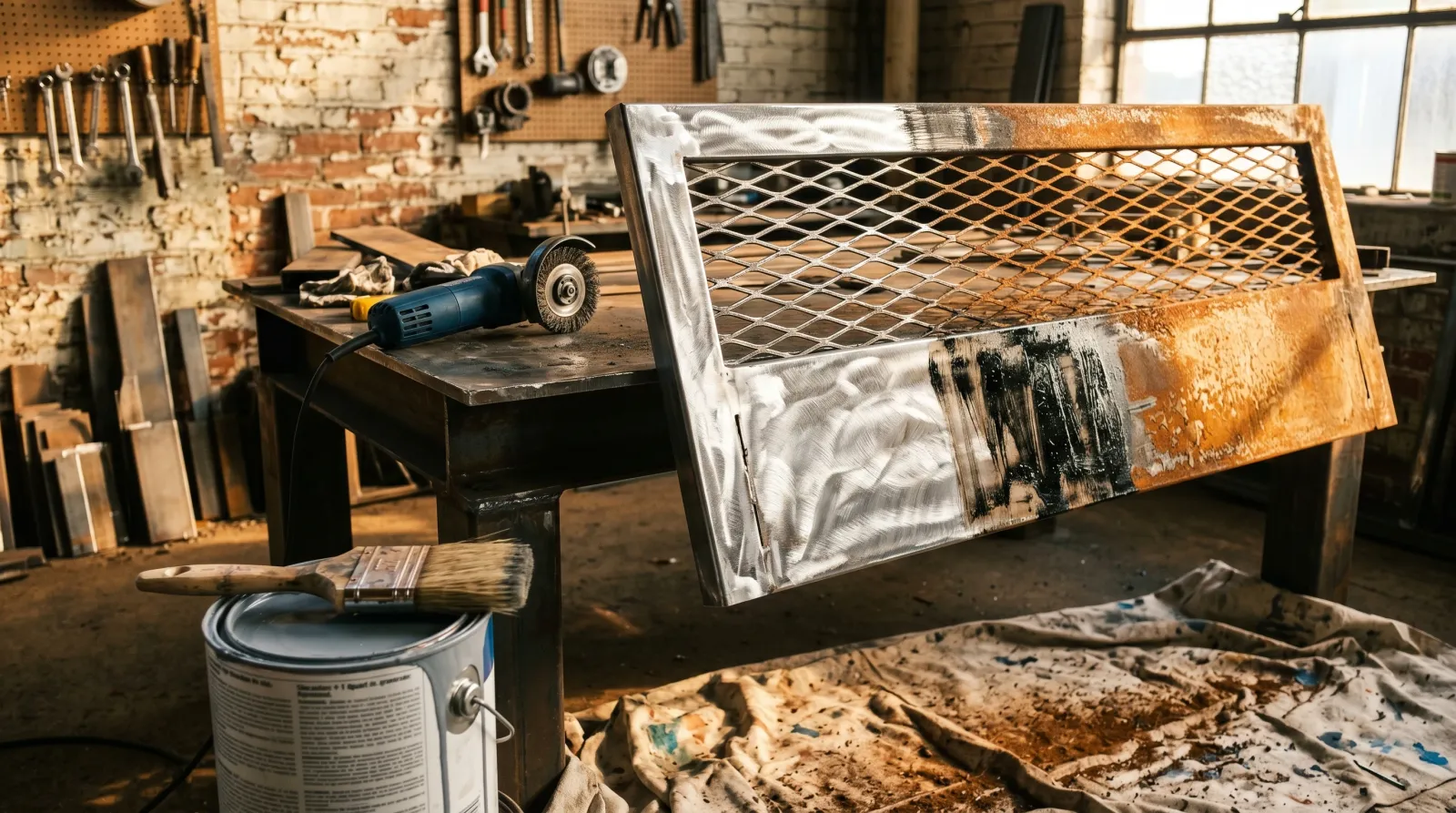
Rust under paint is a clock, not a stain. The orange you see on the railing is iron oxide: what steel becomes when oxygen and moisture reach it. Paint over it without prepping and the rust keeps eating the steel under your fresh topcoat. Two summers later the paint lifts off in a brown sheet. Do the prep right and the same railing goes ten years.
TL;DR
- Prep: Wire-wheel loose flakes to bright metal where you can. Brush a phosphoric-acid rust converter (Corroseal, Ospho, Rust-Oleum Rust Reformer) over what stays.
- Primer: Oil-based rust-inhibitive primer. Rust-Oleum Stops Rust or Zinsser PermaCoat Alkyd. Two coats on bare metal.
- Paint: DTM (direct-to-metal) acrylic topcoat. SW Pro Industrial DTM, Behr Premium Plus DTM, or Rust-Oleum Professional DTM.
- Cure: Topcoat recoat at 4 hours. Full cure 14–30 days before any pressure wash, scrub, or hard weather.
- Skill: Medium. The prep is 80% of the job.
What Counts as “Rusted Metal”
Three depths show up on a homeowner’s call list. Surface rust is the powdery orange film on a patio chair or an old tool. The metal underneath is still solid. A wire wheel takes it off in minutes. Light pitting is what you get on a four-year-old gate that nobody primed properly. The orange has started to eat tiny craters into the steel, but a screwdriver scratch shows bright metal underneath. Heavy scaling and structural rust is the bottom rail of a wrought-iron porch railing where the metal has flaked into layers, the wall thickness is gone, and tapping with a small hammer sounds dead. The first two are paint jobs. The third is a welding job.
This guide saves the first two. The third is a welder’s job, and any painter who promises a fresh coat will fix it is selling you twelve months before the rust eats through.
Why Painting Over Rust Is Different
Rust is porous, brittle, and chemically unstable. New paint film over loose rust has nothing to bond to. The rust flakes off and takes the paint with it. Even compact, tight rust keeps reacting with whatever oxygen and moisture diffuses through the new film. A fresh paint job over unprepped rust looks fine for a season, then bubbles, then peels.
The whole strategy is to stop the reaction. Mechanical removal takes the loose, scaling rust off the steel. The chemical converter reacts with the tight residual rust you can’t grind off and turns it into a stable, paintable film. The rust-inhibitive primer chokes off any new oxygen. The DTM topcoat flexes with temperature swings without micro-cracking. Take out any one layer and the system fails.
Step 1 — Mechanical Removal
This is the work. Skip it and nothing downstream matters.
Wire Wheel for 80% of the Job
A drill-mounted 3-inch crimped wire wheel is the homeowner’s best friend on rusted metal. It strips powdery surface rust to bright steel at maybe 30 seconds per square inch. The knotted wire wheel is more aggressive and chews into pitting; use it on heavier rust and follow with the crimped wheel for a smoother finish. Hand wire brushes get into corners and pickets where the drill won’t fit.
Work outward from the worst rust pocket. Don’t try to grind from clean metal into rusted metal. You’ll over-work the sound paint at the edge. Feather the edge between bright bare metal and sound old paint with 220-grit at the end so the primer has a soft transition to build on.
Angle Grinder for Heavy Scaling
When you have layers of flaking rust, the wire wheel will polish the top layer and leave the rotten layers behind. An angle grinder with an 80-grit flap disc cuts through to fresh metal fast. Used carelessly it eats real metal too, so keep it moving, light pressure, and stop the second you see bright silver. The flap disc leaves a 60-grit-ish profile the primer loves to bite.
How Far Down Do You Have to Go?
You want bare metal anywhere you can get it. Realistically, on a pitted railing, you’ll get 70–90% bright steel and 10–30% tight residual rust deep in the pits. That residual is what the converter is for. Don’t fight it with the grinder for an extra hour.
Safety
Lead test before sanding or grinding any metal painted before 1978. RRP rule applies if you’re a contractor; smart even if you’re not. P100 respirator, eye protection, long sleeves. Rust dust is iron oxide; old paint dust may be lead. Both are lung hazards. Drop cloth catches the dust so you’re not tracking it inside.
Step 2 — Rust Conversion
What didn’t come off mechanically gets chemically converted. Two routes; pick one.
Phosphoric-Acid Converters (Corroseal, Ospho)
Phosphoric acid reacts with iron oxide and forms iron phosphate, a stable black-gray film. Corroseal is a 1-step waterborne phosphoric-acid converter with a latex primer built into the same coat. Brush it on, let it cure 24 hours, topcoat. Ospho is acid only, no primer; it’s been a contractor staple since the 1940s for a reason. Cures in 24 hours, may bloom a white phosphate residue that you wipe off with a damp rag before priming. Both want a clean, degreased surface to start.
Brush, don’t spray. The acid wants contact time and a wet film to react. Apply with a cheap chip brush. The acid eats brush bristles, so don’t use your good sash. Hit pitting twice if it’s deep.
Tannic-Acid Converters (Rust-Oleum Rust Reformer)
Rust-Oleum Rust Reformer uses tannic acid plus a polymer to convert rust into a stable black film in one coat. Dries in 40 minutes, recoatable in 24 hours. The advantage is speed and that it dries to a paint-ready black surface that doesn’t need rinsing. The trade-off is that it’s better on light to moderate rust than on deep, pitted scaling. For the bad stuff, mechanical removal plus a phosphoric-acid converter holds up longer.
A note on aerosol “rust converter primers”: fine for touch-ups on a mailbox or a wrought-iron chair leg. For a whole gate or railing, use the brush-on quart. The aerosol film is too thin to carry the system.
When the Converter Isn’t Enough
If pits run deeper than a dime’s thickness, fill them with a two-part epoxy steel filler like JB Weld SteelStik before priming. Cures hard in 5 minutes, sandable in an hour. Leveling pits is the difference between a smooth paint job and one that telegraphs every crater under raking afternoon light.
Step 3 — Rust-Inhibitive Primer
The primer is what holds the system together. Skip it or use the wrong one and the topcoat is along for a short ride.
Rust-Oleum Stops Rust is the workhorse. Oil-based alkyd, rust-inhibitive, lays down a tough film that penetrates the converted surface and chokes off oxygen at the metal. Two coats on bare and converted metal. Brush, roll, or spray. Touch-dry in 2–4 hours; recoat at 24 hours; topcoat-ready at 24 hours for the same brand and 48 hours if you’re crossing to a different topcoat chemistry.
Zinsser PermaCoat Alkyd is the heavy-duty alternative. A high-build alkyd primer that builds 2–3 mils per coat where Stops Rust builds 1.5. On a railing in a coastal zone or a gate that lives under a sprinkler, the extra film thickness buys years. Same recoat window.
A note on waterborne metal primers: INSL-X Aqua-Lock and Sherwin-Williams Pro Industrial Pro-Cryl are good products on sound previously-painted metal, and on aluminum and galvanized where oil-based won’t grip the oxide. On freshly-wire-wheeled bare rusted steel, the oil-based alkyd primers still hold up longer. Use the oil here.
Step 4 — Topcoat: DTM Acrylic
DTM is “direct-to-metal.” A 100% acrylic engineered to bond to primed metal and flex with the temperature swing without micro-cracking. The black wrought-iron railing that goes from 70°F at dawn to 140°F at 2 p.m. in July is what this chemistry was built for.
Sherwin-Williams Pro Industrial DTM Acrylic Coating is the contractor default. Satin or semi-gloss, low VOC, full SW deck. Behr Premium Plus DTM is the Home Depot answer. Cheaper, narrower color range, performs respectably on residential metal in moderate climates. Rust-Oleum Professional DTM is the aerosol-friendly version for pickets and ornamental work where spray beats brush.
Two coats. Always two coats. The first coat looks like coverage; the second is what gives you the 4–6 mils of dry film thickness that survives ten summers. Lay it on heavy with a 2-inch angled sash on brushed work, and back-roll a 1/4-inch nap mini-roller on flat siding panels to flatten the brush marks before the lap sets up.
For SKU-level picks across the broader category, see the best primer round-up and the best exterior paint round-up.
Step 5 — Application by Surface Type
Railings and Wrought-Iron Gates
Brush. A 2-inch angled sash for the rail and a 1-inch for pickets and scrollwork. Cut in from the top down so any drips you miss land on unpainted metal that’s about to get painted. Hit the underside of the bottom rail first. That’s where water sits and rust restarts.
Patio Furniture and Metal Tools
Spray. Aerosol Rust-Oleum Professional DTM lays down a smoother film than a brush on the curves of a chair or the handle of a shovel. Two perpendicular passes, 50% overlap, light coats. Three light coats beat one heavy one.
Flat Steel Panels and Siding
Roll the flats with a 1/4-inch nap mini-roller, brush the seams with a 2-inch sash. Back-roll the brushed edges into the rolled field while still wet to kill lap marks. If you have an airless and a still day, spray and back-roll.
Step 6 — Dry, Recoat, Full Cure
Touch-dry: 1–2 hours for the topcoat at 70°F and 50% humidity. Recoat: 4 hours for the DTM acrylics named above; 24 hours for oil-based Stops Rust between primer coats. Full cure: 14 days for normal weather exposure, 30 days before a pressure wash or hard scrub.
Don’t lean a ladder on a freshly-painted railing for a week. The film looks dry; it isn’t hard yet. Don’t let a dog brush against a fresh gate for the first 72 hours. Don’t pressure wash for a month.
Common Mistakes
- Painting over loose rust without grinding. The paint film bonds to rust, the rust falls off, the paint goes with it. Wire-wheel first, every time.
- Skipping the converter on pitted metal. The wire wheel can’t reach into deep pits. Whatever rust is left in there keeps reacting under your new topcoat. Brush in a phosphoric-acid converter and let it cure.
- Using a waterborne primer on bare wire-wheeled steel. The acrylic primers are fine on aluminum, galvanized, and sound previously-painted metal. On bare and converted rust, the oil-based rust-inhibitive primer holds up longer. Don’t mix that up.
- One coat of topcoat. One coat is half the mil thickness you need. The film fails at year three instead of year ten. Two coats is the whole job.
- Painting in the wrong window. Below 50°F surface temperature, the primer doesn’t flow. Above 90°F, it flashes off before it levels. A $12 surface thermometer answers the question fast.
Maintenance and Longevity
A properly-prepped, two-coat DTM acrylic system over the right rust-inhibitive primer lasts 8–12 years on a residential railing in zones 5 and 6, and 5–8 years in coastal salt-air zones where chloride accelerates everything.
Rinse exterior metal twice a year. Garden hose, soft brush. Pollen and salt are what eat your topcoat between rains. A pressure washer on full trigger eats DTM acrylic film inside three years; throttle to 1,500 psi and stand back four feet if you have to use one.
If you see a single rust freckle bleeding back through at year three, that’s a pinhole where the primer didn’t cover. Sand it back to bare metal with 80-grit, dab Stops Rust, dab topcoat. Twenty-minute fix. Ignore it and you’re stripping the whole thing.
The thing that’ll bite you in two years: the underside of the bottom rail you didn’t bother to wire-wheel because nobody sees it. Water sits there longest, rust restarts there first, and the new paint lifts from the back. Spend the extra hour with the wire brush on the parts nobody sees. That’s where the system lives or dies.
Related
- How to paint exterior metal — railings, gates, and siding
- How to paint metal — railings, doors, fences, gates, and garage doors
- How to paint galvanized steel — the etch-primer story
- Fix peeling exterior paint — diagnose before you repaint
- Best primer — bonding, stain-blocking, and rust-inhibitive picks