Spray Paint Dry Time by Surface: A Chart
Spray paint dry time by surface, in minutes and hours. Touch-dry, handle, and full-cure numbers for metal, wood, plastic, and glass, plus what temperature changes.

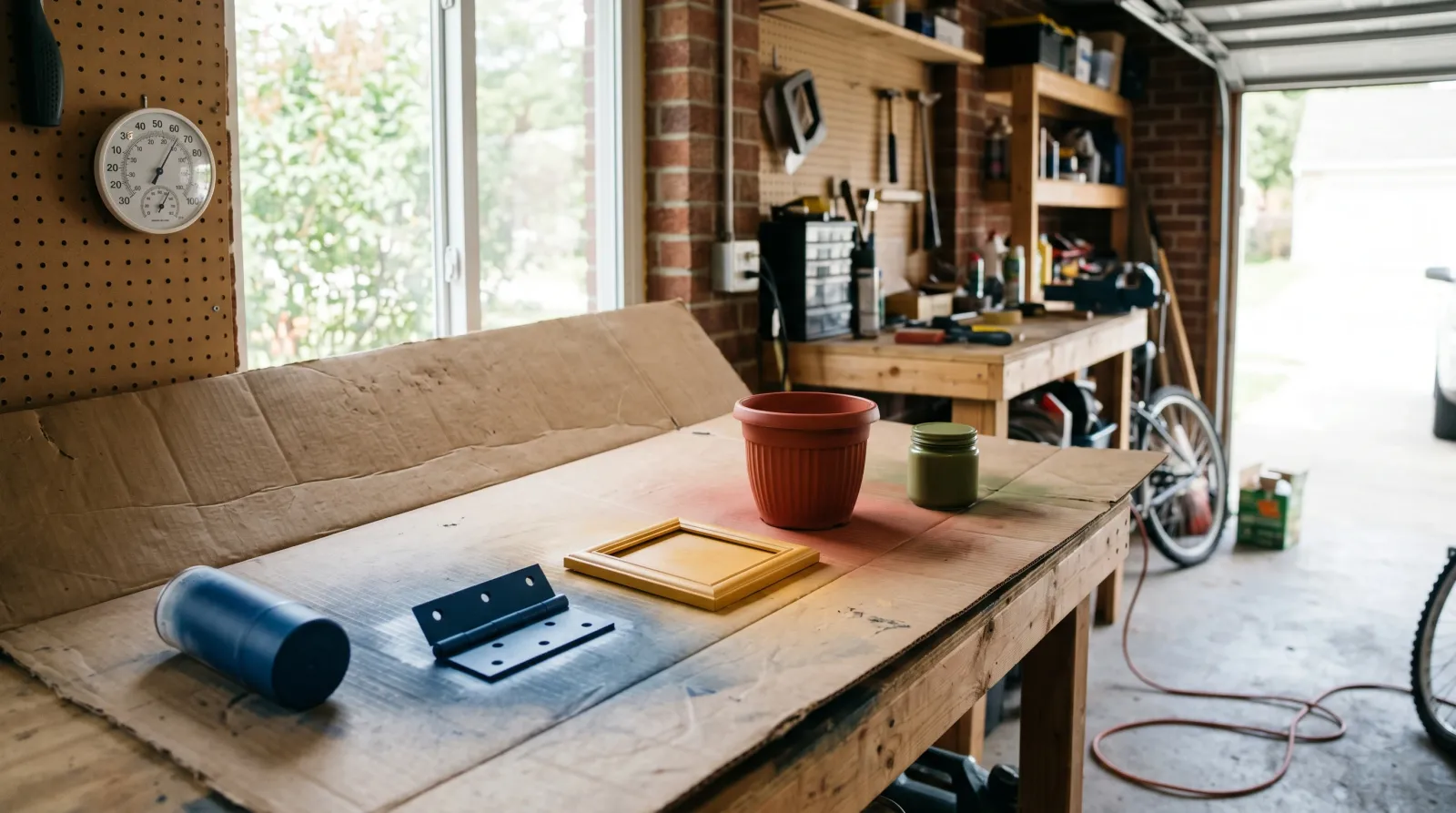
Spray paint dry time depends more on what you sprayed than on the paint itself. On a clean metal bracket at 70°F, a standard aerosol enamel is touch-dry in 10–20 minutes, handleable in about an hour, and fully cured in 24–48 hours. On bare wood it’s touch-dry in 20–30 minutes but takes longer to harden because the surface drinks the first coat. On plastic or glass it skins fast and cures slow, often 48–72 hours, because the solvent has nowhere to go but up. Same can, three different clocks. The surface sets the pace.
Here’s the chemistry behind that spread. Most consumer spray paint is a fast-flashing lacquer or alkyd enamel suspended in a strong solvent and pushed out under pressure as a fine mist. The mist hits the surface, the solvent starts evaporating almost immediately, and the resin left behind begins to film. Two things govern how fast that runs: how quickly the solvent can leave, and whether the surface helps or fights it. A porous surface (raw wood, MDF, cardboard) wicks solvent into itself and speeds the surface dry, but it also pulls binder down into the grain, so the film on top stays thin and the piece needs more coats. A non-porous surface (metal, glass, glazed ceramic) gives the solvent only one exit, straight up, so a coat sprayed too thick traps solvent underneath and stays tacky long after the top has skinned.
Spray Paint Dry Time by Surface
These are typical numbers for a standard aerosol enamel or lacquer at 70°F and 50% relative humidity, sprayed in thin coats. Specialty paints (high-heat, epoxy, plastic-bonding) run their own schedules, so always check the can.
| Surface | Touch-dry | Safe to handle | Full cure |
|---|---|---|---|
| Metal (primed) | 10–20 min | ~1 hour | 24–48 hours |
| Wood (sealed/primed) | 15–25 min | 1–2 hours | 24–48 hours |
| Bare/raw wood | 20–30 min | 2–3 hours | 2–3 days |
| Plastic (with adhesion primer) | 20–30 min | 2–4 hours | 2–3 days |
| Glass / glazed ceramic | 15–30 min | 4–6 hours | 3–5 days |
| Fabric/canvas | 30–60 min | 4–8 hours | 3–5 days |
Two patterns explain the whole table. Porous surfaces dry faster to the touch but cure slower in the deeper layers, because some solvent and binder soaked in and has to work back out. Non-porous surfaces feel dry fast on top but the film stays soft underneath until the trapped solvent finishes its slow exit. Glass is the extreme case on both ends: it skins in under half an hour and still scratches off with a fingernail at day two.
When the Surface Speeds Things Up
A few situations let spray paint dry and cure on the fast end of the chart:
- Primed metal in warm, dry air. No absorption, no trapped solvent, predictable surface-down drying. This is the easiest substrate to spray.
- Thin coats over a sealed surface. Three light passes flash off far faster than one heavy coat, and the total dry time is shorter even counting the wait between passes.
- 65–80°F with moving air. Within that band, every degree of warmth and every bit of airflow carries solvent away faster. A box fan in a ventilated garage shaves real time off.
- Low humidity (under 50%). Water vapor in the air competes with solvent evaporation. Dry air clears the film faster.
When the Surface Slows It Down
Don’t trust the can’s headline dry time on these:
- Plastic and glass. Non-porous and often slightly flexible, so the paint can’t grip or breathe. Even with the right primer, give these the long end of the cure window before handling.
- Cold metal or glass. A part that’s been sitting in a 40°F garage is a heat sink. The film chills, solvent evaporation crawls, and a 20-minute touch-dry stretches into hours. Warm the part first.
- High humidity (over 70%). Lacquer can blush — moisture condenses into the drying film and leaves a cloudy white haze. The finish also stays soft much longer.
- Heavy single coats. The number-one cause of “still tacky tomorrow.” A thick coat skins on top and seals wet solvent underneath, where it can sit for days.
How Spray Paint Compares to Brushed and Rolled
Spray paint isn’t slower or faster across the board than other application methods. It’s different in shape. The dry curve has a steep front and a long tail.
| Aerosol spray | Brushed enamel | Rolled latex wall paint | |
|---|---|---|---|
| Touch-dry | 10–30 min | 1–4 hours | 30–60 min |
| Recoat window | <10 min OR after 48 hr | 16–24 hours | 2–4 hours |
| Full cure | 24 hr–5 days | 7–14 days | 14–30 days |
| Coat thickness | Very thin | Medium | Medium-thick |
Spray paint goes touch-dry fast because each coat is so thin. The recoat window is the trap: you can lay the next coat almost immediately (wet-on-wet) or you wait two full days, but the 1-to-24-hour middle re-softens the layer below and wrinkles the finish. For the broader picture across paint types, see the paint drying time chart, and for why “dry” and “cured” are two separate milestones, the dry time vs cure time explainer.
Common Mistakes
- Reading touch-dry as fully cured. A part feels dry in 20 minutes, so you stack it or screw it back on. The film hasn’t reached hardness yet and you leave fingerprints or imprint the threads. Wait the full cure in the chart before any real handling.
- One thick coat instead of three thin ones. Heavy coats run, sag, and trap solvent. This is the single biggest cause of paint that’s still tacky a day later. Light passes, 50% overlap, let each flash before the next.
- Recoating in the dead zone. Spraying coat two somewhere between one hour and one day after coat one. The fresh solvent re-dissolves the half-set film below and the finish wrinkles. Go wet-on-wet within minutes, or wait 48 hours.
- Skipping the surface-specific primer. Spraying straight onto bare plastic or glossy plastic without an adhesion primer. The paint never bonds, stays gummy, and peels in sheets later. Use a plastic-bonding primer first.
- Spraying in cold or damp conditions. Below 50°F or above 70% humidity, the numbers in the chart roughly double, and lacquer can blush white. Spray in a 65–80°F, low-humidity window.
What It Looks Like
A useful test sits on the workbench: spray four scrap pieces — a metal washer, a wood offcut, a plastic lid, and a glass jar — from the same can in the same minute, then touch each at 20 minutes, 1 hour, and 24 hours. The metal sets first and cures cleanly. The wood feels dry fast on the surface but stays slightly soft where it soaked in. The plastic and glass skin over quickly and dent under a nail well into the next day. Same paint, same air, four different clocks, all visible side by side.
Where to Buy / What to Look For
The dry-time number you want is printed on the can: look for the recoat window and handle time, not just “dry to touch.” For plastic, reach for a paint built for it (Krylon Fusion, Rust-Oleum 2X for plastic) so you can skip the separate adhesion primer; the best spray paint for plastic round-up breaks down which ones actually bond. For larger jobs where an aerosol can’t keep up, an HVLP or airless unit lays a more even film, and the paint sprayers comparison covers what each tool does. If you’re spraying plastic and want the prep right, the guide to painting plastic walks the cleaning and priming steps that decide whether the finish ever cures hard.