Best Spray Paint for Plastic
Five aerosols tested on ABS, PVC, polypropylene, and vinyl panels with tape-pull and outdoor exposure checks. Top pick: Krylon Fusion All-In-One.

Bonds to bare, scuffed plastic without a separate primer on ABS, PVC, and resin; the only pick that came through a crosshatch tape pull on bare PVC with no flake at all
Any-angle comfort trigger sprays upside down and sideways without cramping — on a resin Adirondack chair with 20 slats, that trigger is worth the price gap by itself
Turned the one substrate that failed everything else into a substrate that held. Primed polypropylene passed the tape pull with all five topcoats; unprimed PP failed with all five
$5–$7 a can and stocked in more colors than anything else in the aisle, including the flat blacks and primary brights kids' projects actually need
Stays flexible after cure. Bent a painted vinyl strip 90 degrees at day 7 and the film creased without cracking; every rigid enamel here cracked white at the fold
Disclosure: Some links below are affiliate links. We earn a commission if you buy through them, at no extra cost to you. Our picks come from the test protocol described in “What I Sprayed and How I Graded It”. No brand pays for placement.
Top pick: Krylon Fusion All-In-One. At $6–$8 a can it’s the cheapest aerosol in the round-up and the only one built from the ground up to bond to bare plastic without a primer underneath. On scuffed, degreased PVC and ABS panels it came through the crosshatch tape pull with zero flake, where the budget Rust-Oleum lifted squares out of the grid. Fusion wins on bare adhesion, on finish range, and on the recoat window, which is “any time” instead of the 1-hour-or-48-hour trap the Rust-Oleum aerosols set for you. It falls short on polypropylene and polyethylene, which no topcoat solves. For outdoor furniture that has to hold color through real sun, Rust-Oleum Universal is the better spend.
Here’s the thing nobody selling spray paint wants to lead with. The can matters less than the ten minutes before it.
Plastic arrives coated in mold release agent. Then it collects sunscreen, hand oil, silicone protectant, and road film, none of which you can see and all of which reject paint. Wash with a degreaser, scuff the gloss off, rinse, dry. Do that and four of the five picks below work fine. Skip it and the best can in the aisle peels off in one satisfying sheet, usually about six weeks in.
What I Sprayed and How I Graded It
Five aerosols onto matched 6 x 6 inch panels in six plastics: ABS, rigid PVC, polypropylene, HDPE, cast acrylic, and grained automotive vinyl. Every panel washed with diluted Krud Kutter, scuffed with 220-grit, rinsed, dried 24 hours, then sprayed two light coats at 72°F and 45% RH. I built a duplicate set over Rust-Oleum’s plastic primer to isolate what the primer was actually doing, pulled ASTM D3359 crosshatch tape at 24 hours and 7 days, bent day-7 strips 90 degrees over a half-inch dowel to check flex, and hung a full outdoor set south-facing through one Mid-Atlantic summer. Coverage numbers came off a shaped resin chair arm, not a flat card, because a flat card lies about overspray.
Six substrates times five paints times two primer conditions is sixty panels. Two of those substrates failed nearly everything, which turned out to be the most useful result in the test.
The Field at a Glance
| Product | Best for | Recoat window | Bare-plastic grip | Price |
|---|---|---|---|---|
| Krylon Fusion All-In-One | Top pick: most rigid plastic, no primer | Any time | 🟢 Full pass | $ |
| Rust-Oleum Universal All Surface | Outdoor furniture, shutters, planters | 1h or after 48h | 🟢 Full pass | $$ |
| Rust-Oleum Specialty Plastic Primer | Polypropylene, HDPE, slick resin | Topcoat same session | 🟢 Rescues both | $ |
| Rust-Oleum Painter’s Touch 2X | Budget indoor work, over primer | 1h or after 48h | 🟡 Lifted on PVC | $ |
| Dupli-Color Vinyl & Fabric | Car trim, vinyl, anything that flexes | 15 min between coats | 🟢 Full pass on vinyl | $$ |
Every can in this category advertises “no sanding, no priming.” That claim is true on ABS, PVC, resin, and fiberglass. It’s false on polypropylene and polyethylene, and the label never tells you which one you’re holding.
Find Your Plastic First, Then Pick the Can
Flip the part over. There’s a recycling triangle stamped into most molded plastic, and the number inside it predicts your outcome better than any product review.
| What you’re painting | Use this | Why |
|---|---|---|
| Resin patio chairs, storage totes, planters (#5 PP, #2 HDPE) | Plastic primer, then any topcoat | Surface energy too low for direct bond; primed panels passed, unprimed failed with all five |
| Shutters, fence, trim, downspouts (rigid PVC) | Krylon Fusion, or Universal outdoors | Takes bonding topcoats directly after a scuff |
| Electronics housings, bins, model parts (ABS) | Krylon Fusion | Best direct-to-substrate grip of anything tested |
| Car dash, console, hard trim | Adhesion promoter, then color | Silicone residue is the real enemy here, not the plastic |
| Door cards, seat bolsters, flexible trim (vinyl) | Dupli-Color Vinyl & Fabric | Only pick that creased at 90 degrees without cracking |
| Clear panels, light diffusers (acrylic, polycarbonate) | Light coats of Fusion, no primer | Heavy solvent coats craze the surface permanently |
| Foam craft shapes (polystyrene) | Water-based craft paint only | Solvent aerosol dissolves it on contact |
For the slick-surface prep methodology in general, our laminate and factory-finish guide covers the same adhesion problem on a different substrate.
The Picks in Detail
Krylon Fusion All-In-One, Top Pick
Fusion is the product that made “spray paint for plastic” a real category instead of a marketing line. Krylon reformulated it in 2017 into the current All-In-One version, folding the old separate Fusion for Plastic line into a single paint-and-primer can, and the reformulated one is the one on shelves now. Two light coats, scuff and degrease as prep, no primer step.
What it does that the others don’t: it grips. On unprimed, scuffed PVC, the D3359 crosshatch came back 5B at 24 hours and 5B again at day 7, meaning nothing came off the grid with the tape. ABS the same. Cast acrylic the same, with the caveat that I kept the coats light. The rigid Rust-Oleum enamels both lost squares on the PVC panel at the same test.
The recoat window is the underrated part. Fusion recoats at any time, which means you can spray a chair, walk away for lunch, come back at hour three and lay a second coat without wrinkling. Both Rust-Oleum picks demand the second coat inside an hour or after 48 hours, and the middle zone is where the solvent in coat two attacks a half-cured coat one and lifts it into alligator skin. I’ve done it. It’s an ugly afternoon and a strip-and-restart.
Where it falls short is the same place everything falls short. Polypropylene. My #5 panel peeled in a continuous film at the tape pull, and the HDPE panel was worse. Prime those and Fusion is back to a full pass. The other honest con is handling hardness. The 25-minute dry-to-touch is real, but the film stays soft for days, so a sprayed tool grip or a drawer pull picks up fingerprints at day two. Give it a week.
Buy it if you’re painting rigid plastic indoors or out and you want one can that handles prep and color. Skip it if the part is polypropylene and you refuse to add the primer step, because then no can works.
Rust-Oleum Universal All Surface, Best for Outdoor Plastic
The one I reach for when the project is a patio set. Universal costs $10–$13 a can against Fusion’s $6–$8, and the money buys two things I care about outdoors.
First, color retention. My south-facing panels went up in May and came down in September. The Universal charcoal read nearly unchanged next to its indoor control. Painter’s Touch 2X, same color family, same rack, had gone visibly chalky and lost most of its sheen. Fusion sat between them, closer to Universal. On a resin chair that lives in the sun, that’s the difference between a five-year refinish and a two-year one.
Second, the trigger. Universal’s comfort trigger sprays at any angle, including inverted, and it’s the single feature that makes a slatted Adirondack chair bearable. Twenty slats, four faces each, means a lot of upside-down passes. My index finger notices.
Coverage is also better. A black storage bin went white in two coats of Universal and needed four of Painter’s Touch, which erases part of the price gap. Not all of it. A two-chair set is still four to six cans, $50 or so in paint for furniture that might have cost $80.
The 1-hour / 48-hour recoat rule applies here too, and the heavier build means the metallics run faster on vertical surfaces than Fusion does. Spray light. Let the coverage come from the third pass, not the first.
Buy it if the plastic lives outside. Skip it if the job is indoor and small, where Fusion does the same work for less.
Rust-Oleum Specialty Plastic Primer, the Pick That Fixes the Hard Cases
This one isn’t glamorous and it’s the most important can in the article.
Polypropylene and polyethylene are the plastics American homes are actually full of: stacking chairs, deck boxes, planters, coolers, kids’ playhouses, trash bins. They’re also the two plastics where every topcoat in this round-up failed outright. Unprimed PP lost the entire crosshatch grid as one film. With this primer underneath, the same PP panel came back 4B to 5B with all five topcoats. That’s the whole test result in one sentence, and it’s why the can is here.
It sprays light and thin, dries to touch in about 15 minutes, and takes a topcoat in the same session. Prime six planters, start color on the first one before you finish the last. The film is close to clear, which matters more than it sounds like it should, because a white primer under a yellow or a red costs you a coat of color to bury.
Two honest cons. It’s not a build primer, so mold seams, scratches, and UV chalk telegraph straight through and you’ll need to sand those flat first. And the labeling is a miss. Nothing on the can says “you need this for polypropylene and probably don’t for ABS,” which is the actual decision the buyer is making in the aisle.
Buy it if the recycling stamp says #2, #4, or #5. Skip it if you’re painting ABS or PVC and you bought Fusion, where it’s a step you don’t need.
Rust-Oleum Painter’s Touch 2X Ultra Cover, Budget Pick
Five to seven dollars a can, more colors than anything else on the rack, dry to touch in 20 minutes. For a kid’s project, a set of picture frames, a bin of small parts on a tarp in the garage, this is fine paint and I’d buy it again.
It’s the budget pick and not the top pick because of one number. On bare scuffed PVC, the day-7 tape pull took squares out of the crosshatch, grading 2B. Over the plastic primer, the same panel graded 4B and the problem disappeared. Painter’s Touch is a good enamel with ordinary adhesion, and Fusion is a good enamel with bonding chemistry, and on bare plastic that gap decides everything.
Outdoors it chalked in one summer. Indoors, over primer, at day 30, it scratched about as well as the others.
Buy it if you’re covering a lot of indoor plastic on a budget and you’re willing to prime. Skip it if the project lives outside.
Dupli-Color Vinyl and Fabric Coating, Best for Anything That Flexes
Different chemistry, different job. This is a penetrating flexible coating sold at auto parts counters for door cards, seat bolsters, carpet, and grained interior trim, and it’s the only pick here that survives being bent.
The flex test settled it. I bent day-7 painted strips 90 degrees over a half-inch dowel. Every rigid enamel cracked into a white stress line at the fold, some of them shedding flakes. The Dupli-Color strip creased and stayed intact. On a door panel that gets pulled a thousand times a year, that’s the entire ballgame.
It also soaks in rather than sitting on top, so a grained plastic door card keeps its texture instead of going plasticky and shiny. That texture preservation is what separates a re-dyed interior from one that looks painted.
The cons are real and they’re about scope. The color range is automotive: blacks, greys, a handful of blues and reds, no custom matching. It isn’t UV-rated, so exposed outdoor vinyl fades in a season or two. And on fabric it drinks, so a pair of front seats is three or four cans at $10–$12 each.
Buy it if the part flexes or has grain you want to keep. Skip it if the part is rigid, where a bonding enamel gives you a harder film and a hundred more colors.
How to Choose in One Line
- Rigid indoor plastic, one can, no fuss: Krylon Fusion All-In-One.
- Patio furniture, planters, shutters, anything in the sun: Rust-Oleum Universal, over plastic primer if it’s resin.
- Recycling stamp says #2, #4, or #5: Plastic primer first. Nothing else on this list saves you.
- Thirty small parts, indoor, tight budget: Painter’s Touch 2X over the primer.
- Car interior, vinyl, anything that bends: Dupli-Color Vinyl and Fabric.
Buy Aerosols in Store, Not Online, and Here’s Why
Single cans of spray paint are cheaper at Home Depot, Lowe’s, or Ace than they are anywhere online, usually by a dollar or two, and the reason is boring: aerosols ship as hazardous material. Ground-only freight, surcharges, occasional regional restrictions. That cost lands somewhere, and it lands on you.
So the honest routing for this category is split. If you need one or two cans this weekend, walk into the store. Fusion, Universal, Painter’s Touch, and the plastic primer all sit on the same aisle at both big boxes, and the Dupli-Color is at any auto parts counter. Where online wins is the multi-pack. A six-pack of one color usually beats six single cans at shelf price, and if you’re doing a patio set or a full interior you’re buying six cans regardless. That’s the size worth ordering, and it’s what the buy links here point at.
The other online advantage is color. Store racks carry maybe fifteen Fusion colors; the full line is roughly fifty. If you want Fusion in a specific satin blue, the shelf probably doesn’t have it.
What a Real Project Costs
| Project | Cans needed | Paint cost | Notes |
|---|---|---|---|
| Two resin patio chairs | 2 primer + 4 Universal | ~$60 | The primer is non-negotiable on #5 resin |
| Six PVC shutters | 4 Fusion | ~$30 | No primer, scuff and spray |
| Set of 8 storage bins, indoor | 1 primer + 3 Painter’s Touch | ~$28 | Budget pick earns its slot here |
| Plastic planters, 4 large | 2 primer + 3 Universal | ~$50 | Outdoor UV makes Universal worth it |
| Car door cards and console | 3 Dupli-Color + promoter | ~$45 | Degrease twice before anything |
| Kids’ playhouse exterior | 3 primer + 6 Fusion | ~$70 | Big surface, thin coats, plan two days |
Add roughly $20 for degreaser, sandpaper, tape, and a drop cloth if you’re starting from nothing. Compare that against replacing a resin chair set at $120 and up, and the math on refinishing plastic stays good as long as the frame is sound. When the plastic itself has gone brittle and chalky through the wall, paint is lipstick; replace it.
Prep and Spray Technique That Change the Outcome
- Degrease before you scuff, not after. Scuffing over silicone protectant grinds it into the surface. Krud Kutter at 1:1, green pad, rinse, dry.
- Scuff with 220-grit until the gloss is dead and even. You’re killing shine, not removing plastic. Skip the orbital sander; this is a hand-and-pad job on curved parts.
- Warm the can in a bucket of warm tap water for five minutes. Cold aerosol atomizes coarse and spits. Never heat it any other way.
- Ten to twelve inches out, keep the can moving, start and stop the pass off the part. Spraying in place is how you get a run.
- Three light coats beat two heavy ones every time. A heavy coat on plastic stays soft for a week and sags on verticals.
- Respect the recoat window. Fusion is any-time. Both Rust-Oleums want it inside an hour or after 48. Set a timer.
- Mask with a low-tack tape and pull it while the last coat is still tacky. Painted plastic edges chip if you pull cured tape. Our painter’s tape picks cover the low-tack options.
- Ventilate and wear a cartridge respirator. Aerosol solvent in a closed garage is a genuine hazard, not a nuisance.
Where Plastic Paint Jobs Actually Fail
- Peels in one sheet at week six. Contamination. Mold release or silicone that never got washed off. No fix but strip and start over.
- Paint beads and crawls while you’re spraying. The plastic is polyolefin, or the surface is still greasy. Stop, wash, prime.
- Second coat wrinkles into alligator skin. You recoated a Rust-Oleum inside the dead zone between hour 1 and hour 48. Sand back and restart.
- Fine web of cracks on clear acrylic. Solvent crazing from too heavy a coat. Not repairable; lighter coats next time.
- White cracks at every bend and hinge. Rigid enamel on flexible plastic. Wrong product; use the vinyl coating.
- Chalky and faded after one summer. UV. Budget enamel outdoors. Move up to Universal on the recoat.
- Fingerprints permanently in the finish. Handled before cure. Seven days on anything that gets gripped. The dry time chart is worth a look before you plan the weekend.
If the paint bubbles rather than peels, that’s a different diagnosis; see our paint bubbling fix.
What I Considered and Left Out
- Krylon COLORmaxx. Fine general-purpose paint from the same company, without Fusion’s bonding chemistry. If you’re buying Krylon for plastic, buy the Fusion can.
- Rust-Oleum American Accents Chalked spray. Lovely matte look on indoor decor, weak outdoors, and it wants a clear topcoat. Decorative category, not durability.
- Plasti Dip. Rubberized peelable coating. Genuinely useful for grips and wheels, but it’s a removable layer, not a paint job. Different article.
- Klean-Strip Bulldog Adhesion Promoter. Works, widely used in body shops, and largely redundant with the Rust-Oleum plastic primer at a similar price. Either is a fine choice.
- SEM Color Coat. The professional automotive answer for interior plastic and vinyl, better than Dupli-Color in a shop’s hands. Jobber-counter distribution and a color-matching workflow that doesn’t fit a weekend project.
- Art and graffiti aerosols (Montana, Ironlak). Beautiful color, excellent atomization, no published adhesion or UV data on plastic substrates. Not testable on the criteria that matter here.
If your part is ABS or PVC, buy one can of Krylon Fusion and skip everything else on this page. If the stamp on the bottom says #5, buy the plastic primer with it, because that’s the project that fails without it.
Full Comparison
| Product | Best for | Yellowing | Price |
|---|---|---|---|
| Fusion All-In-One | Top pick — best all-around spray paint for plastic | Low on pigmented colors; the clear yellows slightly outdoors after 2 seasons | $ |
| Universal All Surface Spray Paint | Best for outdoor plastic furniture and shutters | Very low on pigmented colors | $$ |
| Specialty Plastic Primer Spray | Best primer — the fix for polypropylene and slick resin | N/A under a pigmented topcoat | $ |
| Painter's Touch 2X Ultra Cover Spray Paint | Budget pick — cheapest way to cover a lot of plastic | Low indoors; noticeable chalk outdoors by season two | $ |
| Vinyl and Fabric Coating | Best for flexible plastic, vinyl, and car interior trim | Low indoors; not UV-rated for exterior | $$ |
Every Pick, Pros and Cons
Pros, cons, and specs for each pick. The cons are not optional here.
1. Fusion All-In-One
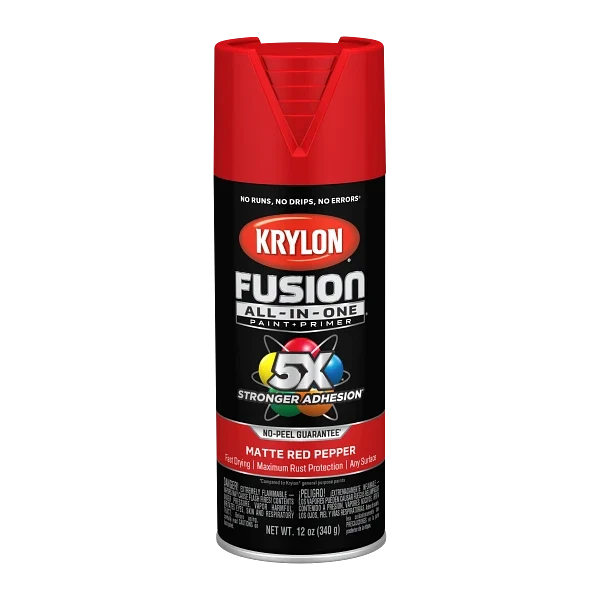
- Coverage
- Up to 25 sq ft per 12 oz can (flat panel); 10–14 sq ft on shaped objects
- Sheens
- Gloss, satin, matte, metallic, hammered, textured
- Dry / recoat
- Touch 25 min · handle 1h · recoat any time
- Full cure
- 7 days to full hardness
- VOC
- Aerosol; nationally available including CARB-compliant states
- Yellowing risk
- Low on pigmented colors; the clear yellows slightly outdoors after 2 seasons
- Primer
- None on ABS, PVC, resin, fiberglass; plastic primer required on PP/PE
- Price tier
- $
- Bonds to bare, scuffed plastic without a separate primer on ABS, PVC, and resin; the only pick that came through a crosshatch tape pull on bare PVC with no flake at all
- Recoat at any time, no 48-hour penalty window — the single biggest practical advantage over the Rust-Oleum aerosols, which lock you out between hour 1 and hour 48
- Widest finish range in the round-up (gloss, satin, matte, metallic, hammered, textured) across roughly 50 colors, all on the same bonding base
- Polypropylene and polyethylene beat it like every other topcoat; a #5 PP patio chair still needs plastic primer underneath
- The 25-minute dry-to-touch is honest but the film stays soft for days; handle a sprayed tool grip at day 2 and you'll leave fingerprints
- 12 oz covers roughly 25 sq ft in theory and about half that in practice on a shaped 3D object, because half your spray misses
2. Universal All Surface Spray Paint

- Coverage
- Up to 15 sq ft per 12 oz can (flat panel)
- Sheens
- Gloss, satin, matte, metallic, hammered
- Dry / recoat
- Touch 30 min · handle 1–2h · recoat within 1h or after 48h
- Full cure
- 24h dry, 7 days to full hardness
- VOC
- Aerosol; check the state-restricted SKU list for CA and OTC states
- Yellowing risk
- Very low on pigmented colors
- Primer
- None on most rigid plastics; plastic primer on PP/PE
- Price tier
- $$
- Any-angle comfort trigger sprays upside down and sideways without cramping — on a resin Adirondack chair with 20 slats, that trigger is worth the price gap by itself
- Heaviest pigment load of the three all-purpose aerosols here; covered a black storage bin in white in two coats where Painter's Touch needed four
- Best outdoor color retention in the round-up. After a full summer south-facing, the charcoal panel read almost unchanged where the budget pick had gone visibly chalky
- $10–$13 a can is roughly double the budget pick, and a two-chair patio set is four to six cans
- Recoat within 1 hour or after 48 hours; miss that window and the second coat lifts the first into wrinkles
- Metallic and hammered finishes need a light touch on vertical plastic; the heavier build runs faster than Fusion does
3. Specialty Plastic Primer Spray
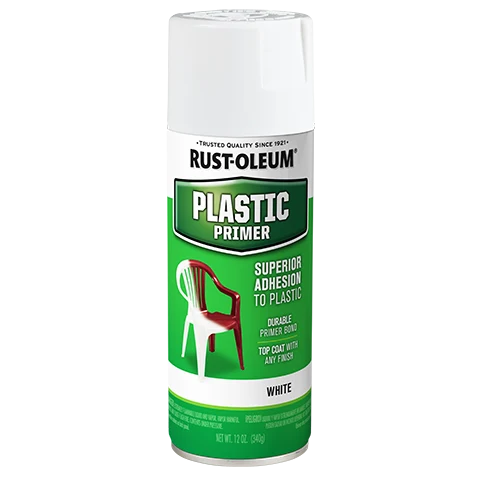
- Coverage
- Up to 12 sq ft per 11 oz can
- Sheens
- Flat primer
- Dry / recoat
- Touch 15 min · topcoat once dry, same session preferred
- Full cure
- N/A — topcoat carries the cure
- VOC
- Aerosol; check the state-restricted SKU list
- Yellowing risk
- N/A under a pigmented topcoat
- Primer
- This is the primer
- Price tier
- $
- Turned the one substrate that failed everything else into a substrate that held. Primed polypropylene passed the tape pull with all five topcoats; unprimed PP failed with all five
- Clear-ish light film, so it doesn't fight your topcoat color the way a white primer does under yellow or red
- Dry to touch in about 15 minutes; you can prime a set of six planters and start color on the first one before you finish the last
- It is not a filler or a build primer. Scratches, mold seams, and UV chalk telegraph straight through
- Adds $8 and a step to every project, which is why people skip it and then post pictures of peeling chairs
- Poor labeling for the actual use case; nothing on the can tells you it's mainly for the polyolefins Fusion can't grab
4. Painter's Touch 2X Ultra Cover Spray Paint

- Coverage
- Up to 12 sq ft per 12 oz can
- Sheens
- Gloss, satin, semi-gloss, flat
- Dry / recoat
- Touch 20 min · handle 1h · recoat within 1h or after 48h
- Full cure
- 24h dry, 7 days to full hardness
- VOC
- Aerosol; check the state-restricted SKU list
- Yellowing risk
- Low indoors; noticeable chalk outdoors by season two
- Primer
- Plastic primer strongly recommended on any bare plastic
- Price tier
- $
- $5–$7 a can and stocked in more colors than anything else in the aisle, including the flat blacks and primary brights kids' projects actually need
- Dry to touch in 20 minutes, the fastest in the round-up, which matters when you're spraying 30 small parts on a tarp
- Fine for indoor rigid plastic over the plastic primer; the failure mode is outdoor UV, not adhesion
- Weakest bare-plastic adhesion of the five. On unprimed PVC it lifted at the tape pull, which is the whole reason it's the budget pick and not the top one
- Chalked visibly on the outdoor panel after one summer south-facing; this is not the can for patio furniture
- Same 1-hour / 48-hour recoat trap as Universal, and the thinner film makes the run-vs-coverage balance fussier
5. Vinyl and Fabric Coating
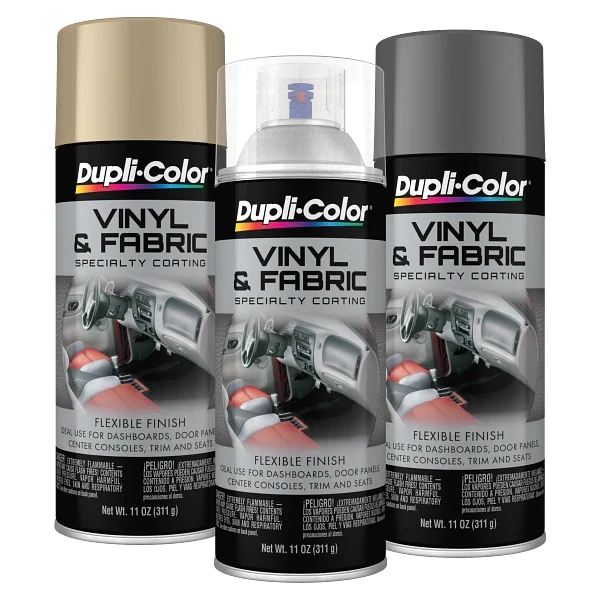
- Coverage
- 8–12 sq ft per 11 oz can on plastic; far less on fabric
- Sheens
- Matte / low sheen (satin on hard trim)
- Dry / recoat
- Touch 30 min · handle 1h
- Full cure
- 24h; flex resistance builds over 7 days
- VOC
- Aerosol; automotive-restricted SKUs in some states
- Yellowing risk
- Low indoors; not UV-rated for exterior
- Primer
- Dupli-Color adhesion promoter on slick hard trim; none on grained vinyl
- Price tier
- $$
- Stays flexible after cure. Bent a painted vinyl strip 90 degrees at day 7 and the film creased without cracking; every rigid enamel here cracked white at the fold
- Soaks into grained plastic and cloth instead of sitting on top, so door cards and seat bolsters keep their texture rather than going shiny
- The right answer for the job everyone tries to do with regular spray paint and then peels off their steering column a month later
- Color range is automotive-narrow: blacks, greys, a few blues and reds, and matching anything custom is a fantasy
- Not an outdoor-durability product. UV fade on exposed patio vinyl shows in a season or two
- 11 oz can at $10–$12 covers very little on absorbent fabric; a pair of front seats is three or four cans
Krud Kutter Original Concentrated Cleaner Degreaser
Plastic comes out of the mold coated in release agent, and everything since has added sunscreen, hand oil, silicone protectant, and road film. None of that is visible and all of it blocks adhesion. A degreaser wash is the step that separates a plastic paint job that lasts five years from one that peels in a sheet the first time someone drags a fingernail across it. Dilute 1:1, scrub with a green pad (that doubles as your scuff step), rinse with clean water, dry completely. On automotive trim and anything that ever met a silicone protectant, wash twice. This matters more than which can you buy, and it costs about $8 for a bottle that does dozens of projects.
BUY ON AMAZON
Ask a Question