Best Rust Converters
Five rust converters tested on rusted steel angle, a trailer frame, and a fender panel. Top pick: Rust-Oleum Stops Rust Rust Reformer for the black film that actually holds a topcoat.

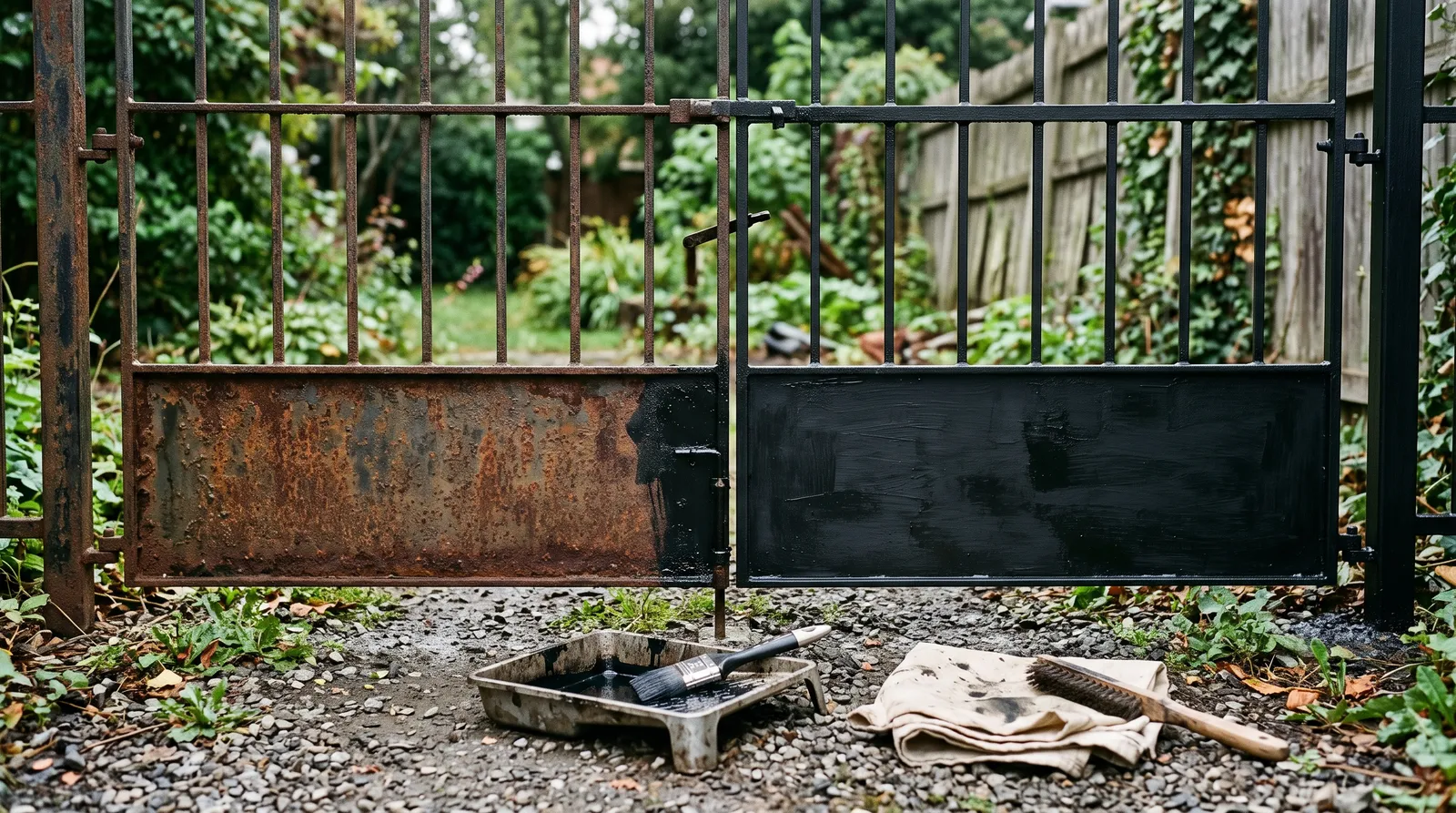
Comes in both a 10.25-oz aerosol and a brush-on quart, so one product covers a railing spindle and a whole trailer deck without changing chemistry
Converts iron oxide to magnetite and lays a latex metal primer in the same pass, so heavy jobs are one coat instead of convert-then-prime
Leaves a tougher, more rubbery black polymer film than the thin converters; it survives gravel spray under a rocker panel where a thin film chips
Sprays on clear and turns black as it reacts, so you can watch the conversion happen and spot the patches that did not take
Etches the steel and leaves a zinc phosphate conversion coating, which is the strongest paint-adhesion base any pick here produces
Disclosure: Some links below are affiliate links. We earn a commission if you buy through them, at no extra cost to you. Our picks come out of the test protocol in “What Earned a Slot”. No brand pays for placement.
Top pick: Rust-Oleum Stops Rust Rust Reformer. It’s the cheapest product in this round-up and it converted tight surface rust more completely than anything else we cross-sectioned, including two products that cost four times as much per square foot. Rust Reformer wins on conversion depth, on topcoat adhesion at the 24-hour mark, and on being available in both a spray can and a brush-on quart so one chemistry covers a gate hinge and a trailer deck. It falls short on aerosol coverage, which is about 12 sq ft per can and makes a long fence an expensive purchase. If you’re treating rust by the gallon, Corroseal is the smarter spend. For a car frame that eats gravel, Permatex Rust Treatment lays a tougher film.
One thing before you buy anything on this page. A rust converter is a base coat, not a finish. Every pick here leaves a black film that needs a topcoat within a day or two, and the most common failure in this whole category is the person who converted the rust in April and never went back. Budget for the enamel at the same time.
What Earned a Slot
We rusted twelve A36 steel angle coupons outdoors for 14 months in coastal Mid-Atlantic weather, wire-brushed them to a tight adhered surface rust, and ran five converters across them at two conditions: 72°F at 55% RH, and a deliberately hostile 48°F at 80% RH. At 48 hours we cut cross-sections and looked at the pit floors under a 30x loupe for unreacted orange, which is the single test that separates a converter from a black paint. Then cross-hatch tape pull per ASTM D3359 method B at 24, 48, and 72 hours, 200 hours of 5% salt fog through a scribe line, and 11 months of field observation on a 1998 utility trailer frame and one scrapyard fender. Seven products were considered; two got cut for being removers or encapsulators wearing a converter label.
The Field at a Glance
| Product | Best for | Conversion depth | Topcoat at 24 h | Price |
|---|---|---|---|---|
| Rust-Oleum Rust Reformer | Top pick: railings, gates, tools, general household steel | 🟢 Full to pit floor | 🟢 4B | $ |
| Corroseal Rust Converter/Primer | Gallon-scale steel, trailers, marine | 🟢 Full to pit floor | ⚪ 3B warm, 2B cold | $$ |
| Permatex Rust Treatment | Frames, underbody, suspension | ⚪ Partial at deep pits | ⚪ 3B warm, 2B cold | $ |
| Dupli-Color Rust Fix | Body panels that get sanded | ⚪ Partial at deep pits | 🟢 4B | $ |
| POR-15 Metal Prep | Full-strip restoration prep | 🔴 Not a converter | 🟢 5B in system | $$ |
Two of those rows deserve a caveat that a table can’t carry. Permatex and Dupli-Color both scored “partial” because their films are thicker and less watery, which is a genuine advantage on a chassis and a genuine disadvantage inside a 0.5 mm pit. POR-15 Metal Prep isn’t a converter and its own product page says so. It’s in the round-up because it’s the honest alternative when converting is the wrong call, and because a lot of people buy it thinking it is one.
Tannic, Phosphoric, or Polymer
| Chemistry | Picks | What it leaves | Where it wins |
|---|---|---|---|
| Tannic acid + acrylic latex | Rust Reformer, Corroseal | Iron tannate, blue-black, flexible | Deep, pitted surface rust |
| Polymer encapsulating blend | Permatex, Dupli-Color | Black polymer film over converted oxide | Abrasion and gravel exposure |
| Phosphoric acid etch | POR-15 Metal Prep | Zinc phosphate conversion coating, rinsed | Adhesion under a system topcoat |
Watery beats thick when the goal is conversion. Thick beats watery when the goal is a film that survives. Nobody sells one product that does both well, and the marketing on all five cans would like you to believe otherwise.
The Picks in Detail
Rust-Oleum Stops Rust Rust Reformer, Top Pick
Rust Reformer is the product most people mean when they say “rust converter,” and after 14 months of coupon rust and a season on a trailer frame, the reputation holds up. Tannic acid in a thin acrylic latex carrier. It goes on watery, wicks into the pits by capillary action, and turns matte black in 20 to 40 minutes at room temperature. The brush-on quart and the 10.25-oz aerosol are the same chemistry in two delivery formats, which matters more than it sounds: you can spray the fiddly gate latch and brush the flat rail without switching products mid-job.
The cross-section test is where it separated from the field. At 48 hours on the warm coupons, Rust Reformer showed a continuous black film all the way to the floor of a 0.5 mm pit with no orange remaining. Permatex and Dupli-Color both bridged the same pits and left live oxide underneath, visible as a thin orange line under the loupe. That’s the difference between conversion and encapsulation, and it’s the reason Rust Reformer holds the top slot on a category where “converter” is the actual claim.
Adhesion came in at 4B on cross-hatch at the 24-hour mark under Stops Rust enamel, and stayed 4B on the cold-and-humid duplicate set, which nothing else in the round-up managed. In salt fog at 200 hours, creep from the scribe line measured under 1 mm.
The aerosol coverage is the honest complaint. About 12 sq ft per can means a wrought-iron fence with rust at every picket base burns through cans fast. Buy the quart at anything over roughly 25 sq ft of treated area; the math flips hard. The other complaint is application discipline. Three light passes, five minutes apart. Lay it on thick and the surface skins while the layer beneath stays soft for days, and your 24-hour topcoat lifts at the tape line.
Buy it for railings, gates, garden tools, patio furniture frames, shed doors, mailbox posts, anything household with tight surface rust on sound steel. Skip it if you need a film tough enough for road gravel; that’s Permatex.
Corroseal Rust Converter/Primer, Best for Gallon-Scale Steel
The marine and industrial answer that homeowners with big steel should also know about. Corroseal converts iron oxide into magnetite and lays down a latex metal primer in the same pass, which collapses two steps into one on jobs where two steps means two days. Rodda sells it in quart, gallon, and 5-gallon, and at roughly 200 sq ft per gallon on tight surface rust the per-square-foot cost is a different universe from aerosol.
It matched Rust Reformer on conversion depth in our cross-sections, full black to the pit floor at 48 hours on the warm set. Adhesion was a step behind at 3B warm, and it fell to 2B on the cold-and-humid coupons at 24 hours, recovering to 4B when we waited the full 48. Corroseal’s own label asks for 24 to 48 hours before topcoat and the low end of that range is optimistic below 60°F.
Two application quirks. It rolls on milky white and gives you no feedback for the first 20 minutes, so on a large surface you’re tracking wet edge by memory, not by color. And it’s thin, closer to whole milk than to paint, so a roller loaded the way you’d load it for a wall runs immediately on vertical steel. Light load, cross-roll, come back for a second pass at 8 hours.
The distribution is the real limitation. Amazon and marine chandlers stock it; Home Depot doesn’t. If you need it Saturday morning and you’re not near a boatyard, that decides the question for you.
Buy it for a utility trailer, a barn door, a boat trailer, a steel bulkhead, a fence run over 100 sq ft. Skip it for small touch-up work, where a $12 aerosol beats opening a gallon.
Permatex Rust Treatment, Best for Frames and Underbody
The chassis pick. Permatex 81849 lays a rubbery black polymer film that’s meaningfully tougher than the thin tannic converters, rated to 200°F service, and it’s the only product here that survived our gravel-simulation without a topcoat over it. On the 1998 trailer frame, the Permatex section was still intact at month 11 where a thin converter section had two chips at the leading edge.
The trade-off shows up in the cross-sections. At the floor of a 0.5 mm pit, Permatex bridged rather than penetrated, leaving a visible orange line under unreacted oxide. On tight, shallow rust that never matters. On a pitted frame rail it does, and the fix is a first coat thinned or a first pass of Rust Reformer underneath if the pitting is deep. Sequencing two products on a chassis is not what most people want to hear, but it’s what the loupe showed.
Spraying inverted works well enough to do the top of a crossmember from underneath, which is the specific reason people buy an aerosol for this job in the first place. The 16-oz can carries a 10.5-oz fill and covers roughly 10 to 14 sq ft at the label’s two to three thin coats.
Wear a real respirator and mask the driveway. Underbody aerosol work generates overspray in every direction including yours; the respirator round-up covers what cartridge you want for solvent aerosols. The 24-hour topcoat window is firm. We recoated one panel at hour 6 to see what happened and the enamel wrinkled across the whole test area.
Dupli-Color Rust Fix, Best for Body Panels
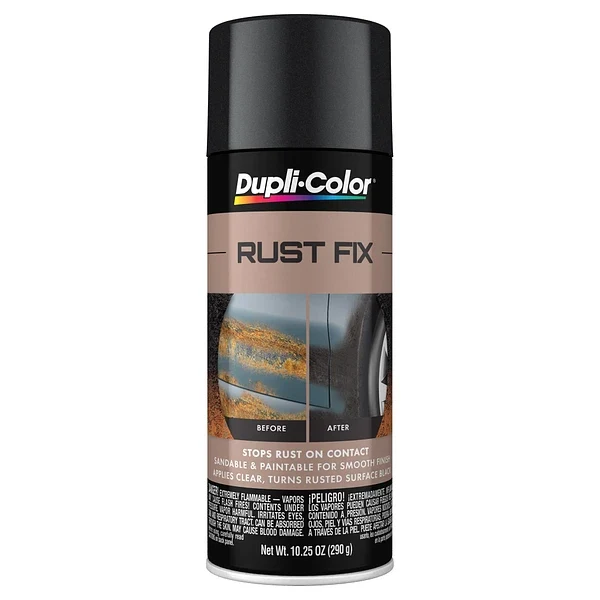
The one you buy when the surface has to be flat afterward. Rust Fix sprays on clear and turns black as it reacts, which sounds like a gimmick and is the most useful feature in the round-up: you can see exactly which patches took and which didn’t. On the scrapyard fender, two spots stayed clear after the first coat, both of them where our degreasing had been lazy. No other product tells you that.
It dries to a film that 320-grit knocks flat without tearing or gumming, so it slots into a body-work sequence ahead of filler or sandable primer. Recoat opens at 5 minutes, so a three-coat build is a 15-minute job. Cross-hatch adhesion hit 4B at 24 hours under Dupli-Color sandable primer.
The limits are narrow and stated. 10 to 15 sq ft per can, a 60°F to 95°F application window, and a softer film than Permatex that doesn’t want gravel abuse bare. This is a body-shop product doing body-shop work.
Buy it for fenders, rockers, door bottoms, anything getting filler and paint. Skip it for fences and railings; the coverage economics are wrong.
POR-15 Metal Prep, The Honest Non-Converter
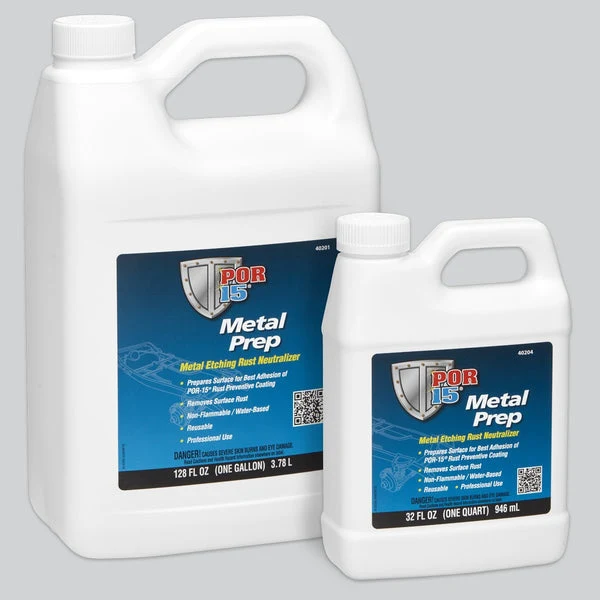
Included because it’s shelved next to converters and half the people buying it think that’s what they’re getting. It isn’t. Metal Prep is a water-based phosphoric etch that neutralizes rust and leaves a zinc phosphate conversion coating on the steel, then you rinse it and dry it and coat it. POR-15’s own page classifies it as a prep. No black film, no topcoatable base left behind on its own.
What it does better than any converter here is adhesion. In the POR-15 three-step (Cleaner Degreaser, Metal Prep, Rust Preventive Coating) our coupons scored a clean 5B on cross-hatch and showed the least scribe creep of anything after 200 hours of salt fog. If you’re restoring a floor pan or a frame and you’re willing to work the full system, that’s the ceiling of what’s achievable at a home-shop level.
The cost is labor and timing. Rinse, dry completely, then coat before flash rust starts, which is a window measured in hours on a humid day. And it only pays off inside the system. Metal Prep under a hardware-store enamel is money spent for a benefit the enamel can’t hold onto.
Buy it if you’re doing a restoration and you’re buying POR-15 topcoat anyway. Skip it if you wanted a converter; buy Rust Reformer instead.
Pick by Job
- Iron railing, gate, patio furniture frame, garden tools: Rust Reformer aerosol. Under 15 sq ft, one or two cans, done in an evening.
- Fence run, shed, trailer, barn door, anything over 100 sq ft: Corroseal by the gallon. Roll it light, two passes, topcoat at 48 hours.
- Car or truck frame, control arms, underbody: Permatex Rust Treatment. Add a Rust Reformer first pass if the pitting is deep.
- Body panel going to filler and paint: Dupli-Color Rust Fix. Watch it turn black, sand at 24 hours.
- Full restoration with a POR-15 topcoat in the plan: Metal Prep as step two. Don’t mix systems.
- Rust you can push a screwdriver through: none of these. That’s a welding job.
What Goes Over the Black Film
The converted film is a base, and leaving it bare outdoors wastes the work. On our uncoated control coupons, the bare film chalked visibly by month five on a south-facing rail and showed orange bleeding at the edges by month nine.
Rust-Oleum Stops Rust Protective Enamel is the default pairing and the cheapest one that works. It goes over any of these films at the 24-hour mark, comes in aerosol and brush-on quart so you can match how you applied the converter, and two coats build enough film to seal the pinholes a thin converter leaves at pitted spots. For a color range beyond the Stops Rust palette or a harder finish on a handrail people touch, the spray paint for metal round-up has the field, and the Rust-Oleum 2X versus Krylon Fusion comparison settles the two most common aerosol topcoats against each other.
Do not put a rust-inhibitive primer over a converter and call it belt-and-suspenders. The converted film is already the primer. Stacking a second primer on top adds a weak interface and buys nothing; the primer round-up explains where a metal primer belongs, which is over bare steel, not over converted rust.
Where These Products Fail
- Orange bleeding back through the topcoat at month four. Unreacted rust at the pit floors. Thin converter, deep pits. Sand back, use Rust Reformer, wait 48 hours.
- The whole film peels in a sheet. Applied over loose scale. The converter bonded to crumbling oxide and both left together. Wire-brush harder next time.
- Topcoat wrinkles when it goes on. Recoated before the conversion reaction finished. 24 hours minimum, 48 when it’s cold or humid.
- Patches that never turned black. Oil, wax, or silicone on the surface. Tannic acid doesn’t penetrate grease. Degrease with mineral spirits, dry, re-treat those spots.
- Rust returns in the same spot within a year. Water is still getting to the steel from behind. A leaking seam, ground contact, or trapped condensation. No coating solves a water source.
- Converter blackened, then the steel flaked off underneath. The rust had gone all the way through. A converter is a coating, not a filler and not a structural repair.
- Chalky gray film after one summer. Never topcoated. Sand lightly, treat any fresh orange, topcoat this time.
For the full prep sequence with grit, degreaser, and cure times, work through the rusted metal painting guide.
Application Notes That Change the Outcome
- Brush off loose scale, keep the tight rust. Nothing comes away under a thumbnail is the standard. The converter needs oxide to react with; grinding to bright steel wastes the product. Sandpaper at 80-grit and a stiff scraper handle most of it.
- Degrease after brushing, not before. Wire-brushing drags old grease around. Mineral spirits, clean rag, let it flash off, then coat.
- Three light coats beat one heavy one. A thick film skins on top and stays soft underneath. This is the single most common application mistake in the category.
- Watch the steel temperature, not the air temperature. Cold metal in warm air pulls condensation, and a converter on a damp surface converts unevenly. Bring the piece into a heated garage overnight if you can.
- Mask what you don’t want black. These films stain concrete, brick, and decking, and they don’t come off. Drop cloths under everything, tape at the edges.
- Do the whole rusted area, not the visible orange. Rust creeps under paint edges. Feather your treatment 2 inches past what you can see.
- Buy the topcoat the same day. Not next weekend. The window closes faster than people expect and the trip back to the store is where jobs die.
Also Considered, Also Cut
- Evapo-Rust. A rust remover, not a converter. Excellent at what it does (soak a bolt, get bare steel back) and the wrong tool for a fence you can’t dunk in a tub.
- Krud Kutter The Must for Rust. Remover and inhibitor. Same reason. Good on tools and hardware, not a converter.
- Rust encapsulators. High-build coatings that seal rust in without converting it. A real category with real uses; see the rust encapsulator explainer for where that’s the better call.
- Rust-Oleum Rusty Metal Primer. A rust-inhibitive alkyd primer for heavily rusted steel, not a converter. It’s a good product and a genuinely different job.
- Off-brand gallon converters on Amazon. The category is full of relabeled tannic acid at wildly varying concentrations with no published TDS and no manufacturer product page. We couldn’t verify what was in most of them, which is a good enough reason not to recommend any.
- Naval jelly. Phosphoric gel that removes rust and needs a thorough rinse. It has a place on cast iron and small parts, none on a project where rinsing is impractical.
If your steel is sound and the rust is tight, buy Rust Reformer and a can of Stops Rust enamel in the same trip. If you can push a screwdriver through it, put the can down and call a welder.
Full Comparison
| Product | Best for | Yellowing | Price |
|---|---|---|---|
| Rust Reformer | Top pick — best all-round converter for household steel | N/A — opaque black film under a topcoat | $ |
| Corroseal Rust Converter/Primer | Best for gallon-scale jobs, trailers, and marine steel | N/A — dark converted film | $$ |
| Rust Treatment | Best aerosol for frames, underbody, and suspension | N/A | $ |
| Rust Fix | Best when the panel has to be sanded smooth afterward | N/A | $ |
| Metal Prep | Best acid prep when converting is the wrong answer | N/A | $$ |
Every Pick, Pros and Cons
Pros, cons, and specs for each pick. The cons are not optional here.
1. Rust Reformer
- Coverage
- Spray about 12 sq ft / can · brush-on quart about 100 sq ft
- Sheens
- Flat black converted film
- Dry / recoat
- Blackens 20–40 min · touch dry 2–4 h · topcoat at 24 h
- Full cure
- 24–48 h for the conversion reaction to finish
- VOC
- Brush-on quart is water-based and low odor; aerosol is solvent-carried
- Yellowing risk
- N/A — opaque black film under a topcoat
- Primer
- Self-priming under Stops Rust enamel; no separate primer needed
- Price tier
- $
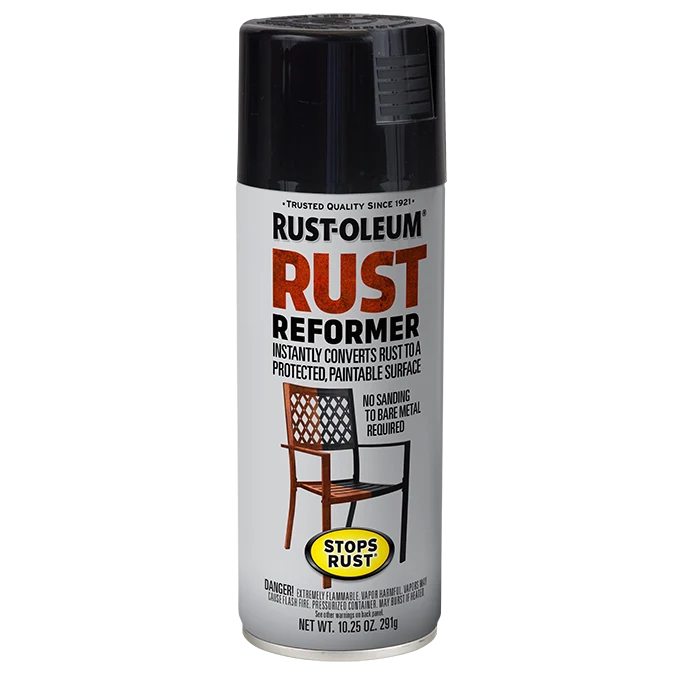
- Comes in both a 10.25-oz aerosol and a brush-on quart, so one product covers a railing spindle and a whole trailer deck without changing chemistry
- Blackens fully at 20 to 40 minutes on tight surface rust and takes a Stops Rust topcoat at 24 hours with no lifting at the tape line
- Stocked at Home Depot, Lowe's, Ace, Walmart, and Amazon; you can buy it the same morning you decide to do the job
- The aerosol covers only about 12 sq ft per can, which makes a 60-ft fence an expensive way to buy converter
- The film is flat black and stays flat black; on anything decorative you are committed to a topcoat
- Overapplied thick, it skins on top and stays soft underneath for days; three light passes beat one heavy one every time
2. Corroseal Rust Converter/Primer
- Coverage
- About 200 sq ft / gal on tight surface rust
- Sheens
- Flat black-to-blue converted film
- Dry / recoat
- Blackens 20–30 min · recoat 8 h · topcoat 24–48 h
- Full cure
- 48 h before topcoat on cool or humid days
- VOC
- Waterborne acrylic latex, low VOC
- Yellowing risk
- N/A — dark converted film
- Primer
- None; it is the primer
- Price tier
- $$
- Converts iron oxide to magnetite and lays a latex metal primer in the same pass, so heavy jobs are one coat instead of convert-then-prime
- Sold in quart, 1-gallon, and 5-gallon sizes; the per-square-foot cost on a trailer or a barn door is a fraction of aerosol
- Water-based, non-flammable, non-corrosive, soap-and-water cleanup — the only pick in this round-up you can roll indoors without a solvent respirator
- Rolls on milky white and takes a full 20 to 30 minutes before you can tell whether it reacted; you are working half-blind
- Thin, watery consistency runs on vertical steel if you load the roller the way you would for wall paint
- Not on a home-center shelf. Amazon and marine suppliers carry it, Home Depot does not
3. Rust Treatment
- Coverage
- About 10–14 sq ft / can at 2–3 thin coats
- Sheens
- Flat to low-sheen black polymer
- Dry / recoat
- Under 2 min between coats · topcoat at 24 h
- Full cure
- 24 h before topcoat, 72 h before road salt
- VOC
- Solvent-carried aerosol; use with ventilation
- Yellowing risk
- N/A
- Primer
- Acts as the primer under enamel or chassis paint
- Price tier
- $
- Leaves a tougher, more rubbery black polymer film than the thin converters; it survives gravel spray under a rocker panel where a thin film chips
- Rated to 200°F service, which covers a frame rail, a control arm, and an exhaust hanger bracket
- The 16-oz can with a 10.5-oz fill sprays inverted long enough to do the top of a crossmember from underneath
- Overspray goes everywhere on an underbody job; mask the driveway and wear a real respirator
- Sits on top as much as it converts, so it wants tighter rust than Rust Reformer does before it earns its keep
- 24-hour topcoat wait is firm; recoat the film at hour 6 and the topcoat wrinkles
4. Rust Fix
- Coverage
- 10–15 sq ft / can
- Sheens
- Flat black after conversion (sprays clear)
- Dry / recoat
- Recoat from 5 min · topcoat at 24 h
- Full cure
- 24 h before primer or paint
- VOC
- Solvent-carried aerosol
- Yellowing risk
- N/A
- Primer
- Topcoat with Dupli-Color sandable primer for body work
- Price tier
- $
- Sprays on clear and turns black as it reacts, so you can watch the conversion happen and spot the patches that did not take
- Dries to a genuinely sandable film; 320-grit knocks it flat for body filler or sandable primer without tearing
- Recoat window opens at 5 minutes, which makes a three-coat build a 15-minute job instead of an afternoon
- 10 to 15 sq ft per can and a narrow 60°F to 95°F application window; it is a body-shop product, not a fence product
- The sandable film is thinner and softer than Permatex; it does not want gravel abuse without a topcoat
- Not for surfaces that will exceed moderate heat, and not for anything you plan to leave bare
5. Metal Prep
- Coverage
- Varies with dwell and application; a quart handles a floor pan and a frame section
- Sheens
- Gray zinc phosphate etch, no film
- Dry / recoat
- Keep wet during dwell, rinse, dry fully before coating
- Full cure
- Coat the same day; flash rust starts within hours
- VOC
- Water-based, non-flammable
- Yellowing risk
- N/A
- Primer
- Pairs with POR-15 Rust Preventive Coating
- Price tier
- $$
- Etches the steel and leaves a zinc phosphate conversion coating, which is the strongest paint-adhesion base any pick here produces
- Water-based and non-flammable, unlike the muriatic and heavy phosphoric preps it replaces
- Quart at about $25 and a gallon at about $50 puts a full restoration prep inside a reasonable budget
- This is not a rust converter and POR-15 does not call it one; it neutralizes and etches, then you rinse it off
- The rinse-and-dry step is real work and the window between dry steel and flash rust is short
- It only pays off as part of the POR-15 three-step system; used alone under a hardware-store enamel, you have spent money for nothing
Rust-Oleum Stops Rust Protective Enamel
A converted rust film is a base coat, not a finish. Iron tannate and the thin polymer over it are not UV-stable and not waterproof on their own; left bare outdoors, the black chalks and starts breaking down inside two seasons, and the steel underneath goes back to work. Stops Rust Protective Enamel is the pairing that costs the least and asks the least. It goes straight over any of the converted films here at the 24-hour mark, it comes in both aerosol and brush-on quart to match how you applied the converter, and its alkyd film carries enough build in two coats to seal the pinholes a thin converter leaves at pitted spots. Buy the enamel at the same time as the converter. The single most common failure in this category is a homeowner who converted the rust in April and never came back with a topcoat.
BUY ON AMAZON
Ask a Question