Best Spray Paint for Metal
Six metal spray paints tested on rusted steel, galvanized, and aluminum panels through 12 months outdoors. Top pick: Rust-Oleum Stops Rust Protective Enamel.

Oil-based alkyd film cured to 2H pencil hardness on our steel panels, the hardest in the group and the only finish that took a fingernail drag at 30 days without marking
Best adhesion in the round-up on galvanized and mill-finish aluminum: 5B cross-hatch (no lifted squares) on a scuffed galvanized post with no primer under it
The dimpled hammered pattern buries surface defects that gloss enamel magnifies; our pitted patio-table panel read as intentional texture instead of damage
Rated to 1200°F continuous, which covers charcoal grill bodies, wood stove surrounds, fire pits, and exhaust manifolds
15 oz can with a wide industrial fan tip lays down a 4-inch pattern, roughly a third faster across a railing than a standard 12 oz consumer can
Widest finish range on this list: satin, gloss, flat, metallic, hammered, distressed, and a pearl-mist line, in over 60 colors
Disclosure: Some links below are affiliate links. We earn a commission if you buy through them, at no extra cost to you. Picks come out of the test protocol described in “What Separated the Cans”. No brand pays for placement.
Top pick: Rust-Oleum Stops Rust Protective Enamel Spray. At $7 to $9 a can it’s the oil-based alkyd that beat every waterborne competitor on our rusted-steel panels, and after twelve months on a south-facing outdoor rack it was the only finish with no rust creep back from the scribe line. Stops Rust wins on film hardness, weather hold-out, and long-term color availability. It falls short on speed, because touch-dry runs two to four hours and handle-dry runs most of a working day. If you need the piece back in service tonight, Krylon Fusion All-In-One is the faster answer with softer film. If the metal is pitted and you don’t want to look at the pits, Rust-Oleum’s Hammered finish hides more damage than anything else here.
Every can on this list fails on greasy, flaking metal. All six of them.
Spray paint is a thin film, usually 1 to 2 mils after two coats, and a film that thin has no ability to bridge over contamination. Degrease with mineral spirits, knock the loose rust off with a wire brush or an 80-grit flap disc, scuff the sound areas with 180-grit paper, blow the dust off, and then the choice of can starts to matter. Our rusted metal prep guide walks the whole sequence with grit numbers and cure times.
What Separated the Cans
Eleven aerosols across four brands went onto 6 x 12 inch panels of three metals: hot-rolled steel carrying active surface rust, hot-dip galvanized fence post stock, and mill-finish aluminum flat bar. No primer under any panel, deliberately, so each coating had to earn its own adhesion. Two coats at 72°F, then 30 days of cure before ASTM D3363 pencil hardness and ASTM D3359 cross-hatch adhesion. Sister steel panels got an X-scribe cut through to bare metal and twelve months on an outdoor rack in coastal Mid-Atlantic weather, inspected at months 3, 7, and 12 for creep. Five cans washed out early and are listed at the bottom. Three trade interviews (a fabricator, a powder-coat shop owner, a fleet maintenance lead) covered where an aerosol realistically belongs and where it doesn’t.
Six Cans, Side by Side
| Product | Best for | Handle-dry | Rust creep at 12 months | Price |
|---|---|---|---|---|
| Rust-Oleum Stops Rust Enamel | Top pick: outdoor steel, gates, furniture | 5–9h | 🟢 None | $ |
| Krylon Fusion All-In-One | Galvanized, aluminum, mixed materials, no sanding | 1h | 🟡 Bloom at month 7 | $ |
| Rust-Oleum Stops Rust Hammered | Pitted or previously rusted metal | 5–9h | 🟢 None | $ |
| Rust-Oleum High Heat | Grills, stoves, fire pits, exhaust | 1–2h | 🟢 None (heat-cured) | $ |
| Rust-Oleum Professional Enamel | Railings, fencing, big open surfaces | 1h | 🟢 Trace at the cut | $ |
| Rust-Oleum Universal All-Surface | Decorative metal, color and finish choice | 1h | 🟡 Trace bloom at month 12 | $$ |
Pick by Job
- Outdoor steel that will see rain and snow: Stops Rust Protective Enamel. Nothing else here held the scribe for a full year.
- Galvanized post, aluminum ladder, chrome-trimmed anything: Krylon Fusion All-In-One, or Self Etching Primer under an alkyd.
- Old patio set with pitting you can feel: Stops Rust Hammered. The texture does the hiding.
- Charcoal grill, wood stove, fire pit ring: High Heat. This is not optional; standard enamel scorches.
- A hundred feet of railing: Professional High Performance Enamel. The 15 oz can and wide fan tip save you an afternoon.
- A lamp base, a headboard, a planter, anything decorative: Universal All-Surface, for the finish range.
The Picks
Rust-Oleum Stops Rust Protective Enamel Spray, Top Pick
Stops Rust is the can that made the category, and after a year of panel data I’m not moving it. The chemistry is a straight oil-based alkyd with rust-inhibitive pigment, the same formula that’s in the quart cans, atomized. That matters because alkyd cures by oxidation into a genuinely hard film rather than by coalescing into a flexible one.
On the numbers: 2H pencil hardness at 30 days, the hardest in the group. Cross-hatch on scuffed bare steel came back 5B with nothing lifting. The scribe test is where it separated. Twelve months on the south-facing rack, salt in the air, and the X-cut still showed no creep back into the film. Krylon Fusion had visible bloom along the same cut by month 7. Universal picked up trace bloom by month 12.
The cost is time. Touch-dry at two to four hours means a whole afternoon between coats, and the recoat window is the thing that bites people: recoat inside one hour, or wait a full 48. Come back at hour six, and the solvent in the new coat re-wets a half-cured film underneath and lifts it into wrinkles. I’ve done it. The panel goes in the trash.
Buy it for gates, railings, mailboxes, wrought-iron furniture, tool bodies, anything steel that lives outside. Skip it if the metal is galvanized or aluminum, where it needs an etching primer first, or if you need the piece usable in under a day.
Krylon Fusion All-In-One, Best When You Are Not Going to Sand
Fusion is the adhesion pick, and the adhesion is real. Sprayed straight onto a scuffed galvanized fence post with no primer, the cross-hatch came back 5B, not one square lifted. Nothing else in the test did that on galvanized. On mill-finish aluminum it was 4B, still the best in the group. Krylon built this around a bonding resin that grips slick, low-energy surfaces, and it works on the two metals that embarrass ordinary enamel.
Handle-dry in about an hour is the other reason it’s here. A patio chair frame sprayed before breakfast is holding a person by lunch, which is not a claim Stops Rust can make.
What it gives up is hardness. HB on the pencil scale, four steps softer than the alkyds, and you feel that difference the first time a tool bag drags across a sprayed steel shelf. It also gives up rust hold-out at the scribe. For furniture, hardware, and mixed-material projects that live under a porch roof, that’s a fair trade. For a gate hinge exposed to weather, it isn’t.
Buy it if the substrate is galvanized, aluminum, or a mix of metal and plastic, or you genuinely will not sand. Skip it if the piece is bare steel in full weather.
Rust-Oleum Stops Rust Hammered, Best over Pitted Metal
A texture that solves a real problem. Gloss enamel on a pitted 1970s patio table reads as damage under any raking light; the dimpled hammered pattern reads as a finish choice. Our pitted panel went from obviously-corroded to convincingly-forged with two coats and no filler work.
Same alkyd underneath as the top pick, so the rust performance follows: no creep at the scribe at twelve months, 2H hardness.
Two real limits. The pattern needs a wetter pass to form correctly, which puts you closer to the run threshold than flat enamel does, and runs on vertical work happen faster than you expect. And touch-ups never disappear, because the pattern restarts wherever the last one stopped. Coat a whole panel in one session or plan on redoing the whole panel later.
The other thing worth knowing: the hammered effect only reads correctly in a mid-tone. Rust-Oleum sells it in nine colors, and the dark bronze, brown, and black versions look forged while the light silver reads mottled and slightly cheap under direct sun. On a pitted table with a glass insert, dark bronze at two coats was the version people stopped and asked about.
Rust-Oleum Specialty High Heat, Best for Grills and Stoves
The category where the wrong can fails visibly and fast. We ran a standard enamel test strip on the same grill firebox as the High Heat, and the enamel went brown and chalky by the third cook. The High Heat panel held its color through a full season.
Rated 1200°F continuous, which covers charcoal grill bodies, wood-stove surrounds, fire pit rings, and exhaust manifolds. Touch-dry in about 30 minutes, so two coats fit in a morning.
The part people skip is the heat cure. Until the part actually runs hot for an hour, the film scratches with a fingernail. Coat the grill, let it dry, then run it empty at temperature before you cook on it. Four colors, mostly black and silver. Don’t use it below its range; on an unheated rail it stays chalkier than Stops Rust.
Rust-Oleum Professional High Performance Enamel, Best for Big Jobs
A 15 oz can with an industrial fan tip that lays a 4-inch pattern instead of the 2 to 3 inches a consumer tip gives you. On a 40-foot railing that difference was about a third less time and one fewer can. Touch-dry hit 15 minutes on our panels, the fastest alkyd in the test, and the solids load meant one pass covered where Stops Rust wanted a pass and a half.
The scribe result was a shade behind the top pick, trace bloom right at the cut at month 12 versus nothing. Practically speaking, they’re the same coating on a fence.
The fan tip cuts both ways. On open surfaces it’s the best applicator here. On a bicycle frame or a chair spindle, half the can goes past the part and into the air. Color range is industrial: safety yellow, machine gray, black, white. Buy it for railings, fencing, gates, shelving, equipment. Skip it for small detailed work.
Rust-Oleum Universal All-Surface, Best Finish Range
The decorative pick. Over 60 colors across satin, gloss, flat, metallic, hammered, distressed, and pearl-mist finishes, which is the widest palette on this list by a distance. The any-angle comfort trigger sprays fully inverted without spitting, and if you’ve ever tried to coat the underside of a table with a standard can, you know what that’s worth.
Middle of the pack on protection. HB-to-F hardness, trace bloom at the scribe by month 12. It resists rust, but it isn’t a rust-first coating the way Stops Rust is, and it costs about a dollar more per can. The metallic and mist finishes are also direction-sensitive; overlap your passes at inconsistent angles and the sheen bands visibly in daylight.
For a lamp base, a headboard, a set of planters, indoor shelving, this is the right can. For a gate, it isn’t.
The Same Six Picks, Grouped by Chemistry
Three chemistries are doing all the work in this round-up, and knowing which one is in the can predicts most of what it will do.
| Chemistry | Picks | Cures by | Behaves like |
|---|---|---|---|
| Oil-based alkyd | Stops Rust, Hammered, Professional Enamel | Oxidation | Hard, weatherable, slow; strict recoat window |
| Bonding acrylic | Krylon Fusion, Universal All-Surface | Coalescence | Fast, flexible, grips slick metal; softer film |
| Silicone-modified | High Heat | Heat cure | Inert to 1200°F; chalky and weak below its range |
Alkyd is what you want on steel that lives outdoors, because oxidation builds a genuinely rigid film that resists both moisture and the abrasion that opens a path to moisture. Bonding acrylic is what you want on galvanized, aluminum, and anything you refuse to sand, because it grips low-energy surfaces the alkyds slide off. Silicone-modified is a single-purpose material. Buy it for heat and nothing else.
Sheen Choice on Metal Is a Maintenance Decision
Gloss is the default on outdoor steel, and it’s the default for a reason. A gloss alkyd sheds water faster, cleans with a rag instead of a scrub, and shows you where a chip started before rust gets under the film. Satin is the compromise for furniture you touch, since gloss on a chair arm shows every hand mark. Flat is the one to think twice about on metal: it holds dirt in the surface texture and it hides the early chip you wanted to catch. The exception is a piece you want to read as aged iron, where flat black is the whole look. Our sheen guide covers the wider comparison.
Primer Is a Three-Way Decision, Not a Yes or No
The most common mistake in this category is treating primer as one question. It’s three.
| Your metal | Use | Why |
|---|---|---|
| Clean bare steel | No primer | Alkyd grips scuffed clean steel directly; a primer coat adds a day for nothing |
| Rusted, wire-brushed steel | Rusty Metal Primer | High-solids alkyd wets into pitting and locks residual oxide instead of sitting on it |
| Galvanized or aluminum | Self Etching Primer | Slick, reactive surfaces shed standard enamel in sheets inside a year |
| Shop-new steel with mill oil | Clean Metal Primer | Bonds through the light oil film that a solvent wipe never fully removes |
For heavy rust you can also convert instead of prime. See what rust converter actually does for where that’s the better call, and the primer round-up for brush-grade equivalents.
Where Spray-Painted Metal Actually Fails
- Sheeting off galvanized at month 8. No etch primer, standard enamel. Strip, etch, recoat, or use Fusion.
- Rust creeping out from a chip. The chip went to bare metal and nobody touched it up. Sand the spot, spot-prime, spot-coat within a week of noticing.
- Wrinkled second coat. Recoated in the dead zone between 1 and 48 hours on an alkyd. No fix but sanding flat and starting the coat over.
- Gritty, sandpaper-feeling finish. Sprayed onto hot metal in direct sun, or from too far back. Solvent flashed before the droplets could level.
- Runs on every vertical face. Can held too close or moved too slowly. Twelve inches out, keep the can moving, three light passes beat one heavy one.
- Fingerprints permanently in the finish. Handled during cure. Alkyds need a week, Fusion needs a week, and day two is not day seven.
- Peeling at a weld seam. Flux residue under the paint. Wash the seam with water and a stiff brush before degreasing, since flux is water-soluble and mineral spirits won’t touch it.
Outdoor pieces that flake in sheets have a different story underneath; see peeling exterior paint for the diagnostic.
Technique That Changes the Result
- Warm the can, not the metal. Twenty minutes in a bucket of warm tap water raises internal pressure and gives a finer, more even fan. Do not use hot water and never heat a can with a heat gun.
- Twelve inches, constant motion, 50 percent overlap. Start the pass off the part and end it off the part. Stopping over the work is what makes runs.
- Three light coats, not two heavy ones. Thin coats cure through. A heavy coat skins over and stays soft underneath for weeks.
- Invert and purge for 5 seconds when you’re done. Clears the tip. A clogged tip is the reason half-full cans get thrown away.
- Wear the cartridge respirator for the alkyds. Solvent-based aerosols in a closed garage are a genuine exposure, not a nuisance smell. Our painting respirator round-up covers the right cartridge.
For a full furniture project from strip to final coat, see repainting metal garden furniture.
What It Actually Costs
| Project | Cans | Materials | Notes |
|---|---|---|---|
| Steel mailbox and post | 2 | ~$16 | One can primer if the post is galvanized |
| Four-chair patio set + table | 6–7 | ~$55 | Add a can; you will use it |
| 40 ft of 36-inch railing | 4–5 (15 oz) | ~$45 | Professional enamel, fan tip |
| Charcoal grill body and lid | 2 | ~$18 | High Heat only, plus a heat cure |
| Wrought-iron gate, both sides | 3 | ~$26 | Rusty Metal Primer first, +$9 |
Aerosols are cheaper in-store than online in almost every case, because you’re paying to ship a pressurized can. A 12 oz can of Stops Rust runs $7 to $9 at Home Depot, Lowe’s, or Ace, and closer to $12 to $14 delivered as a single can. Amazon makes sense for the multi-packs and for colors your local store doesn’t stock. For a two-can project, drive to the store.
Screened Out, and Why
- Krylon ColorMaxx. Fine general-purpose paint and cheap. Weaker on metal specifically than Fusion, no reason to pick it here.
- Rust-Oleum Painter’s Touch 2X. Built for craft and furniture. Real product, wrong category; it holds rust back for a season, not five years.
- Automotive-specific engine and caliper enamels. Excellent within their range and over-specified for a mailbox. Buy them for engine parts.
- Store-brand hardware aerosols. Inconsistent valves and thin pigment loads. Two of the three we screened spat within the last third of the can.
- Brush-grade Stops Rust in a quart. Not an aerosol, so out of scope, but genuinely the better buy for flat surfaces over about 30 square feet.
- Powder coating. The right answer for handled hardware and anything you want to last fifteen years. It needs an oven, so it isn’t a DIY aerosol substitute.
If the metal is steel and it lives outside, buy Stops Rust and give it the full 48 hours between coats. If it’s galvanized or you’re not sanding, buy Fusion. The prep decides the outcome either way.
Full Comparison
| Product | Best for | Yellowing | Price |
|---|---|---|---|
| Stops Rust Protective Enamel Spray Paint | Top pick — best all-around metal enamel | Low on colors, medium on the clear over 3+ years of UV | $ |
| Fusion All-In-One Spray Paint | Best when you are not going to sand | Low | $ |
| Stops Rust Hammered Metal Finish Spray | Best over pitted, previously rusted metal | Low | $ |
| Specialty High Heat Spray Paint | Best for grills, wood stoves, and exhaust | N/A on black and silver; almond shifts slightly with repeated heat cycles | $ |
| Professional High Performance Enamel Spray Paint | Best for big jobs and fastest coverage | Low | $ |
| Universal All Surface Spray Paint | Best color and finish range for decorative metal | Low | $$ |
Every Pick, Pros and Cons
Pros, cons, and specs for each pick. The cons are not optional here.
1. Stops Rust Protective Enamel Spray Paint

- Coverage
- 12–15 sq ft per 12 oz can at 1 coat
- Sheens
- Gloss, satin, semi-gloss, flat, metallic, textured
- Dry / recoat
- Touch 2–4h · handle 5–9h · recoat within 1h or after 48h
- Full cure
- 24h dry, 7 days for full hardness
- VOC
- Varies by color; low-VOC compliant SKUs sold in CA and OTC states
- Yellowing risk
- Low on colors, medium on the clear over 3+ years of UV
- Primer
- Not needed on clean bare steel; Rusty Metal Primer on pitted rust, Self Etching Primer on galvanized or aluminum
- Price tier
- $
- Oil-based alkyd film cured to 2H pencil hardness on our steel panels, the hardest in the group and the only finish that took a fingernail drag at 30 days without marking
- Zero rust creep at the scribe line after 12 months on a south-facing outdoor rack; the two waterborne cans in the test had visible bloom by month 7
- Roughly 60 stocked colors across gloss, satin, semi-gloss, flat, and metallic, so touch-up cans stay available for years
- Slow. Touch-dry runs 2 to 4 hours and handle-dry 5 to 9 hours, which rules it out for a same-evening repair
- The recoat window is a trap: recoat inside 1 hour or wait 48, and the second coat wrinkles the first if you split the difference
- Solvent smell is heavy enough that indoor use needs a real cross-breeze and a cartridge respirator, not an open window
2. Fusion All-In-One Spray Paint
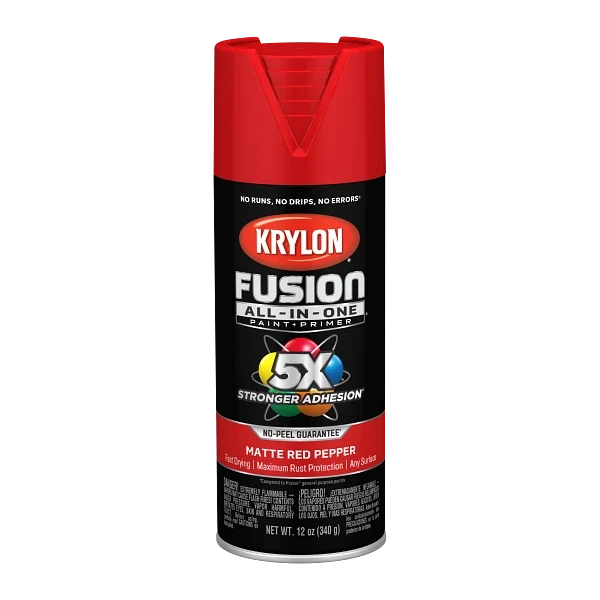
- Coverage
- 20–25 sq ft per 12 oz can at 1 coat
- Sheens
- Gloss, satin, matte, metallic, hammered, textured
- Dry / recoat
- Touch 25 min · handle 1h · recoat any time
- Full cure
- 7 days
- VOC
- Under 350 g/L on most colors
- Yellowing risk
- Low
- Primer
- None on scuffed metal, galvanized, or aluminum; that is the whole point of the product
- Price tier
- $
- Best adhesion in the round-up on galvanized and mill-finish aluminum: 5B cross-hatch (no lifted squares) on a scuffed galvanized post with no primer under it
- Handle-dry in about an hour, so a chair frame sprayed at nine in the morning goes back on the patio by lunch
- Same can also bonds to the plastic end caps, vinyl, and wicker that most metal furniture mixes in, which kills the two-can problem
- Softer film than the alkyds. It scored HB on pencil hardness, so a tool bag dragged across a sprayed steel shelf leaves a mark
- Rust hold-out is the weak spot: our scribed steel panel showed fine bloom along the cut at month 7, where Stops Rust was still clean at 12
- Full cure takes 7 days, and the film stays fingerprint-sensitive for the first two
3. Stops Rust Hammered Metal Finish Spray

- Coverage
- 12–14 sq ft per 12 oz can at 1 coat
- Sheens
- Hammered (low-gloss dimpled texture)
- Dry / recoat
- Touch 2–4h · handle 5–9h · recoat within 1h or after 48h
- Full cure
- 24h dry, 7 days for full hardness
- VOC
- Varies by color; low-VOC SKUs in restricted states
- Yellowing risk
- Low
- Primer
- None over sound or lightly rusted steel; Self Etching Primer on aluminum
- Price tier
- $
- The dimpled hammered pattern buries surface defects that gloss enamel magnifies; our pitted patio-table panel read as intentional texture instead of damage
- Same Stops Rust alkyd chemistry as the top pick, so the rust performance and the film hardness come along with the texture
- Applies directly over lightly rusted metal after a wire-brush knockdown, no primer coat required
- Nine colors, and the pattern only reads correctly in a mid-tone. Light hammered finishes look mottled rather than forged
- The texture needs a wetter pass than flat enamel, which means runs happen fast on vertical work
- Touch-ups never blend invisibly; the pattern restarts wherever you stop, so plan to coat a whole panel at once
4. Specialty High Heat Spray Paint
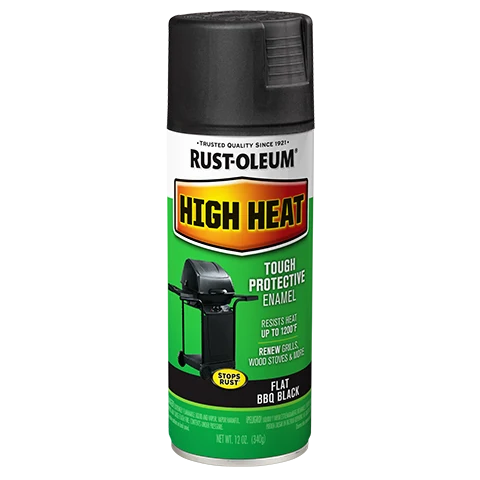
- Coverage
- 8–12 sq ft per 12 oz can at 1 coat
- Sheens
- Flat, semi-gloss
- Dry / recoat
- Touch 30 min · handle 1–2h · recoat within 1h or after 48h
- Full cure
- After heat cure: 1 hour at operating temperature
- VOC
- Under 500 g/L
- Yellowing risk
- N/A on black and silver; almond shifts slightly with repeated heat cycles
- Primer
- None; do not prime under high-heat coatings
- Price tier
- $
- Rated to 1200°F continuous, which covers charcoal grill bodies, wood stove surrounds, fire pits, and exhaust manifolds
- Held color on our propane-grill firebox through a full season of cook cycles where a standard enamel test strip scorched brown by the third burn
- Touch-dry in about 30 minutes, so a grill lid gets two coats in a morning
- Needs a heat cure to reach full hardness. Until the part runs hot for an hour, the film scratches with a fingernail
- Four colors, and three of them are black, silver, or almond. There is no decorative palette here
- Wrong product below its temperature range. On an unheated steel rail it stays chalkier and less scrubbable than Stops Rust
5. Professional High Performance Enamel Spray Paint

- Coverage
- 14–17 sq ft per 15 oz can at 1 coat
- Sheens
- Gloss, semi-gloss, flat
- Dry / recoat
- Touch 15 min · handle 1h · recoat within 1h or after 48h
- Full cure
- 24h dry, 7 days for full hardness
- VOC
- Under 500 g/L on standard SKUs
- Yellowing risk
- Low
- Primer
- Not needed on clean steel; Clean Metal Primer on shop-new stock with mill oil
- Price tier
- $
- 15 oz can with a wide industrial fan tip lays down a 4-inch pattern, roughly a third faster across a railing than a standard 12 oz consumer can
- Touch-dry in about 15 minutes and the highest solids of the Rust-Oleum aerosols, so one pass hides where Stops Rust needs one and a half
- Same price per can as the consumer line in most stores while holding 25 percent more paint
- The fan tip is built for open metal. On a bicycle frame or a chair spindle you waste half the can into the air
- Color range is industrial: safety colors, machine grays, black, white. No decorative metallics
- Overspray travels further than the consumer cans. Mask twice the area you think you need
6. Universal All Surface Spray Paint

- Coverage
- 12–15 sq ft per 12 oz can at 1 coat
- Sheens
- Satin, gloss, flat, metallic, hammered, distressed, pearl mist
- Dry / recoat
- Touch 20 min · handle 1h · recoat any time
- Full cure
- 7 days
- VOC
- Under 500 g/L on standard SKUs
- Yellowing risk
- Low
- Primer
- None on scuffed metal; Self Etching Primer on bare aluminum for outdoor work
- Price tier
- $$
- Widest finish range on this list: satin, gloss, flat, metallic, hammered, distressed, and a pearl-mist line, in over 60 colors
- The any-angle comfort trigger sprays upside down without spitting, which matters under a table or inside a railing
- Bonds without primer to metal, wood, plastic, and wicker, so mixed-material furniture takes one can
- Middle of the pack on hardness and rust creep. It is a decorative coating that resists rust, not a rust-first coating
- The metallic and mist finishes are direction-sensitive; overlap your passes wrong and the sheen bands
- Costs about a dollar more per can than Stops Rust for less protection
Stops Rust Rusty Metal Primer Spray
The pairing that decides whether a rusted railing looks good for two years or ten. Rusty Metal Primer is a high-solids alkyd built to be sprayed onto metal you could not get all the way clean. It wets into residual pitting and locks the remaining oxide layer instead of sitting on top of it, which is the failure most people hit when they wire-brush a gate for ten minutes and topcoat it directly. Two light coats, 48 hours, then any of the alkyd picks above. Bare shop-new steel does not need this and takes Clean Metal Primer instead; galvanized and aluminum need Self Etching Primer, not either of these.
BUY ON AMAZON
Ask a Question