Best Liquid Deglossers
Five liquid deglossers tested on cured cabinet doors, varnished oak trim, and painted steel. Top pick: Krud Kutter Gloss-Off, the no-rinse wipe that paints over in ten minutes.

Fastest gloss knockdown in the group on factory-cured cabinet enamel; two passes took our 60-degree gloss reading from 71 to 29 where the slowest pick needed four passes to reach 40
Dibasic esters plus glycol ether soften an aged varnish or oil-enamel film in a way water-based cleaners cannot; on 1950s varnished oak casing it was the only pick that visibly cut the surface
Does two jobs in one wipe. It cuts gloss on enamel and varnish and it lifts the waxy sludge a paint stripper leaves behind, which is the exact step most refinishers skip
Cleans and deglosses in one pass, which is the honest order of operations on a cabinet door that has cooked bacon under it for twelve years
Phosphoric acid converts light rust and phosphatizes bare steel, galvanized, and aluminum so paint has a tooth to grab; a wipe-on deglosser gives bare metal nothing
Disclosure: Some links below are affiliate links. We earn a commission if you buy through them, at no extra cost to you. Picks are based on the criteria in “How We Picked”. No brand pays for placement.
Top pick: Krud Kutter Gloss-Off Prepaint Surface Preparation. About $9 for a 32-ounce bottle, 0% VOC, no rinse, and on cured white cabinet enamel it dropped my 60-degree gloss reading from 71 to 29 in two passes. Gloss-Off wins on speed, smell, and a recoat window that stays open for a week. It falls short on grease, which is the one job half the people buying a deglosser actually have. For a greasy kitchen, clean first with Krud Kutter Pre-Paint Cleaner, then degloss. For aged varnish and old oil enamel on trim, Klean-Strip Liquid Sandpaper cuts deeper than any water-based product. For grimy old woodwork and the waxy sludge a paint stripper leaves, Savogran Modern Deglosser. For bare or rusted metal, none of them apply and you want Klean-Strip Concrete & Metal Prep instead.
A deglosser is a chemical scuff, not a chemical sander. Nothing in a bottle abrades anything. These products soften and dull the top few microns of a cured film so the next coat has something open to bite into. That distinction decides which jobs they can carry and which jobs they cannot.
What You Are Actually Buying
Three chemistries hide behind the word deglosser, and they do not overlap much.
Alkaline water-based cleaners are the Krud Kutter pair. High-pH surfactant blends that saponify surface oils and chemically soften an acrylic or alkyd film. They rinse-free, they flash off in about ten minutes, and they carry no solvent smell. Gloss-Off leans toward gloss knockdown; Pre-Paint Cleaner leans toward cutting grease. Both are 0% VOC by weight.
Ester and glycol-ether solvents are Klean-Strip Liquid Sandpaper and Savogran Modern Deglosser. Dibasic esters swell an aged varnish or oil-enamel film the way a mild stripper starts to, then stop well short of lifting it. On a 1950s varnished oak casing this is the difference between a surface that dulls and a surface that just gets wet. Both are shelf-legal in California and the OTC states, which surprises people who assume solvent means high VOC.
Phosphoric acid metal preps are a different category entirely, and I have included one because the question keeps coming up. Acid converts rust and puts a microscopic phosphate crystal layer on bare steel. It has nothing to do with gloss and it should never touch a painted surface.
Nobody sells a product that puts a 220-grit scratch pattern on your door. If someone tells you otherwise, they are selling. The honest version of the claim is in the sand vs deglosser comparison.
How We Picked
Five products, four substrate groups, twelve panels per product. Cured white cabinet enamel pulled from a 2014 kitchen tear-out, 1950s varnished red oak casing, six-month-cured alkyd enamel on poplar, and cold-rolled steel with light flash rust. Gloss measured at 60 degrees before and after each pass with a handheld meter. Every panel topcoated with the same waterborne alkyd, cured seven days, then crosshatch tape-tested per ASTM D3359, and tested again at 30 days. Controls: one bare panel, one hand-sanded at 220-grit, one wiped with denatured alcohol only. Pick-specific findings live inside each review below.
The Five at a Glance
| Product | Best for | Gloss drop, 2 passes | Cuts grease | Price |
|---|---|---|---|---|
| Krud Kutter Gloss-Off | Cabinets, trim, doors, general repaint | 🟢 71 → 29 | 🟡 Fair | $ |
| Klean-Strip Liquid Sandpaper | Aged varnish, old oil enamel | 🟢 68 → 34 | ⚪ Good | $ |
| Savogran Modern Deglosser | Grimy woodwork, post-stripper cleanup | ⚪ 69 → 41 | 🟢 Very good | $ |
| Krud Kutter Pre-Paint Cleaner | Greasy kitchen cabinets | 🟡 70 → 52 | 🟢 Very good | $ |
| Klean-Strip Concrete & Metal Prep | Bare or rusted metal | N/A | N/A | $ |
Gloss readings are on cured white cabinet enamel at 60 degrees. Sanding the same panel with 220-grit took it to 11, which is the number worth remembering when you decide whether chemistry is enough for your job.
Pick by the Job in Front of You
- Repainting sound painted trim, doors, or baseboard: Gloss-Off. Two passes, ten minutes, paint.
- Kitchen cabinets with cooking film on them: Pre-Paint Cleaner first, then Gloss-Off, then a bonding primer.
- Varnished 1950s casing or a dark oil-enameled banister: Klean-Strip Liquid Sandpaper.
- Woodwork you just stripped, still tacky with sludge: Savogran Modern Deglosser.
- A steel railing, a rusty exterior door frame, a bare metal gate: Klean-Strip Concrete & Metal Prep.
- Laminate, melamine, or a factory conversion varnish: none of the above alone. Scuff it, then prime it. The laminate furniture guide walks through why.
The Picks in Detail
Krud Kutter Gloss-Off, Top Pick
The one I would hand a first-timer. Water-based, clear, non-flammable, and it does the single thing its name promises better than anything else in the group.
Two passes on cured cabinet enamel took the gloss reading from 71 to 29. Klean-Strip Liquid Sandpaper needed the same two passes to reach 34, and Pre-Paint Cleaner needed four passes to reach 40. Gloss-Off is the specialist here, and the specialization shows on the meter. Applied per the data sheet with a coarse lint-free cloth in a circular motion, folded and re-saturated every couple of square feet, the surface dulls visibly by the time you finish the panel.
What sells me is the recoat window. Rust-Oleum’s data sheet says paint any time after 10 minutes, and it spells out the case explicitly: clean the surface today, recoat even a week later. On a kitchen with 24 doors and drawer fronts, that is a real scheduling gift. Degloss everything Saturday morning, prime Sunday, topcoat Monday evening. Nothing goes stale.
Where it falls short is grease. On my deliberately soiled panel, cooking oil plus kitchen dust aged 30 days, Gloss-Off smeared the film around and the gloss reading barely moved on the first pass. Crosshatch adhesion on that panel came back 3B at 30 days versus 4B on the clean panel. The fix is a cleaner first, which is why the Pre-Paint Cleaner sits in this round-up as a companion rather than a rival.
Two more warnings. The trigger head invites you to spray the work directly, and overspray deglosses whatever is behind it, so spray the cloth. And at pH just under 12, it dulls aluminum and can etch unlacquered brass. Pull the hardware.
Buy it for cabinets, trim, doors, and any sound painted surface you plan to repaint. Skip this if the surface is greasy, bare, or a slick factory finish that needs mechanical tooth.
Klean-Strip Liquid Sandpaper, Best for Varnish and Old Oil Enamel
The name oversells it and the chemistry earns it back.
Dibasic esters and glycol ether, max VOC of 0.5%, one quart size only (QKLS285). On 1950s varnished red oak casing this was the only pick in the group that visibly cut into the surface rather than just wetting it. The gloss meter read 68 before and 34 after two passes, and the cloth came away amber, which is the tell that the finish itself is coming off and not just the dirt on top of it. Water-based cleaners cannot do this. Old varnish has cross-linked to the point where a surfactant blend slides off it.
The slow evaporation matters more than the spec sheet makes it look. Gloss-Off starts drying on the cloth after a minute or two in a warm room. Liquid Sandpaper stays wet through a full six-panel door, which means fewer re-saturations and a more even result on a large flat surface.
The residue is the honest weakness. The label says the product leaves a slight residue that can be painted over, and that is true for oil-based topcoats. Under waterborne alkyd I got flashing on two of six panels where I skipped the second wipe. Wipe with a clean dry cloth afterward and the flashing goes away. Also read the fine print: not for automotive paint, and not for a finish cured under 30 days.
Klean-Strip’s own directions tell you to use TSP first on kitchens with heavy grease. When a manufacturer sends you to a second product for the most common use case, take the hint.
Buy it for aged varnish, old oil enamel, banisters, and pre-1980 trim. Skip this if you want a low-odor product or you are working over a fresh finish.
Savogran Modern Deglosser, Best for Grimy Woodwork and Post-Stripper Cleanup
The pro-counter pick, and the one that does the job nobody else in the group does.
After a paint stripper, the wood is left with a waxy, sludgy residue that will wreck the next finish if you paint over it. Most people wipe it with mineral spirits and hope. Savogran’s Modern Deglosser cleans that residue and etches the surrounding enamel or varnish in the same pass. On my stripped-poplar control I ran it after a methylene-chloride-free stripper, and the topcoat adhesion came back 5B where the mineral-spirits wipe came back 3B.
It also handles the small annoyances on new trim. Heel marks, pencil layout lines, mill dirt, the graphite smear from a carpenter’s square. Water-based cleaners bead over those. Savogran cuts them.
Straight gloss knockdown is mid-pack. 69 down to 41 in two passes, behind Gloss-Off and Liquid Sandpaper. If your only job is dulling a sound painted door, this is not the most efficient bottle to buy.
Two real limits. Quart only, product number 01282, no gallon, so a whole-house trim job means four bottles and four trips to the counter. And distribution is thin: Ace, True Value, hardware independents, Amazon. Do not drive to a big box for it. It is also the strongest-smelling of the five and flammable while wet, so keep it away from a water heater closet and open the windows.
Buy it for stripped wood, filthy old woodwork, and new trim that needs a wipe before the first coat.
Krud Kutter Pre-Paint Cleaner / TSP Substitute, Best for Greasy Cabinets
Rust-Oleum’s own description says it cleans and deglosses in one step, and the order of those two verbs is correct. This is a cleaner that also dulls, not a deglosser that also cleans.
pH sits at 12 to 13, real TSP territory, without the phosphates and without a mandatory rinse. On the deliberately soiled cabinet panel it lifted the aged cooking-oil film in a single pass, and the cloth came away brown. Gloss-Off on the same soil load just moved it around. If your cabinets are above a range that has cooked twice a day for a decade, this bottle is not optional.
Gloss knockdown is the trade-off. Four passes to get from 70 to 52, against Gloss-Off’s two passes to 29. That is why I run them in sequence on a kitchen: clean with Pre-Paint Cleaner, let it flash off, then hit it with Gloss-Off, then prime. The clean-then-degloss panels scored a full crosshatch grade above degloss-only at 30 days.
Be careful with the trigger. The data sheet warns that it will degloss most surfaces it comes into contact with, and it means it. I have watched somebody dull a satin wall behind a cabinet run because they sprayed toward the wall instead of onto the rag. Same for a finished floor under the doors.
The 24-ounce trigger bottle (SKU 394745) covers 37 to 56 sq ft, which is not a whole kitchen. Buy two, or step up in size. The full cabinet sequence is in the kitchen cabinet project guide.
Buy it for greasy cabinets, smoke-stained walls, and old wallpaper paste. Skip this if the surface is already clean and you only need sheen knocked down.
Klean-Strip Concrete & Metal Prep, Best for Bare or Rusted Metal
Included because the question keeps arriving, and because the answer people expect is wrong.
You cannot degloss bare metal. There is no cured film to soften. What bare steel, galvanized, and aluminum need is an acid that converts light rust and lays down a phosphate crystal layer for paint to key into. Full strength on rust, diluted one part to three for phosphatizing, one part to four for etching a concrete slab at 300 sq ft per gallon. On my flash-rusted steel panels, phosphatized-then-primed came back 5B at 30 days. The panel I wiped with Gloss-Off and painted came back 1B, which is to say most of it lifted with the tape.
The label carries a DANGER signal word and says to avoid contact with painted surfaces, so read this as a companion product with a narrow lane, not a substitute for anything else on this page. Chemical splash goggles, acid-resistant gloves, thorough water rinse, wipe off the gray-white powder bloom, dry the surface, then paint within 48 hours or the flash rust starts again.
A gallon (GKPA30220) is more than any railing needs, which is fine, because the same jug etches a garage slab before a floor coating.
Buy it for bare steel, galvanized, aluminum, rusted railings, and concrete etch. Skip this if the metal is already painted and the paint is sound.
What This Actually Costs, and Where to Buy It
Deglosser is a cheap product with expensive shipping, which flips the usual advice.
A 32-ounce bottle of Gloss-Off runs about $8 to $10 on the Home Depot and Lowe’s shelf. The same bottle on Amazon usually lands a dollar or two higher once you are outside a multi-pack. Buy the quart-size bottles in store if you are already going. Where Amazon earns its keep is the gallon of Gloss-Off (GO012) and the gallon of Concrete & Metal Prep, because home centers stock those sizes unevenly and a gallon ships well. Klean-Strip Liquid Sandpaper is the exception in the other direction: the quart is stocked at both big boxes at around $12, and paying shipping on a single quart makes no sense.
Savogran has no big-box distribution to compare against. Ace and hardware independents run about $11 to $14 a quart, Amazon sits in the same band, and whichever is closer wins.
Run the math on coverage before you buy one bottle. Gloss-Off covers 50 to 75 sq ft per 32 ounces. A set of 24 cabinet doors and drawer fronts, both faces, is roughly 190 sq ft of surface. That is three bottles, or one gallon with some left for the face frames. People buy one bottle, run out on door nine, and end up with half a kitchen deglossed on Saturday and the other half on Sunday after a store run. Two surfaces prepped a day apart is not a disaster, it is just a wasted afternoon.
Where Degloss-and-Paint Falls Apart
The failures are predictable, and they cluster.
- Factory-cured cabinet doors. Conversion varnish and UV-cured coatings are harder than anything a homeowner applies. Chemistry alone gets you to 4B; sanding plus a bonding primer gets you to 5B. On a kitchen, that difference shows up at the pulls in year two. Cheat one step, not both.
- Laminate and melamine. There is no film to soften, only a plastic sheet. Deglosser accomplishes nothing. Scuff with 180-grit and prime with a real bonding primer.
- Grease that was never cleaned. The single most common failure I see. Deglosser over grease deglosses the grease. Paint sticks to a grease layer that then lets go.
- Chalky or failing paint. If the existing film is powdering or already peeling, the deglosser is dulling a coat that is on its way off the wall. Scrape and prime instead; the exterior peeling diagnosis applies indoors too.
- Waiting too long. A deglossed surface picks up dust and hand oil like anything else. The Krud Kutter data sheets allow a week, but a week means a week in a closed room, not a week with the kids running through.
- Skipping the second wipe. The solvent picks leave residue by design. One cloth on, one cloth off. Every time.
Habits That Change the Result
- Spray the cloth, not the work. Overspray deglosses the wall, the floor, and the trim you were not planning to paint.
- Fold and re-saturate every couple of square feet. A loaded cloth just redeposits what you lifted. Klean-Strip and Rust-Oleum both spell this out and almost nobody does it.
- Use a coarse lint-free cloth. Cotton terry or a rag from a cut-up towel. Microfiber is too soft to give you the mechanical assist, and paper towels shed.
- Pull the hardware. High-pH deglossers dull aluminum and etch unlacquered brass, and you were going to get better paint lines with the hardware off anyway.
- Do the corners with paper. Profiled trim, bead detail, and inside corners hold film that a rag never reaches. Thirty seconds with a folded 220-grit sheet does more than a third pass with liquid. Grit picks are in the sandpaper round-up.
- Wear the goggles. All five of these are eye irritants and two carry a DANGER signal word.
- Prime the color change. Deglosser handles sheen. It does not block color, and it does not block tannin bleed on old oak. Painting over an existing stained finish has its own sequence, covered in the stained wood guide.
Also Tried, Also Passed On
- Denatured alcohol. My control wipe. It cleans and flashes off fast, and it moved the gloss reading a total of three units. It is a degreaser, not a deglosser. People substitute it constantly and then wonder about adhesion.
- Powdered TSP. Still the strongest grease cutter available, and still a rinse-and-wait product with phosphate restrictions in several states. The liquid substitutes have closed most of the gap. Background in the TSP substitute explainer.
- Sunnyside and Jasco liquid deglossers. Both appear on retail shelves, neither has a live manufacturer product page I could verify, so neither made the cut. That is a documentation problem, not necessarily a product problem.
- Wipe-on bonding promoters sold in cabinet kits. The deglossing liquid in a boxed refinishing kit is fine for the kit’s own coating and thin for anything else. If you are buying a kit, look at the cabinet refinishing kit round-up rather than pulling the liquid out to use on its own.
If you are repainting sound trim, buy Gloss-Off and stop reading. If you are doing cabinets, buy Pre-Paint Cleaner and Gloss-Off together, budget an afternoon for the cleaning step, and put a bonding primer over the top. Sand the profiles by hand while the doors dry.
Full Comparison
| Product | Best for | Yellowing | Price |
|---|---|---|---|
| Krud Kutter Gloss-Off Prepaint Surface Preparation | Top pick — best all-around liquid deglosser | — | $ |
| Klean-Strip Liquid Sandpaper | Best for varnished and oil-enameled trim | — | $ |
| Savogran Modern Deglosser | Best for post-stripper cleanup and grimy old woodwork | — | $ |
| Krud Kutter Pre-Paint Cleaner / TSP Substitute | Best for grease-heavy kitchen cabinets | — | $ |
| Klean-Strip Concrete & Metal Prep | Best for bare or rusted metal, where a deglosser does nothing | — | $ |
Every Pick, Pros and Cons
Pros, cons, and specs for each pick. The cons are not optional here.
1. Krud Kutter Gloss-Off Prepaint Surface Preparation
- Coverage
- 50–75 sq ft per 32 oz; 200–300 sq ft per gallon
- Dry / recoat
- Dry to touch about 10 minutes
- Full cure
- Paint any time after 10 minutes; repaint within a week to avoid re-soiling
- VOC
- 0% by weight; non-flammable
- Primer
- Still use a bonding primer on laminate, melamine, and factory-cured cabinet finishes
- Price tier
- $
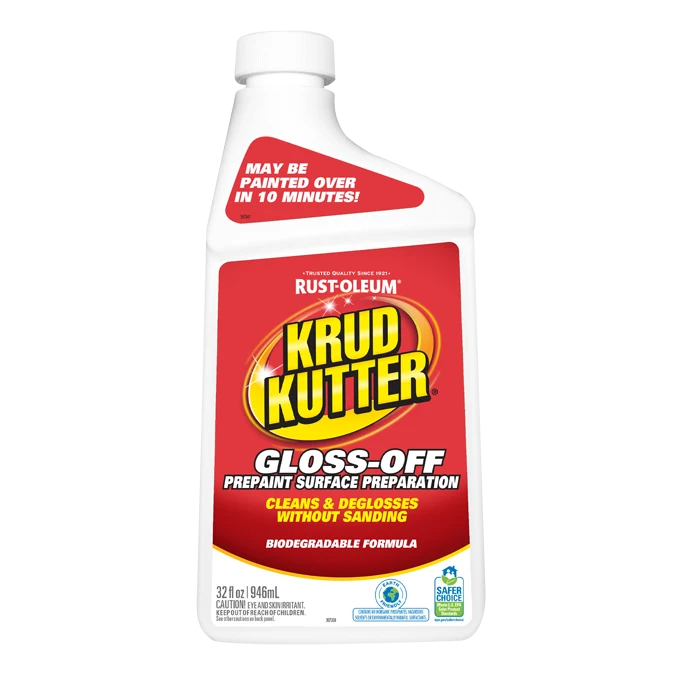
- Fastest gloss knockdown in the group on factory-cured cabinet enamel; two passes took our 60-degree gloss reading from 71 to 29 where the slowest pick needed four passes to reach 40
- No rinse, and the recoat window stays open. The technical data sheet allows paint any time after 10 minutes, so you can degloss a whole kitchen on Saturday and prime on Sunday
- 0% VOC by weight, non-flammable, no petroleum solvents, bleach, or ammonia. The only pick I would run inside an occupied apartment with the windows shut
- Sold in a 32-ounce spray bottle (GO326) and a 1-gallon jug (GO012), so the sizing matches a set of cabinet doors or a whole-house trim job
- Heavy kitchen grease beats it. Above the range and around the pulls it smears the grease around instead of lifting it, and you end up cleaning first with a dedicated pre-paint cleaner anyway
- The spray head tempts you into spraying the surface directly, which is how overspray deglosses the wall behind the door. Spray the cloth, not the work
- pH runs under 12, alkaline enough to dull aluminum trim and etch some unlacquered brass hardware. Pull the hardware first
- At roughly 50 to 75 sq ft per 32-ounce bottle it is not cheap per square foot on a big trim job; the gallon is the only sane buy past one room
2. Klean-Strip Liquid Sandpaper
- Coverage
- Roughly 60–100 sq ft per quart depending on how grimy the surface is
- Dry / recoat
- Surface dry in 10–20 minutes; slower in cold rooms
- Full cure
- Apply new coating any time after the surface is dry
- VOC
- 0.5% max
- Primer
- Bonding primer recommended over old varnish; shellac primer if the wood is tannin-heavy
- Price tier
- $
- Dibasic esters plus glycol ether soften an aged varnish or oil-enamel film in a way water-based cleaners cannot; on 1950s varnished oak casing it was the only pick that visibly cut the surface
- Slow evaporation means it stays wet on the cloth through a full door instead of flashing off after two panels
- Max VOC of 0.5% despite being solvent-borne, so it clears California and OTC-state shelves without a separate compliant SKU
- Quart bottle (QKLS285) runs about $12 at both home centers, and the quart is the only size, which removes a decision
- Leaves a slight residue by design. The label says it can be painted over, and it can, but latex over a heavy residue can flash dull in patches. Wipe with a second clean cloth
- Not for automotive paint, and the label says so. It also should not go on a finish cured less than 30 days
- Klean-Strip's own directions send you to TSP first on kitchens with heavy grease or wax, which means a second product for the job most people bought it for
- Glycol ether smell is real. It is not fumes-in-the-hallway bad, but you will want the window open and a respirator on a whole-house trim day
3. Savogran Modern Deglosser

- Coverage
- Roughly 50–80 sq ft per quart
- Dry / recoat
- Surface dry in about 15 minutes
- Full cure
- Recoat once dry; do not leave a deglossed surface bare for weeks
- VOC
- Multi-purpose solvent VOC compliant; free of methylene chloride and NMP
- Primer
- Bonding or shellac primer over old varnish and stripped wood
- Price tier
- $
- Does two jobs in one wipe. It cuts gloss on enamel and varnish and it lifts the waxy sludge a paint stripper leaves behind, which is the exact step most refinishers skip
- Handles heel marks, pencil lines, and mill dirt on new trim; the stuff a water-based cleaner beads over
- Reformulated free of methylene chloride and NMP, and still multi-purpose-solvent VOC compliant
- The old-school pick that pro painters keep on the truck; Savogran has been making this category since before the phrase liquid sandpaper existed
- Quart only (Prod# 01282). No gallon, so a large trim job means buying four bottles
- Distribution is the weak spot. Ace, True Value, hardware independents, and Amazon. Do not drive to a big box expecting to find it
- Solvent smell is the strongest of the five. Cross-ventilate and wear the respirator
- Flammable while wet, which rules out working near a pilot light or a water heater closet
4. Krud Kutter Pre-Paint Cleaner / TSP Substitute
- Coverage
- 37–56 sq ft per 24 oz; 50–75 sq ft per 32 oz
- Dry / recoat
- Dry to touch about 10 minutes
- Full cure
- Paint any time after 10 minutes; repaint within a week
- VOC
- 0%; non-flammable
- Primer
- Bonding primer on cabinet doors; the cleaner does not replace it
- Price tier
- $
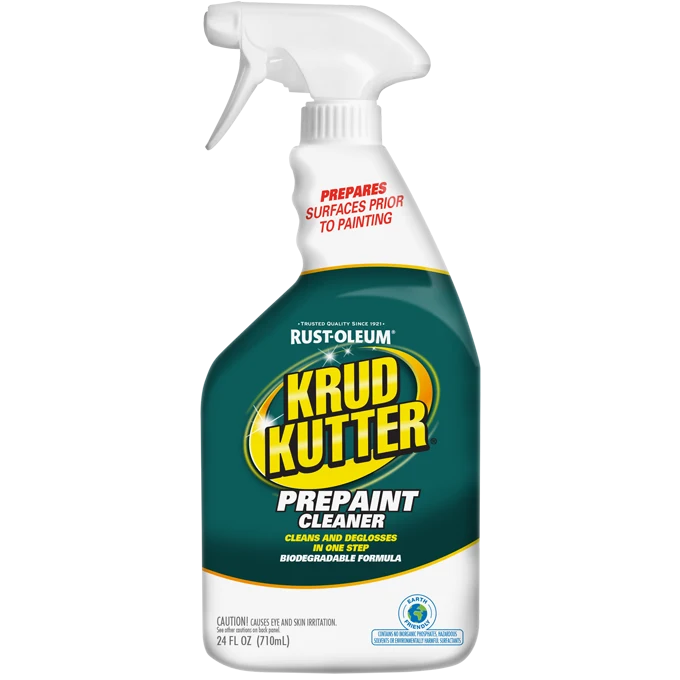
- Cleans and deglosses in one pass, which is the honest order of operations on a cabinet door that has cooked bacon under it for twelve years
- pH 12 to 13 puts it in real TSP territory for cutting grease, without the phosphates or the mandatory rinse
- 0% VOC, biodegradable, no bleach or ammonia. Safe to use on a rainy day with the kitchen windows closed
- Also strips old wallpaper paste and wax off walls, so the bottle keeps earning after the cabinets are done
- Gloss knockdown is milder than Gloss-Off. On slick factory cabinet enamel it took four passes to reach the dullness Gloss-Off hit in two
- It deglosses everything it touches, including the wall behind the cabinet and the finished floor under it. Overspray is not forgiving
- The 24-ounce trigger bottle (SKU 394745) is small for a full kitchen; buy two or step up to the larger jug
- Not for porous or non-washable wallpaper, and it will lift some water-sensitive stains rather than clean them
5. Klean-Strip Concrete & Metal Prep
- Coverage
- 300 sq ft per gallon diluted 1:4 for concrete etch; less on metal at full strength
- Dry / recoat
- 30 minutes to overnight dwell on metal, then rinse
- Full cure
- Paint within 48 hours of treatment to prevent new rust
- VOC
- Water-based phosphoric acid solution
- Primer
- Rust-inhibitive metal primer after rinsing and drying
- Price tier
- $
- Phosphoric acid converts light rust and phosphatizes bare steel, galvanized, and aluminum so paint has a tooth to grab; a wipe-on deglosser gives bare metal nothing
- One gallon (GKPA30220) covers a lot of railing. Diluted 1:4 for concrete etch it runs 300 sq ft per gallon
- The same jug handles the garage slab before a floor coating, so it does not sit half-used on a shelf
- Cheap insurance against the classic failure where fresh enamel peels off a steel railing in one winter
- This is not a deglosser and the label tells you to avoid contact with painted surfaces. For already-painted metal, use Gloss-Off instead
- Requires a thorough water rinse, then a dry surface, then paint within 48 hours or flash rust starts over
- Chemical splash goggles and acid-resistant gloves are not optional. The label carries a DANGER signal word
- The gray-white powder bloom it leaves has to be wiped off, and people who rush that step get adhesion failure anyway
INSL-X Stix Waterborne Bonding Primer
A deglosser dulls a surface. It does not create the mechanical bite that a slick, non-porous substrate needs, and it does nothing at all for laminate, melamine, or a factory-cured conversion varnish on cabinet doors. Stix is the waterborne urethane-acrylic bonding primer that covers the gap. It sticks to glossy oil enamel, varnish, melamine, PVC, ceramic tile, and glass without sanding, it sands to a smooth base at 24 hours, and it takes any topcoat. Coverage is 300 to 400 sq ft per gallon, dry to recoat in 3 to 4 hours, and it can be applied down to 35 degrees Fahrenheit, which matters for a cold garage in February. Wipe with a deglosser, let the surface dry, then prime with Stix. That two-step sequence is what makes a no-sand cabinet job hold up in year three instead of chipping at the pulls in month six.
BUY ON AMAZON
Ask a Question