Sanding vs Liquid Deglosser: When Each Works
220-grit scuff or a wipe-on chemical de-glosser? A jobsite verdict on prep speed, adhesion, and where each method peels in year two.

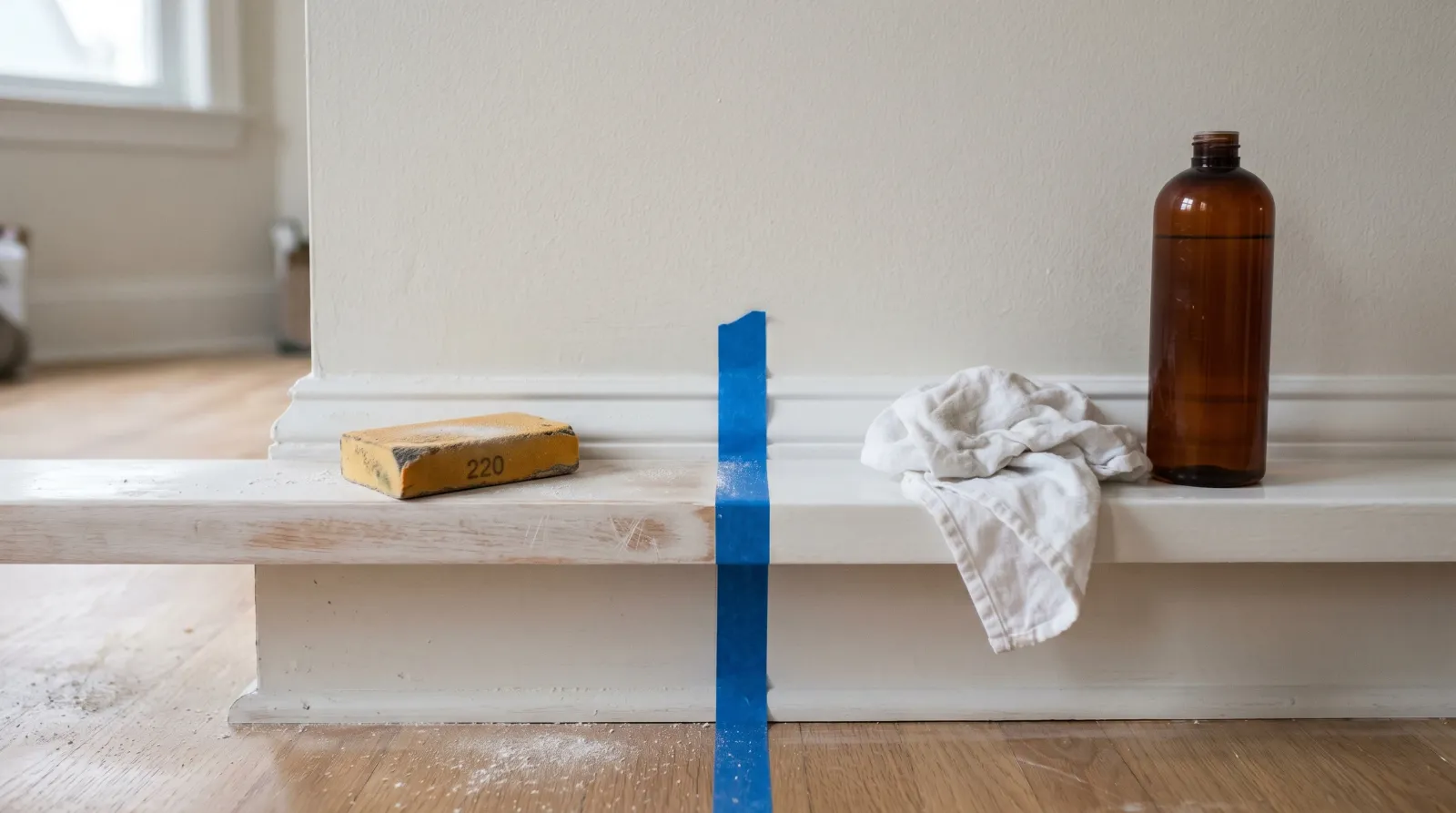
The 30-Second Answer
Sand. Two-twenty grit, a hand block, ten minutes per door. That’s the answer 95% of the time. Liquid deglosser earns its slot in two specific situations: an occupied home where sanding dust ruins the day, and trim or sash work where the geometry won’t take a sander cleanly. On factory finishes, polyurethane, or anything older than five years, deglosser alone will not hold. Always follow either prep with a bonding or shellac primer. That’s the part most peeling jobs skipped.
At a Glance
| Sanding (220-grit) | Liquid deglosser | |
|---|---|---|
| Adhesion confidence | 🟢 reliable on anything | 🟡 only on sound oil/alkyd |
| Speed | ⚪ 10 min per door by hand | 🟢 2 min per door |
| Dust | 🔴 always, even with a vac sander | 🟢 zero |
| Works on factory finishes | 🟢 yes | 🔴 no |
| Cost per project | 🟢 ~$5 in paper | 🟡 $12–18 per quart |
How to Tell What You’re Prepping
Before you pick a method, name the finish. Same alcohol-cotton test from the oil vs water comparison: dab denatured alcohol on a cotton ball in an inconspicuous spot. Latex softens. Oil stays put. Polyurethane and conversion varnish also stay put — and that’s the trap, because those don’t take deglosser either.
A second tell: scrape a fingernail across an edge. Conversion varnish chips off in a brittle flake. Old oil paint dents but doesn’t chip. Latex deforms. If you scrape and get a brittle flake, you’re on factory-applied catalyzed coating. Deglosser won’t bond-prep that. Sand and prime, period.
Sand vs Deglosser — Side by Side
Same kitchen, same door style, two halves prepped two ways, primed and topcoated identically. Twelve months later the sanded half passes a fingernail test and a cross-hatch tape pull. The deglossed half passes at the field but lifts at the rail edges where the original gloss was thickest. That’s the real-world gap nobody puts on the can label.
Adhesion Result
Sanding makes a mechanical key. The 220-grit scratches are deeper than the paint film, so the primer flows into them and locks. It doesn’t matter what the substrate is — factory cabinet finish, three-decade-old enamel, polyurethane sealed pine — the scratch pattern doesn’t care.
Liquid deglosser is chemistry. Krud Kutter Gloss-Off uses a glycol-ether-based solvent to soften the surface gloss; M-1 Easy Sand uses a surfactant package to wet out and dull. Both work. Both have a ceiling: they’re rated for sound oil and alkyd finishes, not for fully cross-linked factory coatings. On a typical kitchen cabinet from 1995 onward, the factory finish is a catalyzed conversion varnish. Deglosser barely dents it.
Winner: Sanding. Wider substrate tolerance, deeper bite.
Speed and Mess
This is where deglosser earns its keep. Six interior doors, hand-sanded with 220 and a block: about an hour, plus another 20 minutes vacuuming and tacking. Same six doors with Krud Kutter and a rag: 12 minutes total, zero dust, the homeowner stays in the kitchen.
For occupied homes — kitchens during a week-night repaint, bedrooms with a baby down the hall, anywhere the customer is paying you partly to not wreck their week — deglosser is the right call when the substrate allows it.
A vacuum sander (Festool, Mirka) closes part of the dust gap but adds $400+ of tooling and a corded hose. For a one-off cabinet job it’s overkill.
Winner: Deglosser on speed and dust, by a wide margin.
Surface Type Tolerance
This is where the comparison breaks open.
- Sound oil-painted trim (no heavy oxidation): both work.
- Latex over latex: neither is strictly required; a hand scuff with 220 is plenty.
- Factory cabinets (conversion varnish, lacquer, catalyzed urethane): sand only. Deglosser will not bond-prep these.
- Polyurethane on furniture: sand only. Sometimes sand plus a shellac primer.
- Heavy oxidation (chalky exterior trim, decades-old gloss): sand or chemically strip first; deglosser can’t reach through the chalk.
- MDF that’s already painted: sand only. The factory primer on most MDF doors is harder than people expect.
Winner: Sanding. Deglosser has a narrow window. Sand works everywhere.
Cleanup and Disposal
Sanding dust is inert. Vacuum it, bag it, throw it out. The mess is the air, not the disposal.
Deglosser is wet-chemistry. Krud Kutter Gloss-Off cleans up with water, which is the marketing reason to choose it. M-1 needs rinsing with water too. The used rag has solvent residue — let it dry flat outdoors before bagging, same caution as oil-paint rags. Don’t pile wet deglosser rags in a closed bin.
Both methods leave a surface that needs a final tack-cloth wipe before primer.
Winner: Sanding on disposal simplicity. Deglosser on jobsite air quality.
Cost and Coverage
A pack of three 220-grit hand sheets is $4 at any hardware store. A box of 25 quarter-sheet pads for a palm sander runs $10–15. That covers a full kitchen of cabinets and trim with paper left over.
Krud Kutter Gloss-Off Pre-Paint Surface Prep: roughly $12 per quart, covers about 200 square feet per quart at the recommended wipe-on rate. M-1 Easy Sand: about $18 per quart, similar coverage. For one set of cabinets you’ll use most of a quart.
Per-project, sanding wins on cost. Deglosser is the convenience tax — you’re buying the dust-free workflow, not better adhesion.
Winner: Sanding on raw cost. Deglosser pays for itself only when the alternative is a complaint about dust.
Verdict by Use Case
- Pick sanding if: the surface is factory-finished, you can’t confirm what’s on it, the home is empty during the work, or the job has to hold for ten-plus years. Default answer.
- Pick liquid deglosser if: the substrate is confirmed sound oil or alkyd paint, the home is occupied, or the geometry (window sashes, behind toilets, ceiling-line trim) makes a sander impractical. Confirm the substrate first.
- It’s a tie when: you’re scuffing latex over latex for adhesion insurance. A light 220 scuff and a deglosser wipe both do the job; pick the one you already have.
What’ll bite you in two years: skipping the bonding primer because the deglosser felt thorough. Deglosser is prep, not promise. Over latent oil you still need Zinsser BIN or Stix between the deglossed surface and the new latex topcoat — see the BIN vs 1-2-3 breakdown for which shellac primer to reach for. Skip that step and the paint will peel at the door edges between months six and twelve, every time.
Top Picks by Side
Going with sanding for a cabinet repaint? See the no-sand cabinet paint round-up — the picks there pair best with a 220-grit scuff plus a bonding primer, despite the category name.
Need the no-sand workflow end to end? Walk through the no-sand cabinet repaint project for the full deglosser-and-bonding-primer sequence.