Best Cabinet Refinishing Kits
Five cabinet refinishing kits tested on maple, thermofoil, and old oil-painted doors for adhesion, edge wear, and cure hardness. Top pick: Rust-Oleum Cabinet Transformations.

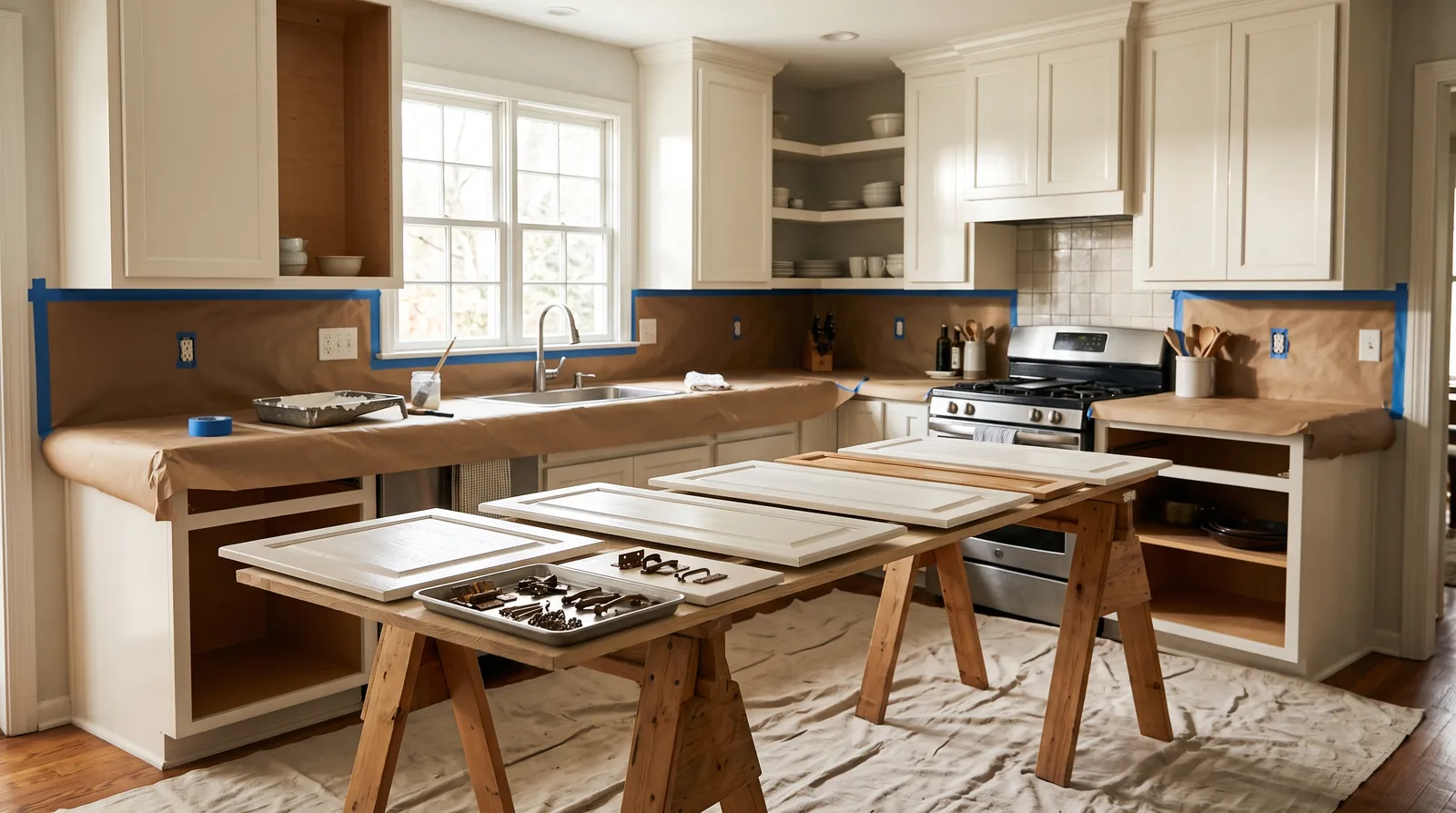
Everything for the job ships in one box: deglosser, scrub pads, bond coat, optional decorative glaze, protective top coat, stir sticks, and a printed step guide
Hardest cured film in the round-up; at 30 days a fingernail dragged across the door face left nothing where the Rust-Oleum and Beyond Paint panels both marked
Bonder, primer, paint, and sealer live in one can, so the whole system is a single product with no sequencing to get wrong
$79.95 a kit, and refill quarts are $36.95, which is the lowest cost-per-door of anything in this round-up
Wipes over an existing finish without stripping to bare wood, which no other product in this category does honestly
Disclosure: Some links below are affiliate links. We earn a commission if you buy through them, at no extra cost to you. Our picks come from the test protocol in “How We Ranked These Kits”. No brand pays for placement.
Top pick: Rust-Oleum Cabinet Transformations. At roughly $150 for the small kit and $240 for the large, it is the only boxed system that puts every step of the job in one carton, and on our cross-hatch tape pull it held 100 percent adhesion on glossy factory maple after seven days. Cabinet Transformations wins on completeness, on prep tolerance, and on being the kit a person who has never refinished anything can actually finish. It falls short on cured hardness, where the film stays softer than a real cabinet enamel and the door edges show it first. If you want the finish to survive a decade, buy INSL-X Cabinet Coat over Stix primer and assemble your own kit. If your doors are laminate or thermofoil, Beyond Paint is the one that bonds. If the grain is worth keeping, stop reading about paint and buy gel stain.
The doors decide the kit, not the color. Every system here works on sound doors with a dull, intact finish. None of them work on swollen particleboard at the sink base or thermofoil that has already lifted at a corner. Press a fingernail along the edges of your worst four doors before you spend a dollar.
How We Ranked These Kits
Five refinishing systems went onto matched door sets in four substrates: glossy factory-sealed maple, white thermofoil, previously oil-painted poplar, and bare red oak. Each followed its own published process exactly, including the no-sand deglosser steps, at 70°F and 45% relative humidity, then cured 30 days. We ran ASTM D3359 cross-hatch tape pulls at 7 and 30 days, a stacked-door imprint test at 10 lbs for 24 hours, 500 open-close cycles on a hinged door with a consistent hand grab, and a four-hour cooking-oil soak followed by a degreaser wipe. Three cabinet refinishers gave us callback data on jobs they were hired to repair. Pick-specific findings sit inside each review below.
The Five Kits Side by Side
| Kit | Best for | Everything in the box | Cured hardness | Price |
|---|---|---|---|---|
| Rust-Oleum Cabinet Transformations | Top pick: first-timers, wood doors | 🟢 Yes | 🟡 Medium | $$ |
| INSL-X Cabinet Coat + Stix | Longest-lasting finish | 🔴 No, you assemble it | 🟢 High | $$ |
| Beyond Paint Cabinet Kit | Laminate and thermofoil | 🟢 Yes | 🟡 Medium | $$$ |
| Nuvo Cabinet Paint | Cheapest color change | ⚪ Paint and applicators only | 🟡 Medium | $ |
| Minwax Gel Stain | Keeping the wood grain | 🔴 No, add a topcoat | 🟢 High | $ |
One column that does not appear in that table: color selection. Three of the five picks have no tint base at all. Rust-Oleum offers around 70 fixed colors, Beyond Paint about 50, Nuvo eleven. If you are trying to match cabinets to an existing painted built-in or a specific trim white, only Cabinet Coat gets you there, because only Cabinet Coat takes a custom tint. That constraint eliminates more people from the boxed-kit category than any performance number does.
What Is Actually in the Can
Kit marketing hides the chemistry behind step numbers, and the chemistry is what predicts how the finish ages. Grouped by what the film really is:
| System | Film chemistry | Bonding step | Ages by |
|---|---|---|---|
| Rust-Oleum Cabinet Transformations | Waterborne acrylic bond coat under a urethane-modified top coat | Chemical deglosser | Burnishing at grab points |
| INSL-X Cabinet Coat | Waterborne alkyd | Separate acrylic bonding primer | Almost not at all for 8–10 years |
| Beyond Paint | Mineral-loaded acrylic, self-sealing | Built into the resin | Finger polish on the matte |
| Nuvo Cabinet Paint | Waterborne acrylic, single-component | Built into the resin | Thinning at edges and corners |
| Minwax Gel Stain | Pigmented oil gel under a separate clear | None; mechanical scuff | However the topcoat ages |
Two things fall out of that table. The waterborne alkyd is the only chemistry here that keeps hardening past the first month, which is why Cabinet Coat wins the wear tests and why it also stays fragile longer during the job. And the two self-sealing acrylics carry their own bonder in the resin, which is what makes them idiot-proof on laminate and what caps their ultimate hardness. You cannot have both properties in one can, and no kit on the market has solved that.
Sheen is the other choice nobody frames well. Three of these systems give you no sheen decision at all, and the one that does caps at semi-gloss. For a kitchen that gets cooked in, semi-gloss on the doors and satin on the boxes is the combination that cleans best without lighting up every imperfection in an old rail. Our sheen guide has the gloss-unit ranges if you want the numbers.
Which One Matches Your Kitchen
- Wood doors, dull finish, first refinishing project: Rust-Oleum Cabinet Transformations. One box, one weekend, no decisions.
- Wood doors, want it to last ten years, willing to plan: INSL-X Cabinet Coat over Stix. Three days of schedule, a lifetime of film.
- Laminate, melamine, or thermofoil doors: Beyond Paint Cabinet and Furniture Kit. Nothing else in the box category bonds to cured polyester.
- Rental, resale prep, or a budget under $200: Nuvo Cabinet Paint. Buy the refill quart with the kit.
- Solid wood you like, color you do not: Minwax Gel Stain plus a wipe-on clear. Darker only.
The Kits in Detail
Rust-Oleum Cabinet Transformations, Top Pick
This is the kit that made cabinet refinishing a home-center category. The carton holds a bottle of deglosser and scrub pads for step one, the tinted bond coat for step two, an optional decorative glaze for step three, and a protective top coat for step four, plus stir sticks and a printed guide you can follow without a video. Small kit does 100 square feet, large kit does 200. A standard 10 by 12 kitchen with about 20 doors is one large kit.
The deglosser is the reason it earns the top slot. On our glossy factory-sealed maple door, the two-pass deglosser step opened the surface enough that a cross-hatch tape pull at seven days came off with zero squares lifting. That is the same result Stix primer gave on the same substrate, and Stix is the gold standard for bonding to a slick factory finish. Rust-Oleum got there with a wipe-on chemical and a scrub pad, which is a meaningful thing to hand a person who does not own a sander.
Hardness is the trade. At 30 days, the stacked-door imprint test left a faint but visible ring on the Cabinet Transformations panel where the Cabinet Coat panel showed nothing. On the 500-cycle hinged-door test, the stile where the hand grabbed took on a burnish. Neither is failure. Both are the tell that this is a coating system tuned for ease rather than for a decade of a family of four slamming a trash pull.
The color problem is real and underdiscussed. About 70 fixed colors, no tint base. If your kitchen has painted trim or an adjacent white built-in, the near-miss between the kit color and the existing white will bother you every day. Choose a color that is deliberately different rather than one that is trying to match.
Buy it if you have wood doors in sound shape, no color-match requirement, and you want the whole project to be one purchase. Skip it if the doors are laminate, or if this kitchen has to survive teenagers for the next ten years.
INSL-X Cabinet Coat over Stix, Longest-Lasting Finish
Not a kit. That is the honest headline. You buy a gallon of Stix bonding primer, a gallon or two of Cabinet Coat, 220-grit paper, a good brush, and a 3/8-inch microfiber mini roller, and you build the system yourself. It costs about what a large Rust-Oleum kit costs and it takes about a day longer because of the 16-hour recoat window on the finish coats.
What you get for that is the hardest film in the round-up by a wide margin. Fingernail drag at 30 days left nothing on the Cabinet Coat panel. The stacked-door imprint test left nothing. The 500-cycle hinged-door test left nothing. Grease soaked for four hours wiped clean with no gloss change. This is a waterborne alkyd doing exactly what waterborne alkyds do, which is level like an oil enamel and cure like one without the amber shift a real oil gives white cabinets in year three.
Custom tint is the other half of the argument. Any Benjamin Moore color, any depth, matched to whatever is already in the room. Nothing else here does that.
Sequencing is where people get in trouble. Stix first, one coat, recoat in 3 to 4 hours if you need a second on bare wood. Let it cure a full day before the enamel, not the four hours the can allows. Then two coats of Cabinet Coat with the full 16 hours between them. Rushing the second finish coat at hour eight is the mistake that produces the soft, fingerprint-holding film people blame on the paint. For the primer question in general, our explainer on what primer does covers when you can genuinely skip it.
Buy it if you want the finish to outlast the kitchen. Skip it if you need the doors back on by Sunday night.
Beyond Paint Cabinet and Furniture Kit, Best for Laminate
The specialist. Bonder, primer, paint, and sealer in a single can, which means there is no sequence to get wrong: clean the door, roll two coats, done. The $79.95 kit ships the quart with a 2-inch bristle brush, a 3/8-inch microfiber roller and handle, and a tray. One quart covers 150 square feet.
Thermofoil is where it separated from the field. Our white thermofoil door is the panel that humbles most cabinet coatings, because cured polyester film gives a bonding chemistry almost nothing to grab. Rust-Oleum’s bond coat lifted at the tape pull. Nuvo lifted. Beyond Paint held with zero squares off at both 7 and 30 days, which matches what the two laminate-heavy refinishers we called said about it unprompted.
The cure is slow and the first week is soft. Full hardness at 30 days is a real 30 days, and doors closed tight against a soft matte film will print. Felt bumpers on every door before you rehang, and leave them cracked for the first several days.
Matte-only is the finish constraint. It looks correct on a modern flat-panel door and it shows finger oils around the pulls faster than a satin does. On a busy kitchen, budget a wipe-down habit rather than expecting a satin’s forgiveness.
Buy it if your doors are laminate, melamine, or tight thermofoil. Skip it if you want a satin sheen or you need the kitchen back in three days.
Nuvo Cabinet Paint, Budget Pick
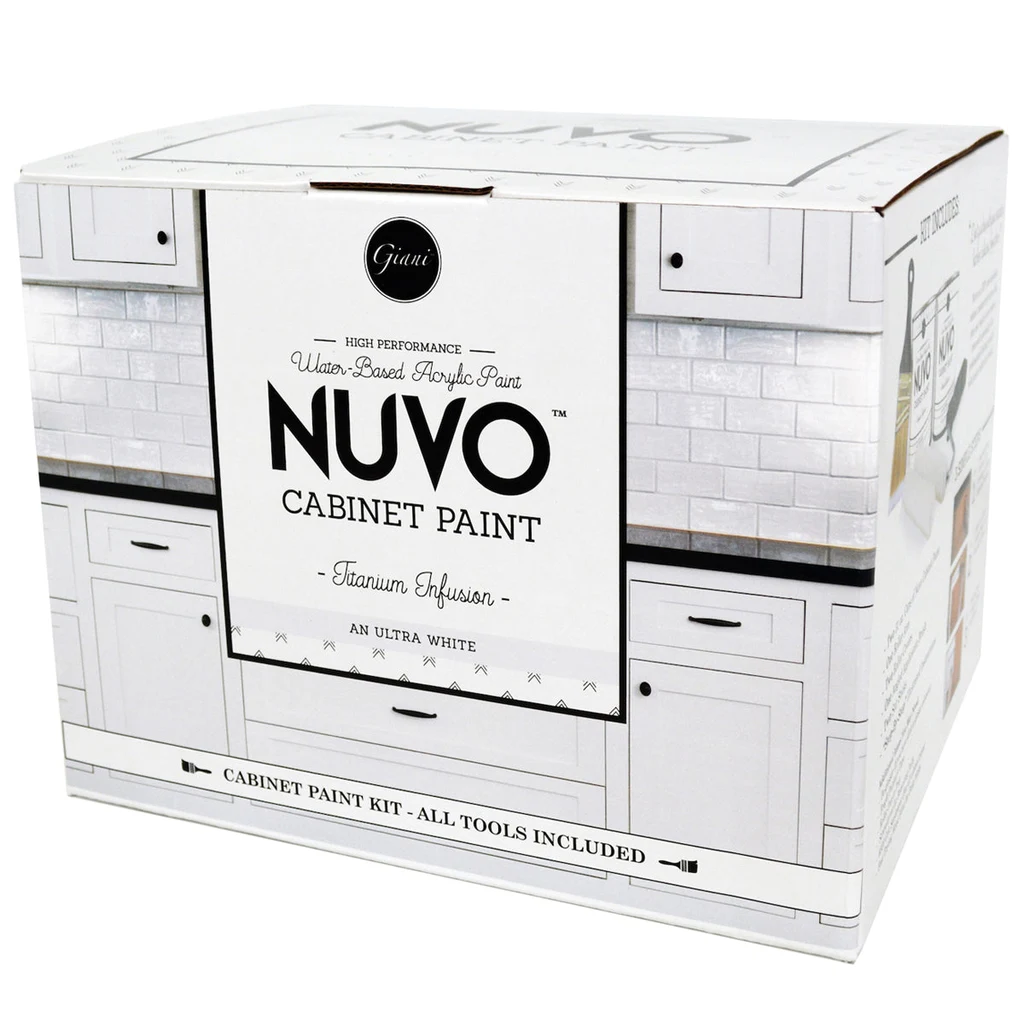
$79.95 for a kit, $36.95 for a refill quart. Nothing else in this category is close on cost per door, and the published process skips both cabinet removal and priming, which is why it keeps showing up in rental kitchens and pre-listing refreshes.
The film is thin. Two coats is the published spec, and over dark oak or a mid-tone cherry, two coats reads streaky at every angle where the light rakes. Plan on three and buy the refill quart with the kit rather than driving back for it. Over a light or already-painted cabinet, two is genuinely enough.
Grain telegraphs. That is not a defect, it is physics: a thin paint film over open-grain red oak gives you blue open-grain red oak. If the grain lines bother you, the fix is a grain filler pass before paint, and at that point you have left the budget category entirely.
Eleven colors, and Giani chose them well. Oxford Blue and Black Deco both held their tone through our UV panel with no visible chalking.
Buy it if the budget is the constraint and the kitchen is not forever. Skip it if the doors are dark oak and you were hoping for white.
Minwax Gel Stain, Best for Keeping the Grain
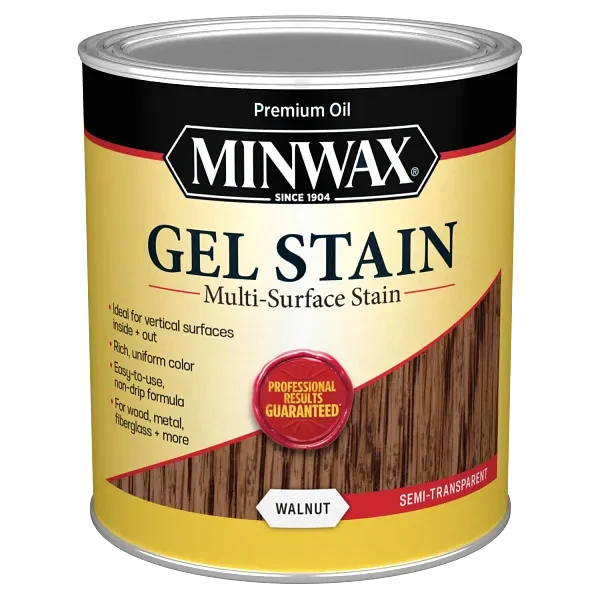
The pick that is not paint. Gel stain sits on the surface rather than penetrating, which is exactly why it works over an existing finish: scuff the old clear coat with a maroon pad, degrease, wipe the gel on, wipe most of it back off, let it sit 24 to 48 hours, then topcoat with a wipe-on poly or Polycrylic. 200 square feet per quart, 10 colors, about $40 in stain for a whole kitchen of doors.
Direction is the whole story. Gel stain goes darker and only darker. Golden oak to Coffee, honey maple to Walnut, worn cherry to Black. There is no version of this product that lightens a kitchen, and every disappointed review of gel stain on cabinets is somebody who wanted the other direction.
The failure mode we saw on our bare red oak panel with a deliberately worn-through spot: the thin area drank more pigment and left a dark halo you cannot wipe back out. If your doors have worn-through rings around the pulls, either accept the halos as character or spot-seal those areas with a wash coat of shellac before staining.
Buy it if the doors are solid wood you actually like and the complaint is color. Skip it if you want lighter, or if the doors are veneer that has already worn through in more than a couple of places.
Where These Refinishes Actually Fail
- Peeling at the trash-pull door within 18 months. Skipped degreasing. Kitchen grease migrates to the doors people touch most, and no bonding chemistry beats an oil film. Wash with a degreaser, rinse, dry, then prep.
- Print marks on the door faces. Doors closed tight, or stacked face to face, before the film cured. Felt bumpers and cracked doors for the first week.
- Chipping along the profile edges of raised-panel doors. Coating built too thick in the profile groove. Unload the brush before you work the profile.
- A white that yellowed in the sun by year two. Fixed-color kit whites carry more yellowing risk than a tinted alkyd. South-facing kitchens should use Cabinet Coat in a tinted white.
- Thermofoil bubbling near the dishwasher. The substrate was already delaminating from steam. Paint does not glue foil back down. Replace those doors.
- Blotchy gel stain around the pulls. Worn-through finish drank extra pigment. Wash-coat those areas first.
- The whole finish stayed tacky for weeks. Second coat went on before the first cured, or the kitchen was under 60°F. Refinishing in a cold garage is the classic version of this, and our cold-weather painting guide covers the temperature floors.
What a 30-Door Kitchen Actually Costs
| System | Coating | Primer / prep | Tools and hardware | Total |
|---|---|---|---|---|
| Rust-Oleum Cabinet Transformations (large kit + small) | $390 | in kit | $50 | ~$440 |
| Rust-Oleum Cabinet Transformations (large kit only, 20 doors) | $240 | in kit | $50 | ~$290 |
| INSL-X Cabinet Coat (2 gal) + Stix (1 gal) | $130 | $60 | $80 | ~$270 |
| Beyond Paint (2 kits + 1 refill quart) | $210 | in can | $20 | ~$230 |
| Nuvo (2 kits + 1 refill quart) | $197 | in can | $25 | ~$222 |
| Minwax Gel Stain (2 qt) + wipe-on clear (2 qt) | $40 | $55 | $40 | ~$135 |
Prices are July 2026 US retail. Cabinet Coat and Stix are both sold in gallons at Ace and Benjamin Moore dealers for meaningfully less per ounce than the quart sizes on Amazon, so buy the gallon at the counter if you have a store nearby and keep the Amazon link for a single quart or for a same-week delivery. A professional refinish on the same 30-door kitchen runs $3,000 to $6,000 with spray equipment and a booth for the doors.
Prep Notes That Decide the Outcome
- Degrease twice, not once. Every failure the three refinishers described to us started here. TSP substitute or a strong dish detergent, rinse with clean water, dry fully.
- Number the doors and bag the hardware by door. Masking tape on the hinge mortise, a numbered bag for each set of screws. Cabinet doors are not interchangeable even when they look identical.
- Take the doors off and lay them flat. Horizontal is how you get a level film without sags at the bottom rail. The boxes get coated in place; the doors do not.
- Scuff, do not sand through. A maroon pad or 220-grit, enough to kill the sheen, not enough to cut through veneer. Our sandpaper grit guide covers where the line is.
- Two thin coats beat one thick one, every time. A heavy coat traps solvent, stays soft for months, and prints under a closed door.
- Spray if you can borrow the gear. An HVLP gun turns a kit finish into something that reads factory-sprayed; see our HVLP sprayer picks for the models that atomize cabinet enamel properly.
- Ventilate the gel-stain route. Oil-based gel stain in a closed kitchen lingers for days. Cross-ventilate, and if the smell outstays its welcome, our lingering paint fume fix has the actual remedies.
Kit or No Kit
If you have painted a room before and liked the result, buy INSL-X Cabinet Coat and a gallon of Stix and skip this whole category. The kits exist to remove decisions, and you no longer need that service. Our kitchen cabinet paint round-up is the right page for you.
If you have never done this, the Rust-Oleum box is worth what it costs, and the reason is not the chemistry. It is that every step is in front of you in the right order, so the failure modes that come from skipping a step do not get the chance to happen. Buy the large kit, degrease the doors twice, and put pulls on everything before you rehang.
Full Comparison
| Product | Best for | Yellowing | Price |
|---|---|---|---|
| Rust-Oleum Cabinet Transformations | Top pick — most complete boxed kit | Medium on whites | $$ |
| INSL-X Cabinet Coat | Best cured hardness — the kit you assemble yourself | Low (waterborne alkyd) | $$ |
| Beyond Paint Cabinet and Furniture Kit | Best for laminate and thermofoil doors | Low | $$$ |
| Nuvo Cabinet Paint | Budget pick — cheapest full color change | Medium on whites | $ |
| Minwax Gel Stain | Best for keeping the wood grain instead of painting | N/A on a pigmented stain | $ |
Every Pick, Pros and Cons
Pros, cons, and specs for each pick. The cons are not optional here.
1. Rust-Oleum Cabinet Transformations
- Coverage
- 100 sq ft (small kit) · 200 sq ft (large kit)
- Sheens
- Satin (system finish)
- Dry / recoat
- Touch dry 1h · recoat 2–3h between system layers
- Full cure
- 7 days light use · 30 days normal use
- VOC
- <250 g/L
- Yellowing risk
- Medium on whites
- Primer
- Self-priming via the included bond coat
- Price tier
- $$
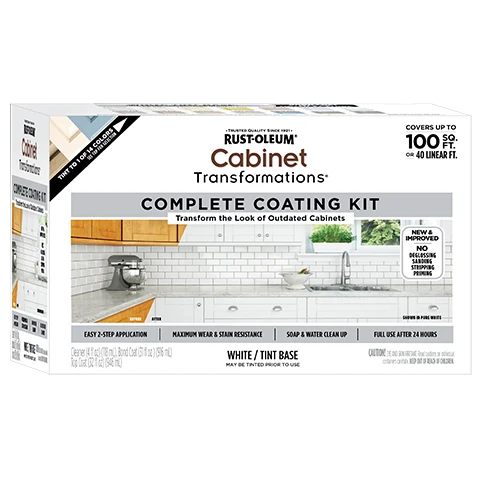
- Everything for the job ships in one box: deglosser, scrub pads, bond coat, optional decorative glaze, protective top coat, stir sticks, and a printed step guide
- The deglosser genuinely replaces sanding on factory-sealed maple and cherry; our cross-hatch tape pull on a glossy maple door came off clean at 100 percent adhesion after 7 days
- Small kit covers 100 sq ft, large kit covers 200 sq ft, so a normal kitchen is one box on the cart with no math at the paint desk
- The cured film stays softer than a real cabinet enamel; door edges and the strip above the trash pull are where reader reports show wear inside 18 months
- About 70 fixed colors and no custom tint, so matching an existing trim white is off the table
- The glaze step reads as refinished, not as factory-sprayed, once you are standing a foot away
2. INSL-X Cabinet Coat
- Coverage
- 350–450 sq ft / gal
- Sheens
- Satin, semi-gloss
- Dry / recoat
- Touch dry 1h · recoat 16h
- Full cure
- 30 days
- VOC
- <100 g/L
- Yellowing risk
- Low (waterborne alkyd)
- Primer
- INSL-X Stix bonding primer, bought separately
- Price tier
- $$
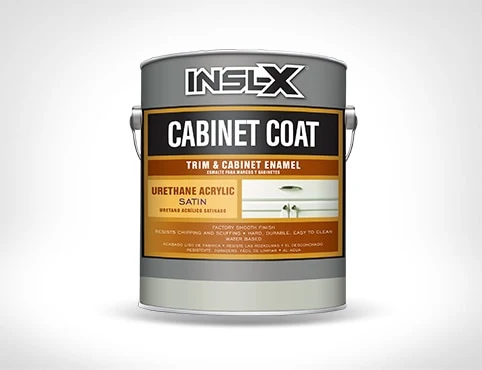
- Hardest cured film in the round-up; at 30 days a fingernail dragged across the door face left nothing where the Rust-Oleum and Beyond Paint panels both marked
- Full custom tint off any Benjamin Moore fan deck, which is the only way to match cabinets to existing trim or an adjacent built-in
- Roughly half the per-gallon price of BM Advance and it brushes more forgivingly, so a first-timer lands a clean two-coat face
- Not a boxed kit. You buy Stix bonding primer separately, plus sandpaper, brushes, and a roller, and you have to sequence it yourself
- 16-hour recoat on the finish coats stretches a two-coat door to a three-day schedule
- Ace and Benjamin Moore dealers stock it; Home Depot and Lowe's do not, so a Sunday restock can stall the job
3. Beyond Paint Cabinet and Furniture Kit
- Coverage
- 150 sq ft / quart
- Sheens
- Matte (system finish)
- Dry / recoat
- Touch dry 1h · recoat 2–4h
- Full cure
- 30 days
- VOC
- <100 g/L
- Yellowing risk
- Low
- Primer
- Self-priming, no separate bonding primer
- Price tier
- $$$
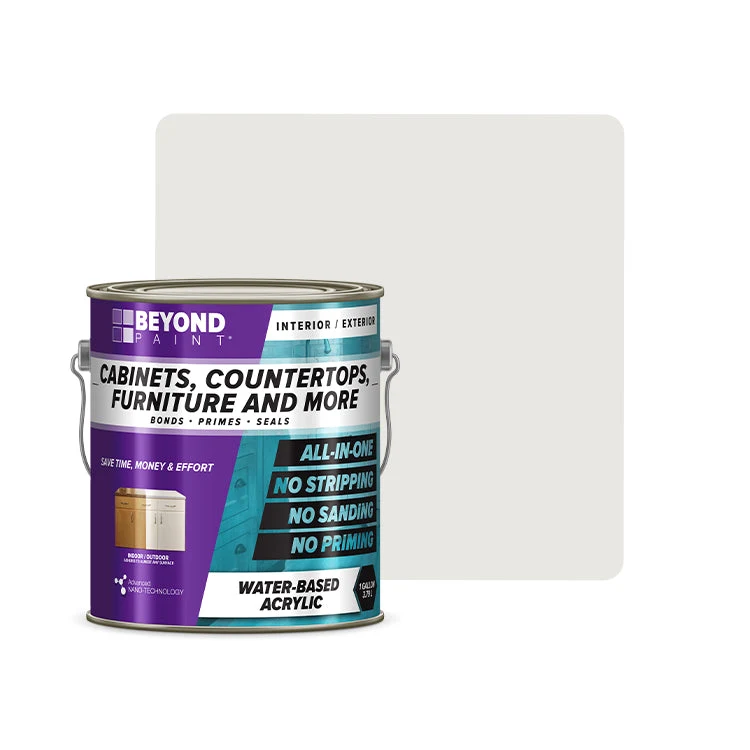
- Bonder, primer, paint, and sealer live in one can, so the whole system is a single product with no sequencing to get wrong
- The only pick that held on white thermofoil in our tape test; the mineral-loaded acrylic bites cured polyester where standard enamels sit on top and peel
- Kit ships with the quart, a 2-inch bristle brush, a 3/8-inch microfiber roller with handle, and a tray for $79.95
- 30-day cure and a genuinely soft first week; doors stay off the hinges longer than any other pick here
- Matte-only system finish, which shows finger oils around pulls faster than a satin or semi-gloss
- About 50 stock colors, no tint base, and roughly $200 per gallon-equivalent
4. Nuvo Cabinet Paint
- Coverage
- ~100 sq ft / kit (2 quarts)
- Sheens
- Satin (system finish)
- Dry / recoat
- Touch dry 1h · recoat 2–4h
- Full cure
- 14 days light use · 30 days normal
- VOC
- <100 g/L
- Yellowing risk
- Medium on whites
- Primer
- Self-priming per the published process
- Price tier
- $
- $79.95 a kit, and refill quarts are $36.95, which is the lowest cost-per-door of anything in this round-up
- No cabinet removal and no priming in the published process; it is the one kit a renter can finish over a long weekend
- Eleven colors including real ones people want, not just beige and off-white (Oxford Blue and Black Deco both hold their tone)
- Thin build. Two coats is the published spec and two coats is not enough over dark oak; plan on three and buy the refill quart up front
- No decorative glaze and no separate topcoat step, so the finish is only as tough as the paint film itself
- Grain telegraphs. Open-grain red oak still reads as open-grain red oak under this paint, only bluer or whiter
5. Minwax Gel Stain
- Coverage
- 200 sq ft / quart
- Sheens
- N/A — topcoat sets the sheen
- Dry / recoat
- Recoat 6h · dry 24–48h before topcoat
- Full cure
- 30 days with topcoat
- VOC
- Oil-based; check state restrictions
- Yellowing risk
- N/A on a pigmented stain
- Primer
- None; clean, degreased, scuffed existing finish
- Price tier
- $
- Wipes over an existing finish without stripping to bare wood, which no other product in this category does honestly
- 200 sq ft per quart and 10 colors, so a full kitchen of doors costs about $40 in stain
- Darkening golden oak to Coffee or Walnut hides 20 years of sun drift without erasing the grain that made the doors worth keeping
- Only goes darker. There is no lightening an orange oak kitchen with gel stain, and pretending otherwise is how people end up disappointed
- 24 to 48 hours between the stain and the topcoat, and it needs a separate clear finish, so this is a week of evenings
- Blotches on doors with worn-through spots; the thin areas drink more color and read as dark halos around the pulls
INSL-X Stix Waterborne Bonding Primer
The kits that come in a box include their own bonding step, so skip this if you buy Rust-Oleum, Beyond Paint, or Nuvo. Stix is what makes the build-your-own route work. It grips glossy factory-cured maple, thermofoil, melamine, and old oil enamel without sanding to bare wood, recoats in 3 to 4 hours, and cures hard in 3 to 4 days. One gallon primes roughly 30 doors and their boxes. Every cabinet enamel on the market bonds better over Stix than over a scuffed factory finish, and peeling cabinet paint almost always traces back to a skipped bonding primer rather than a bad topcoat.
BUY ON AMAZON
Ask a Question